多边贸易体制

Search documents
维护多边贸易体制 推进全球经济治理体系改革
Ren Min Ri Bao· 2025-09-27 21:54
Core Viewpoint - China announced that it will not seek new special and differential treatment in current and future negotiations within the World Trade Organization (WTO), signaling its commitment to a more balanced and fair global trade system [1][2][3]. Group 1: China's Position and Commitment - China's decision reflects its role as a responsible developing country and aims to strengthen the multilateral trading system [2][3]. - The announcement is seen as a significant step towards enhancing China's participation in WTO reforms and international trade rule adjustments [2][4]. - China maintains that its status as a developing country remains unchanged despite this new stance on special and differential treatment [5][6]. Group 2: Implications for Multilateral Trade - The move is expected to bolster the confidence of developing countries in the multilateral trading system and contribute to resolving the deadlock on development issues within the WTO [3][4]. - It emphasizes China's commitment to defending the legitimate rights and interests of developing members while promoting global trade and investment liberalization [4][6]. - The initiative aims to enhance the inclusivity and universality of international trade, addressing the North-South development gap [4][8]. Group 3: Global Economic Governance - China's actions are positioned as a response to the rising challenges of protectionism and unilateralism, reinforcing its role in global economic governance [7][8]. - The commitment to not seek new special and differential treatment is part of China's broader strategy to engage in global governance initiatives and promote a fairer global economic order [7][8]. - The initiative is viewed as a constructive contribution to the WTO's effectiveness and authority amid increasing global trade tensions [8].
商务部回应多个热点问题!
Jin Rong Shi Bao· 2025-09-26 07:17
Group 1 - The core message of the articles emphasizes China's commitment to multilateral trade and its decision not to seek new special and differential treatment in WTO negotiations, reflecting its role as a responsible developing country [1][2] - China's submission of a position paper to the WTO on special and differential treatment highlights its status as the largest developing country and its rights under WTO agreements, while also addressing the negative impacts of unilateral tariffs imposed by certain countries [2] - The announcement is seen as a significant step towards promoting WTO reform and achieving the UN's 2030 Sustainable Development Goals, reinforcing China's commitment to global development initiatives [2][3] Group 2 - China maintains its identity as the largest developing country and emphasizes its solidarity with other developing nations, advocating for a multilateral trade system based on rules [3] - The ongoing negotiations regarding China's purchase of more Boeing aircraft are framed within the context of mutual benefits in US-China economic relations, with a call for the US to remove unilateral restrictions to foster a stable and sustainable trade relationship [3]
坚持共同发展才能破解时代难题(和音)
Ren Min Ri Bao· 2025-09-25 22:12
Group 1 - The core message of the news is China's commitment to advancing the Global Development Initiative, emphasizing collaboration to address global development challenges and accelerate the UN's 2030 Sustainable Development Agenda [1][2][3] Group 2 - The Global Development Initiative was proposed by President Xi Jinping in September 2021, aiming to promote common development and address the widening North-South development gap amid rising unilateralism and protectionism [2][3] - Over 130 countries and international organizations are involved in the implementation of the Global Development Initiative, showcasing its growing influence and appeal as a public good that meets global needs [2] - The initiative has mobilized over $23 billion in funding over the past four years, supporting more than 1,800 cooperation projects across various sectors, including technology cooperation, poverty alleviation, and digital economy [3] Group 3 - China has announced specific action plans, including the implementation of 2,000 "small but beautiful" livelihood projects in developing countries over the next five years and the establishment of a special fund for digital capacity building [4] - The initiative aims to ensure that no country or individual is left behind in the development process, reflecting the vision of building a community with a shared future for humanity [4]
商务部:中国发展中国家的地位和身份没有改变
Qi Huo Ri Bao· 2025-09-25 16:08
Core Viewpoint - China announced at the 80th United Nations General Assembly that it will not seek new special and differential treatment in current and future World Trade Organization negotiations, emphasizing its role as a responsible developing country [1] Group 1: China's Position in Global Trade - China reaffirms its status as the largest developing country, maintaining its identity and position within the global South [1] - The announcement reflects China's commitment to true multilateralism and support for a rules-based multilateral trading system [1] Group 2: Development Agenda - China aims to place development at the center of the World Trade Organization's agenda, seeking to bridge the development gap between the Global North and South [1] - The country emphasizes the importance of improving global economic governance and building an open world economy [1]
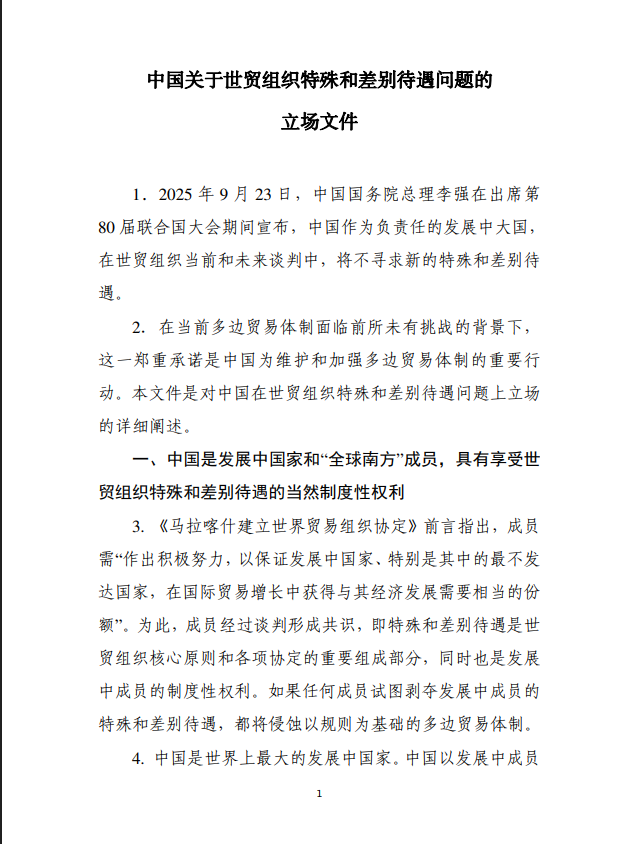
中国关于世贸组织特殊和差别待遇问题的立场文件
Xin Jing Bao· 2025-09-25 13:07
Core Viewpoint - China submitted a position paper on special and differential treatment to the WTO, emphasizing its rights as a developing country and its commitment to multilateral trade systems [1][4]. Group 1: China's Position on Special and Differential Treatment - China's accession to the WTO in 2001 under the Marrakech Agreement granted it less special and differential treatment compared to other developing members [4]. - China has actively contributed to the WTO negotiations and global trade liberalization, aligning its obligations with its development stage and economic level [4]. Group 2: China's Pragmatic Approach in WTO Negotiations - In negotiations, China has adopted a pragmatic approach, not requesting Category C measures in the Trade Facilitation Agreement, with 94% of measures being Category A [5]. - China did not seek special and differential treatment in discussions on service trade regulations and COVID-19 vaccine intellectual property exemptions, contributing significantly to concluding negotiations [5]. - China announced it would not pursue special and differential treatment as proposed by the G90 group and continues to support negotiations based on that proposal [5]. Group 3: Commitment to Multilateral Trade System - China's decision not to seek new special and differential treatment underscores its support for the multilateral trade system amid rising unilateralism and protectionism [6]. - This decision aims to facilitate the 14th WTO Ministerial Conference in March 2026 and contribute to substantial progress in WTO reforms [6]. - The decision does not affect China's status as a developing member in the WTO or its rights under existing agreements [6]. Group 4: China's Role in Global Trade - China remains a part of the "Global South" and will continue to support genuine multilateralism and the rules-based multilateral trade system [7]. - The country is committed to participating in WTO reform processes and protecting the legitimate rights of developing members [7].

《区域全面经济伙伴关系协定》(RCEP)生效实施后第四次部长级会议联合媒体声明(参考译文)
Shang Wu Bu Wang Zhan· 2025-09-25 12:53
Group 1 - The RCEP meeting emphasized the importance of deepening trade and investment relationships to enhance economic resilience and support the implementation of the RCEP agreement [1][2] - The meeting acknowledged the significance of the comprehensive review of the agreement scheduled for 2027 to adapt to changing economic conditions [1] - The RCEP members committed to avoiding measures inconsistent with RCEP obligations and to maintaining an open, free, and rules-based market [1][2] Group 2 - The meeting welcomed the progress made by the RCEP Joint Committee and its subsidiary bodies in executing the RCEP agreement and encouraged continued efforts for transparent and effective implementation [2] - The meeting praised Japan for organizing the "RCEP E-commerce Dialogue Report" and encouraged member countries to promote the development and use of e-commerce [2][3] - The meeting reiterated the importance of economic and technical cooperation under RCEP to support inclusive and effective implementation of the agreement [2] Group 3 - The meeting welcomed the RCEP Joint Committee's establishment of guidelines for stakeholder engagement, facilitating collective communication with stakeholders [3] - The meeting noted the progress made during the first consultation with the RCEP Business Advisory Council (RBAC) [3] - The meeting encouraged further engagement with stakeholders to obtain strategic input and specific recommendations for better implementation of RCEP [3]
商务部9月25日召开例行新闻发布会
Shang Wu Bu Wang Zhan· 2025-09-25 12:49
Group 1: Digital Consumption Development - The Ministry of Commerce, along with seven other departments, issued guidelines to promote digital consumption, emphasizing the importance of enhancing both "hard infrastructure" and "soft environment" for digital consumption [4][5] - Digital consumption is projected to reach 23.8 trillion yuan in 2024, accounting for 44.2% of total household consumption [4] - The guidelines encourage the development of digital products, services, and content, aiming to innovate consumption scenarios and stimulate diverse and quality consumption [4][5] Group 2: WTO and Trade Relations - Premier Li Qiang announced that China will not seek new special and differential treatment in WTO negotiations, reflecting China's commitment to a balanced and fair global trade system [6][7] - China submitted a position paper to the WTO, asserting its rights as the largest developing country while emphasizing the need for reform in the organization [7][8] - The announcement aims to strengthen multilateral trade systems and support the global development agenda, aligning with the UN's 2030 Sustainable Development Goals [7][8] Group 3: Free Trade Zone Best Practices - The Ministry of Commerce released the sixth batch of "best practice cases" from free trade zones, totaling 29 cases that focus on trade facilitation, free flow of factors, and high-quality industrial development [9][10] - These cases highlight innovative achievements in areas such as cross-border data flow and customs efficiency, showcasing the unique regional characteristics of different free trade zones [9][10] - The Ministry plans to guide local areas in learning from these best practices to further enhance reform and innovation in free trade zones [11] Group 4: Service Export Policies - The Ministry of Commerce, along with nine other departments, introduced measures to promote service exports, which have grown from $219.1 billion in 2014 to $445.9 billion in 2024, with an average annual growth of 7.3% [12][13] - The new policies include 13 practical measures focusing on financial support, tax incentives, and facilitating international market access for service exports [12][13] - The Ministry aims to enhance the international competitiveness of service export enterprises through these targeted measures [13] Group 5: Sino-US Trade Relations - The Ministry of Commerce emphasized the importance of local-level economic cooperation in Sino-US relations, suggesting that the US should remove unreasonable tariffs to facilitate bilateral trade [14] - The essence of Sino-US economic relations is mutual benefit, with both countries having extensive common interests and cooperation potential [14] - The Ministry expressed hope for a favorable environment for stable and sustainable development of Sino-US trade relations [14]
商务部:美方应采取积极行动 取消大豆贸易相关的不合理关税
智通财经网· 2025-09-25 08:17
Group 1: US-China Economic Relations - The essence of US-China economic relations is mutual benefit and win-win cooperation, with both countries having extensive common interests and broad cooperation space in the economic field [1][16] - The biggest obstacle affecting normal economic cooperation is the unilateral restrictive measures imposed by the US, and there is a call for the US to take positive actions to create favorable conditions for stable and sustainable development of US-China economic relations [1][16] Group 2: Digital Consumption Development - The Ministry of Commerce, along with seven other departments, issued guidelines to promote digital consumption, which is expected to reach a scale of 23.8 trillion yuan in 2024, accounting for 44.2% of total resident consumption [4][5] - The guidelines emphasize the importance of digital technology innovation as a driving force for digital consumption, encouraging enterprises to accelerate research and development and integrate artificial intelligence into various consumption fields [5][6] Group 3: WTO and Global Trade - China has submitted a position paper to the WTO regarding special and differential treatment, asserting its rights as the largest developing country while committing not to seek new special treatment in current and future negotiations [7][8] - This position is seen as a significant step in maintaining a multilateral trading system and promoting global development initiatives, with China emphasizing its role as a responsible developing country [7][9] Group 4: Free Trade Zone Practices - The Ministry of Commerce has promoted 29 best practice cases from the sixth batch of free trade zones, focusing on trade facilitation, free flow of factors, and high-quality industrial development [10][11] - These cases reflect innovative achievements and experiences in the free trade zones, highlighting the importance of regional characteristics and collaborative efforts across departments and regions [11][12] Group 5: Service Export Policies - The Ministry of Commerce has introduced 13 practical measures to promote service exports, which have grown from $219.1 billion in 2014 to $445.9 billion in 2024, with an average annual growth rate of 7.3% [13][14] - The measures aim to enhance the international competitiveness of service export enterprises by providing more detailed, practical, and targeted support [13][14]
商务部召开例行新闻发布会(2025年9月25日)
Shang Wu Bu Wang Zhan· 2025-09-25 08:16
Group 1 - The core viewpoint of the news is the emphasis on the development of digital consumption in China, highlighting its potential to significantly contribute to the economy and improve quality of life [3][4]. - The "Guiding Opinions" issued by the Ministry of Commerce and other departments aim to enhance digital consumption quality and scale, projecting a digital consumption size of 23.8 trillion yuan in 2024, accounting for 44.2% of total household consumption [3][4]. - The document focuses on three key aspects: promoting digital consumption, driving innovation through digital technology, and enhancing quality of life through digital services [4]. Group 2 - The "Guiding Opinions" encourage the integration of artificial intelligence in various consumer sectors, aiming to create immersive and experiential consumption scenarios [4]. - The Ministry of Commerce plans to implement measures to ensure the effective execution of the "Guiding Opinions," aiming to stimulate digital consumption potential [4]. - The service export policies introduced by the Ministry of Commerce and other departments include 13 practical measures to enhance service export competitiveness, with a focus on high-tech and high-value-added services [10][11]. Group 3 - The service export total is projected to grow from $219.1 billion in 2014 to $445.9 billion in 2024, with an average annual growth rate of 7.3% [10]. - The new policies aim to provide more detailed support for service exports, streamline tax refund processes, and enhance financial services for small and medium enterprises [11]. - The Ministry of Commerce will work with relevant departments to ensure the policies are implemented effectively, enhancing the international competitiveness of service export enterprises [11].
中国在世贸谈判中不寻求新的特殊和差别待遇,要怎样落实?商务部最新回应
Sou Hu Cai Jing· 2025-09-25 08:10
记者 辛圆 商务部周四举行例行新闻发布会。有媒体提问称,当地时间9月23日,李强总理在出席联合国大会相关活动时表示,中国作为负责任的发展中大国在世贸组 织当前和未来谈判中将不寻求新的特殊和差别待遇。请问中方未来将如何落实这一承诺? 中国社会科学院美国研究所副研究员杨水清在接受环球时报采访时表示,中国这一宣示是一次精准、有限且自主的政策调整。 对此,商务部新闻发言人何亚东表示,李强总理这一重要的立场宣示,是中方作为发展中大国坚定维护多边贸易体制,积极落实全球发展倡议和全球治理倡 议的重要举措。 杨水清解释称,首先,中国这一决策的范围限定于"当前和未来谈判",中国的承诺明确指向"新"的谈判。这意味着,中国在过去所有已达成并生效的WTO 协定——如《农业协定》《补贴与反补贴措施协定》等——中所享有的所有特殊和差别待遇条款将完全保留。中国不寻求的是在尚未开始、且要求获得额外 差别化待遇的谈判中的特殊和差别待遇权利。 当地时间9月23日,中方在第80届联合国大会相关活动上宣布,中国作为负责任的发展中大国,在世贸组织当前和未来谈判中,将不寻求新的特殊和差别待 遇。 "同时,中国在WTO中的发展中成员身份没有改变。中国将继 ...