
PMI

Search documents
宏观经济专题报告:10月制造业PMI环比下滑,服务业PMI小幅扩张
Ge Lin Qi Huo· 2025-10-31 08:29
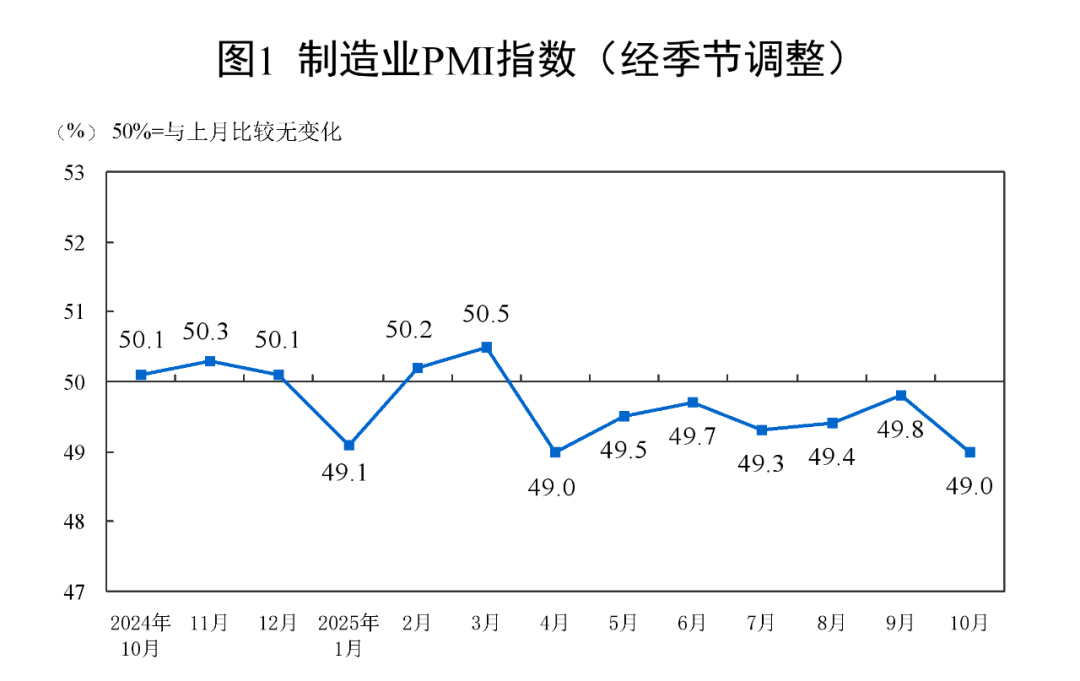
Report Summary 1. Industry Investment Rating No industry investment rating is provided in the report. 2. Core Viewpoints - In October, the manufacturing PMI continued to be below the boom - bust line for the seventh consecutive month, with a larger - than - seasonal decline due to holiday disruptions and external factors. The new export order index was affected by trade frictions but is expected to rebound in November. The service industry's business activity index showed a mild expansion, and the new policy - based financial instruments are expected to promote economic development [2][3][10]. 3. Summary by Related Contents Manufacturing Industry - **Overall PMI**: In October, the manufacturing PMI was 49.0%, down from 49.8% in the previous month. The decline had some seasonal factors but was larger due to holiday and external impacts. Large - scale enterprises' PMI dropped below the boom - bust line after 5 - month expansion, medium - sized enterprises remained stable, and small - sized enterprises faced greater pressure [2][5]. - **Production and Demand**: The production index was 49.7% (previous 51.9%), and the new order index was 48.8% (previous 49.7%), indicating a slowdown in production and a decline in market demand. The new export order index was 45.9% (previous 47.8%), pulling down the overall new order index. It is expected to rebound in November due to Sino - US trade talks [2][5][6]. - **Industry Performance**: New - energy - related industries such as equipment manufacturing, high - tech manufacturing, and consumer goods manufacturing remained in the expansion range. The basic raw material industry's PMI continued to decline. Some industries like农副 food processing and automotive were active, while others like textile and chemical fiber had weak supply and demand [2][5]. - **Price and Inventory**: The main raw material purchase price index was 52.5% (previous 53.2%), and the ex - factory price index was 47.5% (previous 48.2%), squeezing corporate profits. The raw material inventory index was 47.3% (previous 48.5%), and the finished - product inventory index was 48.1% (previous 48.2%), showing cautious inventory increase [3][6][7]. - **Employment and Expectation**: The manufacturing employment index was 48.3% (previous 48.5%), with little change. The production and business activity expectation index was 52.8% (previous 54.1%), with a slight decline in expectations [8]. Non - manufacturing Industry - **Overall Non - manufacturing**: In October, the non - manufacturing business activity index was 50.1%, up slightly from 50.0% in the previous month [4][8]. - **Construction Industry**: The construction business activity index was 49.1% (previous 49.3%), with a slight decline. The new order index was 45.9% (previous 42.2%), and the employment index was 39.9% (previous 39.7%). The business activity expectation index was 56.0% (previous 52.4%). The real - estate market continued to drag down the construction industry [8]. - **Service Industry**: The service business activity index was 50.2% (previous 50.1%), showing a mild expansion. The new order index was 46.0% (previous 46.7%), the employment index was 46.1% (previous 45.9%), and the business activity expectation index was 56.1% (previous 56.3%). Some industries like railway and aviation were in a high - level boom range, while insurance and real - estate were weak [9]. Policy Impact As of the end of October, 500 billion yuan of new policy - based financial instruments were fully invested, and the supported projects are expected to be implemented intensively from October to December, driving over 7 trillion yuan in total project investment and promoting economic development [4][10].
【广发宏观郭磊】10月PMI、宏观面与股债定价
郭磊宏观茶座· 2025-10-31 06:43
Core Viewpoint - The October PMI data indicates a slight decline below expectations, with the manufacturing PMI at 49.0, down 0.8 points month-on-month, reflecting a lack of consistent economic signals in the short term [1][5][15]. Summary by Sections PMI Data Overview - The manufacturing PMI for October is reported at 49.0, lower than the previous value of 49.8, while the service PMI is at 50.2, slightly up from 50.1. The construction PMI stands at 49.1, down from 49.3 [5][11]. - The October EPMI (Emerging Industries PMI) saw a significant increase of 7.3 points to 59.7, marking the largest historical increase for this month [5][6]. Production and Economic Signals - A notable contraction in the production sector is observed, with production, procurement, new orders, and backlog orders indices decreasing by 2.2, 2.6, 0.9, and 0.7 points respectively [8][11]. - The production index fell sharply from 51.9 in September to 49.7 in October, attributed to uncertainties in tariffs and shipping environments, leading companies to adopt a more cautious production approach [8][10]. Recent Developments in Trade - Recent negotiations between China and the U.S. in late October resulted in the cancellation of certain tariffs and a pause on additional tariffs, which may positively influence the PMI production index in November [2][10]. Construction Sector Insights - A positive signal from the October PMI series is the rebound in new orders and business activity expectations in the construction sector, with increases of 3.7 and 3.6 points respectively, reaching the highest levels since March and February [3][11]. - The National Development and Reform Commission reported that 500 billion yuan has been fully allocated to support over 2,300 projects, with a total investment of approximately 7 trillion yuan, focusing on digital economy, AI, and urban infrastructure [3][11]. Market Implications - The October PMI reflects a manufacturing PMI retreat and a decline in the construction index, indicating that the rise in infrastructure has not fully offset the decline in real estate investment, which is favorable for the bond market [4][15]. - The central bank's resumption of bond purchases suggests a potential decrease in interest rates, although the space for significant rate cuts may be limited due to the ongoing fiscal policies and rising construction orders [4][15].


2025年10月PMI数据点评:内外部因素共振带动10月制造业PMI指数下行,年底前稳增长政策有望进一步加码
Dong Fang Jin Cheng· 2025-10-31 05:57
Manufacturing PMI Insights - In October 2025, China's manufacturing PMI fell to 49.0%, a decrease of 0.8 percentage points from September, indicating a contraction in the manufacturing sector[2] - The production index dropped significantly by 2.2 percentage points to 49.7%, marking its first entry into the contraction zone since April[3] - The new orders index declined by 0.9 percentage points to 48.8%, reflecting weakened market demand due to seasonal factors and reduced policy impact[4] Economic Policy and Investment - A total of 500 billion yuan in new policy financial tools was fully deployed by the end of October, aimed at accelerating infrastructure investment[5] - An additional 500 billion yuan in local government debt was arranged to address existing debt and expand effective investment, indicating a strong focus on stabilizing growth[6] - The anticipated outcomes of the new round of Sino-U.S. trade talks are expected to bolster market confidence, despite ongoing external pressures[6] Sector Performance - High-tech manufacturing PMI remained in the expansion zone at 50.5%, despite a decline of 1.1 percentage points, supported by strong market demand and policy backing[7] - The service sector PMI rose slightly to 50.2%, driven by increased tourism during the extended holiday period, although overall consumer spending remains weak[8] - The construction PMI fell to 49.1%, continuing a contraction trend due to cooling real estate markets, although civil engineering activity showed signs of improvement[9] Future Outlook - The manufacturing PMI is projected to rebound to approximately 49.4% in November, influenced by seasonal factors and the impact of recent economic policies[10] - The overall economic climate is expected to depend heavily on the effectiveness and timing of growth-stabilizing policies leading up to the end of the year[10]
三大重点行业保持扩张!国家统计局发布重要数据
Zhong Guo Zheng Quan Bao· 2025-10-31 05:42
Group 1: Manufacturing Sector - The manufacturing Purchasing Managers' Index (PMI) for October is reported at 49.0%, a decrease of 0.8 percentage points from the previous month, indicating a slowdown in manufacturing activity [1][2] - The production index and new orders index for manufacturing are at 49.7% and 48.8%, respectively, reflecting declines of 2.2 and 0.9 percentage points compared to last month [5] - Large enterprises maintain a PMI of 49.9%, while medium and small enterprises are at 48.7% and 47.1%, respectively, showing varying degrees of decline in economic sentiment [5] Group 2: Key Industries - High-tech manufacturing, equipment manufacturing, and consumer goods industries have PMIs of 50.5%, 50.2%, and 50.1%, respectively, indicating continued expansion and support for the overall manufacturing sector [5] - High-energy-consuming industries have a PMI of 47.3%, down 0.2 percentage points, suggesting a decline in economic activity within this sector [5] Group 3: Non-Manufacturing Sector - The non-manufacturing business activity index is at 50.1%, an increase of 0.1 percentage points from the previous month, indicating a slight expansion in the non-manufacturing sector [1][6] - The service sector's business activity index is reported at 50.2%, reflecting a slight increase and improved economic conditions in service-related industries [9] - The construction sector's business activity index is at 49.1%, a decrease of 0.2 percentage points, indicating a slight contraction in construction activities [10] Group 4: Market Expectations - The production and business activity expectation index for manufacturing is at 52.8%, indicating a generally optimistic outlook among manufacturers [6] - The business activity expectation index for the service sector is at 56.1%, suggesting strong confidence in future industry performance [10] - Overall, the non-manufacturing sector shows signs of stability, with positive changes in investment and consumption-related activities [11]
刚刚,国家统计局公布重要数据!
Zheng Quan Ri Bao Wang· 2025-10-31 03:25
Group 1: Manufacturing Sector - The manufacturing Purchasing Managers' Index (PMI) decreased to 49.0% in October, down 0.8 percentage points from the previous month, indicating a slowdown in production activities [1][2] - The production index and new orders index for the manufacturing sector were 49.7% and 48.8%, respectively, reflecting declines of 2.2 and 0.9 percentage points from last month [2] - Large enterprises maintained a PMI above the critical point, with large, medium, and small enterprises' PMIs at 49.9%, 48.7%, and 47.1%, respectively, showing varying degrees of decline [2] Group 2: Key Industries - High-tech manufacturing, equipment manufacturing, and consumer goods industries continued to expand, with PMIs of 50.5%, 50.2%, and 50.1%, respectively, all above the overall manufacturing level [3] - High-energy-consuming industries saw a PMI of 47.3%, down 0.2 percentage points, indicating a decrease in economic activity [3] Group 3: Non-Manufacturing Sector - The non-manufacturing business activity index rose to 50.1%, up 0.1 percentage points, indicating a slight recovery in the sector [4] - The service sector's business activity index increased to 50.2%, with significant growth in sectors closely related to consumer travel, such as rail transport and accommodation, which had indices above 60.0% [4] - The construction sector's business activity index fell to 49.1%, down 0.2 percentage points, indicating a slight decline in activity [4] Group 4: Composite PMI - The composite PMI output index stood at 50.0%, indicating overall stability in production and business activities across sectors [5]
10月份制造业采购经理指数有所回落 非制造业商务活动指数略有回升
Guo Jia Tong Ji Ju· 2025-10-31 02:32
Group 1: Manufacturing PMI Insights - In October, the manufacturing PMI decreased to 49.0%, down 0.8 percentage points from the previous month, indicating a slowdown in production activities [1][2] - Both production index and new orders index fell to 49.7% and 48.8%, respectively, reflecting a decline in manufacturing production and market demand [2] - Large enterprises maintained a PMI above the critical point, with indices at 50.9% for production and 50.1% for new orders, indicating sustained demand in this segment [2][3] Group 2: Non-Manufacturing PMI Insights - The non-manufacturing business activity index rose to 50.1%, up 0.1 percentage points from the previous month, indicating a slight expansion in the sector [4] - The service industry business activity index increased to 50.2%, with significant growth in sectors closely related to consumer travel, such as rail and air transport, which saw indices above 60.0% [4] - The construction industry business activity index slightly decreased to 49.1%, but the business activity expectation index improved to 56.0%, suggesting a positive outlook for future market conditions [4] Group 3: Composite PMI Insights - The composite PMI output index stood at 50.0%, indicating overall stability in production and business activities across sectors [5] - The manufacturing production index and non-manufacturing business activity index were recorded at 49.7% and 50.1%, respectively, contributing to the composite index's position at the critical point [5]
国家统计局解读2025年10月中国采购经理指数
Guo Jia Tong Ji Ju· 2025-10-31 01:49
Group 1: Manufacturing PMI Insights - In October, the Manufacturing Purchasing Managers' Index (PMI) decreased to 49.0%, down 0.8 percentage points from the previous month, indicating a slowdown in manufacturing activity [1][2] - Both production index and new orders index fell to 49.7% and 48.8%, respectively, reflecting a decline in production and market demand [2] - Large enterprises maintained a PMI above the critical point, with indices at 50.9% for production and 50.1% for new orders, indicating sustained demand in this segment [2][3] Group 2: Non-Manufacturing PMI Insights - The Non-Manufacturing Business Activity Index rose to 50.1%, up 0.1 percentage points from the previous month, indicating expansion in the non-manufacturing sector [1][4] - The service sector's business activity index increased to 50.2%, with significant growth in sectors closely related to consumer travel, such as rail and air transport, which exceeded 60.0% [4] - The construction sector's business activity index slightly declined to 49.1%, but the business activity expectation index improved to 56.0%, suggesting a positive outlook for future market development [4] Group 3: Comprehensive PMI Insights - The Comprehensive PMI Output Index stood at 50.0%, indicating overall stability in production and business activities across sectors [1][5] - The manufacturing production index and non-manufacturing business activity index were recorded at 49.7% and 50.1%, respectively, contributing to the comprehensive index's position at the critical point [5]
主流钢企11月份出厂价出炉 为何品种钢调涨、普材维稳?
Zhong Guo Chan Ye Jing Ji Xin Xi Wang· 2025-10-30 00:36
Group 1 - The core viewpoint of the article is that the majority of steel products' prices remain stable compared to October, with some varieties experiencing price increases due to high steel production and inventory levels, leading to a relaxed supply-demand situation that hinders sustained price recovery [1][2] - The prices of various steel products such as thick plates, hot-rolled coils, and cold-rolled products remain unchanged from October, while hot-dip galvanized and electro-galvanized steel prices have increased by 100 yuan per ton [1] - Domestic consumption is currently stable, with potential for increased orders in seasonal consumption sectors, although demand for construction steel is constrained by financial and emotional factors [1][2] Group 2 - Steel production remains at a certain scale, with stable orders for specialty steel, but the overall price recovery of steel is limited due to pressure from common materials [2] - Overseas retail and manufacturing consumption is holding up, with liquidity from interest rate cuts promoting investment and consumption, providing a supportive backdrop for domestic steel prices [2] - The adjustment of steel prices by major steel enterprises for November is primarily to address the high production levels and increasing inventory, with a focus on the specialty steel market moving forward [2]
