
下沉市场

Search documents
“两新”加码撬动下沉市场与银发经济,降息预期下红利资产与科技成长共舞
Sou Hu Cai Jing· 2025-08-02 01:45
步入2025年下半年,A股市场震荡上行,交投活跃度提升,投资者情绪随政策预期升温持续回暖。伴 随"十四五"规划进入收官之年,财政政策提效与产业转型升级协同推进,一系列尚未被市场充分定价的 政策红利正步入兑现阶段。接受采访的资深分析师认为,在"两新"政策扩围与"反内卷"产能出清的双轮 驱动下,下沉市场消费升级、银发经济产业链以及"专精特新"企业成为被低估的价值洼地。伴随四季度 中美降息共振预期强化,红利资产防御属性与科技成长板块弹性或将共同主导市场结构性机会,政策与 市场的动态博弈正步入关键阶段。(中国证券报) ...
“两新”加码撬动下沉市场与银发经济 降息预期下红利资产与科技成长共舞
Zhong Guo Zheng Quan Bao· 2025-08-01 23:43
Group 1: Market Overview and Policy Implications - The A-share market is experiencing a rebound with increased trading activity and improved investor sentiment as policy expectations rise, particularly as the "14th Five-Year Plan" approaches its conclusion [1] - Analysts suggest that under the dual drivers of the expansion of "two new" policies and the "anti-involution" capacity clearance, the upgrading of consumption in lower-tier markets, the silver economy supply chain, and "specialized, refined, and innovative" enterprises are undervalued opportunities [1][9] - The current market strategy is to adopt a dual allocation of "dividend assets as a shield and new tracks as a spear," with dividend assets providing stability amid uncertainty and new tracks driven by policy support and technological innovation [9] Group 2: Fiscal Policy and Economic Growth - Fiscal policy in the first half of the year has been proactive, with increased spending intensity and a focus on urban renewal, human investment, and industrial upgrades [2][3] - The fiscal deficit has increased significantly, with government debt financing reaching 55.2% of the annual plan, indicating the critical role of fiscal policy in stabilizing consumption, investment, and the financial system [3] - The government is expected to introduce additional fiscal measures to support employment, businesses, and market stability, particularly in response to potential declines in tax revenue and land transfer income [3][4] Group 3: Consumer Market and Silver Economy - The introduction of policies promoting the replacement of old consumer goods is expected to benefit lower-tier markets and the silver economy, creating significant market opportunities [5][6] - The "old-for-new" policy is anticipated to enhance consumer experiences in lower-tier markets, leading to improved logistics and after-sales services, thus fostering a better consumption environment [5] - The aging population is expected to drive demand in healthcare, elderly services, and related industries, with opportunities in medical devices, innovative drugs, and elder-friendly products [6] Group 4: Industry Dynamics and Competitive Landscape - The "anti-involution" policy is expected to accelerate capacity clearance in traditional industries, benefiting leading companies with strong technical capabilities and efficient production processes [7][8] - Leading enterprises are likely to gain market share and improve profitability as they navigate price pressures and competition, supported by favorable policy measures [7][8] - The competitive landscape may undergo significant changes as policies are implemented, with leading companies becoming primary beneficiaries of the policy dividends [7] Group 5: Investment Opportunities and Market Trends - The investment logic for core assets is shifting from "reassessing resilience" to "reassessing growth," with a focus on companies that demonstrate strong fundamentals and growth potential [10][11] - The anticipated U.S.-China interest rate cuts are expected to lower financing costs for the real economy, benefiting sectors such as real estate and technology, while also enhancing consumer demand [11] - The market is likely to see increased interest in high-dividend, stable cash flow sectors, such as banking and utilities, as investors seek refuge amid potential market volatility [11]
在美国开餐厅,「中国经验」可以弥合碎片化供应链吗?(下)|科技早知道
声动活泼· 2025-08-01 10:04
Core Viewpoint - The article discusses the challenges and strategies for Chinese restaurant brands entering the U.S. market, focusing on the fragmented supply chain and the importance of local adaptation in operations and management [2][3][41]. Group 1: Background and Experience - The guest, Huang Wenbing, transitioned from a Fintech entrepreneur to managing multiple Asian restaurant brands in the U.S., overseeing 7 brands and 53 locations [3][5]. - Huang's initial interest in restaurants stemmed from viewing them as tangible assets, similar to real estate, and aimed to make the industry more transparent and calculable [4][5]. Group 2: Market Strategy - The strategy of "encircling the city from the countryside" is emphasized, suggesting that focusing on suburban markets in the U.S. is more viable than targeting major cities like New York or Los Angeles [5][11]. - The U.S. market is characterized by a significant middle-class population residing in suburban areas, which presents unique opportunities for restaurant brands [11][12]. Group 3: Supply Chain Challenges - The U.S. restaurant supply chain is highly fragmented, requiring operators to manage multiple suppliers for different needs, complicating operations [17][20]. - Each restaurant typically needs to coordinate with six suppliers, and the lack of a unified supply chain can lead to inefficiencies and increased costs [17][20]. Group 4: Operational Insights - The importance of standardization in restaurant operations is highlighted, as it is crucial for scalability and efficiency [14][27]. - The article discusses the necessity of digital transformation in the U.S. restaurant industry, particularly post-pandemic, to enhance operational efficiency and reduce cash handling risks [15][16]. Group 5: Future Outlook - Huang believes that leveraging local experience and adapting to the U.S. market's unique characteristics will be key to successful expansion [29][30]. - The potential for growth in the U.S. restaurant market is significant, with many areas still underdeveloped, indicating opportunities for brands that can effectively navigate the supply chain and operational challenges [31][36].

入驻快手抢下沉流量 交个朋友和辛巴掰手腕
Bei Jing Shang Bao· 2025-07-31 12:45
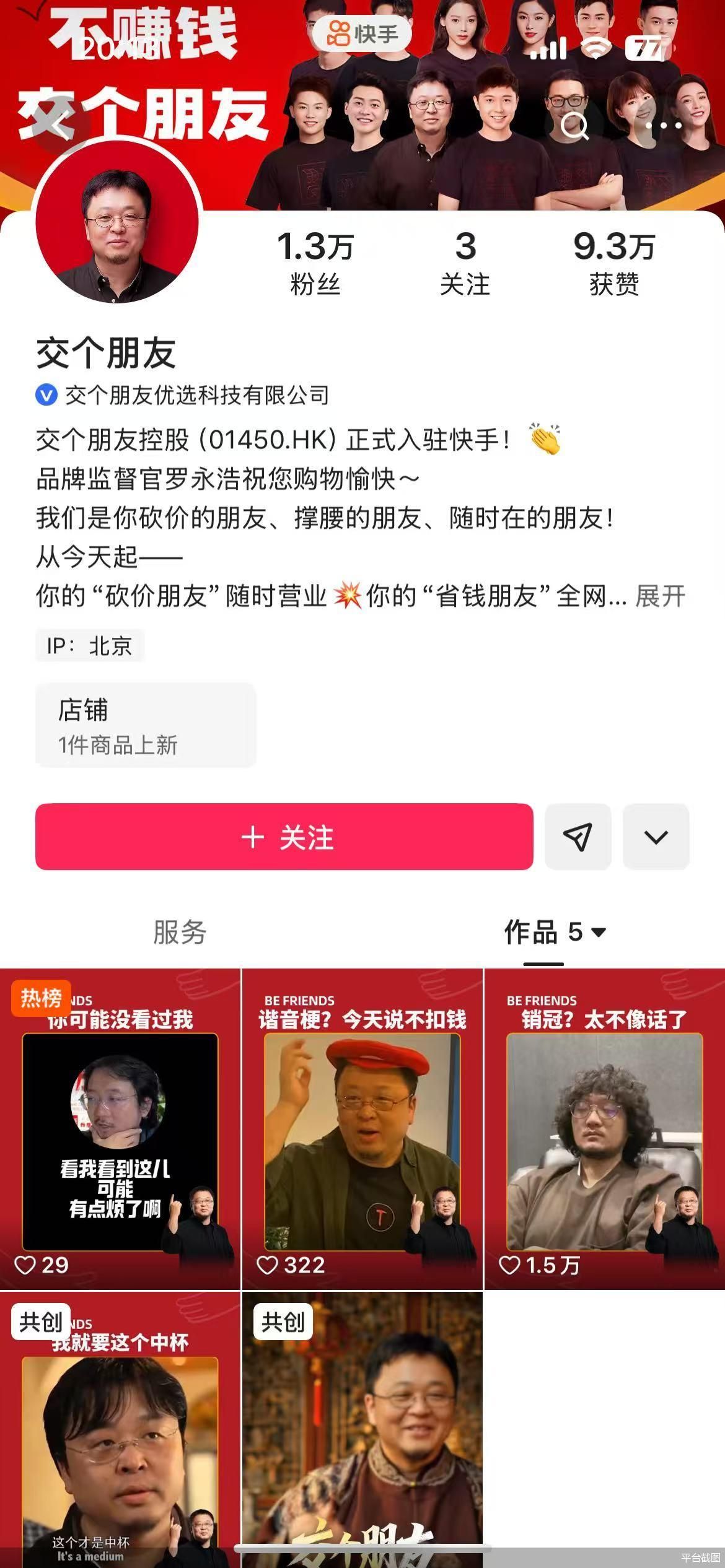
Core Viewpoint - The company "交个朋友" is expanding its presence on the Kuaishou platform to tap into the lower-tier market, aiming to create a matrix of live streaming accounts to enhance its user engagement and sales potential [1][10]. Group 1: Market Expansion - "交个朋友" has rapidly gained followers on Kuaishou, reaching 13,000 followers and 93,000 likes within three days of launching its first video [8]. - The decision to enter Kuaishou is driven by the platform's unique community ecosystem and user demographics, which align well with "交个朋友"'s business direction [8]. - Kuaishou has a strong penetration in lower-tier markets, with significant user activity in third to fifth-tier cities, particularly in northern provinces [8][12]. Group 2: Content and Strategy Adaptation - To cater to Kuaishou users, "交个朋友" plans to innovate its live streaming experience by creating more relatable and interactive scenarios, enhancing user participation and loyalty [9][10]. - The product selection will include high-cost performance local goods that resonate with Kuaishou's user consumption habits, alongside classic bestsellers [9]. Group 3: Competitive Landscape - "交个朋友" faces significant competition from established Kuaishou influencers like辛巴, who have a stronghold in the live streaming market, making it challenging to capture market share [11][12]. - During the "6·18" shopping festival, Kuaishou's overall GMV for general merchandise increased by over 53%, with辛巴's group achieving substantial sales figures [11]. Group 4: Financial Performance and Challenges - In 2023, "交个朋友" reported a revenue of 9.89 billion yuan from its live streaming e-commerce business, which constituted 92% of its total revenue, nearly doubling its GMV from the previous year [14]. - However, the company is experiencing increased operational pressures, with a reported profit decline of 36.6% year-on-year, attributed to market conditions and rising costs from rapid expansion [14][15]. Group 5: Future Outlook - The company aims to develop a matrix of live streaming accounts on Kuaishou to meet diverse user needs, indicating a strategic focus on long-term growth and user engagement [10]. - "交个朋友" plans to leverage AI technology for optimizing product selection and enhancing user interaction during live streams, which may improve conversion rates [15].

20家资本竞逐星巴克中国:最新业绩回暖,“择偶”条件大曝光
3 6 Ke· 2025-07-31 08:08
Core Viewpoint - Starbucks China has experienced a performance rebound, with Q3 FY2025 showing an 8% year-on-year revenue growth to $790 million and a 2% increase in same-store sales, marking a significant recovery from a previous 14% decline in Q3 FY2024 [1][4]. Group 1: Same-Store Sales and Revenue Growth - Same-store sales in Starbucks China have returned to growth after four consecutive quarters of decline, with a 2% year-on-year increase in the latest quarter [2][4]. - The growth is attributed to a 6% increase in same-store transaction volume, despite a 4% decline in same-store average ticket price [5][6]. - Product innovation, integrated marketing activities, and the expansion of delivery services have been key drivers of this growth [6][8]. Group 2: Market Expansion and Store Strategy - As of Q3 FY2025, Starbucks China has a total of 7,828 stores, with a net increase of 522 stores year-on-year, including 70 new stores in the latest quarter [9][10]. - The company has focused on expanding into lower-tier cities, with 50% of new stores in FY2024 located in third-tier cities and below [10][11]. - Localized strategies, such as introducing region-specific products and culturally themed store designs, have enhanced customer engagement and sales performance in new markets [11][13]. Group 3: Capital Movements and Partnership Strategy - Starbucks China is actively seeking strategic partners, with over 20 potential partners expressing interest in acquiring a stake in the business [14][15]. - The company aims to retain a significant equity stake, potentially around 30%, while looking for partners that share its mission and can operate efficiently in the local market [14][15]. - Notable potential partners include Hillhouse Capital, KKR, and Meituan, all of which have experience in the food and beverage sector [14][15]. Group 4: Competitive Landscape and Challenges - Despite the positive financial results, Starbucks China faces challenges from a competitive market, with local brands aggressively expanding and driving prices down [17][19]. - Competitors like Luckin Coffee and others are rapidly increasing their store counts, intensifying the competition in both lower-tier and higher-tier markets [18][19]. - The company must navigate these pressures while maintaining its brand positioning and adapting to market pricing dynamics [19].


理财代销“朋友圈”密集“添新”
Jin Rong Shi Bao· 2025-07-31 02:29
Group 1 - Recent announcements from various wealth management companies, including Zhaoyin Wealth Management and Xinyin Wealth Management, indicate a rapid expansion of agency sales partnerships with city commercial banks, rural commercial banks, and rural credit cooperatives, highlighting a trend towards deeper market penetration [1][3] - The addition of new agency sales institutions, such as Guilin Bank and Rizhao Bank, reflects a strategic shift to enhance distribution channels and reach long-tail customers at lower costs, driven by the urgent need for wealth management business expansion [1][2] - The trend of channel diversification is evident, with the proportion of agency sales from parent banks decreasing to 65%, indicating progress in expanding external sales channels [3] Group 2 - The shift towards agency sales is characterized by a "downward" trend, where wealth management companies collaborate with rural banks to create integrated financial solutions, enhancing customer engagement through tailored product recommendations [3] - The competitive landscape in the wealth management market is intensifying, as banks seek to increase intermediary income and diversify revenue sources amid pressure on net interest margins [4] - A report from Guosheng Securities predicts that the scale of bank wealth management products will reach 30.67 trillion yuan by mid-2025, with a year-on-year growth of 7.53%, underscoring the growing importance of agency sales in the industry [3]
湖北前首富身故背后,多名大佬接连遭遇“巨震”,这个行业怎么了
Xin Lang Cai Jing· 2025-07-30 11:27
Group 1 - The home furnishing industry is facing significant challenges, with only 11 out of 26 listed companies reporting profits in the first half of the year, while 15 companies are in the loss category [4][17] - The recent death of Wang Linpeng, the founder and CEO of Juran Home, has shocked the industry, as he was a prominent figure with a net worth of 12.5 billion [4][10] - Juran Home's performance has been declining, with a net profit of 769 million in 2024, down approximately 40% year-on-year, and a debt ratio of 57.8% [8][14] Group 2 - Juran Home is undergoing a digital transformation, focusing on smart home products, but new business revenue accounts for less than 12% of total income, with a gross margin of only 15% compared to 63% for traditional stores [8][19] - Red Star Macalline has also faced management changes and financial difficulties, reporting a net loss of 2.216 billion in 2023 and a further loss of 2.983 billion in 2024 [11][13] - The company has seen a reduction in the number of its stores, with a decline from 87 to 77 self-operated stores from 2023 to 2024 [14] Group 3 - Companies like Juran Home and Red Star Macalline are not isolated cases; the entire industry is experiencing a downturn, with a reported sales drop of 8.88% year-on-year for large-scale building materials and home furnishing markets [16][17] - Some companies are exploring international markets and product upgrades to counteract losses, with Dream Baishe reporting a significant profit increase of 90.14% to 128.17% in the first half of the year [18][20] - The future growth points for the industry are expected to be in smart home products, health-oriented home solutions, and the lower-tier market, as companies adapt to changing consumer demands [20]



银行理财代销“朋友圈”密集“添新”
Jin Rong Shi Bao· 2025-07-29 08:11
兴银理财近期新增机构包括海南农商行、广东潮阳农商行、蒙商银行、广西凌云农商行、河池市区农村 信用合作联社、新疆玛纳斯农商行等。 北银理财近日新增浙江衢州柯城农商行为代销机构。今年以来,北银理财还与浙江上虞、诸暨、桐乡、 嵊州、宁波慈溪等多地的农商行建立代销业务合作。 近日,招银理财、兴银理财、信银理财、北银理财等纷纷发布新增代理销售合作机构的公告,加快拓展 城商行、农商行甚至农信社为代销机构。下沉市场的趋势进一步显现。 具体来看,信银理财新增桂林银行、日照银行、广西北部湾银行、湖南银行、南通农商行等为代销机 构。 招银理财新增上海农商行、海宁农商行、绍兴银行等为代销机构。 "'下沉'的本质是金融机构资源再分配的缩影,表现为'渠道下沉'向'生态下沉'升级,理财公司与农商 行、城商行合作,将从'产品代销'转向'场景共建'。例如,理财公司嵌入农商行的农村电商、普惠金融 场景,实现'资金+场景'双驱动,通过客户画像推荐适配理财产品,提升转化率。未来,谁能打通'下沉 市场'中'人、货、场'的精准匹配,谁就能在财富管理新赛道中占据先机。"田利辉对此分析认为。 《金融时报》记者通过梳理发现,理财代销作为冲规模的利器,已经进 ...
孕婴世界靠“亲友团”逆势扩张 拟IPO募资近2亿元合理性存疑
Mei Ri Jing Ji Xin Wen· 2025-07-28 14:24
江大兵配偶王琼也在公司发展过程中扮演着关键角色。创业早期,夫妻二人曾共同创办成都市创托妇婴 商贸有限公司(孕婴世界业务前身)并持股至2014年。 在出生率持续走低的背景下,母婴连锁企业成都孕婴世界股份有限公司(以下简称孕婴世界)却逆势扩 张,凭借加盟模式和下沉市场策略实现业绩增长,并宣称"位居国内母婴连锁行业前三"。近日,孕婴世 界向北交所递交的上市申请已获受理。 《每日经济新闻》记者注意到,孕婴世界家族经营色彩浓厚。公司实际控制人、高管及员工的多名亲友 扮演了多重角色,包括股东、供应商和客户,甚至在公司前五大供应商和前五大客户名单中都有他们的 身影。 这种"亲友合力"的商业模式虽助推了公司发展,但也为其IPO(首次公开募股)之路埋下隐忧。7月21 日,公司收到了监管部门的问询函,公司的股权清晰稳定情况、加盟模式、收入真实性等问题均被问 及。 庞大的"亲友商业网络" 孕婴世界主营业务为母婴商品销售,以及为上游品牌供应商、下游加盟商提供服务。孕婴世界招股说明 书(申报稿)(以下简称招股书)显示,江大兵、王伟鉴合计实际控制公司表决权比例为83.4929%, 为公司实际控制人。 现年54岁的江大兵是孕婴世界核心人物 ...
对飙盒马、京东,美团再出招
3 6 Ke· 2025-07-28 10:57
Core Viewpoint - The article discusses the competitive landscape of offline retail in China, focusing on Meituan's new discount supermarket project "Happy Monkey" as it aims to penetrate the lower-tier market, contrasting its strategy with Alibaba's Hema NB and highlighting the challenges and opportunities in the sector [1][2][3]. Group 1: Meituan's Strategy and Market Position - Meituan is launching "Happy Monkey" in Hangzhou, with plans for a flagship store in Beijing, targeting the lower-tier market from the outset [1][2]. - The leadership team for "Happy Monkey" is primarily composed of members from the previously downsized Meituan Youxuan, indicating a strategic shift within the company [1]. - Meituan's CEO Wang Xing has identified "food and grocery retail" as a top priority for the company's future, marking a significant strategic pivot towards offline retail [3][4]. Group 2: Competitive Landscape - Hema NB has rapidly expanded to over 300 stores since its launch, positioning itself as a key player in the offline retail space, which Meituan is now entering with "Happy Monkey" [2]. - The competition in the lower-tier market is intensifying, with "Happy Monkey" facing rivals like Hema NB and Aoleqi, highlighting the need for differentiation in product offerings and pricing strategies [11][12]. Group 3: Operational Challenges and Opportunities - Meituan's previous attempt at offline retail with "Little Elephant Fresh" failed due to high operational costs and a lack of expertise in supply chain management, which the company aims to address with its new approach [5][7]. - The "Happy Monkey" model focuses on hard discounting and high private label ratios, catering to price-sensitive consumers in lower-tier cities, which is a shift from previous high-end strategies [8][9]. - The integration of "Happy Monkey" with Meituan's existing flash purchase service could enhance product quality and supply chain efficiency, addressing past challenges faced by the flash purchase platform [10]. Group 4: Future Expansion Plans - Meituan has set an ambitious target of opening 1,000 "Happy Monkey" stores, indicating a strong commitment to scaling its offline retail presence [11]. - The company is leveraging its extensive logistics network and rider workforce to optimize resource allocation and improve operational efficiency in its new stores [13][14]. - "Happy Monkey" is part of a broader strategy that includes the development of "Little Elephant Supermarket," which targets higher-end markets, showcasing a dual approach to market segmentation [14].
