卫星互联网

Search documents
上证早知道|卫星互联网,加速组网!易点天下,停牌核查完成!华菱线缆,终止收购商业航天资产!
Shang Hai Zheng Quan Bao· 2026-01-20 13:43
Group 1 - The National Bureau of Statistics reported that in December 2025, the sales prices of commercial residential properties in 70 large and medium-sized cities decreased month-on-month, with an expanded year-on-year decline. The GDP for the entire year of 2025 was 14,018.79 billion yuan, reflecting a growth of 5.0% at constant prices [6] - The International Monetary Fund updated its World Economic Outlook report, raising the economic growth forecast for China in 2026 [7] - Micron Technology indicated that the shortage of memory chips has worsened over the past quarter, reiterating that supply tightness will persist into the following year due to surging demand for high-end semiconductors driven by AI infrastructure development [7] Group 2 - Jianghua Microelectronics announced that its stock will resume trading on January 20, 2026, with a change in its actual controller to the Shanghai State-owned Assets Supervision and Administration Commission [5] - Hunan YN announced an expected net profit for 2025 of 1.15 billion to 1.4 billion yuan, representing a year-on-year growth of 93.75% to 135.87% due to the rapid development of the new energy vehicle and energy storage markets [10] - Jiangxi Copper signed a cooperation framework agreement with a military supply company to supply various metal products, which will enhance its market competitiveness and brand influence [10] Group 3 - The satellite internet industry is entering a rapid development phase, with the successful launch of 19 low-orbit satellites by China's Long March 12 rocket, indicating accelerated networking and industrialization of satellite internet [8] - The demand for AI is driving up the prices of copper-clad laminates (CCL) due to tight supply of raw materials, with price increases of over 30% announced by Resonac and 10% by Kintor Group [9] - The company Ding Tong Technology expects a net profit of 242 million yuan for 2025, marking a year-on-year increase of 119.59% [10]
中国星网换帅增资 冲刺星座部署关键期
Jing Ji Guan Cha Wang· 2026-01-20 10:56
经济观察报记者 王雅洁 2026年1月20日,经济观察报从中国卫星网络集团有限公司(下称"中国星网")获悉,其已完成工商信息变更,法定代表人由张冬辰变更为苟坪,总经理由 张洪太变更为梁宝俊,新增梁宝俊、牟相军、高春雷三位董事。 作为中国卫星互联网的"国家队",中国星网管理层此番调整正值其推进1.3万颗低轨卫星星座部署的关键阶段。其紧迫性源于一项具体的国际规则约束:中 国在2020年至2022年间向国际电信联盟(ITU)密集申报了包括其GW星座在内的多个大规模星座计划。 根据ITU规则,申报方需在7年内发射首颗卫星,9年内完成申报规模10%的部署,以激活并保留所申报的宝贵频轨资源使用权。因此,2027年至2029年成为 中国首批星座计划履约的首个关键节点,时间窗口已然紧迫。 相比之下,中国在2025年底新近申报的超大规模星座计划,其履约期限则远在此之后。当前产业冲刺的重心与焦点,正是面临"九年节点"考验的首批计划。 卫星互联网产业正从技术验证迈向商业冲刺,而中国星网的动向之所以比同类企业更受关注,源于其"国家队"定位与统筹使命,其决策直接关系着中国在首 轮全球太空资源竞争中的实际站位。 产业动态正在加速显现。中 ...


卫星互联网低轨19组卫星成功发射
Ren Min Wang· 2026-01-20 08:16
Core Viewpoint - The successful launch of 19 low Earth orbit satellites for satellite internet by China on January 19, 2023, marks a significant advancement in the country's commercial space capabilities and satellite technology [1] Group 1: Launch Details - The launch was conducted using the Long March 12 rocket at the Hainan commercial space launch site, achieving a successful mission with the satellites entering their designated orbits [1] - The Long March 12 rocket is a new generation of cryogenic liquid launch vehicle developed by the China Aerospace Science and Technology Corporation, with a near-Earth orbit carrying capacity of no less than 12 tons and a 700 km sun-synchronous orbit capacity of no less than 6 tons [1] - This launch represents the 628th mission of the Long March series of rockets [1] Group 2: Satellite Technology - The 19 satellites were developed by Galaxy Space, featuring core technologies such as phased array, millimeter-wave antennas, integrated electronics, and energy systems aimed at reducing costs [1] - The development process of this batch of satellites achieved a fully digital workflow for the first time, incorporating automated testing, intelligent assembly and inspection, and optimized launch site processes to significantly enhance efficiency [1]
粤开市场日报-20260120-20260120
Yuekai Securities· 2026-01-20 07:54
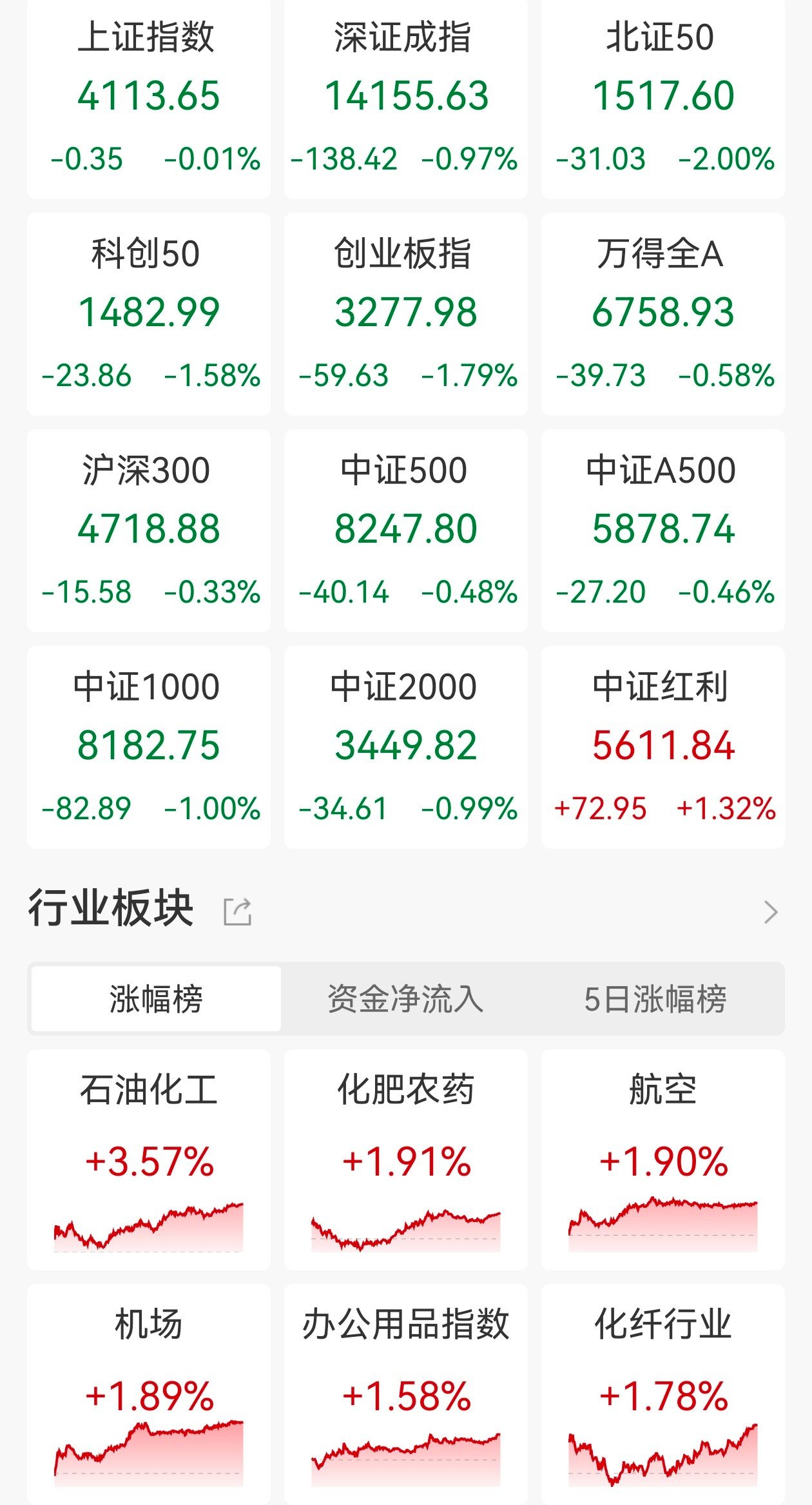
Market Overview - The A-share market indices closed down today, with the Shanghai Composite Index falling by 0.01% to 4113.65 points, the Shenzhen Component Index down by 0.97% to 14155.63 points, the Sci-Tech 50 down by 1.58% to 1482.99 points, and the ChiNext Index down by 1.79% to 3277.98 points [1][14] - Overall, there were 2231 stocks that rose and 3102 stocks that fell, with a total market turnover of 27,777 billion yuan, an increase of 693 billion yuan compared to the previous trading day [1] Industry Performance - Among the Shenwan first-level industries, the sectors that performed well included Petroleum & Petrochemicals (up 1.74%), Building Materials (up 1.71%), Real Estate (up 1.55%), Transportation (up 1.25%), Construction Decoration (up 1.24%), and Basic Chemicals (up 1.15%) [1][14] - Conversely, the sectors that saw declines included Communication (down 3.23%), Defense & Military (down 2.87%), and Computer (down 1.94%) [1][14] Concept Sector Performance - The leading concept sectors with gains today included Cultivated Diamonds, Cement Manufacturing Selection, Real Estate Selection, Major Infrastructure Central Enterprises, Chemical Raw Materials Selection, Food Processing Selection, Advanced Packaging, Gold and Jewelry, First-Class Real Estate Developers, Aviation Transportation Selection, Banking Selection, Central Enterprises, Old Infrastructure, Western Major Infrastructure, and Superhard Materials [2][11]
北交所双周报(1.5-1.16):北交所开年持续上涨,三大交易所上调融资保证金比例
ZHONGTAI SECURITIES· 2026-01-20 07:30
Investment Rating - The report maintains an "Accumulate" rating for the industry [1] Core Insights - The overall market performance of the North Exchange shows a significant increase, with the North 50 Index rising by 7.49% during the period from January 5 to January 16, 2026, closing at 1548.33 points. In comparison, the Shanghai and Shenzhen 300, ChiNext, and Sci-Tech 50 indices increased by 2.20%, 4.93%, and 12.64%, respectively [4][10] - The average market capitalization of the 288 constituent stocks in the North Exchange is 32.69 billion yuan, with a total market value of 941.449 billion yuan and a circulating market value of 573.460 billion yuan [1][4] - The daily average trading volume during this period reached 331.61 billion yuan, representing a 67.96% increase compared to the previous period [4][12] Summary by Sections North Exchange Market Overview - As of January 16, 2026, the North Exchange has 288 listed companies, with an average market capitalization of 32.69 billion yuan. The North 50 Index increased by 7.49% during the specified period [4][10] - The daily average trading volume was 331.61 billion yuan, with a turnover rate of 6.62%, which is an increase of 2.30 percentage points from the previous period [12][13] North Exchange Sector Performance - The top five performing sectors in the North Exchange during this period were Media (45.09%), Oil and Petrochemicals (22.23%), Non-ferrous Metals (16.87%), Automotive (14.64%), and Communications (13.47%) [4][15] North Exchange New Stocks - Three new stocks were issued during this period: Kema Materials (920086.BJ), Aisheren (920050.BJ), and Guoliang New Materials (920076.BJ) [5][23] North Exchange Key News - On January 5, 2026, the company Guangdao Tui (920680) was officially delisted, marking the first forced delisting due to major violations since the establishment of the North Exchange [7][24] - On January 14, 2026, the financing margin ratio for investors was adjusted from 80% to 100%, aimed at reducing leverage and protecting investors' rights [7][24] North Exchange Investment Strategy - The report suggests focusing on sectors expected to perform well in 2026, including Data Centers, Robotics, Semiconductors, Consumer Goods, and Military Information Technology [7][26]
A股收评:三大指数集体下跌!创业板指跌近2%,卫星互联网、光通信模块板块重挫
Ge Long Hui A P P· 2026-01-20 07:10
Market Performance - The three major A-share indices collectively declined, with the Shanghai Composite Index down 0.01% to 4113 points, the Shenzhen Component Index down 0.97%, and the ChiNext Index down 1.79% [1] - The total market turnover reached 2.8 trillion yuan, an increase of 72 billion yuan compared to the previous trading day, with over 3100 stocks declining [1] Sector Performance - The commercial aerospace and satellite internet sectors experienced significant declines, with multiple stocks such as Tongyu Communication and Sanwei Communication hitting the daily limit down [1] - The CPO concept and optical communication module sectors also fell, with Tiantong Co. hitting the daily limit down [1] - The photovoltaic equipment sector declined, with Guosheng Technology hitting the daily limit down [1] - The military industry sector weakened, with stocks like Shenjian Co. hitting the daily limit down [1] - Other sectors that saw notable declines included Hainan, 6G concept, PCB, and battery sectors [1] Rising Sectors - The epoxy propane and chemical raw materials sectors saw gains, with stocks like China Chemical and Hongbaoli hitting the daily limit up [1] - Spot gold prices surpassed 4700 USD for the first time, leading to a continued rise in the precious metals sector, with Hunan Silver and Zhaojin Gold both hitting the daily limit up [1] - The cultivated diamond sector also saw a rise, with Hengsheng Energy hitting the daily limit up [1] - Other sectors with notable gains included glyphosate and longevity drugs [1]

航天发展、中国卫星盘中逼近跌停!航空航天ETF天弘(159241)逆市获1300万份净申购
2 1 Shi Ji Jing Ji Bao Dao· 2026-01-20 07:01
Core Viewpoint - The aerospace and defense sector in China is experiencing significant fluctuations, with a notable decline in major indices and specific stocks, while the aerospace ETF shows positive net inflows and growth potential in the commercial space sector by 2026 [1][2]. Group 1: Market Performance - On January 20, the three major indices collectively declined, with the Shanghai Composite Index down 0.31%, the Shenzhen Component down 1.47%, and the ChiNext Index down 2.36% [1]. - The CN5082 Aerospace and Defense Industry Index fell by 3.86%, with significant declines in stocks such as Aerospace Development and China Satellite approaching their daily limit down [1]. Group 2: ETF Activity - The Tianhong Aerospace ETF (159241) had a trading volume of 132 million yuan, with a net subscription of 13 million shares during the session [1]. - The ETF saw a net inflow of over 21 million yuan on the previous trading day (January 19), with a current circulation of 531 million shares and a total market size of 814 million yuan [1]. Group 3: Industry Outlook - The Tianhong Aerospace ETF closely tracks the CN5082 index, which encompasses various sectors including aerospace equipment, military electronics, and emerging technologies like satellite internet and low-altitude economy [1]. - According to Open Source Securities, the domestic commercial space sector is expected to experience a "triple resonance" of policy, technology, and capital by 2026, highlighting the importance of the rocket and satellite industry chains [1]. - Guotai Junan Securities noted that the China Aerospace Science and Technology Corporation has announced plans to focus on reusable rocket technology and the development of commercial space by 2026, indicating a significant acceleration in the commercial space sector [2].




越跌越买!两融标的卫星产业ETF(159218)盘中再揽金近1亿!臻镭科技、航天环宇、航宇微跌超10%
Sou Hu Cai Jing· 2026-01-20 05:58
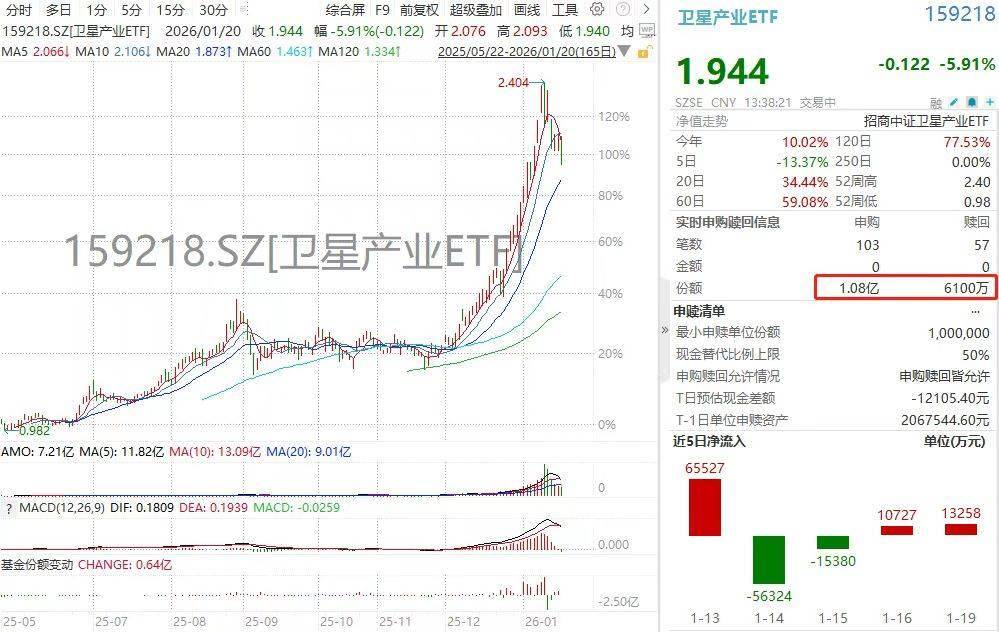
Core Viewpoint - The satellite sector continues to adjust, with evident intentions for capital to accumulate at lower levels, as indicated by recent trading data [1][3]. Group 1: Market Performance - As of 1:34 PM, the satellite industry ETF (159218) experienced a decline of 5.95%, with companies like Zhenlei Technology, Aerospace Huanyu, Aerospace Micro, Changjiang Communication, and China Satellite Communications leading the losses [1]. - Despite the downturn, there was a net inflow of approximately 96 million yuan during the trading session, with the fund seeing a continuous net inflow over three days, totaling around 340 million yuan [1]. Group 2: Industry Developments - On January 19, China successfully launched 19 low-orbit satellites for satellite internet using the Long March 12 rocket from the Hainan commercial space launch site, marking a significant step in the construction of the satellite internet constellation [3]. - This successful launch reinforces the acceleration of the satellite industry in accordance with planned developments, providing solid orders and growth expectations for the sector [3]. - The satellite industry has become widely recognized as a high-growth sector, driven by the ongoing commercialization and rapid development of low-orbit satellite constellations [3]. - The satellite industry ETF (159218) is the first in the market to double its returns while tracking the CSI Satellite Industry Index, covering upstream and downstream companies involved in satellite manufacturing, launching, and navigation communication applications [3].

创业板指半日跌近2%,商业航天、光模块重挫,芯片股走强,分析:高波题材或将降温
2 1 Shi Ji Jing Ji Bao Dao· 2026-01-20 04:15
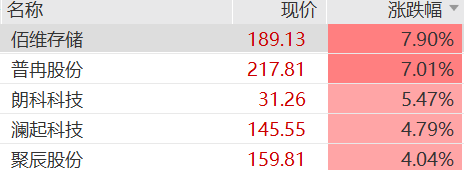
Market Overview - On January 20, A-shares experienced a significant drop, with the ChiNext Index falling over 2% at one point, ultimately closing down 1.8% [1] - The chemical sector showed resilience, with several stocks such as Hongbaoli and Shandong Heda hitting the daily limit [1] AI and Semiconductor Sector - AI application stocks rose, with companies like Jiayun Technology and Yue Media hitting the daily limit [2] - The storage chip concept remained active, with Yingfang Micro, which plans to acquire shares in two semiconductor companies, also hitting the daily limit; Bawei Storage saw a nearly 200% increase over the last 120 trading days [2] - Micron Technology reported a worsening shortage of memory chips, indicating that supply tightness will persist beyond this year [2] Retail and Real Estate Sector - The retail sector strengthened, with Shanghai Jiubai and Xinhua Department Store hitting the daily limit, following the National Development and Reform Commission's announcement to develop a strategy for expanding domestic demand from 2026 to 2030 [2] - The real estate sector also saw gains, with stocks like Dayue City and Wo Ai Wo Jia hitting the daily limit [2] Financing and Market Dynamics - A-shares' financing balance decreased for the first time in two weeks, with a reported balance of 27,059 billion yuan, down 8.5 billion yuan from the previous day [4] - The electronic, communication, defense, computer, and basic chemical sectors were the main areas of net selling by financing clients, each exceeding 1 billion yuan in net sell amounts [5] - Analysts noted that the recent increase in margin requirements is likely aimed at cooling off overheated speculative trends, particularly affecting high-volatility sectors [6] - Despite short-term fluctuations, the long-term outlook for A-shares remains bullish, with expectations for new highs in the cross-year market [6]
中国一口气申报20万颗卫星,将如何利好汽车业?
Zhong Guo Qi Che Bao Wang· 2026-01-20 02:40
Core Viewpoint - China's telecom companies have submitted applications for 203,000 low Earth orbit (LEO) satellite frequency resources to the International Telecommunication Union (ITU), leading to a significant rise in related A-share sectors, indicating a potential new industrial opportunity in the market [3]. Group 1: Industry Dynamics - The competition for LEO orbital and frequency resources is intense due to their scarcity and irreproducibility. Current technology allows for the safe deployment of only about 100,000 to 175,000 LEO satellites, while global applications have already exceeded this threshold [5]. - SpaceX currently leads in satellite deployment with over 9,000 satellites in orbit, accounting for 60% of global LEO satellites. The company plans to reduce the orbital height of 4,400 satellites, further constraining resources for other nations [6]. - The ITU's "first come, first served" allocation rule emphasizes the need for early applications to secure development opportunities. China's recent applications are seen as a necessary step to lock in reasonable space for future aerospace development [5][6]. Group 2: Impact on Automotive Industry - The automotive industry is rapidly transitioning into the era of intelligent connectivity and autonomous driving, where high-speed communication and precise positioning are crucial. LEO satellites are essential for overcoming the limitations of traditional ground communication networks, especially in remote areas [7]. - Many smart connected vehicles are already equipped with satellite internet and phone functionalities, allowing users to communicate even when ground networks are unavailable [7]. - The demand for high-precision positioning in autonomous driving is increasing, with traditional GPS accuracy being insufficient. A complete domestic "star chain" could achieve centimeter-level positioning accuracy, enhancing travel safety [8]. Group 3: Safety and Insurance Innovations - Satellite technology can significantly enhance vehicle lifecycle management by providing real-time data on driver behavior and vehicle status, enabling timely identification of potential safety hazards [9]. - In the insurance sector, satellite positioning combined with big data analysis can reshape pricing models, allowing for more accurate risk assessments based on actual driving behavior, which could lead to fairer insurance rates [10]. Group 4: Future Prospects - The development of a comprehensive satellite network is expected to facilitate seamless communication across various environments, enhancing the integration of vehicles with smart home systems and improving user experience [11]. - The integration of satellite technology with artificial intelligence and big data is anticipated to revolutionize autonomous driving, improving decision-making capabilities and overall safety [11]. - Experts believe that the "space dividend" from satellite technology presents a unique opportunity for China's automotive industry to transition from traditional manufacturing to intelligent mobility solutions, potentially giving it a competitive edge in the global market [12].