好房子建设

Search documents
房价涨跌榜出炉!全国60城近半数上涨,你的城市是涨是跌?
Sou Hu Cai Jing· 2025-07-15 10:25
中央层面系统性布局:2025上半年,中央政策围绕"止跌回稳"的核心基调,从金融、土地、城市更新三大维度协同发力。金融端,央行下调了5年期 以上LPR和首套公积金利率,以降低购房成本、支持刚需。土地端,自然资源部通过专项债支持土地储备,并要求优先盘活存量闲置土地,旨在稳 定土地市场。同时,中央将城市更新提升至战略高度,强调"好房子"建设,力图通过构建新模式实现行业长期健康发展。 地方"因城施策"差异化调控:地方政府根据自身市场情况,推出了多样化的配套政策。一线城市在公积金、购房补贴、保障房、城市更新等五大领 域全面布局。新一线及二线城市则侧重于优化公积金政策、推进城市更新和"好房子"建设。而三四线城市更多聚焦于发放购房补贴和减免税费,直 接降低居民购房成本,调控策略的精准性和差异化特征显著。 公积金政策与购房补贴覆盖面广:在所有地方性政策中,公积金政策的优化调整最为普遍,上半年全国至少有67个城市推出相关举措,包括提高贷 款额度、支持提取支付首付、实施异地互认等。同时,至少有29个城市通过发放"真金白银"的购房补贴或税费优惠来刺激需求,这些城市不仅包括 一线和重点二线城市,也涵盖了部分三四线城市,体现了政策的广 ...

上半成都销售排行 华润夺冠
3 6 Ke· 2025-07-15 02:25
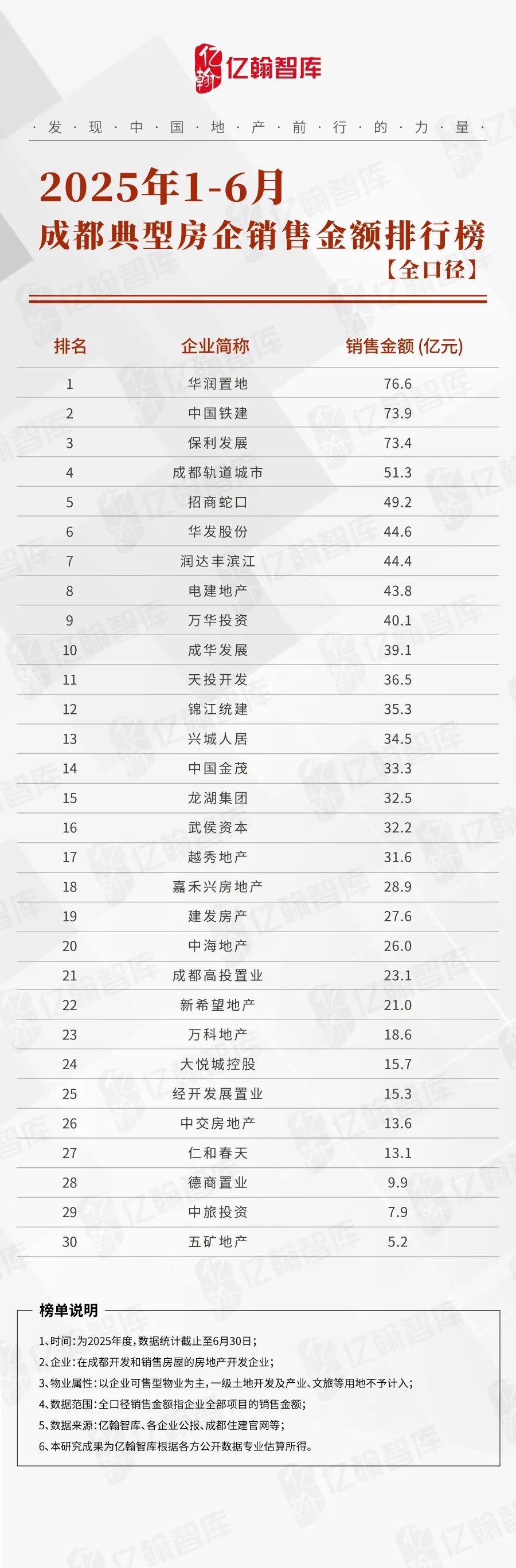
Sales Performance - In the first half of 2025, the total sales amount of the top 30 real estate companies in Chengdu reached 99.82 billion yuan, with China Resources Land, China Railway Construction, and Poly Developments leading the sales at 7.66 billion yuan, 7.39 billion yuan, and 7.34 billion yuan respectively [10] - The total sales area for the top 30 companies was 4.337 million square meters, with Poly Developments, China Resources Land, and China Railway Construction achieving sales areas of 343,000 square meters, 329,000 square meters, and 314,000 square meters respectively [10] Market Trends - The new housing market in Chengdu saw a total of 5,982 new homes sold in June, representing a year-on-year decrease of 13.7% but a month-on-month increase of 2.1% [10] - The new residential price index in Chengdu increased by 0.1 percentage points in May, marking the seventh consecutive month of price increases since November 2024 [10] Policy and Development - On June 6, the Chengdu Housing and Urban-Rural Development Bureau issued the "Good House" construction action plan, which includes 18 key tasks aimed at improving residents' living quality and happiness [10] - Upcoming projects such as Jianfa Zhaoshang Yuanqi Jinsha and Green City Run Baihe are expected to bring renewed activity to the Chengdu new housing market in July [10] Secondary Market - In June, the secondary housing market in Chengdu recorded 19,214 transactions, showing a year-on-year increase of 14.4% and remaining stable month-on-month [11] Land Market - The land market in Chengdu is experiencing record-breaking floor prices, with the Jinniu District's land price exceeding 20,000 yuan per square meter for the first time [11]


2025上半年中国房地产总结与展望(全版)
克而瑞地产研究· 2025-07-13 01:36
Core Viewpoint - The real estate market is gradually stabilizing and developing healthily under continuous policy regulation, with a focus on urban renewal, high-quality transformation, and inventory optimization [3][5][14]. Policy and Market Environment - The central and local governments have actively promoted policies to stabilize the real estate market, including financial measures to reduce costs and expand demand [3][5]. - The real estate financial environment remains loose, with a package of financial policies introduced in April aimed at stabilizing demand [3][5]. - Local governments are responding to central policies by increasing the frequency of land repurchase announcements and implementing measures to stimulate consumption [3][5]. Market Performance - The real estate industry is moving towards stabilization, with new home sales area and amount remaining stable year-on-year, and the inventory of unsold properties decreasing for three consecutive months [5][9]. - The land market continues to show a trend of reduced volume but improved quality, with land transaction volume down 8% year-on-year, yet average floor prices have increased [7][9]. - The overall performance of real estate companies has stabilized, with nearly 45% of the top 100 companies reporting year-on-year growth in performance [13]. Future Outlook - The second half of 2025 is expected to see further efforts to stabilize the market, with urban renewal and land storage policies expected to alleviate inventory pressure [3][5]. - The introduction of new housing standards is expected to lead to a significant influx of new products into the market, which may create challenges related to safety and quality [11]. - The financing environment for real estate companies remains tight, with a significant decline in financing scale, indicating ongoing challenges for companies in managing debt [14].

突然,地产股集体飙升
Zheng Quan Shi Bao· 2025-07-10 08:28
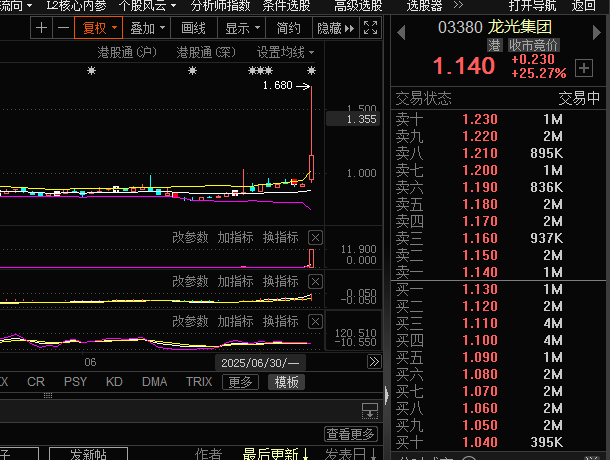
Core Viewpoint - The significant rise in Hong Kong real estate stocks is attributed to successful debt restructuring by several property companies, leading to improved market sentiment and investor confidence [1][3][4]. Group 1: Market Performance - Hong Kong real estate stocks experienced substantial gains, with Longfor Group rising over 80% and other companies like Oceanwide Holdings and Sunac China also seeing significant increases [1]. - A-share market mirrored this trend, with multiple stocks such as China Fortune Land Development and Shenzhen Metro Group hitting the daily limit up [1]. Group 2: Debt Restructuring - Longfor Group announced the successful completion of a debt restructuring involving 21 bonds and asset-backed securities, totaling a principal balance of 21.96 billion yuan, with strong investor support [3]. - The restructuring plan included options such as asset swaps, cash buybacks, debt-to-equity swaps, and debt retention, with a focus on providing liquidity and reducing debt pressure [3][4]. - Other property companies, including Sunac and R&F, have also received approval for debt restructuring, indicating a broader trend of risk clearance in the sector [3]. Group 3: Policy Environment - Recent government policies aim to support new urbanization and enhance investment in key areas, which may provide long-term benefits to the real estate market [6]. - The State Council's emphasis on constructing a new model for real estate development is expected to stabilize the market and promote healthy growth [7]. - Analysts predict that the upcoming year will be crucial for the real estate sector, with potential turning points in policy implementation and market dynamics [7].
行业ETF风向标丨地产股早盘获资金追捧,两只房地产ETF半日涨幅超1.5%
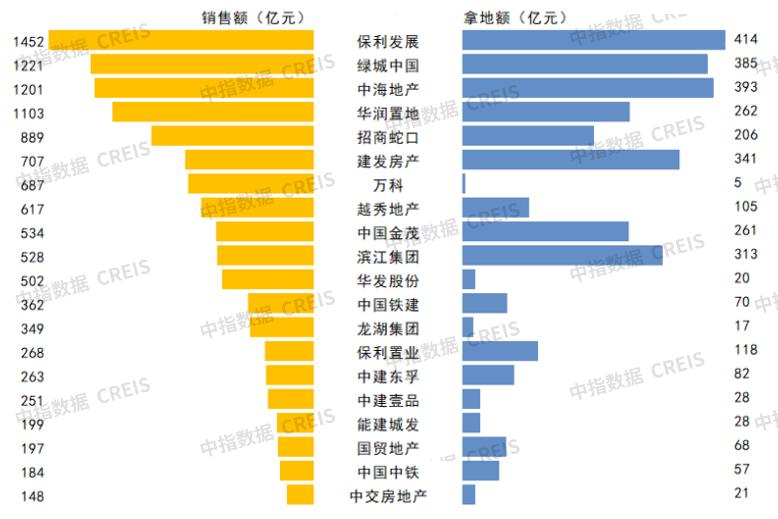
Mei Ri Jing Ji Xin Wen· 2025-07-07 05:00
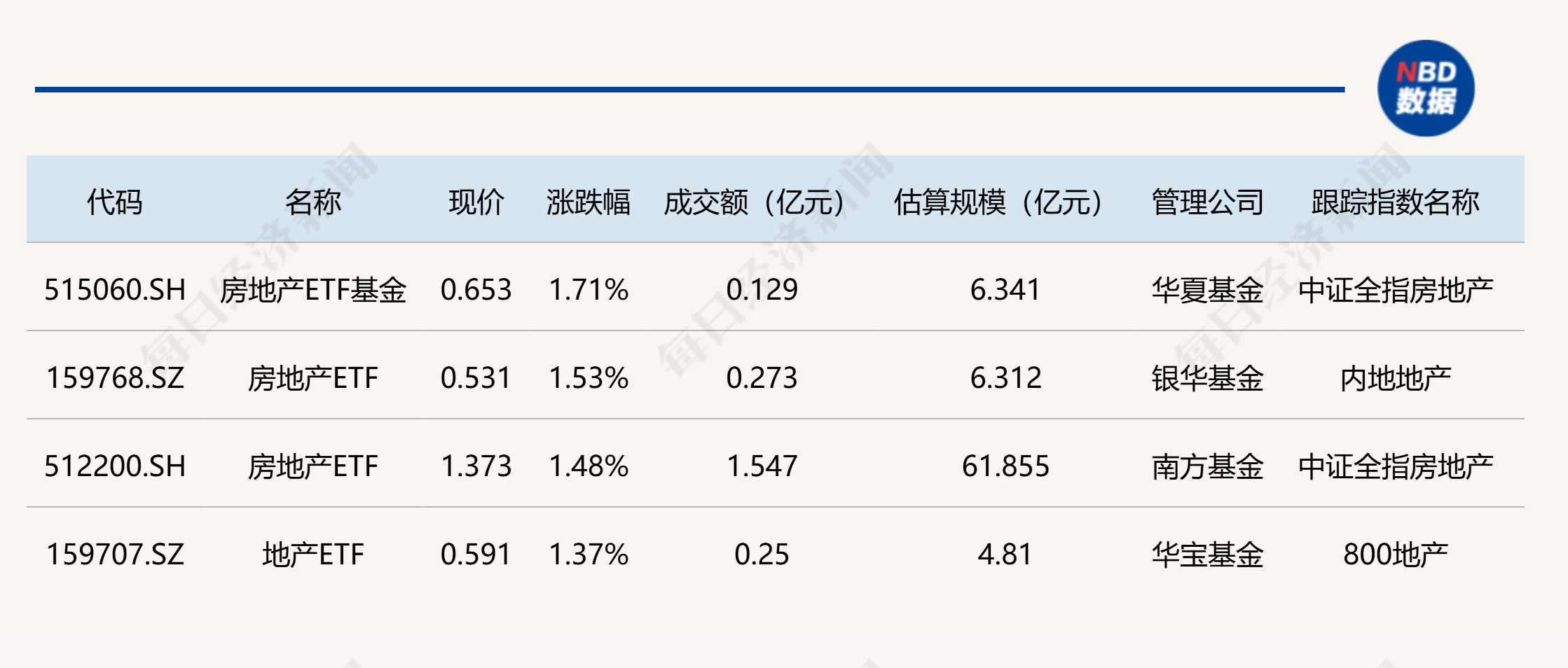
Market Overview - The market experienced fluctuations in the morning session, with the ChiNext Index leading the decline [1] - Real estate stocks showed a rebound, with companies like Yucheng Development and Shahe Shares hitting the daily limit [1] ETF Performance - Real estate-related ETFs performed well, with the Real Estate ETF Fund (515060) and Real Estate ETF (159768) both rising over 1.5% during the morning session [1][2] - The Real Estate ETF Fund (515060) increased by 1.71%, while the Real Estate ETF (159768) rose by 1.53% [2] - The estimated scale of the Real Estate ETF Fund (515060) is 6.186 billion, with a morning trading volume of 155 million [2] Investment Logic - The real estate policy is expected to strengthen in the second half of the year, particularly regarding special bonds for acquiring idle land and accelerating the progress of existing housing [2] - Analysts suggest focusing on two areas: (1) leading real estate companies with land acquisition capabilities and reasonable land reserves; (2) top intermediary institutions benefiting from active second-hand housing transactions [2] Key Stocks in Real Estate ETFs - The top weighted stocks in the CSI All Real Estate Index include Poly Development, Vanke A, and China Merchants Shekou [3][4][5] - The estimated scale of the Real Estate ETF (159768) is 631 million, with a half-day trading volume of 27.326 million [3] - The Real Estate ETF (159707) saw a half-day increase of 1.37%, with an estimated scale of 481 million and a trading volume of 25.0215 million [4][5]
行业周报:新房成交面积环比增长,多地力推商转公贷款-20250706
KAIYUAN SECURITIES· 2025-07-06 14:20
Investment Rating - The industry investment rating is "Positive" (maintained) [1] Core Viewpoints - New housing transaction area has increased month-on-month, while year-on-year figures show a decline. The report tracks 68 cities where new housing transactions increased by 38% month-on-month but decreased by 32% year-on-year. The total transaction area for the year to date is 67.46 million square meters, reflecting an 8% year-on-year decline [5][17] - The report indicates that the land transaction area has decreased year-on-year, but the premium rate has increased month-on-month. In Tianjin, a hot land auction market saw 15 residential plots sold, with one plot in the Hexi District sold at a premium of over 10%, generating a total revenue of 8.777 billion yuan [5][37] - The issuance of domestic credit bonds has increased both year-on-year and month-on-month, with a total issuance of 8.95 billion yuan, marking a 606% year-on-year increase and a 63% month-on-month increase [5][44] Summary by Sections Policy Direction - The central government emphasizes the construction of "good houses" that are safe, comfortable, green, and smart, aiming to stabilize expectations, activate demand, optimize supply, and mitigate risks. Local governments are implementing policies to promote the conversion of commercial loans to public housing fund loans, thereby lowering mortgage rates [6][14][15] Sales Data - In the 27th week of 2025, the new housing transaction area in 68 major cities was 3.68 million square meters, showing a year-on-year decline of 32% but a month-on-month increase of 38%. The cumulative transaction area for the year to date is 67.46 million square meters, reflecting an 8% year-on-year decline [7][17][33] Investment Data - In the 27th week of 2025, 100 major cities launched land planning with a total area of 27.86 million square meters, while the transaction area was 32.41 million square meters, showing a year-on-year decline of 19%. The premium rate for land transactions was 7.8% [37][38] Financing Data - The issuance of credit bonds in the 27th week of 2025 reached 8.95 billion yuan, with an average weighted interest rate of 2.34%, remaining stable month-on-month. The cumulative issuance for the year is 185.09 billion yuan, reflecting a 16% year-on-year decrease [44][46] Investment Recommendations - The report maintains a "Positive" rating for the industry, anticipating that ongoing supportive fiscal and monetary policies will help stabilize the real estate market and improve the housing supply-demand relationship [5][55]
新房、二手房成交同比放缓,政策端仍需发力
Xiangcai Securities· 2025-07-06 11:53
Investment Rating - The industry investment rating is maintained as "Buy" [1] Core Views - The report highlights that new and second-hand housing transactions are slowing down year-on-year, indicating a need for continued policy support to stimulate demand [4][6] - The Beijing government is actively optimizing real estate policies to enhance housing supply and improve living conditions for residents [3][8] Summary by Sections Policy Tracking - On July 1, the Beijing government held a meeting to discuss advancing housing policies, emphasizing a multi-supplier and multi-channel housing supply system [3][8] - The focus is on improving the quality of housing and ensuring adequate land supply near transportation hubs and employment centers [3][8] Transaction Data - In June, Beijing's second-hand housing transactions reached 16,800 units, showing a year-on-year increase of 2.3% but a slowdown compared to previous months [4][6] - For new homes, the transaction area in 30 major cities was 2.63 million square meters, reflecting a year-on-year decrease of 20.8% [5][9] Investment Recommendations - The report suggests focusing on leading real estate companies with strong land acquisition capabilities and reasonable land reserves, such as Poly Developments [6][15] - It also recommends attention to major intermediary firms benefiting from active second-hand housing transactions, like I Love My Home [6][15]
加快建设“好房子”提升居住品质
Jing Ji Ri Bao· 2025-07-05 22:12
Group 1 - The core viewpoint emphasizes the importance of constructing "good houses" to stimulate related consumption upgrades in building materials, home furnishings, smart devices, and property services, thereby driving strong domestic demand and improving housing quality [1][2] - The State Council's recent meeting highlighted the need to incorporate "good house" construction into urban renewal mechanisms, providing policy support in planning, land, finance, and other areas [1][2] - The shift in housing demand from "availability" to "quality" necessitates a comprehensive enhancement of housing standards through better design, construction, materials, and services [1][2] Group 2 - Policy support will focus on strengthening guarantees for "good house" projects, increasing the supply of quality land, and optimizing the scale, structure, and layout of residential land supply [2] - Encouragement of collaborative development models among enterprises, along with support for technological research and innovation, aims to improve construction quality and efficiency [2] - Financial measures will include providing financing convenience for projects meeting standards, leveraging fiscal subsidies, and special bonds to mobilize resident funds or social capital [2] Group 3 - The construction of "good houses" must also address the renovation of old houses to meet residents' quality of life needs, integrating "good house" indicators into urban renewal plans [2][3] - Enhancing supporting infrastructure and services is essential for ensuring a comfortable living experience in "good houses" [3] - Property companies are encouraged to create a quality closed loop throughout the project delivery cycle, improving long-term living experiences and brand value [3]
住房城乡建设部:持续巩固房地产市场稳定态势
证券时报· 2025-07-04 13:34
Core Viewpoint - The article emphasizes the importance of promoting a stable, healthy, and high-quality development of the real estate market, urging local governments to take responsibility and implement targeted policies to stabilize the market [1][2]. Group 1: Policy Implementation - The research team from the Ministry of Housing and Urban-Rural Development conducted investigations in Guangdong and Zhejiang provinces, highlighting the need for tailored real estate policies to enhance the effectiveness of policy implementation [1]. - Local governments are encouraged to accelerate the construction of safe, comfortable, green, and smart housing to meet the new expectations of the public [1]. Group 2: Market Performance - In the first half of the year, both Guangdong and Zhejiang provinces saw a year-on-year increase in the transaction area of newly built commercial housing, while second-hand housing transactions remained active [1]. - The inventory turnover period for commercial residential properties in major cities has returned to a reasonable range, effectively stabilizing market expectations [1]. Group 3: Regional Initiatives - Cities like Guangzhou and Shenzhen are actively promoting a coordinated mechanism for real estate financing, with credit and financing limits ranking among the top in the country [2]. - Ningbo and Zhuhai have implemented convenient measures such as "old for new" exchanges and "mortgage transfer" to effectively release housing consumption demand [2]. - Hangzhou has established a mechanism linking land supply, housing demand, and financial resources to promote balance and stability in the real estate market [2]. Group 4: Overall Market Trends - The article notes that despite complex domestic and international economic conditions, the real estate market has shown overall stability, with a year-on-year increase in both new and second-hand housing transactions nationwide [2]. - The proportion of second-hand housing transactions is gradually increasing, with several provinces reporting second-hand transaction volumes exceeding those of new homes, indicating new market characteristics [2].
头部房企撑起“半边天”,做对了什么?
3 6 Ke· 2025-07-03 02:19
Sales Performance - The total sales revenue of the top 100 real estate companies in China for the first half of 2025 was 1,836.41 billion yuan, representing a year-on-year decline of 11.8%, although the decline has narrowed significantly compared to the same period last year [2] - In June 2025, the sales revenue of the top 100 companies decreased by 18.5% year-on-year, which is a 1.2 percentage point increase in the decline compared to May [2] - There were 4 companies with sales exceeding 100 billion yuan, a decrease of 2 compared to the same period last year, while the number of companies with sales exceeding 10 billion yuan increased by 2 to 46 [2] Market Share - The sales revenue share of the top 10 companies reached 48.7%, an increase of 0.5 percentage points from 2024, while the shares for the top 20 and top 50 companies were 64.8% and 85.5%, respectively, reflecting increases of 0.8 and 0.2 percentage points [4][5] Policy Response - The strong performance of leading companies is attributed to their proactive alignment with policy directions, focusing on creating "good houses" to enhance project sales and cash flow [7] - The concept of "good houses" was included in the 2025 government work report, indicating the government's emphasis on this initiative [7] Land Acquisition - The total land acquisition amount for the top 100 companies in the first half of 2025 was 506.55 billion yuan, marking a year-on-year increase of 33.3%, ending an 8-month streak of negative growth in land acquisition [9] - Among the top 100 companies, 73 were state-owned enterprises, accounting for 60% of the total land acquisition amount, while the number of private enterprises participating in land acquisition increased by 14 compared to the previous year [10] Investment Trends - The top 10 companies accounted for 55.3% of the total land acquisition amount, and the top 20 companies accounted for 69.3%, indicating a significant increase in the land acquisition efforts of leading firms [12] - The average land acquisition ratio for 20 representative companies was 39.2%, a 20.3 percentage point increase from the previous year, with some companies like Jianfa Real Estate and Jinmao exceeding a ratio of 60% [15]