智能体

Search documents
喝点VC|a16z对话AI领袖:AI的“蛮力”之路能走多远?从根本上具备人性,才能真正理解人们想要什么
Z Potentials· 2025-11-22 03:21
Core Insights - The discussion highlights the rapid advancements in AI technology and its potential to create a new wave of independent entrepreneurs, transforming the software development landscape [5][30]. - There is a divergence in opinions regarding the timeline and feasibility of achieving Artificial General Intelligence (AGI), with some experts expressing optimism about imminent breakthroughs while others remain skeptical [9][19]. AI Development Status and Path to AGI - Adam D'Angelo emphasizes that there are no fundamental challenges that cannot be solved by the brightest minds in the coming years, citing significant progress in reasoning models and code generation [3][8]. - Amjad Masad compares the current AI evolution to historical revolutions, suggesting that humanity is undergoing a transformative change that may not be easily defined [4][27]. - D'Angelo believes that the next five years will see a drastically different world, contingent on resolving current limitations in AI context and usability [8][10]. Economic Transformation and Future Societal Landscape - D'Angelo predicts that the economic impact of AI could lead to GDP growth far exceeding 4-5% if AI can perform tasks at a lower cost than human labor [21]. - Masad raises concerns about the second-order effects of AI on the job market, particularly the potential for entry-level jobs to be automated while expert roles remain [22][23]. - The conversation suggests that as AI automates more tasks, the nature of work will shift, with a potential increase in demand for roles that leverage human creativity and emotional intelligence [24][25]. Technological Landscape Evolution and Entrepreneurial Ecosystem Outlook - D'Angelo expresses excitement about the increase in independent entrepreneurs enabled by AI technologies, which allow individuals to bring ideas to fruition without the need for large teams [28][30]. - The discussion touches on the balance between large-scale companies and new entrants in the market, suggesting that both can coexist and thrive in the evolving landscape [32][36]. - Masad highlights the importance of AI in programming, indicating that as these tools improve, they will democratize software development, allowing more people to create complex applications [44]. Future Challenges and Ultimate Thoughts - The conversation reflects on the cultural implications of increased reliance on AI, particularly regarding knowledge sharing and collaboration among employees [49]. - D'Angelo and Masad both acknowledge the need for ongoing research and innovation in AI to unlock its full potential and address the challenges that arise from its integration into society [41][42].

低成本叫板GPT-5.1!马斯克杀入智能体
Sou Hu Cai Jing· 2025-11-22 02:41
Core Insights - xAI has launched two major updates for its xAI API: Grok 4.1 Fast and Agent Tools API, focusing on fast, low-cost, and agent-centric models [2][5] - Grok 4.1 Fast is the best-performing tool invocation model to date, supporting a context window of 2 million tokens, excelling in customer support and financial applications [2][8] - The model has improved its ranking in the Artificial Intelligence Index (AII) to sixth place and achieved a top score of 93.3% in the τ²-bench Telecom ranking, outperforming models like GPT-5.1 and Gemini 3 Pro [2][7] Pricing Structure - The pricing for Grok 4.1 Fast is set at $0.20 per million tokens for input, $0.05 for cached input, and $0.50 for output tokens, while the Agent Tools API starts at $5 for 1,000 successful calls [5][6] - Users can experience the services for free for two weeks until December 3 [5][29] Performance and Features - Grok 4.1 Fast has shown significant improvements in real-time information retrieval compared to its predecessor, Grok 4 Fast, but has underperformed in classic programming tasks [11][15] - The model has been trained using reinforcement learning in simulated environments, enhancing its tool invocation capabilities while maintaining cost-effectiveness [7][8] - The Agent Tools API allows developers to create autonomous agents capable of web browsing, searching X posts, executing code, and retrieving documents with minimal coding effort [20][22] Competitive Edge - Grok 4.1 Fast has set a new standard in factual accuracy, reducing hallucination rates by half compared to Grok 4 Fast, while maintaining competitive performance in the FactScore evaluation [25][27] - xAI's focus on integrating real-time data and deep research capabilities positions it favorably in the evolving AI landscape, emphasizing practical applications [30]

2025年度十大科普热词发布 大模型、人形机器人、智能体等入选
Zhong Guo Xin Wen Wang· 2025-11-21 06:59
Core Insights - The article highlights the release of the "Top Ten Popular Science Buzzwords for 2025" by the China Association for Science and Technology, emphasizing key trends in science communication and technology development in China [1] Group 1: Key Buzzwords - The ten buzzwords include: National Science Popularization Month, Scientist Spirit, Large Models, Low-altitude Economy, Humanoid Robots, Intelligent Agents, Innovation Culture, Industrial Heritage, Scene Innovation, and Science Fiction Industry, reflecting the comprehensive development of China's popular science efforts and technological frontiers [1][2][3][4] Group 2: Large Models - Large models are defined as AI models built on deep neural networks with massive parameters, including large language models, visual large models, and scientific large models, which are expected to play significant roles in scientific research and various industry applications by 2025 [2][3] - The development of large models is anticipated to drive personalized, customized, and interactive science communication, raising the importance of safe and reliable utilization in the context of high-quality science development [2] Group 3: Low-altitude Economy - The low-altitude economy is characterized as a new economic form centered around low-altitude flight activities, involving both manned and unmanned aerial technologies, which will stimulate the development of related industries such as low-altitude infrastructure and flight services [2] Group 4: Humanoid Robots and Intelligent Agents - Humanoid robots are designed to closely resemble human appearance and behavior, with a standardized evaluation system for their intelligence capabilities established in May 2025 [3] - Intelligent agents are systems that can perceive their environment and autonomously act to achieve specific goals, showcasing adaptability and interactivity, and are foundational for various intelligent systems [3] Group 5: Scene Innovation and Science Fiction Industry - Scene innovation is described as a digital economy innovation model that focuses on understanding user needs through specific scenarios, driving the development of AI and other emerging industries [4] - The science fiction industry is an emerging sector that integrates cultural creativity, technological innovation, and manufacturing, leveraging new technologies like big data and AI to fuel its growth [4]

国泰海通|计算机:谷歌Gemini 3实现断层式领先,大模型竞争格局加速重构
国泰海通证券研究· 2025-11-20 12:46
Core Insights - The launch of Google's Gemini 3 marks a significant leap in large model technology, showcasing breakthroughs in reasoning, multi-modal capabilities, and code generation, while introducing a generative UI and the Antigravity agent platform [1][2][3] Group 1: Model Performance - Gemini 3 demonstrates substantial advancements in reasoning abilities, achieving a score of 37.5% in Humanity's Last Exam, up from 21.6% with the previous model, and scoring 31.1% in the ARC-AGI-2 test, nearly doubling the performance of GPT-5.1 [1] - The model excels in multi-modal understanding, setting new records in complex scientific chart analysis and dynamic video comprehension, laying a solid foundation for practical AI agents [1] - In mathematical reasoning, Gemini 3 has improved from basic operations to solving complex modeling and logical deduction problems, providing a reliable technical basis for high-level applications in engineering and financial analysis [1] Group 2: Code Generation and Design - Gemini 3 shows revolutionary progress in code generation and front-end design, reversing Google's competitive stance in programming contests and paving the way for large-scale commercial applications [2] - The model leads in LiveCodeBench and ranks first in four categories of the Design Arena, demonstrating its ability to generate functional code and aesthetically intelligent user interfaces that align with modern design standards [2] - The new architecture of Gemini 3, featuring sparse MoE design, supports a context length of millions of tokens, excelling in long document comprehension and fact recall tests [2] Group 3: Agent Capabilities - Gemini 3 achieves a qualitative leap in agent capabilities, becoming the first foundational model to deeply integrate general agent abilities into consumer products [3] - The model's tool usage capability has improved by 30% compared to its predecessor, excelling in terminal environment tests and long-duration business simulations, enabling it to autonomously plan and execute complex end-to-end tasks [3] - The introduction of the Antigravity agent development platform allows developers to engage in task-oriented programming at a higher abstraction level, transforming AI from a mere tool to an "active partner" [3]


刘德兵说上限,刘知远讲拐点:中国AI十年剧本被他们提前揭开了
3 6 Ke· 2025-11-20 09:57
Core Insights - The future of AI in China is becoming clearer, with significant developments expected in the next decade, particularly in foundational models and intelligent agents [2][4][21] Group 1: Foundational Models - Foundational models are crucial as they determine the upper limits of the AI industry, with open-source becoming a mainstream approach that rapidly amplifies performance differences [2][6] - The company has embraced open-source, having released over 50 models, with more than 40 being open-sourced, leading to substantial commercial benefits and user engagement [5][6] - The competition among foundational model companies is intensifying, with high costs and the necessity for practical validation of model performance [6][10] Group 2: Intelligent Agents - A significant turning point in 2025 is expected to be "AI + Programming," which is becoming a vital support for software productivity [3][17] - The transition from large models to intelligent agents requires models to possess the ability to learn autonomously in specific job roles, akin to a graduate becoming an expert through real task feedback [3][18] - The development of intelligent agents is seen as a critical phase, where models must not only accumulate knowledge but also determine what to learn and how to grow in practical applications [18][19] Group 3: Industry Applications - AI applications are maturing in various sectors, including internet, finance, and education, with expectations for deeper integration in areas like smart manufacturing and energy [8][10] - The next decade is anticipated to witness AI becoming a universal capability, necessitating widespread education and participation in AI development [8][12] - The rapid growth of AI applications is evident, with models like GLM-4.6 achieving top rankings in international evaluations, showcasing the competitive capabilities of Chinese AI [10][11] Group 4: Future Outlook - The next ten years are viewed as a critical period for AI, with the potential for China to transition from "catching up" to "keeping pace" and possibly leading in certain areas [10][21] - The focus will be on collaboration across the industry to enhance data, computing power, models, and applications, which is essential for sustained development [12][14] - The overarching theme for the next decade is the collaboration and coexistence of AI and humans, emphasizing the importance of improving foundational technologies and practical industry applications [13][14][21]

推动人工智能在金融业的应用
腾讯研究院· 2025-11-20 09:03
Core Insights - The article emphasizes the integration of artificial intelligence (AI) with industry development, particularly in the financial sector, highlighting the need for innovation and governance to ensure sustainable growth [2][4]. Application Status of AI in Finance - The financial industry has transitioned from conceptual exploration to large-scale implementation of AI, with a dual development trend where leading institutions drive advancements while smaller institutions seek breakthroughs [4][5]. - Financial institutions are adhering to three principles: prioritizing controllable risks, enhancing internal efficiency, and supporting decision-making rather than replacing jobs [4][5]. Impact of AI Technology Evolution on Finance - The rapid iteration of large model technology is leading to significant advancements in model architecture and task boundaries, with intelligent agents emerging as a new frontier in AI evolution [7][8]. - Intelligent agents can autonomously complete tasks and enhance the efficiency of financial services and products, addressing traditional challenges in investment research and risk management [7][8]. Deepening AI Large Model Applications in Finance - The article identifies multiple challenges in AI applications within finance, including algorithmic opacity, regulatory lag, and high development costs [10][11]. - Financial institutions are encouraged to establish systematic methodologies for AI implementation, focusing on value-driven approaches and collaborative mechanisms across departments [10][11]. Building a Robust Technical Foundation - A multi-layered collaborative model architecture is recommended, combining general large models with lightweight models tailored for specific financial scenarios [11][12]. - Addressing model hallucinations is crucial for ensuring the reliability of AI in high-risk financial areas, necessitating improvements in training and knowledge management processes [12].

低成本叫板GPT-5.1,马斯克杀入智能体
3 6 Ke· 2025-11-20 08:56
Core Insights - xAI has launched two major updates for its xAI API: Grok 4.1 Fast and Agent Tools API, focusing on fast, low-cost, and agent-centric models [2][3] Group 1: Grok 4.1 Fast Model - Grok 4.1 Fast is the best-performing tool invocation model to date, supporting a context window of 2 million tokens, excelling in customer support and financial applications [2][3] - The model has risen to sixth place in the Artificial Intelligence Index (AII), scoring 93.3% on the τ²-Bench Telecom leaderboard, outperforming GPT-5.1 (high) and Gemini 3 Pro by a significant margin [3][9] - Grok 4.1 Fast has improved factual accuracy, with a hallucination rate reduced by 50% compared to Grok 4 Fast [3][32] Group 2: Agent Tools API - The Agent Tools API allows agents to access real-time X data, web searches, and remote code execution, significantly enhancing the capabilities of Grok 4.1 Fast [6][31] - Developers can easily implement the Agent Tools API to enable Grok to browse the web, search X posts, execute code, and retrieve uploaded documents with minimal coding [27][31] Group 3: Performance and Pricing - Grok 4.1 Fast's pricing is set at $0.20 per million input tokens, $0.50 per million output tokens, and $5 for 1,000 successful API calls, with a free trial available until December 3 [8][9] - The model has shown superior performance in real-time information retrieval compared to Grok 4 Fast, although it has faced challenges in classic programming tasks [14][21] Group 4: Market Context and Future Outlook - The launch of Grok 4.1 Fast and the Agent Tools API reflects a shift in the AI industry towards agent-focused models, driven by market demand for enhanced capabilities [35] - xAI's emphasis on practical application integration positions it favorably in the competitive landscape of AI model development, although the stability of Grok 4.1 Fast's performance remains to be validated through further testing [35]

腾讯智慧零售出席CCFA新消费论坛:智能体成企业链接效率与增长的关键点
Jiang Nan Shi Bao· 2025-11-20 07:55
Core Insights - The CCFA New Consumption Forum highlighted the role of AI agents in retail industry upgrades, emphasizing the transition from "AI that answers questions" to "AI that performs tasks" [1][2] - Over 50% of retailers are utilizing AI across more than six operational scenarios, with over 80% actively testing or deploying generative AI applications [2] Group 1: AI in Retail - AI applications are becoming systematic and pervasive in retail, with significant adoption across various business scenarios [2] - The shift from traditional large model deployment to AI agents addresses challenges like model hallucination and task planning, enhancing efficiency and productivity [2] Group 2: Core Competitiveness - Retailers need to build core competitiveness in three areas: products and services, data and knowledge, and organizational culture [2] - High-quality data governance is essential for maximizing AI value, and organizations must encourage training and experimentation with AI [2] Group 3: Intelligent Agent Applications - Tencent's "Enterprise Intelligent Agent Application Planning Compass" categorizes intelligent agent applications into four quadrants: Efficient Assistant, Execution Expert, Decision Expert, and All-round Expert [3][4][5] - In the Efficient Assistant quadrant, AI enhances personalized service capabilities, significantly improving response times and employee knowledge utilization [3] - Execution Experts handle complex tasks with low planning dependency, exemplified by AI ordering systems in the restaurant industry [4] Group 4: Decision-Making and Optimization - Decision Experts leverage big data and operational insights to assist management in making informed decisions, improving the scientific basis of business expansion [5] - All-round Experts manage complex tasks and optimize resource integration, leading to substantial improvements in sales performance and conversion rates [5] Group 5: Strategic Initiatives - Tencent Cloud is committed to supporting the deployment of intelligent agents by providing a comprehensive development platform and ecosystem [5] - The goal is to accelerate the release and diffusion of AI productivity in the retail sector, enabling companies to achieve high-quality growth in a competitive landscape [5]

谷歌发布Gemini 3,AI竞赛转向比拼“执行力”
2 1 Shi Ji Jing Ji Bao Dao· 2025-11-19 11:40
Core Insights - Google has launched its latest AI model, Gemini 3, which is seen as a significant move to reclaim its position in the AI sector, following the release of competing models from OpenAI and Anthropic [1][2][8] - Gemini 3 aims to transform user ideas into reality, showcasing advancements in deep reasoning, multi-modal understanding, and programming capabilities [1][3][5] Model Performance - Gemini 3 has achieved significant breakthroughs in three key areas: deep reasoning, multi-modal understanding, and programming capabilities [3][4] - It scored 1501 points on the LMSys Elo Arena leaderboard, surpassing its predecessor by 50 points, and achieved a 37.5% score on the Humanity's Last Exam benchmark [3][4] - In the MathArena test, Gemini 3 scored 23.4%, outperforming competitors like GPT-5.1, which scored around 1% [3][5] Multi-Modal Understanding - The model demonstrates strong multi-modal understanding, scoring 81% on the MMMU-Pro test and 87.6% on the Video-MMMU test [4][5] - It can generate structured outputs from complex inputs, such as creating a digital recipe book from a photo of a handwritten recipe [4] Accuracy and Context Length - Gemini 3 achieved a 72.1% score on the SimpleQA Verified benchmark, emphasizing its commitment to providing accurate information [5] - The model supports a context length of up to 1 million tokens, allowing it to handle complex multi-modal inputs effectively [5] Programming and Automation - In programming tasks, Gemini 3 scored 1487 in the WebDev Arena coding competition and achieved a 76.2% success rate in the SWE-bench Verified test [5][7] - The introduction of the Antigravity platform allows for the development of AI-driven coding agents, marking a shift towards autonomous programming capabilities [6][7] Strategic Positioning - The release of Gemini 3 is viewed as a strategic move for Google to redefine the next generation of AI, focusing on task execution rather than just technical prowess [9][10] - Google has integrated Gemini 3 into its product ecosystem, including search, YouTube, and Android, enhancing its distribution network [10][11] Market Impact - Gemini applications have reached 650 million monthly active users, with AI-related revenue in Google Cloud growing significantly [12] - The company has increased its capital expenditure forecast for 2025, indicating a strong commitment to AI development despite ongoing investment return pressures [12]
谷歌Gemini 3把GPT-5.1打成计量单位!马斯克奥特曼都服了
量子位· 2025-11-19 01:37
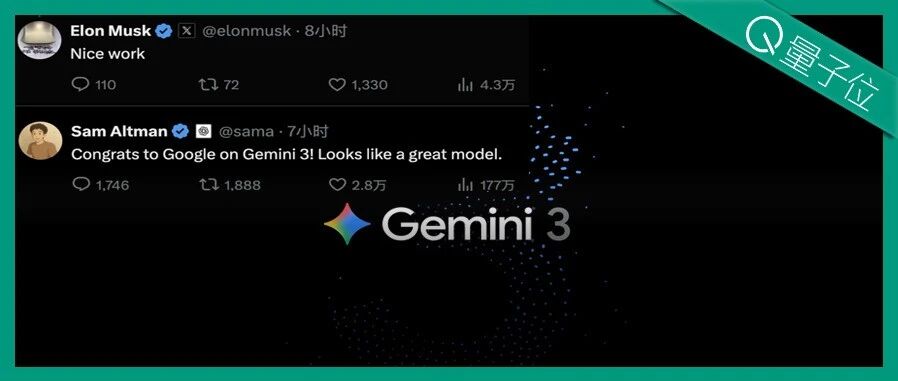
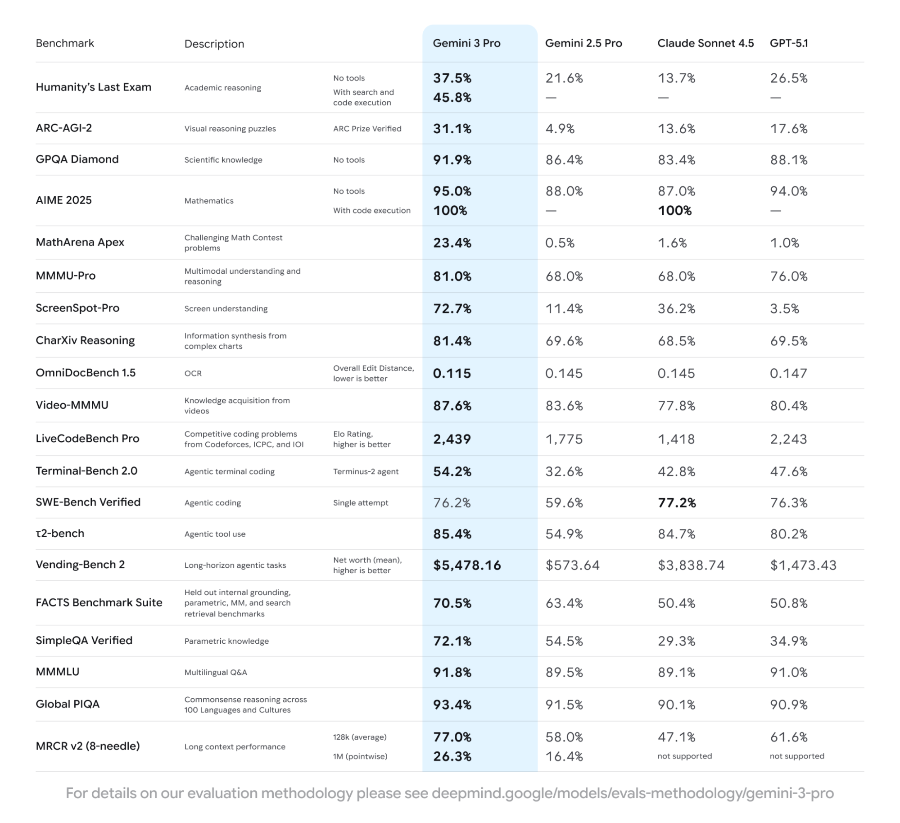
Core Insights - Google Gemini 3 Pro shows significant advancements over its predecessor, Gemini 2.5 Pro, outperforming GPT-5.1 and Claude 4.5 in nearly all benchmark tests, including academic reasoning and visual reasoning puzzles [1][2]. Benchmark Performance - In "Humanity's Last Exam," Gemini 3 Pro scored 37.5% without tools and 45.8% with search and code execution, compared to 21.6% for Gemini 2.5 Pro [2]. - For the ARC-AGI-2 visual reasoning puzzles, Gemini 3 Pro achieved 31.1%, a substantial increase from 4.9% in Gemini 2.5 Pro [2]. - In mathematics, Gemini 3 Pro scored 95.0% in AIME 2025 without tools and achieved a perfect score of 100% with code execution [2]. - The LiveCodeBench Pro benchmark saw Gemini 3 Pro with an Elo Rating of 2,439, significantly higher than Gemini 2.5 Pro's 1,775 [2]. Model Evolution - The Gemini series has evolved significantly, with each generation addressing the shortcomings of the previous one. The first generation established multimodal capabilities, while the second focused on decision-making and planning [15][18]. - Gemini 2.5 introduced a reasoning engine for deeper reasoning and problem-solving, leading to the current generation, which integrates multimodal, reasoning, and agent capabilities [19][20]. User Interaction and Usability - Gemini 3 Pro is designed to understand user intent better, allowing for more straightforward interactions without the need for complex prompts [21]. - The model can seamlessly process text, images, videos, audio, and code, enhancing its usability across various applications [23]. Development Platform - Google introduced the Antigravity platform alongside Gemini 3 Pro, aimed at simplifying the development process for AI agents, allowing developers to focus on higher-level tasks [29][33]. - Antigravity supports multiple models, including third-party options, and has attracted significant developer interest due to its generous rate limits [33]. Future Developments - A more advanced version, Gemini 3 Deep Think, is in development, promising further enhancements in capabilities [13][14].