春季行情

Search documents
春季行情叠加低估值 机构看好券商板块投资机会
Zhong Guo Zheng Quan Bao· 2026-01-06 20:50
Core Viewpoint - The brokerage sector is experiencing a collective rise, driven by favorable market conditions and policy reforms, with analysts optimistic about the investment value of quality brokerages due to low valuations and potential for growth [1][2]. Group 1: Market Performance - On January 6, the non-bank financial sector rose by 3.73%, with notable gains from Huazhong Securities and Hualin Securities reaching the daily limit [1]. - The Shanghai Composite Index increased by 1.5%, reaching a ten-year high, with market turnover exceeding 2.83 trillion yuan [2]. Group 2: Valuation and Investment Opportunities - Analysts highlight that the brokerage sector's current valuation is low, presenting a buying opportunity as institutional holdings are also at a low level [2]. - The non-bank financial sector is expected to benefit from growth in public funds and investment banking, with analysts recommending quality brokerages that are undervalued relative to their performance [2][3]. Group 3: Industry Outlook - The brokerage industry is anticipated to maintain a high level of prosperity in 2026, supported by ongoing capital market reforms and a shift towards new business models [3]. - Analysts predict that the brokerage sector will see significant business growth from investment banking, public funds, and international operations, enhancing profitability [3]. - Specific investment strategies include focusing on undervalued leading brokerages, firms with strong wealth management capabilities, and those benefiting from cross-border asset management trials in Hainan [3].
春季行情叠加低估值机构看好券商板块投资机会
Zhong Guo Zheng Quan Bao· 2026-01-06 20:43
Core Viewpoint - The brokerage sector is experiencing a collective rise, driven by favorable market conditions and low valuations, with expectations for increased trading volume and investment value in the sector [1][2]. Group 1: Market Performance - On January 6, the non-bank financial sector rose by 3.73%, with notable gains from Huazhong Securities and Hualin Securities reaching the daily limit [1]. - The Shanghai Composite Index increased by 1.5%, marking a ten-year high, with market turnover exceeding 2.83 trillion yuan [1]. - The A-share market's strong start in 2026 is anticipated to boost brokerage trading volumes [1]. Group 2: Valuation and Investment Opportunities - Analysts suggest that the brokerage sector is currently undervalued, with institutional holdings also at low levels, indicating potential for price recovery in the spring market [1]. - The non-bank financial sector is projected to rise by 12% in 2025, lagging behind the 18% increase of the CSI 300 index, highlighting the sector's low valuation and institutional holdings [1]. - The brokerage sector is expected to benefit from growth in public funds and investment banking, supported by positive policy impacts [1]. Group 3: Industry Outlook - The brokerage sector is seen as having favorable conditions for upward breakthroughs in 2026, with improved chip structure and reduced turnover rates [2]. - Continuous capital market reforms are expected to enhance brokerage business transformations, contributing to overall industry prosperity in 2026 [2]. - Regulatory policies are entering a "positive" cycle, with investment banking, public funds, and overseas business expected to support profitability in the brokerage sector [2]. Group 4: Investment Strategies - Recommended investment strategies include focusing on undervalued leading brokerages, firms with significant wealth management advantages, and those benefiting from cross-border asset management trials in Hainan [3]. - Attention should be given to the beta attributes of the brokerage sector, with catalysts such as performance reports and the optimization of competitive dynamics being key areas of focus [3].
ETF日报|金融科技八连阳,券商ETF急涨超4%,大金融点燃春季行情?有色化工、商业航天引爆,多只ETF历史新高
Sou Hu Cai Jing· 2026-01-06 13:04
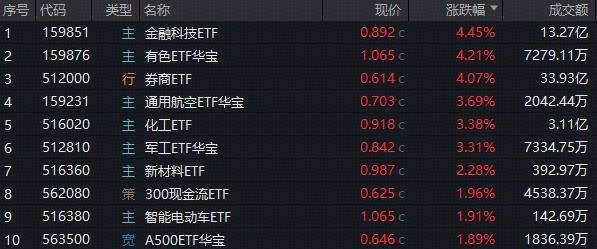
Market Overview - The A-share market continues to show strong performance, with the Shanghai Composite Index achieving a 13-day winning streak, reaching a new 10-year high, and total trading volume of 2.83 trillion yuan [1][2] - Over 4,100 stocks rose, with 143 stocks hitting the daily limit up, indicating a broad market rally [1] Financial Sector - The financial sector experienced a significant surge, with major stocks like Huayin Securities and Huashan Securities hitting the daily limit up [1] - The Financial Technology ETF (159851) rose by 4.45%, marking its eighth consecutive day of gains, with a net subscription of 181 million units [1] - The top broker ETF (512000) surged by 4.07%, achieving the largest single-day increase since October 2025, with a trading volume of 3.393 billion yuan, a 146% increase from the previous day [1][2] Commodity Sector - The non-ferrous metals and chemical sectors also saw strong performance, with Zijin Mining and Luoyang Molybdenum reaching historical highs [1] - The Non-Ferrous Metals ETF (159876) rose over 4%, achieving a new listing high, with a net subscription of 39 million units [1][7] - The Chemical ETF (516020) increased by 3.38%, reaching a new high since September 2022, with over 350 million yuan in net inflows over the past five days [1][13] Aerospace and Defense Sector - The commercial aerospace sector saw a surge in stock prices, with multiple stocks hitting the daily limit up [1] - The General Aviation ETF (159231) rose by 3.69%, achieving a new listing high, with a net subscription of 21 million units [1] Future Outlook - Huatai Securities expresses optimism for the spring market, suggesting that the technical model indicates a recovery phase for major indices, with the Shanghai Composite Index entering a bullish zone [1] - The report recommends focusing on growth styles and themes related to domestic demand improvement as key investment strategies [1][6]







上证指数13连阳创历史,多路资金合力助推春季行情开启
2 1 Shi Ji Jing Ji Bao Dao· 2026-01-06 13:03
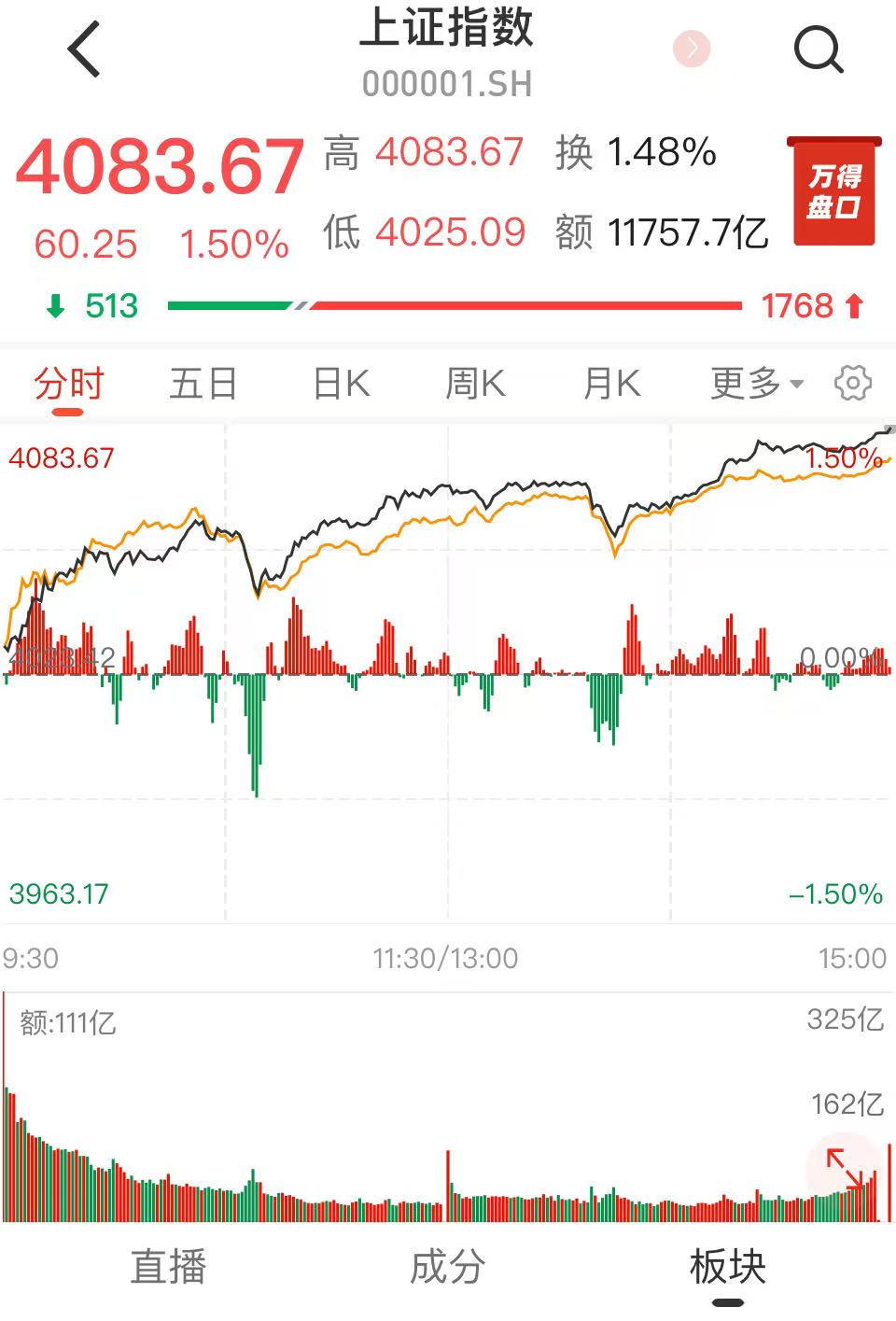
Core Insights - The A-share market has set two historical records on January 6, with the Shanghai Composite Index closing at 4083.67 points, marking a nearly ten-year high, and achieving a 13-day consecutive rise, breaking a 33-year record for the longest consecutive gains [1][3][6]. Market Performance - On January 6, all three major A-share indices rose, with the Shanghai Composite Index increasing by 1.50%, the Shenzhen Component Index by 1.4%, and the ChiNext Index by 0.75% [3]. - The trading volume reached 2.83 trillion yuan, indicating strong investor enthusiasm [1]. Sector Performance - The brain-computer interface sector saw a surge, with nearly 20 stocks hitting the daily limit [6]. - The commercial aerospace sector also performed well, with several stocks, including China Satellite Communications, reaching their daily limit [6]. - The non-ferrous metals sector was active, with companies like Luoyang Molybdenum and Zijin Mining hitting historical highs [6]. - Financial sectors, including insurance and securities, showed strong performance, with New China Life and China Pacific Insurance reaching new highs [6]. Fund Inflows - There is a strong expectation for fund inflows due to the "opening red" effect from financial institutions, with significant new premium funds available for market allocation [9][10]. - As of January 5, 2026, the financing balance reached 2.54 trillion yuan, a historical high, indicating increased market participation [9]. Market Outlook - Analysts predict a shift from valuation-driven to profit-driven market dynamics, with a more balanced market style expected in 2026 [11][12]. - The market is anticipated to maintain an upward trend supported by global liquidity easing and expectations of a stronger renminbi [10][12]. Investment Strategies - Investment firms suggest a balanced allocation strategy, focusing on sectors such as AI, resilient external demand, domestic consumption, and high dividend stocks [16]. - The "dumbbell strategy" is recommended, emphasizing growth sectors like technology and defensive sectors like non-ferrous metals and chemicals [16][17]. - Analysts advise against short-term trading and suggest focusing on long-term industry directions and value of dividend assets [17][19].
市场流动性改善助力中长期资金入市,自由现金流ETF(159201)连续3日合计“吸金”4.43亿元
Mei Ri Jing Ji Xin Wen· 2026-01-06 08:19
Group 1 - The Shanghai Composite Index continued to rise on January 6, with the Guozheng Free Cash Flow Index increasing by over 1.3%, and constituent stocks such as Jiasitang and Yaxiang Integration hitting the daily limit [1] - The largest free cash flow ETF (159201) has seen a net inflow of funds totaling 443 million yuan over the past three days, bringing its latest scale to 8.861 billion yuan, a record high since its inception [1] - According to a report from Industrial Securities, several factors supporting the previous market "excitement" are expected to continue, with potential catalysts for a spring market rally anticipated [1] Group 2 - The free cash flow ETF (159201) and its linked funds (A: 023917; C: 023918) closely track the Guozheng Free Cash Flow Index, addressing the shortcomings of traditional dividend strategies by focusing on internal growth capabilities and emphasizing financial health and sustainability [2] - The annual management fee for the fund is set at 0.15%, and the custody fee at 0.05%, both of which are among the lowest in the market, maximizing benefits for investors [2]
收评:沪指成功13连阳再创十年新高 两市成交额突破2.8万亿 连续两日超百股涨停
Jin Rong Jie· 2026-01-06 07:11
Market Performance - The three major stock indices opened high and continued to rise, with the Shanghai Composite Index reaching a ten-year high, closing up 1.5% at 4083.67 points, marking a 13-day consecutive increase [1] - The Shenzhen Component Index rose 1.4% to 14022.55 points, while the ChiNext Index increased by 0.75% to 3319.29 points [1] - The total trading volume in the Shanghai and Shenzhen markets was 28065.75 billion yuan, an increase of 260.2 billion yuan compared to the previous trading day [1] - Over 4100 stocks in the market rose, with 143 stocks hitting the daily limit up, continuing a trend of over a hundred stocks hitting the limit up for two consecutive days [1] Sector Performance - The brain-computer interface concept continued to rise, with stocks like Sanbo Brain Science and Innovation Medical hitting the daily limit up [1] - The financial sector saw a significant increase, led by internet finance and brokerage stocks, with Dazhihui hitting the daily limit up [1] - The commercial aerospace concept surged, with China Satellite Communications achieving four limit ups in six days, and Goldwind Technology hitting three limit ups in seven days [1] - The intelligent driving sector also saw gains, with Wanji Technology hitting the daily limit up and several other related stocks following suit [1] - The retail sector experienced a boost, with Shanghai Jiubai hitting the daily limit up, alongside other retail stocks [1] Institutional Insights - Huaxi Securities predicts that 2026 will be a "big year" with multiple positive factors, indicating a solid foundation for a bull market [2] - Huatai Securities expects the spring market to strengthen further, recommending investment in growth sectors like electric power equipment and new energy [3] - CITIC Construction points out that the cross-year market may show characteristics of "growth leading, liquor accumulating," with a focus on sectors like snacks and dairy [4] - Tianfeng Securities highlights the growth potential in high-end consumption sectors such as cosmetics, gold and jewelry, and duty-free shopping [5]
机构:上证指数有望挑战2015年市场高点,建议宽基锚定大势
Mei Ri Jing Ji Xin Wen· 2026-01-06 06:01
Group 1 - The core viewpoint is that the "transformation bull market" in the Chinese stock market is far from over, with expectations of reaching higher levels by 2026 and a larger scale of new capital entering the market [1] - The Shanghai Composite Index is anticipated to challenge its 2015 peak, which reached a high of 5178 points in June 2015 after rising from around 3000 points [1] - The spring season is historically a favorable period for growth styles in the market, with significant investment opportunities expected, particularly in technology, non-bank financials, and consumer sectors [1] Group 2 - The current market environment is characterized by an overall valuation expansion in both A-shares and Hong Kong stocks, with long-term supportive factors remaining unchanged [1] - The CSI 300 Index, known as a "barometer" for A-share performance, includes key sectors such as finance, technology, and consumer [2] - The Huaxia CSI 300 ETF (510330.SH) is noted for having the lowest fee rate among similar products in the market [2]
沪指强势涨超1%创十年新高,费率低的A500ETF易方达(159361)交投活跃上涨1.37%,机构:2026年建议高配中国股票
Xin Lang Cai Jing· 2026-01-06 04:00
截至2026年1月6日午间收盘,沪指上涨1.14%,点位再创十年新高,强势冲击13连阳。中证A500指数 (000510)强势上涨1.24%,A500ETF易方达(159361)上涨1.37%,换手16.71%,成交58.56亿元,市场交投 活跃。 华泰证券指出,看好春季行情进一步强化,技术模型显示多数宽基指数的得分回升、市场处于修复通 道,上证指数已进入看多区间。 相关产品: A500ETF易方达:159361 联接A:022459 联接C:022460 截至1月5日,A500ETF易方达(159361)最新规模达347.23亿元,创成立以来新高。A500ETF易方达 (159361)最新资金净流入1.41亿元。拉长时间看,近8个交易日合计"吸金"51.21亿元。 A500ETF易方达(159361)紧密跟踪中证A500指数,中证A500指数从各行业选取市值较大、流动性较好 的500只证券作为指数样本,以反映各行业最具代表性上市公司证券的整体表现。 A500ETF易方达(159361)的管理费率为0.15%,托管费率为0.05%,均为行业最低水平,能为投资者节省 投资成本。 A500ETF易方达(15936 ...
午评:沪指涨1.14%,创逾10年新高,券商、保险涨幅居前,脑机接口、有色金属板块爆发
Jin Rong Jie· 2026-01-06 03:44
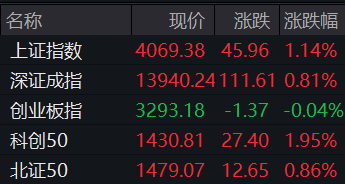
Market Performance - The Shanghai Composite Index rose by 1.14% to 4069.38 points, reaching a new high in over 10 years [1] - The Shenzhen Component Index increased by 0.81% to 13940.24 points, while the ChiNext Index fell by 0.04% to 3293.18 points [1] - The total trading volume in the Shanghai and Shenzhen markets was 178.13 billion yuan, with over 3600 stocks rising [1] Sector Performance - The leading sectors included brain-computer interfaces, chemical engineering, non-ferrous metals, insurance, securities, semiconductors, and photovoltaic equipment [2][3] - The non-ferrous metals sector saw a significant increase of 4.05%, while non-bank financials and oil & petrochemicals rose by 3.27% and 2.95%, respectively [3] - The brain-computer interface sector experienced a surge, with multiple stocks hitting the daily limit [3] Institutional Insights - Huatai Securities anticipates a strengthening spring market, recommending investments in growth sectors such as electric equipment and renewable energy, as well as domestic demand improvement themes [4] - CITIC Securities suggests that the cross-year market will exhibit characteristics of "growth leading and liquor accumulating," with a focus on sectors like snacks and dairy [5] - Guoxin Securities predicts that 2026 will be a significant year for the market, supported by favorable macro policies and improving corporate earnings [6] Emerging Opportunities - Guoxin Securities highlights the potential for 2026 to be the year of reusable commercial rockets, driven by the need for cost-effective launch solutions [7] - Tianfeng Securities expresses optimism about the growth potential in high-end consumer sectors such as cosmetics, gold jewelry, and duty-free shopping [8]




天风策略:春季行情的线索与启示
Xin Lang Cai Jing· 2026-01-06 03:33
Core Conclusion - The degree of divergence in the spring market can be seen as a sign of the cyclical transition between bear and bull markets, indicating the beginning of style rotation [3][27] - The new main line emerging from the spring market window is expected to continue to outperform for 1-2 years after the style is established [3][27] - The spring market is influenced by expectations of reversals in the previous year's annual reports and certainty in the next year's reports [3][27] Group 1: Spring Market Insights - The variance in the rise and fall of primary and secondary industries during the spring market serves as a measure of its divergence, with higher divergence years often marking long-term cyclical transitions [4][31] - Historical examples include 2013, 2015, 2019, 2021, and the anticipated 2024, where high divergence indicated significant market shifts [4][31] - In 2019, the spring market saw a significant shift where growth outperformed value, leading to a three-year dominance of growth stocks [4][33] Group 2: Style Rotation and Market Performance - The spring market's divergence also initiates style rotation, as seen in 2019 and 2021, where growth stocks outperformed value stocks and large-cap blue chips accelerated to their peaks [4][33] - The new main line from the spring market is expected to sustain its advantage for 1-2 years, as demonstrated by the semiconductor and consumer electronics sectors leading the market in 2019 and 2020 [10][35] - The performance of industries during the spring market often correlates with their performance in the subsequent year, with a negative correlation observed between the month before the spring market and the spring market itself [11][35] Group 3: PPI and Market Dynamics - The relationship between the Producer Price Index (PPI) and market performance indicates that as PPI approaches zero, the certainty of returns in more prosperous sectors increases [21][30] - Historical data from 2010-2024 shows that industries positioned for stabilization in the previous year's reports tend to perform better during the spring market [5][18] - The transition from trading recovery to stability in market conditions is marked by the PPI moving from low to zero, influencing the overall market sentiment [21][30]