
基建投资

Search documents
财政发力更加积极,稳内需诉求进一步提升
Tianfeng Securities· 2025-04-27 10:44
Investment Rating - Industry rating is maintained at "Outperform" [5] Core Viewpoints - The report emphasizes a more proactive fiscal policy and a demand for stabilizing domestic consumption, with a focus on accelerating the issuance and utilization of local government special bonds and ultra-long-term special treasury bonds [2][13] - The construction sector is expected to benefit from improved infrastructure investment, particularly in the central and western regions of China, as well as from cyclical opportunities in related sectors [2][30] - The report highlights a recovery in operational rates and an increase in new orders from central and state-owned enterprises, indicating an upward trend in construction activity [20][24] Summary by Sections Fiscal Policy and Economic Outlook - The April 25 Politburo meeting stressed the need for more active macroeconomic policies, including the use of fiscal and monetary tools to support the real economy [2][13] - The meeting also indicated a commitment to stabilizing the real estate market and enhancing local government investment capabilities [13][15] Market Performance - The construction index rose by 0.56% during the week of April 21-25, outperforming the CSI 300 index by 0.16 percentage points [4][25] - Key stocks that performed well included Hanjia Design (+31%), Sanwei Chemical (+22%), and Meichen Technology (+16%) [25][30] Investment Recommendations - Focus on traditional construction blue-chip stocks and cyclical opportunities in infrastructure, particularly in water conservancy, railways, and aviation projects [30][31] - Recommendations include high-performing local state-owned enterprises such as Sichuan Road and Bridge, Zhejiang Communications, and Anhui Construction [30][31] - Attention is also drawn to emerging business directions such as computing power and cleanroom investments, as well as the semiconductor sector [32][33]




四川路桥(600039):股权出让完成,施工主业或迎拐点
Changjiang Securities· 2025-04-24 02:21
Investment Rating - The investment rating for the company is "Buy" and is maintained [11] Core Views - The company is expected to achieve a total revenue of 107.24 billion yuan in 2024, a year-on-year decrease of 6.78%. The net profit attributable to shareholders is projected to be 7.21 billion yuan, down 19.92% year-on-year, while the net profit after deducting non-recurring gains and losses is estimated at 6.34 billion yuan, a decrease of 29.69% year-on-year [2][8] Summary by Sections Financial Performance - In 2024, the company’s revenue is expected to decline due to a slowdown in domestic project advancement, with the engineering construction segment generating 92.95 billion yuan, down 10.53% year-on-year. The highway investment and operation business is projected to earn 2.88 billion yuan, a decrease of 3.96% year-on-year. The total number of newly awarded projects is 524, amounting to approximately 138.3 billion yuan, reflecting an 18% decline year-on-year [13] - The overall gross margin for the company is anticipated to be 15.68%, down 2.47 percentage points year-on-year, with the engineering construction gross margin decreasing by 2.41 percentage points and the highway investment operation margin declining by 2.85 percentage points. However, margins in mining, new materials, and clean energy sectors have improved [13] - The company recorded a net cash inflow from operating activities of 3.43 billion yuan, with a cash collection ratio of 90.07%, an increase of 6.44 percentage points year-on-year. The total dividend payout for 2024 is approximately 360 million yuan, representing about 50% of the net profit attributable to shareholders [13] Future Outlook - The demand for infrastructure in Sichuan province is robust, with the company expected to see stable growth in performance. In June 2024, Sichuan province announced 36 highway projects with a total investment of approximately 840 billion yuan. The company has successfully secured several projects, totaling over 260 billion yuan in investment, which lays a solid foundation for future development [13] - The dividend payout ratio is expected to increase to 60% from 2025 to 2027, with a projected dividend yield exceeding 6.5% if the company's performance surpasses 8 billion yuan in 2025 [13]
国泰海通:3月水泥需求正增 价格支撑力度更强
Zhi Tong Cai Jing· 2025-04-23 07:09
国泰海通主要观点如下: 水泥需求下滑幅度进入放缓区间行业盈利就有望改善需要达成合意错峰天数,实现供给侧优化的累积与 下滑的需求匹配。如需求下降较快,合意天数达成难度大,现需求弱降甚至单月正增长有助于合意天数 的达成进而对价格形成更强的支撑。 投资建议 国泰海通发布研报称,3月以来华东和华南磨机开工率保持正增长,3月初至4月10日华东、华南平均磨 机开工率分别为63%、62%,较2024年同期的55%、51%有明显提升;沿江熟料库存保持在40%以下的 低位,水泥需求正增长的确信度高。从微观角度看,卓创等数据统计的样本(多为大企业)磨机开工率表 征的需求更佳,海螺水泥(600585)一季度销量优于行业实现正增长,考虑到大企业在大型基建项目中 份额更高,微观数据亦可验证基建是需求增长的抓手。 磨机开工率、库存印证数据可靠性高,3月水泥需求正增长 从卓创磨机开工率、库存可验证需求数据的可靠性:3月以来华东和华南磨机开工率保持正增长,3月初 至4月10日华东、华南平均磨机开工率分别为63%、62%,较2024年同期的55%、51%有明显提升;沿江 熟料库存保持在40%以下的低位,水泥需求正增长的确信度高。自2021下半 ...




3月基建投资提速,实物工作量有所恢复
Changjiang Securities· 2025-04-16 23:30
Investment Rating - The industry investment rating is "Positive" and maintained [11] Core Insights - In March, narrow infrastructure investment reached 1.9 trillion yuan, a year-on-year increase of 5.9%, with a month-on-month increase of 0.3 percentage points. Broad infrastructure investment was 2.6 trillion yuan, a year-on-year increase of 10.7%, with a month-on-month increase of 1.0 percentage points. For the first three months, narrow infrastructure investment totaled 3.2 trillion yuan, a year-on-year increase of 5.8%, and broad infrastructure investment was 4.3 trillion yuan, a year-on-year increase of 10.3% [2][8] Summary by Sections Investment Performance - In March, narrow infrastructure investment increased, with notable growth in transportation, storage, and postal services, which accounted for 0.8 trillion yuan, a year-on-year increase of 4.7%. Water conservancy, environment, and public facilities management saw an investment of 1.0 trillion yuan, a year-on-year increase of 10.7% [14] Broad Infrastructure Insights - Broad infrastructure investment in March was 2.6 trillion yuan, with a year-on-year increase of 10.7%. The electricity, heat, gas, and water production and supply sector contributed 0.7 trillion yuan, a year-on-year increase of 26.4% [14] Physical Workload Analysis - Cement production in the first three months saw a year-on-year decline of 1.4%, but March showed a recovery with a 2.3% increase. Excavator sales increased by 28.5% year-on-year, indicating strong demand in water conservancy projects [14] Debt Issuance and Future Outlook - Special bond issuance accelerated compared to the previous year, with a total of 1.0183 trillion yuan issued by April 12, 2023. The government plans to issue 4.4 trillion yuan in special bonds for infrastructure investment, which is expected to support steady growth in infrastructure investment throughout the year [14]
转债再现“黄金坑”
Guohai Securities· 2025-04-15 14:32
1. Report Industry Investment Rating No relevant content provided. 2. Core Viewpoints of the Report - China's economy shows resilience despite multiple variables. The US tariff policy on China increases economic uncertainty in Q2, and the policy level may need to cut reserve requirements and interest rates to cooperate with fiscal expansion. The central bank's injection of special treasury bonds into large - scale banks creates room for interest rate decline, and the financial regulatory department's response to abnormal A - share fluctuations stabilizes the market [4]. - The convertible bond market presents an opportunity to enter. The convertible bond price has fallen to a relatively low level, and the current cost - performance is significantly improved. The bond - like nature provides a bottom - support effect. The convertible bond market has adjusted to a "golden pit", and investors can focus on "double - low" indicator bond selection [4]. - Under the adjustment of the global trade pattern, three directions of convertible bond targets are worth focusing on: infrastructure, the Belt and Road Initiative, and semiconductor domestic substitution. These convertible bonds have both defensiveness and growth potential and are cost - effective at the current price level [4]. 3. Summary by Relevant Catalogs 3.1. Stock and Bond Markets Show Resilience 3.1.1. Bond Market May See Another Buying Window - The US tariff policy on China increases the uncertainty of the Q2 economic fundamentals. If exports drag down the economy more than expected, there is a high probability of reserve requirement and interest rate cuts in Q2 to cooperate with fiscal expansion. If the cuts start in April, there is still a 1 - 2 - month window for fiscal stimulus, and the basis for interest rate decline still exists [5]. - The central bank's injection of 50 billion yuan of special treasury bonds into large - scale banks has two impacts on the bond market. On the supply side, the issuance is relatively smooth from April to June, and the supply shock is mild. On the demand side, it eases the asset - side allocation pressure caused by the lack of liabilities, which is conducive to the increase in large - scale banks' demand for bonds. If credit lending remains weak, interest - rate bonds will still be an important allocation variety, and the downward space for interest rates may open up [6]. 3.1.2. Stock Market Demonstrates Resilience - When the A - share market fluctuates abnormally, Chinese financial decision - makers take quick action. The central bank and Central Huijin make important statements, and other institutions such as China Guoxin, China Chengtong, China Electronics Technology Group, and the social security fund inject liquidity into the market. Listed companies also actively repurchase shares. From April 7th to 11th, the total repurchase scale of listed companies exceeded 16.2 million yuan [8]. - The stock market has stabilized and rebounded, and trading volume has recovered. On April 11th, major stock indexes rebounded, and the average daily trading volume of the Wind All - A Index from April 7th to 11th rebounded to 1.61 trillion yuan [8]. 3.2. Convertible Bonds Re - emerge in the "Golden Pit" - The timing indicator shows that the convertible bond price has returned to a relatively low level. After 2025, the convertible bond price first rose, reducing its cost - performance. With the stock market adjustment, the price has fallen back, and the bond - like nature of convertible bonds can provide support, limiting further decline [13]. - As of April 11th, the median price of the convertible bond market is about 119 yuan, and the 100 - yuan premium rate is 23.04%, both returning to the level of December 2024, indicating a relatively low price [17]. - In terms of price range, convertible bonds in the medium - price range (100 - 130 yuan) have high cost - performance. They have sufficient liquidity and a reasonable valuation, with the conversion premium rate at a historical median, providing both downside protection and upside potential [20]. - Overall, convertible bonds have adjusted to a "golden pit", and it is recommended to focus on "double - low" indicator bond selection, which can enjoy the upside potential of the stock market recovery while having a bond - like safety margin [24]. 3.3. Convertible Bond Industry Allocation Ideas 3.3.1. Domestic Infrastructure and the Belt and Road Initiative with Weak Tariff Correlation - In recent years, China has been de - leveraging, leaving large policy space for infrastructure investment in 2025. As of March, 16 provinces/municipalities/autonomous regions have released key/major project investment plans for 2025, with a total of about 16,099 projects and an investment budget of over 38 trillion yuan. The infrastructure industry usually performs well in Q2, and currently, funds may be flowing into the infrastructure sector [26]. - In the context of the Sino - US trade war, the Belt and Road Initiative is expected to be the "ballast stone" of the economy. In 2024, China's trade volume with Belt and Road countries reached 22.07 trillion yuan, a year - on - year increase of 6.4%, higher than the overall growth rate of China's foreign trade. China is accelerating economic and trade cooperation with Belt and Road countries to reduce its export dependence on the US [29]. - Recommended convertible bonds include Zhejiang Construction Convertible Bond, Huashe Convertible Bond, Sheyan Convertible Bond, Aidi Convertible Bond, Liugong Convertible Bond for infrastructure, and Beigang Convertible Bond, Jiaojian Convertible Bond, Tianlu Convertible Bond for the Belt and Road Initiative [31]. 3.3.2. Semiconductor Industry Related to Self - Reliance and Control - Sino - US tariff frictions may disrupt the mainland semiconductor industry chain, and there is still a large space for domestic substitution in many links. In 2024, China imported semiconductor - related equipment and materials worth 2.589 billion US dollars from the US, accounting for 2.60% of the total semiconductor imports. The tariff frictions may force China to accelerate the construction of its independent semiconductor industry chain [32]. - Recommended convertible bonds include Zhengfan Convertible Bond, Feikai Convertible Bond, Liyang Convertible Bond, Jingxing Convertible Bond, Zhongqi Convertible Bond, and the upcoming Anji Convertible Bond, Dinglong Convertible Bond, Weice Convertible Bond [33].
“对等关税”超预期,重申内需复苏投资逻辑
Tianfeng Securities· 2025-04-05 13:09
Investment Rating - Industry rating is maintained at "Outperform the Market" [6] Core Viewpoints - The announcement of "reciprocal tariffs" by Trump has exceeded expectations, reinforcing the logic of domestic demand recovery. The focus is on infrastructure and key strategic industries like coal chemical investments, which are expected to receive policy support [2][21] - The construction index rose by 0.13% this week, outperforming the Shanghai and Shenzhen 300 index by 0.57 percentage points, with significant gains in small and mid-cap transformation stocks [1][31] - The first quarter of 2025 saw a significant increase in local government bond issuance, indicating potential for local investment release despite external demand pressures [4][21] Summary by Sections Section 1: Tariff Impact and Domestic Demand - Trump's new tariffs, including a 10% baseline tariff and higher rates for major trade deficit countries, are expected to suppress overseas and manufacturing investments while boosting domestic demand [2][14] - The previous trade friction period saw a decline in manufacturing and infrastructure investments, with real estate becoming a key contributor to economic stability [3][21] Section 2: Market Performance - The construction index's performance this week was driven by sectors such as professional engineering and building design, with notable stock gains from companies like Shanshui Bide and Zhongyan Dadi [1][31] Section 3: Investment Recommendations - Focus on infrastructure-related stocks, particularly in high-growth regions like Tibet and Xinjiang, and sectors benefiting from domestic demand recovery [21][28] - Coal chemical projects are expected to see significant investment, with recommendations for companies like Sanwei Chemical and China Chemical [28] - Companies with production layouts in North America or Mexico are likely to benefit, with recommendations including China Jushi and Puyang Refractories [28] Section 4: Fiscal Policy and Investment Opportunities - The first quarter of 2025 saw local government bond issuance reach approximately 2.84 trillion yuan, a year-on-year increase of about 80%, indicating a strong fiscal push for infrastructure investment [4][21] - The report emphasizes the importance of structural and regional characteristics in infrastructure investment, particularly in water conservancy and transportation sectors [38]



中国中铁(601390):2024年报点评:新兴业务表现亮眼,基本盘稳健经营
Huachuang Securities· 2025-03-31 03:43
Investment Rating - The report downgrades the investment rating to "Recommended" with a target price of 7.2 CNY [2] Core Views - In 2024, the company achieved total revenue of 1,160.3 billion CNY, a year-on-year decrease of 8% and a net profit attributable to shareholders of 27.9 billion CNY, down 17% year-on-year [2][7] - The infrastructure construction revenue was 992.85 billion CNY, also down 8.71% year-on-year, accounting for approximately 85.6% of total revenue [7] - Emerging businesses, including water conservancy and clean energy, showed strong performance with new contract amounts increasing by 50% and 22.6% respectively [7] - The average financing cost decreased to 3.57%, down 0.31 percentage points year-on-year, while accounts receivable increased by 56.96% to 246.2 billion CNY [7] Financial Summary - **2024 Financial Indicators**: - Total Revenue: 1,160,311 million CNY - Year-on-Year Growth: -8.2% - Net Profit: 27,887 million CNY - Year-on-Year Growth: -16.7% - Earnings Per Share: 1.13 CNY - Price-to-Earnings Ratio: 5 [2][8] - **Future Projections**: - 2025E Revenue: 1,121,390 million CNY, with a growth rate of -3.4% - 2026E Revenue: 1,159,448 million CNY, with a growth rate of 3.4% - 2027E Revenue: 1,248,194 million CNY, with a growth rate of 7.7% [2][8]

热点思考 | “倒春寒”如何扰动经济?
赵伟宏观探索· 2025-03-10 09:37
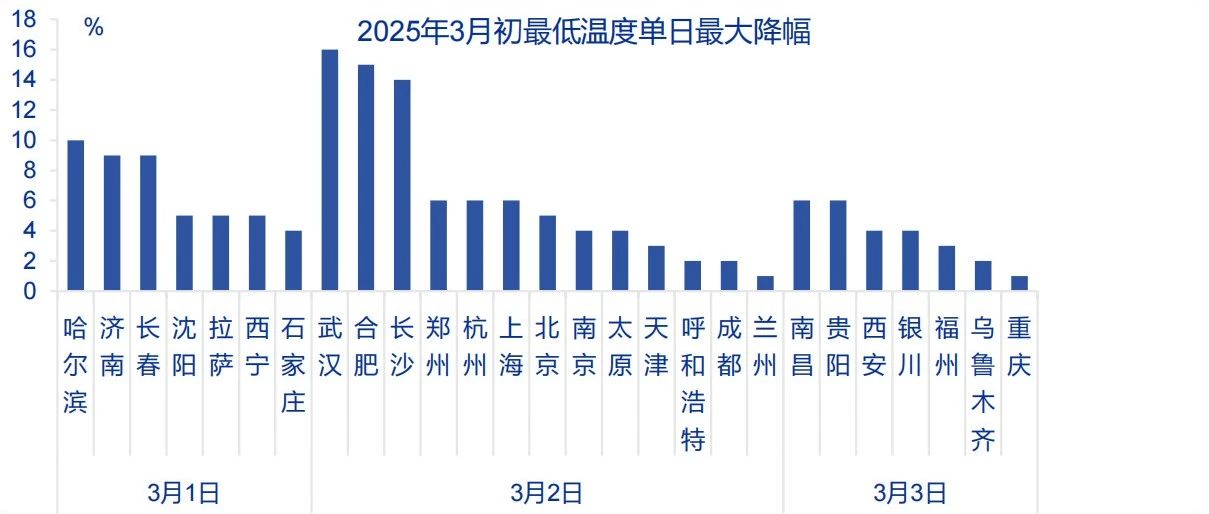
Group 1 - The core viewpoint of the article discusses the early occurrence and low intensity of the "late spring cold" phenomenon in March, which is unusual as it affected regions like Henan and Shandong [2][3][23] - The "late spring cold" typically occurs between March and May, with a significant drop in average temperatures below the seasonal norm, impacting agricultural production [2][4][10] - This year's "late spring cold" was noted for its early onset, being the earliest in nearly a decade, and lasted only three days, with temperature drops of 6-12°C, which is less severe than the historical average of around 15°C [2][11][24] Group 2 - The impact on agricultural prices is expected to be limited, as the "late spring cold" occurred before the flowering period of fruit trees, thus minimizing potential disruptions to fruit production [4][25][26] - Historical data indicates that previous "late spring cold" events during flowering periods led to significant price increases in fruits, but this year's timing suggests a lower risk of such price spikes [4][14][25] - Vegetable production is less affected by minimum temperatures and more by average temperatures; this year's average temperatures are close to seasonal norms, indicating manageable risks for vegetable supply [4][15][26] Group 3 - The construction industry experienced a noticeable decline in activity due to the cold weather, particularly in North and Central China, where temperatures fell below the suitable range for outdoor work [6][18][27] - The construction sector's slowdown may temporarily impact infrastructure investment, but a forecasted temperature rise later in March could mitigate long-term effects [6][19][27] - The cold weather also indirectly affected consumer movement and spending, but the overall risk to retail sales remains low due to the short duration of the cold spell and the relatively stable consumer activity in higher retail share regions [6][20][27]

建筑装饰行业研究周报:25年财政政策加码有望带来多少基建增量资金?
Tianfeng Securities· 2025-03-09 14:07
Investment Rating - The industry rating is "Outperform the Market" (maintained rating) [5] Core Viewpoints - The fiscal policy increase in 2025 is expected to support infrastructure investment growth of over 5% [2][3] - The report emphasizes the importance of monitoring the conversion pace of physical workloads in the infrastructure industry chain and investment opportunities in high-prosperity regions, such as Sichuan Road and Bridge [1][3] - The report suggests focusing on cyclical trends in infrastructure and real estate, with particular attention to leading companies in steel structures and chemical engineering [1] Summary by Sections Fiscal Policy and Infrastructure Investment - The government work report indicates a continued implementation of proactive fiscal policies, with a fiscal deficit target of 5.66 trillion yuan for 2025, an increase of 1.6 trillion yuan year-on-year [13] - The total public budget expenditure is projected to be 29.7 trillion yuan, with a year-on-year increase of 1.2 trillion yuan [13] - The report estimates that the increase in fiscal deficit will contribute approximately 3,000 billion yuan to infrastructure funding [20][21] Market Performance Review - The construction index rose by 0.37% during the week of March 3-7, with the Shanghai and Shenzhen 300 index increasing by 0.10% [28] - Notable stock performances included Hainan Huatie (+28.4%), Zhenghe Ecology (+23.6%), and Saiwei Intelligent (+18.9%) [28] Investment Recommendations - Focus on the conversion pace of physical workloads in infrastructure, particularly in high-demand sectors such as water conservancy, railways, and aviation [33] - Recommended stocks include Sichuan Road and Bridge, China Communications Construction, and China Railway Construction, among others [33][34] - Attention should also be given to cyclical engineering sectors, particularly in steel structures and coal chemical projects [34] - The report highlights potential investment opportunities in low-altitude economy, overseas expansion, and small-cap transformation themes [35]