
智能家居

Search documents
遭遇史诗级寒冬,国产电视卖不动了?
3 6 Ke· 2025-12-09 12:04
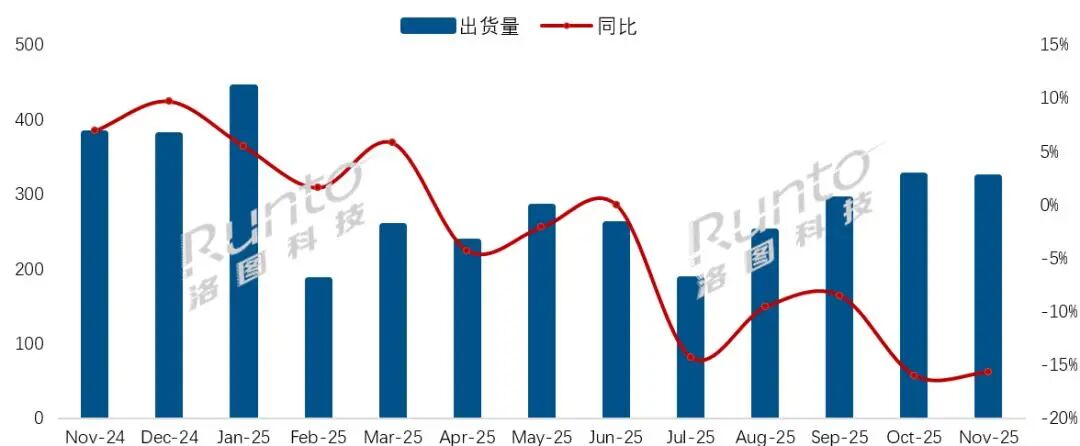
Core Insights - The Chinese television market is experiencing a significant downturn, with major brands reporting a collective decline in shipments during the November sales period, which was expected to be strong due to the early and extended Double Eleven promotion [1][3] - The total shipment for November was approximately 3.22 million units, representing a year-on-year decrease of 15.7% [3] - The overall retail volume during the Double Eleven promotion period saw a drastic decline of 19.6%, while retail revenue plummeted by 22.1%, indicating a severe "volume and price double kill" scenario [3][5] Market Performance - The top eight television brands, including Hisense, TCL, Xiaomi, and others, accounted for over 95% of the market share, with a total shipment of about 3.08 million units, down 13.9% year-on-year [3][5] - Xiaomi's shipment was 530,000 units with a market share of 16.5%, slightly down from 17.9% in October [3] - The global television shipment for Q3 2025 was 52.5 million units, a slight decline of 0.6% year-on-year, with China's market contributing to a 12.2% drop [5] Consumer Behavior and Market Trends - The television usage rate in China has drastically decreased from 70% in 2016 to below 30% in 2022, indicating a shift in consumer behavior [6] - The complexity of operating smart TVs has increased, leading to consumer frustration, especially among older users [8] - The rise of smartphones as the primary entertainment device has diminished the necessity for large-screen televisions [8] Future Outlook - The domestic television market is under pressure, with factors such as a declining single-person household population and a downturn in the real estate market affecting demand for large appliances [9][12] - Major brands are focusing on expanding into overseas markets to compensate for domestic declines, with TCL and Hisense showing positive growth in Europe and emerging markets [14] - Simplifying smart TV operations, reducing advertisements, and enhancing content offerings could help mitigate the decline in the domestic market [14][15]






融捷健康:目前乐金环境研发团队已顺利完成智能床面清洁机器人前期设计与开发工作
Mei Ri Jing Ji Xin Wen· 2025-12-08 06:33
Group 1 - The core viewpoint of the article is that Rongjie Health's subsidiary, Anhui Lejin Environmental Technology Co., is developing a smart bed cleaning robot that integrates multiple functions for efficient cleaning [1] - The smart bed cleaning robot features high-frequency beating, strong suction, and ultraviolet sterilization capabilities, effectively removing allergens such as dust mites, dust, skin flakes, and pet hair [1] - The product is equipped with an intelligent sensing system that allows for autonomous navigation, obstacle avoidance, and fall prevention, enabling fully automated operation with a simple one-button start [1] Group 2 - The research and development team at Lejin Environmental has successfully completed the initial design and development phase, and the mold opening and related trial production and optimization processes are progressing smoothly [1]


政策赋能行业升级 浙江美大推动厨电产业向“高质量、智能化、绿色化”转型
Quan Jing Wang· 2025-12-07 12:01
Core Viewpoint - The Chinese home appliance industry is undergoing a significant transformation from scale expansion to quality and efficiency, with Zhejiang Meida Industrial Co., Ltd. as a leading representative in this transition, aligning its strategies with national policies aimed at enhancing consumer goods supply and demand adaptability [1][5]. Group 1: Industry Transformation - The industry is focusing on high-quality, intelligent, and green upgrades in response to national policies promoting structural reforms and consumer demand adaptability [1][4]. - There is a structural contradiction in the market characterized by an oversupply of low-end products and a shortage of high-quality offerings, prompting companies like Zhejiang Meida to optimize product structures [2][5]. Group 2: Product Innovation and Quality - Zhejiang Meida has established a complete industrial chain and strict quality control system, enabling the production of high-quality products that meet or exceed national standards [2]. - The company is committed to technological innovation to enhance product performance and reliability, despite facing short-term pricing pressures due to market demand changes [2][5]. Group 3: Smart Home Integration - The company has proactively invested in smart technology, launching AI-enabled integrated stoves that enhance kitchen safety and convenience, aligning with national encouragement for "artificial intelligence + consumption" [3]. - Zhejiang Meida is transitioning from a kitchen appliance manufacturer to a provider of smart kitchen and home solutions, reflecting a broader strategy to create diverse product matrices [3]. Group 4: Green Development Initiatives - The company is actively participating in national policies promoting equipment upgrades and trade-in programs, aiming to revitalize the market for outdated kitchen appliances [4]. - Zhejiang Meida anticipates significant growth in the market for over 120 million outdated kitchen renovations, viewing this as a long-term growth driver while fulfilling its social responsibility for green consumption [4]. Group 5: Strategic Positioning - In the context of national policies supporting consumer goods industry upgrades, Zhejiang Meida has built a differentiated advantage through high-quality products, intelligent scenarios, green consumption, and diversified channels [5]. - The company's development path exemplifies the shift in the home appliance industry from "incremental growth" to "structural optimization," ultimately achieving high-quality development [5].

25W48周观点:黑五销售额创纪录;iRobot面临破产-20251207
Huafu Securities· 2025-12-07 10:46
Investment Rating - The report assigns a "Buy" rating for the industry, indicating that the overall return is expected to exceed the market benchmark by more than 20% within the next six months [77]. Core Insights - Black Friday sales reached a record high, with total online sales during the shopping week (Thanksgiving to Cyber Monday) amounting to $44.2 billion, a year-on-year increase of 7.7%. Notably, Black Friday online sales hit $11.8 billion, up 9.1% year-on-year [3][13]. - The report highlights a significant performance in the cleaning appliance sector, with sweeping robot sales in Europe reaching 390,000 units, a 41% increase year-on-year, and in North America, sales reached 210,000 units, up 58% year-on-year [3][14]. - iRobot is facing bankruptcy, which may lead to further optimization of the overseas market landscape for sweeping robots. The report suggests focusing on domestic leaders in the sweeping robot market, such as Roborock and Ecovacs [5][20]. Summary by Sections Black Friday Sales Performance - Online sales during Black Friday reached a record $11.8 billion, with a year-on-year growth of 9.1%. The overall retail sales (excluding automobiles) increased by 4.1%, with e-commerce channels growing by 10.4% [3][13]. - The average selling price of goods increased by 7%, while the number of items purchased decreased by 2%, indicating a trend of consumer price sensitivity [14]. iRobot's Financial Situation - iRobot's main manufacturer, Picea, acquired $191 million of iRobot's unpaid loans, becoming its primary creditor. If iRobot fails to meet financial covenants by January 15, 2026, it may trigger a default [4][19]. - iRobot is currently negotiating with Picea for a solution to its debt issues, but the likelihood of reaching an agreement outside of bankruptcy is considered low [20]. Market Trends and Data - The home appliance sector saw a weekly increase of 1.7%, with specific segments like white goods and black goods showing gains of 2.0% and 0.1%, respectively [21]. - The report also notes fluctuations in raw material prices, with LME copper and aluminum increasing by 5.83% and 1.38% week-on-week [21].
AI重构家电业:何种路径能够引领万亿消费新赛道
Sou Hu Cai Jing· 2025-12-07 10:44
在AI技术深度渗透的2025年,智能家居已从"概念炒作"进入"系统落地"的关键阶段。产业竞争不再局限 于单品性能或价格,而是系统整合、生态协同与长期服务能力的综合比拼。 当前,行业正形成三种典型路径:有A.O.史密斯这种专注AI家电"深度集成",全链路打造高端家庭空气 与水的智能体验;有小米这种依托生态链与高性价比策略,构建普惠型智能生态;也有华为这种以操作 系统为底座,推动全场景无缝协同。这些不同范式,共同勾勒出中国智能家居的未来图景。 产业变局:AI设备虽多,但多数仍在"连接层"打转 当前,我国家电行业面临存量博弈、同质化严重、用户需求分层等多重挑战。与此同时,国家推动"大 规模设备更新""适老化改造""智慧社区建设"等政策,为行业打开万亿级新空间。 AI成为破局关键,然而多数企业仍停留在"设备互联"或"语音控制"层面,缺乏深层次的系统协同与数据 闭环。设备之间"连而不通""通而不动",难以实现真正的场景化智能。行业亟需从"功能叠加"转向"系 统集成",从"被动响应"迈向"主动服务"。 真正的突破,将来自于那些能将技术、体验、生态、服务深度融合的企业。 技术破局:三种路径,一个未来 在智能家居的技术演进中 ...

黑五销售额创纪录;iRobot面临破产——25W48周观点:家用电器-20251207
Huafu Securities· 2025-12-07 10:30
行 家用电器 2025 年 12 月 07 日 业 研 究 家用电器 黑五销售额创纪录;iRobot 面临破产——25W48 周观点 投资要点: 黑五销售额创纪录,消费分化趋势显著 行 业 定 期 报 告 黑五网一销售额创纪录,线上增速远超线下。根据亿恩网、Adobe Analytics 数据,网络购物周(感恩节至网络星期一五天)总线上销售 额达 442 亿美元,同比增长 7.7%,其中黑色星期五线上销售额创纪录 达 118 亿美元,同比增长 9.1%,网络星期一线上销售额达 142.5 亿美 元,同比增长 7.1%。根据 21 世纪经济报道、Mastercard SpendingPulse, 美国黑五当天零售总销售(剔除汽车)同比增长 4.1%,其中电商渠道 增长 10.4%,线下门店销售增长 1.7%。根据出海网,黑五期间,玩具、 电子产品及运动用品领跑热卖榜单,乐高、宝可梦卡牌、任天堂 Switch、 PS5、AirPods、KitchenAid 等传统节日热销商品表现抢眼。 清洁电器黑五表现亮眼。根据石头科技黑五战报:1)欧洲:扫地 机全渠道销量达 39 万台,同比+41%,洗地机全渠道销量同比+36 ...


IDC:前三季度中国市场扫地机器人出货量同比增长27.2%
Bei Jing Shang Bao· 2025-12-07 07:06
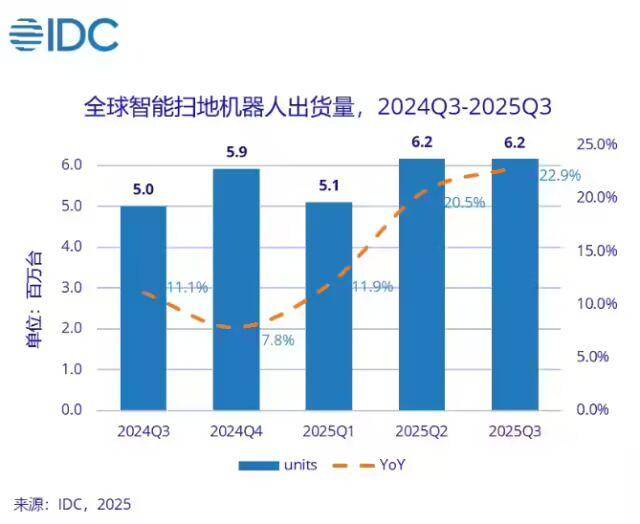
Core Insights - The global smart vacuum cleaner market saw a total shipment of 17.424 million units in the first three quarters of 2025, representing a year-on-year growth of 18.7% [1] - In Q3 2025 alone, shipments reached 6.161 million units, with a year-on-year increase of 22.9% [1] - The Middle East, Africa, and Europe are identified as key growth drivers for the industry [1] Company Performance - Chinese brands dominate the global market, capturing the top five positions in shipment volume [1] - Stone Technology leads with a cumulative shipment of 3.788 million units, ranking first in countries like the USA and Germany [1] - Ecovacs follows with 2.453 million units shipped, achieving a year-on-year growth of 27.7% and maintaining the top position in the Chinese market [1] - Dreame ranks first in the European market with a 26.8% share, although its domestic market share has declined [1] - Xiaomi ranks fourth globally, focusing on mid-range value while expanding into the high-end market [1] - Yunji enters the global top five, experiencing significant growth in overseas markets while holding a 16.2% share in the domestic market [1] Market Trends - The Chinese market saw a total shipment of 4.63 million units in the first three quarters, reflecting a year-on-year growth of 27.2% [1] - DJI entered the market in August, ranking sixth in shipments for Q3 [1]
人形机器人重塑公司估值,美的集团股价接连创年内新高
Di Yi Cai Jing· 2025-12-07 06:02
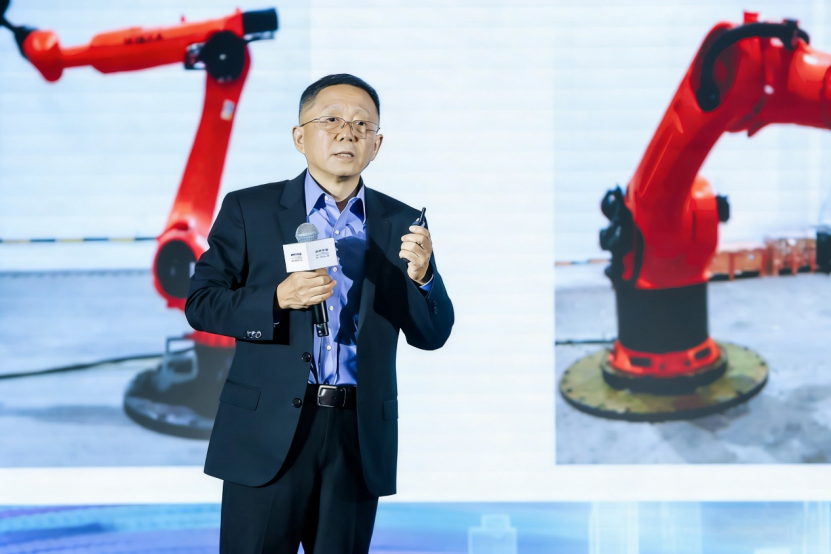
Group 1: Company Developments - Midea Group's Vice President and CTO Wei Chang announced the launch of the humanoid robot "MIRO U," which is the industry's first six-arm wheeled humanoid robot aimed at addressing the practical value of humanoid robot technology [1][3] - Midea's stock price reached a new high of 83.17 yuan per share, with a market capitalization exceeding 630 billion yuan, reflecting the company's growth resilience and potential despite facing demand and cost pressures in the domestic appliance market [1][12] - The company has established a comprehensive R&D capability in the robotics sector, from core component development to complete system integration, following significant milestones such as the acquisition of KUKA Group and the establishment of a national key laboratory for high-end heavy-duty robots [3][4] Group 2: Technological Innovations - The MIRO U robot features a core technology system developed by Midea, enabling stable elevation, 360-degree rotation, and high-precision control with six bionic arms, significantly enhancing operational efficiency in industrial scenarios [3][4] - Midea's humanoid robots are designed to follow a path of "industrial first, commercial follow, family exploration," prioritizing technology value transformation in controllable environments [4][5] - The company aims to solve the "technical landing value" issue in the humanoid robot industry through continuous technological iteration and deep engagement in practical scenarios [5] Group 3: Strategic Partnerships and Market Expansion - Midea has signed a strategic cooperation agreement with BYD Group to deepen the integration of smart home and smart vehicle technologies, expanding the "human-vehicle-home" ecosystem [6][8] - The partnership will focus on collaborative innovation in AI and the standardization of technology interfaces and data protocols, aiming to establish industry standards for smart interconnectivity [8][9] - Midea's overseas market is a significant growth point, with overseas revenue reaching 107.2 billion yuan in the first half of 2025, a 17.7% increase year-on-year, and the company plans to expand its overseas production scale and enhance localized product innovation [11] Group 4: Financial Performance and Investor Relations - Midea has committed to substantial shareholder returns, with a total of approximately 10.975 billion yuan spent on share buybacks this year, representing 1.9383% of the total share capital [12][13] - The company reported a revenue of 363.1 billion yuan and a net profit of 37.883 billion yuan for the first three quarters, reflecting a year-on-year growth of 13.81% and 19.5%, respectively [13] - Midea plans to distribute a dividend of 35 yuan per 10 shares for the 2024 fiscal year and an additional 5 yuan per 10 shares for the mid-2025 fiscal year, which is expected to attract value investors [13]

欠中国代工厂超25亿元 扫地机器人鼻祖iRobot爆雷
Sou Hu Cai Jing· 2025-12-06 11:41
Core Viewpoint - iRobot, once a leader in the robotic vacuum industry, is facing a severe financial crisis, with debts exceeding $350 million and cash reserves dwindling to $24.8 million, putting the company on the brink of technical bankruptcy [1] Financial Situation - As of November 24, iRobot owes over $350 million (approximately 2.5 billion RMB) to its Chinese manufacturing partner, Shanjun Robotics, while its cash reserves are only $24.8 million [1] - The company reported a 24% year-over-year revenue decline in 2022, totaling $1.183 billion, with a net loss of $286.3 million [1] - By September of this year, iRobot's total assets were $481 million, total liabilities were $508 million, and shareholders' equity was negative $26.8 million, officially marking the company as insolvent [4] Market Position - iRobot's global market share has plummeted to 7.9% this year due to increased competition and a rigid pricing strategy [4] - The company was once a dominant player, holding over 80% of the U.S. robotic vacuum market but has since lost significant ground [1] Corporate Actions - Following the failed acquisition by Amazon, which was initially valued at $1.7 billion and later reduced to $1.4 billion, iRobot laid off 350 employees (31% of its workforce) and saw its CEO resign, further deteriorating its financial condition [2][3] - iRobot is currently in negotiations with Shanjun for a debt resolution, which is seen as the company's only potential survival strategy, albeit at the cost of losing control to a Chinese entity [4] Industry Trends - The global robotic vacuum market saw a shipment of 17.424 million units in the first three quarters of 2025, reflecting an 18.7% year-over-year growth, with the third quarter alone showing a 22.9% increase [5] - Chinese manufacturers dominate the global shipment rankings, with companies like Roborock and Ecovacs leading the market [8] - In the domestic market, China experienced a shipment of 4.63 million robotic vacuums in the first three quarters of 2025, marking a significant 27.2% year-over-year increase [10]
国货实力“圈粉” 智能马桶成居家新宠
Jing Ji Ri Bao· 2025-12-06 05:04
Core Insights - The smart toilet market in China is rapidly growing, with the country becoming the largest producer and consumer of smart toilets globally, expecting an annual production of 13.72 million units in 2024, a year-on-year increase of 8.5% [1] - The demand for "light smart" toilets is surging, with production expected to reach 3.913 million units in 2024, a staggering increase of 144.6%, accounting for 28.5% of the total industry output [3] - Domestic brands are increasingly competitive, with local standards for smart toilets showing advanced features compared to international standards, particularly in energy consumption and performance metrics [4][5] Industry Trends - The smart toilet market is witnessing a shift towards more user-friendly features, such as voice control, heated seats, and warm water cleaning, which are becoming standard offerings [2] - The popularity of light smart toilets is attributed to their simpler functionalities and lower price points, making them attractive to consumers looking for practical solutions [3] - The introduction of a grading system for product quality in China is expected to enhance consumer confidence and drive manufacturers to improve their offerings [5] Consumer Preferences - Consumers are increasingly focused on practical features that enhance the toilet experience, such as warm water cleaning and heated seats, which are now considered essential [2][3] - The price range for popular smart toilets is between 2,000 to 3,000 yuan, with promotional pricing making advanced models more accessible [2] - The market is expected to see a rise in demand for smart toilets that incorporate health monitoring and advanced hygiene features, reflecting changing consumer priorities [3] Quality and Standards - Recent studies indicate that domestic smart toilets are performing well in key areas such as flushing efficiency and antibacterial properties, positioning them alongside top international brands [6] - The establishment of a comprehensive standard framework for smart toilets in China is aimed at ensuring product safety, reliability, and environmental sustainability [5] - The upcoming regulations requiring 3C certification for smart toilets will help consumers identify safe and reliable products in the market [7]