
食品安全

Search documents
中国食品安全大会召开,59个食品研究项目获科技进步奖
Xin Jing Bao· 2025-12-30 11:38
Group 1 - The 23rd China Food Safety Conference and the 2025 National Food Industry Technology Progress Conference recently convened, focusing on food safety governance and industry innovation pathways [1] - The conference announced that 59 projects, including "Key Technology Research and Application for Food Supply Quality and Safety Control" developed by China Agricultural University, received the "2024 China Food Industry Association Science and Technology Award" [1] - The conference emphasized the importance of food safety for public health and proposed three recommendations: improving the legal system, enhancing full-chain supervision, and promoting digital construction [1] Group 2 - From January to October 2023, 44,000 large-scale food industry enterprises in China achieved a total revenue of 7.4 trillion yuan and profits exceeding 500 billion yuan, contributing significantly to domestic demand and economic stability [2] - The conference highlighted the need for a systematic safety concept during the 14th Five-Year Plan period, promoting the deep integration of artificial intelligence and food safety, and accelerating the digital transformation of the industry [2] - Awards were presented for technological advancements, with 10 projects receiving first prize, including the "Key Technology Research and Application for Food Supply Quality and Safety Control" [2] Group 3 - Experts at the conference discussed the establishment of a risk governance framework for food safety during the 14th Five-Year Plan, focusing on the prevention of foodborne diseases and key aspects such as source control and traceability [3] - There is a call for strengthening collaborative governance across the entire food supply chain and transitioning from segmented supervision to comprehensive management [3] - The integration of big data and artificial intelligence with food science is essential for enhancing risk warning and emergency response capabilities [3]
织牢织密直播卖食品的安全网
Ren Min Wang· 2025-12-30 07:56
Core Viewpoint - The rise of live-streaming e-commerce has led to significant food safety issues, prompting the need for stricter regulations to protect consumers and ensure compliance with food safety laws [1][2][3] Group 1: Regulatory Actions - Recent cases of popular live-streamers selling misleading food products highlight the need for legal accountability in the live-streaming space [1] - The Market Supervision Administration is prioritizing the regulation of online food sales and has developed new guidelines to enforce food safety responsibilities among live-streaming operators [2] - The upcoming regulations will hold various stakeholders, including platform operators and marketing personnel, accountable for food safety compliance [1][2] Group 2: Consumer Protection - Food safety is a fundamental issue for consumers, and the live-streaming format must not become a loophole for selling substandard products [2] - The new regulations aim to address common issues such as exaggerated claims and price fraud in food live-streaming [2] - Enhanced monitoring and accountability measures are necessary to ensure that live-streaming platforms do not exploit consumers, particularly vulnerable groups like the elderly [3] Group 3: Evolving Challenges - The emergence of deceptive practices in food live-streaming, such as fake reviews and misleading marketing tactics, poses ongoing challenges for regulators [3] - Continuous adaptation of regulatory measures is required to combat new tactics used by unscrupulous sellers in the live-streaming environment [3] - Establishing robust safety measures and clear channels for consumer recourse is essential for fostering trust in the live-streaming food market [3]
《中国食品安全状况研究报告》:我国成为世界蔬菜生产和消费第一大国
Zhong Guo Fa Zhan Wang· 2025-12-30 05:21
12月27日,由江南大学与中国食品安全报社联合举办的人工智能在食品安全风险治理中应用场景与食品 安全状况研究成果发布会在北京举行。 2024年,我国共完成食品安全国家标准立项35项、征求意见78项、发布47项。截至2024年3月,全国共 发布食品安全国家标准1610项。 此外,经过多年的努力,目前江南大学已成功开发"食品安全监督抽检数据平台",并逐步投入运行。目 前,该平台的数据已覆盖市场监管总局,31个省级行政区、333个设区市与2843个县级市场监管局的监 督抽检数据,成为较为全面的"食品安全监督抽检数据平台"。该平台已构建坚实的一体化基础数据库, 获得的数据已涵盖近8年全国99%县(市、区)以上的所有食品34大类监督抽检记录、风险主体排行以 及季节性风险画像等关键信息。 另外,江南大学正在建设的"食用植物油产业发展与智慧监管平台"就是使用多学科的理论与技术方法试 图实现促进食用植物油产业高质量发展,同时使之成为"监管工具",通过建设食用植物油监管的"数据 底座",实现吃得放心、吃得安心的目标。目前,此项工作取得积极进展。实验室开发的"食用植物油产 业发展与智慧监管平台"设计方案已在广西壮族自治区市场监管 ...
市监总局开展元旦热销食品专项抽检 合格率为99.53%
Xin Lang Cai Jing· 2025-12-30 04:37
Core Viewpoint - The market regulatory authority conducted a special inspection of popular food items ahead of the New Year, achieving a high compliance rate of 99.53%, indicating overall good food safety quality during the holiday season [1] Group 1: Inspection Overview - The inspection covered 31 provinces, focusing on high-traffic areas such as tourist attractions, large supermarkets, highway service areas, and train stations, as well as major online platforms like JD.com, Tmall, and Taobao [1] - A total of 634 batches of food were sampled, including 10 categories of pre-packaged foods and common ingredients for family gatherings, such as fish, shrimp, chicken, and pork [1] Group 2: Testing Focus - The inspection emphasized testing for excessive use of food additives, microbial contamination, and residues of agricultural and veterinary drugs across 144 different items [1] - No non-compliant samples were found in major food categories such as edible oils, dairy products, meat products, snacks, and alcoholic beverages [1] Group 3: Specific Findings - Traditional foods like dumplings and glutinous rice balls have not shown any non-compliant samples for three consecutive years [1] - However, issues were noted with microbial contamination in beverages, quality standards not met in soy sauce, and excessive veterinary drug residues in seawater shrimp [1] Group 4: Regulatory Actions - The market regulatory authority has urged local regulatory departments to investigate and address the non-compliant samples found during the inspection, ensuring food safety for consumers during the holiday season [1]
云南一小学食堂所用米线超保质期2.5小时被罚5万元,货值76元
Yang Shi Wang· 2025-12-30 03:57
12月25日,昆明市东川区阿旺镇中心学校芋头塘小学食堂因使用过期米线供学生食用被查处。该校食堂 11月23日采购了20公斤当日生产、保质期仅24小时的干浆米线,货值共计76元。次日清晨6时30分,食 堂加工10公斤该米线供餐,此时米线已超保质期2小时30分,剩余10公斤米线于25日被查获。事发后未 出现师生食用不适情况,东川区市监局对该校食堂作出警告、没收剩余米线,并罚款5万元的行政处 罚。 11月23日上午,供货商将外包装标示生产日期为2025年11月23日4点00分、保质期为24小时的干浆米线 20公斤配送到该学校食堂,该批米线用于加工后供学生食用。24日上午6时30分,芋头塘小学食堂将上 述10公斤干浆米线加工出70余份供学生食用,米线使用时已超过保质期2小时30分。剩余10公斤摆放在 该食堂操作间冰箱冷藏室内,于11月25日被执法人员当场查获。货值金额76元,因该学校食堂早餐由学 生自主刷卡消费,刷卡只显示刷卡人次不显示品名,无法区分和判断销售过期米线的违法所得。至案发 时止,未发现有学生及陪餐教师食用后出现不良反应情况。 东川区市场监督管理局认为,当事人上述行为违反了《中华人民共和国食品安全法》第三 ...
米线超保质期2.5小时,食堂被罚5万元,货值76元
Xin Lang Cai Jing· 2025-12-30 03:54
智通财经记者 熊强 12月25日,昆明市东川区阿旺镇中心学校芋头塘小学食堂因使用过期米线供学生食用被查处。该校食 堂11月23日采购了20公斤当日生产、保质期仅24小时的干浆米线,货值共计76元。次日清晨6时30 分,食堂加工10公斤该米线供餐,此时米线已超保质期2小时30分,剩余10公斤米线于25日被查获。 事发后未出现师生食用不适情况,东川区市监局对该校食堂作出警告、没收剩余米线,并罚款5万元 的行政处罚。 处罚决定书显示,经查,昆明市东川区阿旺镇中心学校芋头塘小学食堂于11月23日向供货商东川区粮 油购销公司采购了干浆米线20公斤,采购价每公斤3.8元,共计76元。 责任编辑:杨赐 11月23日上午,供货商将外包装标示生产日期为2025年11月23日4点00分、保质期为24小时的干浆米 线20公斤配送到该学校食堂,该批米线用于加工后供学生食用。24日上午6时30分,芋头塘小学食堂 将上述10公斤干浆米线加工出70余份供学生食用,米线使用时已超过保质期2小时30分。剩余10公斤 摆放在该食堂操作间冰箱冷藏室内,于11月25日被执法人员当场查获。货值金额76元,因该学校食堂 早餐由学生自主刷卡消费,刷卡只显 ...
筑牢食品安全防线
Xin Lang Cai Jing· 2025-12-29 19:18
转自:成都日报锦观 本报讯 (成都日报锦观新闻记者 刘浏) 为切实守护群众"舌尖上的安全",成都高新区市场监管局开展 2025年制售假劣肉制品专项整治行动,严格遵循"五主一体"要求,压实部门主办责任,通过多维度发 力、全链条管控,专项工作取得阶段性成效。 面对流通管控协同不足、餐饮服务风险管理薄弱、社会共治氛围有待提升等问题,高新区已明确后续工 作方向。将压紧压实各方责任,强化区食安办统筹协调作用,加强跨部门信息共享、线索互移和联动执 法,建立"一月一会商"及督办机制;持续强化社会多元共治,壮大食品安全志愿者队伍,创新科普宣传 形式,通过系列互动活动让食品安全可感可知,全力守护群众饮食安全。 专项行动中,市场监管局联合教育、民政、公安等部门形成监管合力,累计出动16839人次,检查重点 单位8126家次,整改各类安全隐患1252项。 针对肉类生产加工、流通、网络销售等关键环节,开展82批次肉制品专项抽检,重点监测非食用物质添 加、食品添加剂超标等问题,依法下架3批次不合格产品,约谈相关经营主体,层层压实食品安全主体 责任。 筑牢食品安全防线 为营造全社会共治氛围,该局编制发放《肉制品食品安全风险管控清单》《涉 ...
别被网红玫瑰盐迷了眼
Jing Ji Ri Bao· 2025-12-29 11:19
Core Viewpoint - The rise of rose salt as a trendy seasoning has been marred by health risks due to heavy metal contamination, highlighting multiple concerns in the influencer-driven food market [1][3]. Group 1: Marketing and Consumer Psychology - The popularity of rose salt is driven by effective marketing that taps into consumer psychology, emphasizing its "natural" and "mineral-rich" qualities [2]. - The unique pink color of rose salt appeals to the aesthetic preferences of consumers, transforming it into a social media symbol rather than just a seasoning [2]. - The marketing narrative surrounding Himalayan salt exploits consumer anxieties about industrial food, leading to misconceptions that higher prices equate to better nutrition [2]. Group 2: Health Risks - Rose salt does not meet national standards for edible salt, particularly in terms of color and purity, posing significant health risks [3]. - The high levels of heavy metals such as lead and arsenic in rose salt can lead to serious health issues, including potential damage to the nervous system and kidneys [3]. - Rose salt lacks the necessary sodium chloride content to be classified as edible salt and contains numerous insoluble impurities, which may increase the metabolic burden on the kidneys [3]. Group 3: Regulatory Issues - The recent food safety concerns reveal regulatory gaps, particularly in cross-border e-commerce, where differences in food standards are exploited by sellers [4]. - Some merchants import rose salt under the guise of "industrial salt" to bypass national food safety regulations, subsequently selling it as food [4]. - E-commerce platforms categorize rose salt as "imported seasoning" or "health products," allowing sales without proper safety certifications, while misleading marketing claims proliferate [4]. Group 4: Recommendations for Safety - Regulatory bodies need to enhance food safety regulations for cross-border e-commerce, clarifying the distinction between industrial and edible salt [5]. - E-commerce platforms should enforce stricter product labeling requirements and eliminate misleading advertising practices [5]. - Consumers are encouraged to prioritize standard-compliant, affordable salt options over trendy products, focusing on scientific understanding rather than marketing allure [5].
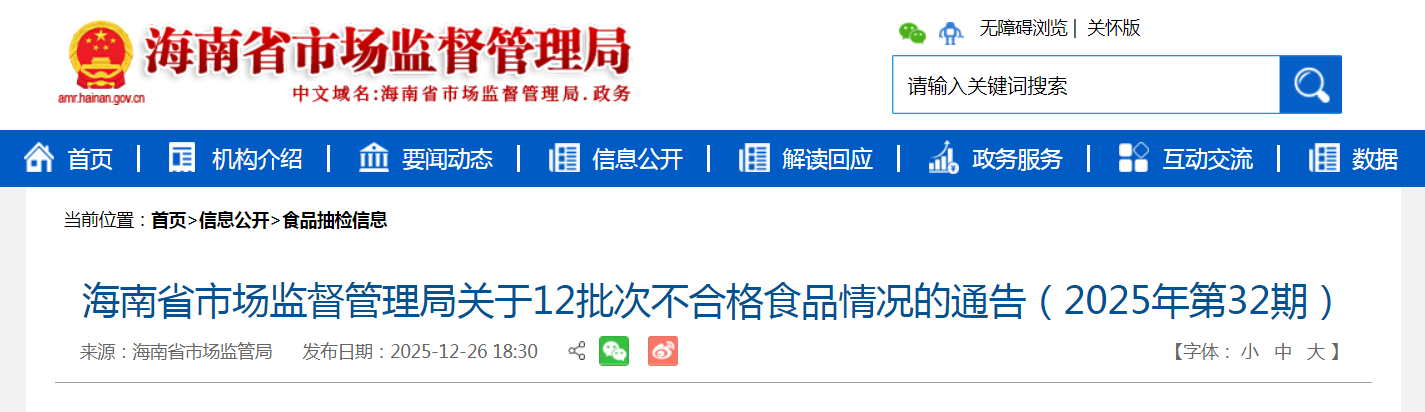
海南省市场监督管理局关于12批次不合格食品情况的通告(2025年第32期)
Zhong Guo Zhi Liang Xin Wen Wang· 2025-12-29 08:52
Core Points - The Hainan Provincial Market Supervision Administration conducted food safety inspections on 956 batches, identifying 12 batches of non-compliant products [1] - The non-compliance issues include excessive use of food additives, pesticide residue exceeding limits, veterinary drug residue, heavy metal contamination, and quality indicators not meeting standards [1] Group 1: Food Additives - The white angelica sold at Chengmai Laocheng Neighborhood Life Supermarket had sulfur dioxide residue exceeding national food safety standards [1] - The dried chili sold at Haikou Longhua Haibaiyi Subfood Business had sulfur dioxide residue exceeding national food safety standards [1] - The handmade pastry (raw wet noodle product) produced and sold by Hainan Xinting Food Co., Ltd. had sorbic acid and its potassium salt exceeding national food safety standards [1] Group 2: Pesticide Residue - The Dongjiang honey tangerines sold at Wenchang Wencheng Yixi Fruit Store had bifenthrin residue exceeding national food safety standards [1] - The leeks sold at Changjiang Shiluo Shulan Vegetable Stall had acephate residue exceeding national food safety standards [1] - The scallions sold at Danzhou Lemait Supermarket Co., Ltd. had acephate residue exceeding national food safety standards [1] - The cucumbers sold at Danzhou Baima Jing Vegetable Basket Supermarket had thiamethoxam residue exceeding national food safety standards [1] - The oranges sold at Chengmai Jinjian Qibo Fruit Store had bifenthrin residue exceeding national food safety standards [1] Group 3: Veterinary Drug Residue - The pangasius (marine fish) sold at Lingao Xinying Qingru Seafood Stall had chloramphenicol residue exceeding national food safety standards [1] Group 4: Heavy Metal Contamination - The chili peppers sold at Sanya Yazhou Yanying Vegetable Store had cadmium (as Cd) exceeding national food safety standards [1] Group 5: Quality Indicators - The peanut oil produced and sold by Ding'an Dingcheng Guangchang Oil Factory had an acid value (KOH) exceeding national food safety standards [1] Group 6: Other Contaminants - The reused dining utensils (bowls) used at Haikou Xiuying District Xinbiao Fast Food Restaurant had anionic synthetic detergent (as sodium dodecylbenzenesulfonate) residue exceeding national food safety standards [1]

广东发布食品安全抽检通告,惠州3批次产品不合格上榜
Nan Fang Du Shi Bao· 2025-12-29 08:36
Group 1 - The Guangdong Provincial Market Supervision Administration released the 47th food safety inspection notice for 2025, revealing that out of 1398 food samples tested, 14 batches were found to be non-compliant [1] - Three batches of non-compliant products were identified in Huizhou, involving packaged drinking water and edible agricultural products [1] - Specific issues included microbial contamination in packaged drinking water, pesticide residue exceeding standards in ginger, and excessive use of food additives in mulberries [1] Group 2 - The Guangdong Provincial Market Supervision Administration has ordered local market regulatory departments to investigate and handle the non-compliant food products promptly [1] - Companies are required to trace the distribution of non-compliant products and implement measures such as removal from shelves and recalls to mitigate food safety risks [1] - Non-compliance will be recorded in the food safety credit files of the involved producers and operators, with relevant information made public for social supervision [1]