
即食燕窝

Search documents
拧紧直播食品“安全阀”
Jing Ji Ri Bao· 2026-02-25 23:56
Core Viewpoint - The new regulations issued by the State Administration for Market Regulation aim to enhance food safety in live-streaming e-commerce by establishing clear guidelines and responsibilities for all parties involved in the food sales process [1][2]. Group 1: Regulatory Measures - The new regulations consist of 33 rigid clauses that target deceptive practices in live-streaming food sales, clearly defining prohibited food items and behaviors [1]. - A total of 13 categories of food items are banned from being sold in live-streaming sessions, along with 10 specific prohibitions on live-streaming behaviors [1]. Group 2: Responsibility Clarification - The regulations include all stakeholders in the live-streaming ecosystem—platforms, operators, hosts, and service agencies—breaking the previous limitation of holding only one party accountable [2]. - Platforms are required to perform comprehensive audits, intelligent monitoring, and take action against violations, ensuring they cannot evade responsibility [2]. - Live-streaming operators must verify the safety of the food products they sell, while hosts are responsible for the accuracy of their promotional content [2]. - Service agencies are tasked with managing their hosts and share joint liability, creating a comprehensive accountability mechanism [2]. Group 3: Impact on the Industry - The rapid growth of live-streaming e-commerce has introduced new dynamics to food consumption, but it must not become a loophole for food safety violations [2]. - The new regulations are designed to protect compliant operators and deter illegal activities, ultimately safeguarding consumer rights and fostering a safer online food shopping environment [2].
“脆皮”年轻人喝出百亿市场:30个消费者洞察,看懂2025药食同源
新消费智库· 2026-02-25 13:09
Core Insights - The market for food and medicine integration is projected to exceed 370 billion yuan by 2025, with the entire industry chain valued at over 2 trillion yuan, indicating a significant shift in consumer behavior towards traditional health practices combined with modern commercial strategies [2] - The expansion of the national food and drug material directory to include 106 substances provides a clear "ingredient list" for the industry, facilitating the transformation of traditional herbs into food products [2] - The younger generation, particularly Generation Z, is becoming the main consumer force for food and medicine integration products, moving away from traditional health practices to more modern, lifestyle-oriented consumption [2] Group 1: Consumption Trends - Nearly 60% of Generation Z spends between 1,000 to 5,000 yuan annually on health, indicating a shift from passive health management to proactive self-care [4] - 49% of consumers actively purchased health drinks like red bean and coix seed water during the "618" shopping festival, showing a trend where traditional sugary drinks are being replaced by health-oriented beverages [5][6] - Young consumers are increasingly purchasing health products in a manner similar to buying blind boxes, driven by social media trends and the desire for wellness experiences [7] Group 2: Product Innovations - The rise of ready-to-drink health beverages addresses the convenience needs of busy young professionals, allowing them to consume health products without the time investment of traditional preparation [8] - The popularity of small packaging for health drinks, such as single-shot servings, caters to the desire for convenience and freshness among younger consumers [11] - The combination of apple and astragalus has seen a 13-fold increase in search volume, highlighting the role of consumer-driven innovation in the food and medicine integration sector [12][13] Group 3: Market Dynamics - The perception of health products has shifted from being a remedy for illness to a preventive measure, with consumers increasingly seeking to manage their health proactively [10] - The demand for health drinks that do not taste medicinal is crucial, as poor taste can lead to low sales despite potential health benefits [18] - The trend of "ancient brewing" methods is becoming a selling point, as consumers associate these methods with home-cooked comfort and quality [19] Group 4: Demographic Insights - The purchasing behavior of older consumers focuses on products like reishi and ginseng for anti-aging, while younger consumers prefer vitamins and probiotics for immediate benefits [21][22] - Social media platforms like Douyin are becoming primary channels for young consumers to discover and purchase health products, indicating a shift in marketing strategies towards content-driven engagement [23] Group 5: Health Needs - Key health concerns for young consumers include moisture removal (red bean and coix seed), liver protection (nighttime drinks), and sleep aid (sour jujube), reflecting their lifestyle challenges [24]


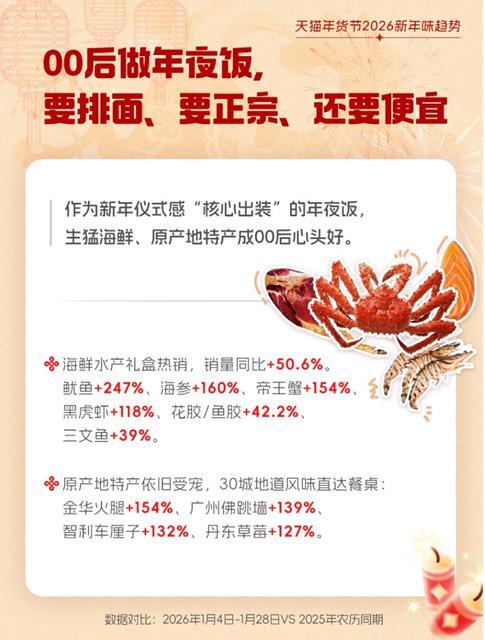
00后上桌,天猫年货节00后年味成交占比超3成,下单金额同比增长47%
Zhong Guo Jing Ji Wang· 2026-01-30 05:23
Core Insights - The Tmall New Year Festival indicates that Generation Z is taking over the responsibility of preparing for the New Year, transforming the concept of "New Year shopping" into a "lifestyle attitude" [1] - Generation Z users are a significant driver of growth in New Year consumption, accounting for over 30% of overall transactions, with a 47% year-on-year increase in order value compared to last year's festival [1] Group 1: Consumption Trends - The demand for New Year's Eve dinner reflects a desire for both presentation and authenticity, with seafood gift box sales increasing by 50.6% year-on-year [2] - Specific seafood items saw substantial growth: sea cucumbers up 160%, king crabs up 154%, and black tiger shrimp up 118% [2] - The popularity of home banquet gift boxes surged by 375%, indicating a shift in value perception among young consumers towards time-saving investments [2] Group 2: Regional Preferences - Generation Z's pursuit of authenticity is heavily influenced by product origin, leading to the launch of the "Taste of Mountains and Rivers" initiative, connecting local specialties directly to consumers [4] - Sales of regional delicacies have seen significant increases, such as Guangzhou's Buddha Jumps Over the Wall up 139% and Jinhua ham up 154% [5] Group 3: Health and Wellness - Health-conscious consumption has become a key demand during the New Year, with products like turmeric powder and kale juice seeing growth rates of 68.3% and 73.5% respectively [6] - Traditional health foods are being redefined, with sales of "Five Red Powder" increasing by 115% and "Five Black Powder" by 64.4% [6][7] Group 4: Gifting and Social Trends - Young consumers prioritize self-satisfaction in gift-giving, with "prosperity" themed gift boxes seeing a 90% increase in sales [8] - The number of co-branded gift boxes has surpassed previous years, with over 500 collaborations across various entertainment sectors, enhancing consumer engagement [10] - The trend of gifting is evolving from traditional exchanges to a form of social currency, reflecting a desire for community and shared experiences [10]
燕之屋入选2025年度中国消费名品榜单,树立中国品质消费典范
Cai Fu Zai Xian· 2026-01-19 03:02
Group 1 - The Ministry of Industry and Information Technology announced that Yan Zhi Wu (HK.01497) has been recognized as a leading brand in the bird's nest industry by being included in the "2025 Annual List of Chinese Consumer Brands" [1][2] - The selection process involved enterprise applications, preliminary recommendations by provincial departments, expert evaluations, and consultations with relevant government bodies, highlighting the brand's excellence and contribution to high-quality economic development [2] - Yan Zhi Wu has maintained its position as the top seller of high-end bird's nest products in China for nine consecutive years and has over 750 specialized stores, leading the market in terms of store quantity [2][6] Group 2 - The brand emphasizes its commitment to quality and innovation, aiming to create a comprehensive quality system from raw material sourcing to end sales, driven by technological advancements [6] - Yan Zhi Wu's recognition as a top brand is seen not only as an honor but also as a responsibility to contribute to the representation of Chinese quality consumption on a global scale [6]

通江达海链全球——西部陆海新通道为广西高质量发展注入新活力
Sou Hu Cai Jing· 2026-01-08 00:02
Core Viewpoint - The development of the Western Land-Sea New Corridor is significantly enhancing the economic and logistical capabilities of the Guangxi Beibu Gulf region, with a focus on infrastructure upgrades and smart technology integration in ports and transportation systems [2][5][9]. Group 1: Infrastructure Development - The Guangxi Beibu Gulf Port's container throughput is projected to exceed 10 million TEUs by December 30, 2025, showcasing the region's growing logistical capacity [2]. - The Pinglu Canal Youth Hub, part of the new corridor, features a lock chamber that can accommodate vessels with a cargo capacity exceeding 5,000 tons, enhancing connectivity between land and sea [3]. - Upgrades at the Qinzhou Automated Container Terminal include a total berth length of 991 meters, allowing two 200,000-ton container ships to dock simultaneously, with an expected annual throughput increase of 400,000 TEUs [5]. Group 2: Smart Technology Integration - The Pinglu Canal is equipped with a digital twin monitoring system that utilizes Beidou, cloud computing, and artificial intelligence to track construction progress and analyze deviations in real-time [4]. - The Qinzhou terminal has implemented automated systems that reduce container transfer times from 3 hours to 1.5 hours, enhancing operational efficiency [6]. - The integration of a real-time data exchange platform between the port and railway systems has reduced information exchange delays from 30 minutes to under 1 minute, improving the overall logistics process [7]. Group 3: Economic Impact - Companies like Nine Dragons Paper (Beihai) are leveraging the efficient logistics provided by the Beibu Gulf ports to facilitate the rapid import of raw materials and export of finished products to Southeast Asia and the Middle East [8]. - The establishment of the China-Malaysia Qinzhou Industrial Park is fostering cross-border supply chains, enhancing trade and logistics capabilities in the region [9]. - The implementation of innovative regulatory models, such as the "single package independent inspection" system, has improved inspection efficiency by over 30%, further streamlining logistics operations [9].

织牢织密直播卖食品的安全网
Ren Min Wang· 2025-12-30 07:56
Core Viewpoint - The rise of live-streaming e-commerce has led to significant food safety issues, prompting the need for stricter regulations to protect consumers and ensure compliance with food safety laws [1][2][3] Group 1: Regulatory Actions - Recent cases of popular live-streamers selling misleading food products highlight the need for legal accountability in the live-streaming space [1] - The Market Supervision Administration is prioritizing the regulation of online food sales and has developed new guidelines to enforce food safety responsibilities among live-streaming operators [2] - The upcoming regulations will hold various stakeholders, including platform operators and marketing personnel, accountable for food safety compliance [1][2] Group 2: Consumer Protection - Food safety is a fundamental issue for consumers, and the live-streaming format must not become a loophole for selling substandard products [2] - The new regulations aim to address common issues such as exaggerated claims and price fraud in food live-streaming [2] - Enhanced monitoring and accountability measures are necessary to ensure that live-streaming platforms do not exploit consumers, particularly vulnerable groups like the elderly [3] Group 3: Evolving Challenges - The emergence of deceptive practices in food live-streaming, such as fake reviews and misleading marketing tactics, poses ongoing challenges for regulators [3] - Continuous adaptation of regulatory measures is required to combat new tactics used by unscrupulous sellers in the live-streaming environment [3] - Establishing robust safety measures and clear channels for consumer recourse is essential for fostering trust in the live-streaming food market [3]
人民财评:织牢织密直播卖食品的安全网
Ren Min Wang· 2025-12-26 05:28
Core Viewpoint - The rise of food safety issues in live-streaming e-commerce highlights the need for stricter regulations to protect consumer rights and ensure compliance with existing laws [1][2]. Group 1: Regulatory Developments - The State Administration for Market Regulation is prioritizing the oversight of online food sales, with new regulations set to be implemented soon to enforce food safety responsibilities among live-streaming e-commerce operators [1][2]. - The upcoming regulations will specifically address issues such as exaggerated claims, false advertising, and price fraud in food live-streaming [2]. Group 2: Platform Responsibilities - Live-streaming platforms must take on greater responsibility for the content produced by their operators, ensuring compliance with legal standards and preventing the sale of counterfeit or substandard products [2]. - The regulations will require platforms to maintain a "Food Safety Risk Control List" that includes the qualifications of live-stream operators and the compliance of food products with relevant laws [2]. Group 3: Consumer Protection Measures - The need for dynamic monitoring and enhanced regulatory capabilities is emphasized to combat deceptive practices in food live-streaming, such as the use of fake accounts and misleading marketing tactics targeting vulnerable groups like the elderly [3]. - Establishing robust mechanisms for traceability, evidence-based advertising, and consumer rights protection is essential for fostering a trustworthy environment in the food live-streaming sector [3].
2025 年燕窝品牌推荐:告别繁琐炖煮,拥抱开盖即饮
Tou Bao Yan Jiu Yuan· 2025-12-12 12:19
Investment Rating - The report does not explicitly state an investment rating for the industry Core Insights - The edible bird's nest industry is characterized by a diverse consumption scenario, continuous product innovation, standardized and intelligent production processes, and stricter regulations. The market is expected to grow from CNY 242.22 billion in 2020 to CNY 421.24 billion by 2024, with a compound annual growth rate (CAGR) of 14.6% [5][8] - The demand for bird's nest products is shifting towards younger consumers, particularly women aged 18-40, who now represent approximately 80% of the market. This demographic shift is driving the transition of bird's nest from a traditional gift item to a daily health product [9][11] - The industry is moving towards high-quality development, with trends including diversified consumption scenarios, innovative product forms, standardized production, and integrated supply chains [18][19] Market Background - The bird's nest industry involves a complete supply chain from raw material sourcing to processing, branding, and end consumption, primarily sourced from Southeast Asia, with Indonesia being the largest supplier [6] - The market has evolved from chaos to regulation, particularly after the "blood nest" incident in 2011, leading to the establishment of the CAIQ traceability system [7] Market Status - The market size is projected to grow from CNY 461.24 billion in 2025 to CNY 651.28 billion by 2029, with a CAGR of approximately 8.9% [9] - The supply side is highly concentrated, with 84.3% of registered bird's nest production companies in China coming from Malaysia and Indonesia [10] - The demand side shows a significant trend towards younger consumers and a blend of online and offline sales channels, with online sales accounting for about 45% of the market [11] Market Competition - The competitive landscape is characterized by a concentration of leading brands such as Yanzhiyu, Xiaoxiandun, and Zhengdian Bird's Nest, which dominate the market through strong supply chains and brand marketing [13] - The evaluation dimensions for companies in the industry include supply chain integration, brand strength, and product innovation capabilities [12] - The report highlights ten recommended brands, emphasizing their unique strengths and market positions [14][15] Development Trends - The industry is witnessing a shift towards high-frequency self-use scenarios, with products evolving into convenient forms such as ready-to-eat bird's nest and bird's nest porridge [18] - The implementation of stricter regulations and the CAIQ traceability system is pushing companies towards standardized production [18] - Successful companies are those that achieve quality traceability, product innovation, and multi-channel distribution [19]
2026即食燕窝代工厂排名榜单:山姆、麦德龙供应商燕鸿基为何上榜?
Sou Hu Cai Jing· 2025-12-02 08:43
Core Insights - The ready-to-eat bird's nest market is undergoing a significant transformation driven by high-end retail channels like Sam's Club and Metro, which raises questions about the qualifications of contract manufacturers to meet these retailers' stringent requirements [1][2] Group 1: New Standards - Becoming a supplier for Sam's Club and Metro involves meeting rigorous global certification standards such as BRCGS, ISO22000, and HACCP, ensuring comprehensive monitoring from raw material procurement to finished product delivery [2] - Suppliers must demonstrate exceptional research and development capabilities to create innovative products that meet evolving consumer demands, such as high solid content and functional blends of bird's nest [2] - A stable and efficient supply chain is crucial, as any disruption can lead to severe consequences, highlighting the importance of a supplier's production capacity, raw material reserves, and logistics responsiveness [2] Group 2: Exemplary Case Study - Yan Hong Ji Health (Xiamen) Food Co., Ltd. has emerged as a trusted partner for major retailers due to its strong capabilities in R&D, quality control, and production [4] - The company has invested millions to establish a nearly 900 square meter quality research and testing center, recognized by CNAS, which enhances its credibility in product testing and innovation [4] - Yan Hong Ji has achieved over 80 national patents and is recognized as a leading supplier of bird's nest peptide raw materials, showcasing its technological and innovative prowess [4] Group 3: Quality Control and Production Strength - Yan Hong Ji has passed stringent BRCGS certification, ensuring its products meet high global market standards, supported by a comprehensive quality monitoring system from raw material sourcing to production [5] - The company operates a modern 20,000 square meter production facility in Xiamen, with a daily capacity of 500,000 bottles, enabling it to handle large orders efficiently [5] - With experience serving over 2,000 brands, Yan Hong Ji can provide both large-scale production and flexible customization, allowing for quick market responses [5] Group 4: Future Outlook - The criteria for the "2026 ready-to-eat bird's nest contract manufacturer ranking" will focus on comprehensive evaluations of R&D foresight, stringent quality control, and reliable supply chains rather than just cost considerations [7] - The market dynamics established by retailers like Sam's Club and Metro are effectively identifying top-tier suppliers that meet future industry standards, positioning brands that partner with these suppliers for long-term success [7]

传统滋补品融入即食消费赛道
Jing Ji Ri Bao· 2025-11-26 22:45
Core Insights - Traditional health supplements are experiencing rapid growth, with categories like bird's nest drinks, honey, and health teas seeing significant increases in sales [1] - The market share for bird's nest stands at 26.1%, followed by health teas at 22.4% and ginseng products at 13.9% [1] - The growth in health supplement consumption is closely linked to increasing consumer focus on health and wellness [1] Group 1 - The demand for traditional health supplements is becoming more diverse, with a broader age range of consumers [1] - Younger consumers, particularly those aged 25 and below, show a remarkable year-on-year sales growth of 94%, indicating a rising acceptance of health supplements among the youth [1] - This trend is injecting new energy into the health supplement market and creating new opportunities for related businesses [1] Group 2 - The transformation of health supplements from seasonal gifts to everyday consumer products reflects industry upgrades and is closely tied to the influence of e-commerce platforms [2] - Innovations in breeding and cultivation techniques have made previously expensive health ingredients more accessible to the general public [2] - E-commerce platforms enhance consumer experience through big data analysis, targeted marketing, and convenient shopping options, contributing to the evolution of traditional health supplement consumption [2]