
首发经济

Search documents
四家传统零售巨头业绩承压,武汉如何冲刺万亿消费城
Di Yi Cai Jing· 2025-12-10 08:42
Core Viewpoint - Wuhan aims to exceed 1.07 trillion yuan in total retail sales of consumer goods by 2027, supported by a three-year action plan to establish itself as an international consumption center city [2] Group 1: Action Plan and Goals - The action plan includes six categories and 25 tasks aimed at enhancing global consumption links, creating new consumption landmarks, and fostering diverse consumption scenarios [2] - The plan sets a target for annual growth in tourism and service sectors, with specific goals for retail sales and international visitor numbers [9][10] Group 2: Retail Sector Performance - In the first three quarters of 2025, Wuhan's total retail sales reached 629.97 billion yuan, a year-on-year increase of 5.5%, leading among 19 sub-provincial cities [3] - Retail companies in Wuhan show mixed performance, with Wushang Group reporting a revenue decline of 11.64% but maintaining a profit margin, while other companies like Zhongbai Group faced significant losses [3][4] - The overall retail market in Wuhan remains resilient, with growth in wholesale and retail, as well as hospitality and catering sectors [4] Group 3: Emerging Consumption Trends - The "first release economy" is gaining traction, with nearly 300 new stores introduced in the first three quarters of the year, indicating a shift towards quality consumption [7][8] - The city is focusing on enhancing its cultural and sports events to drive tourism and consumption, with significant increases in visitor numbers and tourism revenue [5][9] Group 4: Internationalization and Consumer Experience - The action plan emphasizes the need for an international consumption environment, including improved payment systems and a wider range of high-quality goods and services [2][10] - Strategies include expanding tax refund stores and enhancing the shopping experience for international visitors, aiming to create a globally attractive consumption environment [10]
年终特别报道|这一年,经济运行总体平稳、稳中有进
Ren Min Ri Bao· 2025-12-10 03:57
Group 1: Economic Development Trends - The year 2025 is significant for China's modernization process, with a focus on high-quality development and achieving major economic and social goals [2] - The Central Economic Work Conference highlighted the importance of developing new economic sectors such as the "first release economy," "ice and snow economy," "silver economy," and promoting healthy platform economy and county economy [3][4] Group 2: First Release Economy - The first release economy is gaining traction, with cities like Beijing, Shanghai, and Chengdu enhancing policy support to attract new brands and stores, becoming a key driver for domestic demand [3][6] - Chengdu has seen the establishment of 631 first stores in the first three quarters of the year, indicating a growing trend of "first release" becoming a lifestyle [8] Group 3: Ice and Snow Economy - The ice and snow economy is evolving from a seasonal focus to a year-round industry, with the market expected to exceed 1 trillion yuan by 2025 [3][9] - Harbin's Ice and Snow World is integrating technology and culture, offering diverse shopping and dining experiences to enhance consumer engagement [11] Group 4: Silver Economy - The silver economy is expanding with new service models for the elderly, including specialized travel services that cater to their needs, reflecting a shift in consumption patterns towards quality and personalization [12][13] - The elderly demographic is becoming a significant force in the tourism market, with over 80% of travelers on specialized trains being aged 60 and above [13] Group 5: Platform Economy - The platform economy is transitioning from a "what to sell" model to a "what is needed" approach, enhancing consumer experience through direct subsidies and one-stop services [14][15] - E-commerce platforms are driving growth in both domestic demand and foreign trade, with significant increases in sales and participation in global promotional events [16] Group 6: County Economy - The county economy is experiencing robust growth, with initiatives like "Hundred Villages, Thousand Stays" promoting eco-tourism and local industries, leading to increased income for local residents [17][18] - The integration of tourism and local agriculture is driving economic development, with significant increases in visitor numbers and revenue [18] Group 7: Marine Economy - The marine economy is focusing on green and low-carbon initiatives, with advancements in shipbuilding technology and sustainable practices [19][21] - The marine engineering sector is seeing growth, with a reported output value of 32.85 billion yuan in the first ten months of the year, reflecting a 16.9% increase [21] Group 8: Bay Area Economy - The Guangdong-Hong Kong-Macao Greater Bay Area is fostering innovation and collaboration, with companies leveraging regional strengths for technological advancements [22][24] - The synergy between Hong Kong's research capabilities and the manufacturing strengths of the Pearl River Delta is facilitating the commercialization of scientific innovations [24]

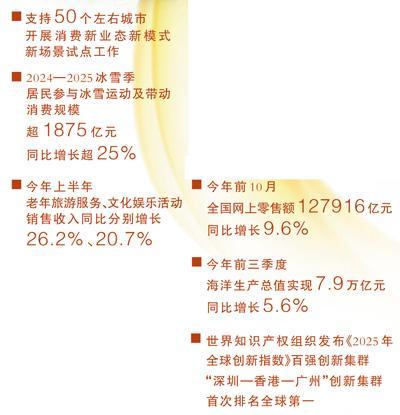
以新场景释放消费新动能
Hai Nan Ri Bao· 2025-12-10 01:15
Core Viewpoint - The Hainan Provincial Committee emphasizes the development of various economic models, including night economy, instant economy, first-release economy, and "Guzi economy," to enhance the international tourism consumption center's capabilities and promote new consumption scenarios [1][6][11][14]. Night Economy - Hainan has significant advantages for developing the night economy, including a favorable climate, a large tourist market, rich culinary resources, a strong commercial atmosphere, and mature coastal landscapes [3][4]. - The province received 84.93 million tourists from January to October 2025, marking an 8.3% year-on-year increase, providing a robust market flow for the night economy [3]. - The government has introduced supportive policies, such as the "Hainan Free Trade Port Tourism Regulations," to enhance the night economy's development [4]. Instant Economy - Instant economy is characterized by meeting consumer demands in real-time through digital platforms, enhancing user experience and efficiency in tourism consumption [6][7]. - The instant retail market in China reached 650 billion yuan in 2023, with a projected growth to over 2 trillion yuan by 2030, indicating a significant market opportunity [7]. - Hainan aims to leverage its policy advantages to foster the instant economy, enhancing the overall competitiveness of its tourism sector [8][10]. First-Release Economy - The first-release economy is identified as a key strategy for Hainan to enhance its international tourism consumption center, capitalizing on unique local advantages [11][12]. - The fifth Consumer Expo showcased nearly 100 new products, demonstrating the potential of the first-release economy to stimulate market engagement and consumer interest [11]. - A comprehensive policy support system is essential for the first-release economy, including streamlined customs processes and intellectual property protections [12][13]. Guzi Economy - The "Guzi economy," derived from the English word "goods," focuses on emotional consumption linked to cultural IPs, with a market size projected to reach 168.9 billion yuan in 2024 [14][15]. - Hainan's free trade policies provide a conducive environment for developing the Guzi economy, attracting top-tier IP companies and fostering local cultural integration [14][15]. - The province aims to create immersive consumer experiences by leveraging its unique tourism resources and developing original IPs that resonate with local culture [15][16].
山东城乡消费正在发生哪些变化
Da Zhong Ri Bao· 2025-12-10 01:00
Core Insights - Shandong is experiencing a significant transformation in consumption patterns, driven by diverse new consumption formats and supportive policies [2][3][4] Group 1: New Consumption Formats - The emergence of new consumption formats in Shandong is characterized by the rapid expansion of major retail players like Sam's Club and Hema, which are establishing a strong presence in the region [3] - Sam's Club is investing 830 million yuan to develop a 24,000 square meter store in Jinan, utilizing an "one store, multiple warehouses" model to enhance service networks [3] - Hema has established operations in eight cities in Shandong since 2025, with its first store in Linyi extending services to the southern region of Shandong [3] Group 2: Policy Support and Market Environment - Shandong's government has implemented a "1+N" consumption promotion policy framework, which enhances the commercial circulation network and fosters a consumption pattern led by core cities and followed by smaller cities [3][4] - The "Good Products Shandong" brand system is being utilized to improve local retail operations, exemplified by the collaboration between Pang Donglai and Yonghui, which integrates local characteristics with advanced operational models [3] Group 3: Consumer Experience and Safety - The "Good Products Shandong" brand system ensures consumer safety by providing traceability for local products, such as the quality management system implemented by Beiyuanfu Food Co., which allows consumers to track the entire production process of millet [5] - The improvement of the circulation network has made shopping more convenient, with initiatives like digital payment systems being introduced in traditional markets [5] Group 4: Rural E-commerce and County Commercial Development - The development of rural e-commerce is facilitating a two-way flow of goods between urban and rural areas, with local products being promoted through live streaming platforms [7] - County commercial construction initiatives are transforming rural consumption landscapes, as seen in the revitalization of traditional markets and the integration of online and offline shopping experiences [7] Group 5: Technological Integration in Tourism - The integration of artificial intelligence in tourism, such as AI-guided tours and smart ticketing systems, is enhancing visitor experiences in scenic areas like Taishan and Qufu [7] - The use of low-speed unmanned delivery vehicles in tourist spots is addressing logistical challenges while attracting younger consumers [7]
这一年,经济运行总体平稳、稳中有进
Ren Min Ri Bao· 2025-12-09 23:59
Economic Development - The year 2025 is significant for China's modernization process, with a focus on high-quality development and achieving major economic and social goals [1] - The Central Economic Work Conference has outlined systematic deployments for economic work in 2025, emphasizing the development of various economies such as the "first launch economy," "ice and snow economy," "silver economy," and others [1][2] First Launch Economy - The first launch economy is gaining traction, with cities like Beijing, Shanghai, and Chengdu enhancing policy support to attract new brands and stores, becoming a key driver for domestic demand [2] - Chengdu has seen the establishment of 631 first stores in the first three quarters of the year, indicating a growing trend towards first launches as a lifestyle choice [4][5] Ice and Snow Economy - The ice and snow economy is evolving from a seasonal focus to a year-round industry, with the scale expected to exceed 1 trillion yuan by 2025 [2] - Harbin's Ice and Snow World is under construction, featuring innovative attractions and a focus on diverse shopping and experiential dining to enhance consumer engagement [5][6] Silver Economy - The silver economy is expanding with new service models for the elderly, including specialized travel services that cater to their needs, reflecting a shift in consumption patterns towards quality and personalization [6][7] - In Yunnan, the elderly tourism market has seen significant growth, with over 80% of travelers being aged 60 and above [7] Platform Economy - The platform economy is transitioning from a "what to produce" model to a "what is needed" approach, enhancing consumer satisfaction through direct connections between platforms and manufacturers [8][9] - E-commerce platforms have facilitated significant growth in agricultural product sales, with rural online retail increasing by 7.5% year-on-year [9][10] County Economy - The county economy is thriving with initiatives like "Hundred Villages Thousand Lodgings," which promote eco-tourism and local agricultural products, leading to increased income for local residents [10][11] - In Luanchuan County, the integration of tourism and agriculture has resulted in a substantial rise in visitor numbers and revenue, with a focus on sustainable development [11] Marine Economy - The marine economy is advancing with innovations in shipbuilding and marine engineering, focusing on green technologies and zero-carbon emissions [12][13] - The Qingdao West Coast New Area has established a marine industry base that has seen a 16.9% increase in output value year-on-year [13] Bay Area Economy - The Guangdong-Hong Kong-Macao Greater Bay Area is fostering innovation and collaboration, with companies leveraging local resources for technological advancements [14] - The synergy between Hong Kong's research capabilities and the Pearl River Delta's industrial strengths is facilitating the commercialization of scientific achievements [14]
这一年 经济运行总体平稳、稳中有进(年终特别报道)
Ren Min Ri Bao· 2025-12-09 22:32
Economic Development - The year 2025 is significant for China's modernization process, with a focus on high-quality development and achieving major economic and social goals [1] - The Central Economic Work Conference has outlined systematic plans for 2025, emphasizing the development of various economies such as the "first release economy," "ice and snow economy," "silver-haired economy," "platform economy," "county economy," and "marine economy" [1][2] First Release Economy - The first release economy is gaining traction, with cities like Beijing, Shanghai, and Chengdu enhancing policy support to attract new brands and stores, thus tapping into domestic demand [1][3] - Chengdu has seen a significant increase in first stores, with 631 new stores established in the first three quarters of the year, making the concept of "catching the first release" a new lifestyle trend [5] Ice and Snow Economy - The ice and snow economy is evolving from a seasonal focus to year-round activities, with the industry expected to exceed 1 trillion yuan by 2025 [1][6] - Harbin is enhancing its ice and snow attractions with innovative features, including AI interactions and diverse shopping experiences, to boost consumer engagement during the ice and snow season [6][7] Silver-Haired Economy - The silver-haired economy is expanding, with tailored services for the elderly, such as specialized travel experiences and community engagement activities, reflecting a shift in consumption patterns towards quality and personalization [1][8] - In Yunnan, over 80% of tourists on specialized silver-haired travel trains are aged 60 and above, indicating the growing importance of this demographic in the tourism market [8][9] Platform Economy - The platform economy is transitioning from a "what to sell" model to a "what is needed" approach, enhancing consumer satisfaction through direct connections between platforms and manufacturers [1][10] - E-commerce platforms have significantly boosted domestic demand and facilitated foreign trade, with notable growth in agricultural product sales and a 5.5% increase in industry e-commerce transaction volumes [10][11] County Economy - The county economy is experiencing rapid growth, with initiatives like "Hundred Villages, Thousand Stays" promoting eco-tourism and local agricultural products, leading to increased income for rural communities [1][12] - In Luanchuan County, the integration of tourism and local agriculture has resulted in high occupancy rates for rural accommodations and significant revenue growth for local farmers [12][13] Marine Economy - The marine economy is advancing with a focus on green technologies, such as ammonia fuel for ships, aiming for zero carbon emissions in the shipping industry [1][14] - The marine engineering sector in Qingdao is witnessing robust growth, with a reported 16.9% increase in output value for the shipbuilding industry in the first ten months of the year [14][15] Bay Area Economy - The Guangdong-Hong Kong-Macau Greater Bay Area is fostering innovation and collaboration, with companies leveraging local resources for technological advancements and market expansion [1][16] - The synergy between Hong Kong's research capabilities and the manufacturing strengths of the Pearl River Delta is enhancing the commercialization of scientific innovations [16][17]
这一年,经济运行总体平稳、稳中有进(年终特别报道)
Ren Min Ri Bao· 2025-12-09 22:32
Group 1: Economic Development Trends - The year 2025 is significant for China's modernization process, with a focus on high-quality development and achieving major economic and social goals [10] - Key economic sectors highlighted include the "first launch economy," "ice and snow economy," "silver economy," platform economy, county economy, marine economy, and bay area economy, all of which are experiencing growth [11][12] Group 2: First Launch Economy - The first launch economy is gaining traction, with cities like Beijing, Shanghai, and Chengdu enhancing policy support to attract flagship stores and brands, becoming a vital driver for domestic demand [11] - Chengdu's first flagship store of the Swiss sports brand On opened in April, attracting significant customer traffic and showcasing a unique shopping experience [15][16] Group 3: Ice and Snow Economy - The construction of the Harbin Ice and Snow World is underway, with nearly 10,000 workers involved, and the park is set to cover 1.2 million square meters [17] - The ice and snow economy is evolving from a seasonal to a year-round industry, with projections indicating the industry scale will exceed 1 trillion yuan by 2025 [11][18] Group 4: Silver Economy - The silver economy is expanding, with tailored services for the elderly, such as the "Starry·Lanmei" themed tourist train, which caters to the needs of senior travelers [19] - The elderly demographic is becoming a significant force in the tourism market, with over 80% of travelers on certain routes being aged 60 and above [19][20] Group 5: Platform Economy - The platform economy is shifting from a "what to produce" model to a "what is needed" approach, enhancing consumer experience through direct subsidies and one-stop services [21][22] - E-commerce platforms are driving domestic demand growth and facilitating foreign trade transformation, with significant sales increases during promotional events [23] Group 6: County Economy - The county economy is thriving, with initiatives like "Hundred Villages, Thousand Lodgings" promoting rural tourism and local industries, leading to increased income for residents [24][25] - The county's tourism revenue reached 11.265 billion yuan, with over 15.45 million visitors recorded in the first ten months of the year [25] Group 7: Marine Economy - The marine economy is advancing with the delivery of the "Guoxin 1号2—2," a large smart fishing vessel, which will conduct year-round farming trials [26][27] - The focus on green and low-carbon initiatives is reshaping the shipping industry, with a significant portion of new vessels being designed for zero-carbon emissions [27] Group 8: Bay Area Economy - The Guangdong-Hong Kong-Macao Greater Bay Area is fostering innovation and collaboration, with companies leveraging regional strengths for technological advancements [29][30] - The integration of research and industry within the bay area is enhancing the commercialization of scientific achievements, creating a robust ecosystem for startups [30]

资产配置日报:科技独树一帜-20251209
HUAXI Securities· 2025-12-09 15:00
Market Overview - On December 9, the stock and bond markets exhibited a seesaw trend, with bonds rising and stocks falling. The overall A-share market declined by 0.55% with a trading volume of 1.92 trillion yuan, down 133.9 billion yuan from the previous day[1] - The Hang Seng Index fell by 1.29%, while the Hang Seng Technology Index dropped by 1.90%. Southbound capital saw a net inflow of 531 million HKD, with Tencent, Xiaomi, and Alibaba receiving net inflows of 878 million HKD, 540 million HKD, and 425 million HKD respectively[1] Sector Performance - The concentration of trading volume reached 45%, indicating a historical high, with technology sectors, particularly AI computing, driving this concentration. Other sectors, such as non-ferrous metals and liquor, experienced significant declines[2] - Consumer sectors are becoming a focus for capital, particularly those related to policy, such as ice and snow tourism, and tech-related consumption like consumer electronics and digital marketing[2] Bond Market Dynamics - The bond market showed mixed performance, with most bonds closing in the green, but intraday rates fluctuated. The long-end rates initially opened lower by about 1 basis point but later turned upward due to market speculation on potential easing of bank economic value sensitivity indicators[4] - Despite a slight recovery in bond market sentiment, there remains pressure from redemptions in medium and short-term bond funds, indicating a cautious outlook for the bond market in the near term[7] Commodity Market Trends - The commodity market saw widespread declines, with precious metals like gold and silver down by 0.92% and 0.68% respectively. Industrial metals also faced downward pressure, with aluminum and copper dropping by 1.67% and 1.46%[7] - The market experienced a significant net outflow of 8.4 billion yuan in commodities, reflecting a lack of sustained bullish sentiment. Non-ferrous metals and precious metals were the main areas of capital outflow[8] Risk Factors - Potential risks include unexpected adjustments in monetary policy, liquidity changes, and fiscal policy shifts, which could impact market stability and investor sentiment[10]
粤开市场日报-20251209
Yuekai Securities· 2025-12-09 07:55
Market Overview - The A-share market saw most indices decline today, with the Shanghai Composite Index down by 0.37% closing at 3909.52 points, and the Shenzhen Component Index down by 0.39% at 13277.36 points. The ChiNext Index, however, increased by 0.61% to close at 3209.60 points. Overall, there were 1305 stocks that rose while 4057 stocks fell, with a total trading volume of 19040 billion yuan, a decrease of 1327 billion yuan from the previous trading day [1][10]. Industry Performance - Among the Shenwan first-level industries, the sectors that performed well included comprehensive, communication, and electronics, with increases of 3.45%, 2.23%, and 0.78% respectively. Conversely, industries such as non-ferrous metals, steel, real estate, and coal experienced declines, with decreases of 3.03%, 2.47%, 2.10%, and 1.62% respectively [1][10]. Concept Sector Performance - The concept sectors that saw the highest gains today included copper-clad laminates, optical modules (CPO), cultivated diamonds, circuit boards, high transfer, superhard materials, dairy industry, NVIDIA supply chain, high-speed copper connections, silicon energy sources, initial public offerings, consumer electronics OEM, ice and snow tourism, lithography machines, and Moore Threads [2].
中银投资精准减持广百股份,持股4年获利甚微
Shen Zhen Shang Bao· 2025-12-08 15:49
Core Viewpoint - The major shareholder, Zhongyin Financial Asset Investment Co., Ltd., plans to reduce its stake in Guangbai Co., Ltd. by 7.2 million shares, bringing its ownership down to 4.99999% due to ongoing poor performance and limited profit opportunities since the company's restructuring [1][3]. Group 1 - Zhongyin Investment acquired shares in Guangbai Co. during a significant asset restructuring in 2021, paying approximately 506 million yuan for 63.049 million shares at a price of 8.03 yuan per share [2]. - Following the restructuring, Guangbai's stock price fluctuated between 3.97 yuan and 8 yuan, significantly below Zhongyin's acquisition cost, leading to challenges in liquidating their investment [2]. - In early 2023, Guangbai's stock price surged, allowing Zhongyin to reduce its holdings from 8.96% to 6% by selling 20.807 million shares between January 3 and January 15 [2]. Group 2 - Guangbai's financial performance has been declining, with a net profit of approximately 261 million yuan in 2021, followed by a loss of 143 million yuan in 2022, a profit of 36.165 million yuan in 2023, and an expected profit of 47.61 million yuan in 2024 [3]. - As of the close on December 8, Guangbai's stock price was 7.68 yuan, with a total market capitalization of 5.383 billion yuan, indicating the impact of the major shareholder's divestment on the company's market perception [3].
