产业转移

Search documents
离职率连续三年下滑,职场人的跳槽热情降温了?
第一财经· 2026-01-13 09:54
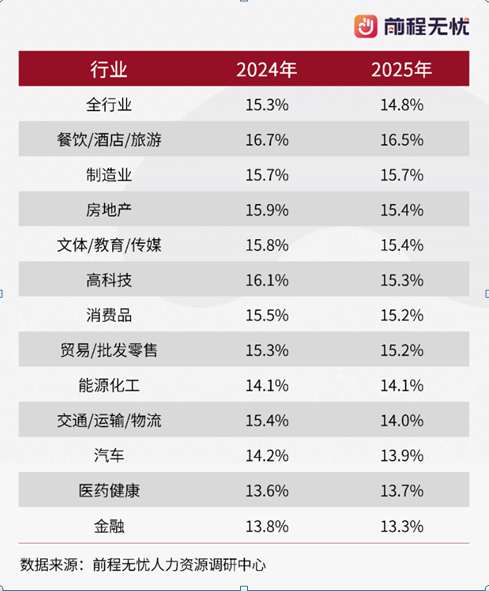
Core Viewpoint - The overall employee turnover rate in China decreased to 14.8% in 2025, reflecting a trend of job stability influenced by macroeconomic conditions, industry adjustments, and changing employment attitudes [3][4]. Group 1: Employee Turnover Rates - The turnover rate in the restaurant/hotel/tourism industry remains the highest at 16.5%, despite a slight decrease of 0.2 percentage points from 2024 [4][6]. - The manufacturing industry also has a turnover rate of 15.7%, which is linked to pressures from carbon neutrality goals and digital transformation, leading to adjustments in frontline worker positions [4][6]. - The real estate sector's turnover rate decreased to 15.4% from 15.9% in 2024, indicating ongoing personnel optimization amid deep industry adjustments [5][6]. Group 2: Industry Comparisons - The transportation/logistics sector saw the most significant decline in turnover rate, dropping 1.4 percentage points to 14.0%, suggesting a more stable employment ecosystem due to mature logistics systems and flexible labor models [5][6]. - Other industries such as high-tech and consumer goods also experienced slight decreases in turnover rates, with high-tech dropping to 15.3% and consumer goods to 15.2% [6]. Group 3: Regional Talent Mobility - The gap in turnover rates between first-tier cities and new first-tier cities is narrowing, with new first-tier cities becoming attractive destinations for talent due to industrial upgrades and lower living costs [7]. - The trend indicates a shift in employment choices among younger individuals, who are increasingly valuing work-life balance and sustainable career development over traditional aspirations of moving to first-tier cities [7]. Group 4: Implications for Employers - The trend towards lower turnover rates suggests a need for companies to optimize HR strategies, focusing on internal talent development rather than external recruitment [7]. - Employers are encouraged to balance efficiency with employee well-being to foster a more engaged workforce during this period of stability [7].


离职率连续三年下滑 职场人的跳槽热情降温了?
Di Yi Cai Jing· 2026-01-13 08:28
Core Insights - The overall employee turnover rate in China decreased to 14.8% in 2025, marking a 0.5 percentage point decline from 2024, continuing a three-year trend of gradual decrease [1] Industry Analysis - The hospitality and tourism sector has the highest turnover rate at 16.5%, despite a slight decrease of 0.2 percentage points from 2024, indicating persistent issues with employee turnover [1] - The manufacturing sector follows with a turnover rate of 15.7%, influenced by pressures from dual carbon goals and digital transformation, leading to adjustments in frontline worker positions [2] - The real estate sector's turnover rate decreased to 15.4% from 15.9% in 2024, reflecting ongoing personnel optimization amid deep industry adjustments [2] - In contrast, the transportation and logistics sector saw a significant decline in turnover rate by 1.4 percentage points to 14.0%, suggesting a more stable employment ecosystem due to mature logistics systems and flexible employment models [2] Regional Trends - The turnover rate gap between first-tier cities and new first-tier cities is narrowing, indicating a shift in talent flow dynamics, with new first-tier cities becoming attractive destinations due to industrial upgrades and lower living costs [2] - Cities like Chengdu are emerging as talent hubs, particularly in the electronic information industry, attracting a significant influx of skilled workers [2] Labor Market Dynamics - The labor market in China is transitioning towards a "stability-oriented" model, prompting companies to optimize HR strategies to address potential challenges [3] - The decrease in turnover rates, while positive, highlights the need for employers to balance efficiency with employee well-being for long-term success [3]
离职率连续三年下滑,职场人的跳槽热情降温了?
Di Yi Cai Jing· 2026-01-13 08:18
Core Insights - The "risk aversion" mentality is leading employees to prefer staying in their current positions rather than seeking new opportunities, as evidenced by a decline in the overall employee turnover rate to 14.8% in 2025, down 0.5 percentage points from 2024, marking a three-year trend of gradual decrease [1][2]. Industry Analysis - The hospitality and tourism sector has the highest turnover rate at 16.5%, despite a slight decrease of 0.2 percentage points from 2024, indicating persistent issues with employee turnover [1][3]. - The manufacturing sector maintains a turnover rate of 15.7%, influenced by pressures from dual carbon goals and digital transformation, which are causing adjustments in frontline worker positions [2][3]. - The real estate sector's turnover rate has decreased to 15.4% from 15.9% in 2024, reflecting ongoing personnel optimization amid industry adjustments [2][3]. - In contrast, the transportation and logistics sector has seen a significant decline in turnover rate to 14.0%, down 1.4 percentage points from 2024, suggesting a more stable employment ecosystem due to the maturation of logistics systems and flexible employment models [2][3]. Regional Trends - The turnover rate gap between first-tier cities and new first-tier cities is narrowing, indicating a shift in talent flow dynamics, with new first-tier cities becoming attractive destinations for talent due to industrial upgrades and lower living costs [3][4]. - The balance between salary competitiveness, industrial foundation, and quality of life in new first-tier cities is changing employment choices, as more young people prioritize work-life balance and sustainable career development over solely targeting first-tier cities [4]. Labor Market Dynamics - The labor market in China is transitioning towards a "stability-oriented" model, prompting companies to optimize HR strategies to address potential challenges, emphasizing the need for a balance between efficiency and employee well-being [4].
直面“真”问题 下好“实”功夫
Xin Lang Cai Jing· 2026-01-12 21:04
Core Viewpoint - The Enshi Municipal Committee of the China Democratic League has made significant contributions to local governance and economic development through extensive research, proposals, and community engagement since its reorganization in 2021 [2][3]. Group 1: Economic Development Initiatives - The committee has established a comprehensive work mechanism focusing on economic development, including regular economic analysis meetings and targeted research groups [2]. - A notable achievement includes the successful creation of a provincial-level demonstration zone for the transfer of modern traditional Chinese medicine industry, which was recognized by the Hubei Provincial Development and Reform Commission [2]. - The committee's suggestions for creating a national high-tech zone to promote high-quality development in ethnic regions have been adopted in the Hubei provincial government work reports for two consecutive years [2]. Group 2: Support for Private Enterprises - The committee has organized events to facilitate communication between government departments and private enterprises, addressing financing challenges faced by businesses [3]. - A recent meeting aimed at alleviating difficulties for private enterprises resulted in signed credit agreements, boosting confidence among entrepreneurs [3]. Group 3: Social Governance and Education Reform - The committee has actively engaged in social governance, focusing on education reform, traffic optimization, and grassroots governance [4]. - A proposal to adjust the examination policy for middle school entrance exams was implemented, reducing the burden on students and improving educational quality [5][6]. - Traffic congestion issues in key areas have been addressed through member-led research and proposals, leading to effective solutions being adopted by relevant authorities [6]. Group 4: Community Welfare and Public Services - The committee emphasizes grassroots engagement, addressing community needs through initiatives like the completion of the Cheba River drinking water project, which has significantly improved water quality for residents [8]. - The establishment of community canteens to serve vulnerable groups is another example of the committee's commitment to enhancing public welfare [9]. - Various proposals aimed at improving transportation costs and services for the elderly and promoting the development of new energy vehicle infrastructure have been put forward, reflecting the committee's focus on community welfare [9]. Group 5: Institutional Strengthening and Capacity Building - The committee has implemented systems to enhance the quality of its political participation, including establishing guidelines and performance evaluation criteria [10]. - A talent development strategy has been initiated to build a strong team for political participation, including training programs for new members and ongoing education for existing members [10]. - The principle of "no proposal without research" has been adopted to ensure that all recommendations are well-informed and relevant to community needs [10].
越南楼市每年涨40%,中国出海人吃到意外红利|一线
吴晓波频道· 2026-01-09 00:30
Core Viewpoint - The article discusses the booming real estate market in Vietnam, particularly in Hanoi and Ho Chi Minh City, driven by both local and foreign investments, with significant price increases observed in recent years [4][19][40]. Group 1: Market Dynamics - In 2021, property prices in Hanoi surged, with an example of a 130 square meter apartment purchased for 1.6 million RMB now valued at 3.58 million RMB, reflecting over a 100% increase [2]. - The average primary sales price in Hanoi reached approximately 21,000 RMB per square meter in Q3 2024, a 33% increase compared to the same period in 2023 [4]. - The demand for housing has led to a buying frenzy, with reports of crowded sales events and significant competition among buyers [6][7]. Group 2: Buyer Profiles - The primary buyers in Vietnam's real estate market include business owners with operations in Vietnam, who seek properties for personal use or rental income [10]. - A notable trend is the influx of Chinese investors, with some purchasing multiple properties, driven by the potential for high returns compared to traditional banking options [12][18]. - The second and third categories of buyers are those looking for overseas asset diversification and pure investors attracted by lower entry prices compared to other markets [18]. Group 3: Economic Context - Vietnam's real estate sector attracted 5.72 billion USD in foreign investment as of November 2022, accounting for 20.7% of total foreign investment, with significant contributions from Singapore and China [19]. - The overall real estate prices in Vietnam have increased by 59% over the past five years, outpacing growth in other countries like the US and Australia [24]. - The ongoing shift of manufacturing from China to Vietnam, influenced by geopolitical factors, has further stimulated the real estate market [26][28]. Group 4: Supply and Demand - The supply of new housing units in Vietnam has been insufficient to meet the rising demand, with only about 30,000 units available annually, while over 200,000 people migrate to major cities each year [36]. - The local population's income levels have risen, contributing to increased purchasing power in the real estate market [33]. Group 5: Market Risks and Challenges - The Vietnamese real estate market is characterized by a limit on foreign ownership, with only 30% of units in a high-rise project available to foreign buyers, indicating that local demand remains the primary driver [29][30]. - There are concerns regarding the reliability of property developers and the potential for delays in project completion, which can pose risks for investors [47][49]. - The lack of property titles for many buyers creates legal uncertainties, as transactions often rely on contracts rather than formal ownership documents [49][50].

公司冲刺开门红 工人攒劲“拼手速”
Xin Lang Cai Jing· 2026-01-07 22:24
Group 1 - The core viewpoint of the article highlights the robust production activities and optimistic growth targets of Guizhou Er Yi Medical Technology Co., Ltd. in the textile industry, particularly in medical and household textiles [3] - The company aims to achieve a production value target of 100 million yuan in 2023, with a strong order backlog, including 130,000 household textile items scheduled for delivery by the end of January [3] - The production environment is characterized by active employee engagement and training, with a focus on maintaining product quality to avoid delays and maximize earnings [3] Group 2 - The overall textile industry in Duyun is experiencing a busy and organized production atmosphere, with over 40 light textile and supporting enterprises striving to achieve their respective performance goals [4] - By 2025, the light textile industry in Duyun is projected to reach a production value of 500 million yuan, representing a 100% year-on-year growth [4] - Duyun City plans to leverage the Green Lake Industrial Park to develop a smart manufacturing cluster in the light textile sector, focusing on attracting industries from the eastern coastal regions and expanding the scale of garment manufacturing [4]

很多人低估能源门槛,印尼电解铝产业难题浮现,最大困扰并非煤炭
Sou Hu Cai Jing· 2026-01-05 19:02
Core Viewpoint - The relocation of aluminum electrolysis production is more complex than it appears, with significant challenges related to energy consumption and the stability of electrical supply [1][3][19] Group 1: Energy Consumption and Requirements - Producing one ton of aluminum requires approximately 13,500 kWh of electricity, which can supply a typical household for five to six years [3][4] - The production line for aluminum electrolysis demands a highly stable electrical current, as any power interruption can lead to equipment failure and substantial repair costs [4][10] Group 2: Regional Challenges - Indonesia's fragmented electrical grid poses a significant challenge for aluminum production, as companies must either build their own power plants or face the risk of power outages [8][10] - The UAE relies on cheap natural gas for power, but its industrial structure is too singular to ensure stable electricity supply for aluminum production [11] - In contrast, regions like the U.S., India, and Brazil show more potential for aluminum production due to their stable electrical infrastructure and diverse industrial bases [13][14] Group 3: Industrial Infrastructure Importance - China's aluminum production accounts for 58% to 60% of global output, highlighting that resource availability alone cannot explain this dominance; a robust industrial electrical grid is crucial [16][19] - The complexity of the energy system and industrial infrastructure is often overlooked, yet it serves as a significant barrier to entry for new players in the aluminum sector [16][19] - A successful transition of the aluminum industry will depend on regions with well-developed electrical grids and supportive policies, rather than merely on resource availability [19]
“大新智造”闯东盟
Guang Xi Ri Bao· 2026-01-03 03:43
Group 1 - The core achievement of Daxin County is the signing of a 1.5 billion yuan elevator procurement order between Xixili Elevator Co., Ltd. and MIK Group, marking a significant breakthrough in the Southeast Asian high-end market [1] - Daxin County has successfully transformed its industrial structure, reducing the proportion of traditional industrial enterprises from 83.56% in 2019 to 61.49% in 2024, while emerging industries like smart equipment and electronic devices are expected to achieve over 100% growth in output value from 2023 to 2025 [1] - The county's industrial park has become a new engine for economic growth, with an industrial output value of 6.9945 billion yuan from January to November last year, a year-on-year increase of 17.04%, and the new materials manufacturing park achieving an output value of 850 million yuan, up 318.15% [3] Group 2 - Daxin County has adopted an innovative "EPC+O" model for park development, focusing on demand-driven construction to avoid issues like idle factories and mismatched supply and demand [2] - The park has successfully attracted 26 key enterprises with a total signed investment of 11.262 billion yuan, with several companies achieving production and regulatory compliance in the same year [4][5] - The logistics line between Shenzhen and Daxin has reduced delivery time to 10 hours and cut costs by 50%, benefiting supply chain-dependent enterprises [4] Group 3 - The collaboration model between Daxin County and Jiangmen City is a significant innovation, integrating eastern innovation advantages with western cost benefits to effectively connect with the ASEAN market [6] - Daxin County is becoming a hub for industrial materials and small household appliances, with a cross-border supply chain that enables a six-hour delivery circle between China and Vietnam [6] - The park has created over 500 jobs, generating an annual income increase of over 20 million yuan for local residents, enhancing the quality of life [7] Group 4 - The cooperation between Daxin County and Jiangmen City has led to the construction of eight standard factories, generating over 4 million yuan in collective economic dividends for 54 poverty-stricken villages [7] - The county aims to leverage its border port and advantages in the ASEAN market to actively undertake industrial transfers from the east, focusing on artificial intelligence industries [8]
越南发展的天花板在哪里?
创业邦· 2026-01-01 10:18
Core Viewpoint - Vietnam is experiencing significant economic growth, with a projected GDP growth rate of 7.4% to 8% by 2025, making it a "star" in global economic development [5][6]. Economic Performance - Vietnam achieved a GDP growth rate of 7.52% in the first half of the year, the highest in 15 years, and aims for an annual target of 8% [6]. - Foreign Direct Investment (FDI) reached $117.2 billion in the first half of 2025, marking an 8.1% increase year-on-year, indicating strong investment interest [6][8]. - The total trade volume is expected to reach $900 billion by 2025, significantly exceeding the GDP of $470 billion in 2024 [6]. Geopolitical and Geographical Challenges - Vietnam's geographical position, while advantageous for trade, limits its market size and resource availability, creating a natural ceiling for economic growth [12][16]. - The country's long and narrow shape complicates infrastructure development, leading to high costs and inefficiencies in transportation [16][18]. - Vietnam faces competition from neighboring countries in manufacturing and agriculture, increasing its reliance on external markets and making it vulnerable to geopolitical shifts [18][21]. Historical Context and Opportunities - Unlike successful countries like South Korea and Japan, Vietnam lacks the historical opportunities that facilitated their industrial growth, such as significant foreign aid and favorable global conditions [19][20]. - The current global economic environment is characterized by rising protectionism and localized supply chains, which pose challenges for Vietnam's export-driven economy [21][23]. Governance and Institutional Challenges - Vietnam struggles with governance issues, including a fragmented political landscape and inefficient policy execution, stemming from historical conflicts [25][27]. - The administrative structure is overly complex, with a high percentage of the budget allocated to public sector salaries, limiting investment in critical areas like education and infrastructure [27][30]. - The lack of skilled labor and inadequate governance capacity hinder Vietnam's ability to transition from an assembly-based economy to one focused on high-value industries [25][30].

特朗普想清楚,现在不是中国的对手,18个月后,美国还要再打一场
Sou Hu Cai Jing· 2025-12-30 07:27
Group 1 - The core point of the article is that the U.S. has announced a tax increase on Chinese semiconductors set for 18 months later, reflecting strategic limitations rather than a straightforward aggressive stance [1][3] - The delay in implementing the tax is attributed to the current domestic and international conditions in the U.S., including ongoing inflation and the potential burden on consumers and businesses [3][4] - The 18-month period is viewed as an opportunity for the U.S. to reposition its semiconductor industry and reduce reliance on China, while acknowledging that such transitions require significant time and investment [4][6] Group 2 - The article highlights that the U.S. often politicizes economic issues, which can lead to market disruptions and increased costs for American consumers [6][8] - China's response to U.S. tariffs indicates its capability and determination to counteract, particularly through its control over rare earth resources, which are crucial for high-tech products [8] - The U.S. appears to be in a contradictory position, wanting to maintain a tough stance against China while also being cautious of domestic economic repercussions [8]