
人工智能技术

Search documents
国际劳工组织报告指出——全球就业质量改善明显放缓
Jing Ji Ri Bao· 2026-01-18 22:17
Core Insights - The International Labour Organization's report indicates that while the global economy shows resilience, progress towards "decent work" has significantly stalled [1] Economic Outlook - Global GDP growth is expected to remain consistent from 2025 to 2027, with no significant recession anticipated [1] - The global unemployment rate is projected to stabilize at 4.9% in 2026, with approximately 186 million unemployed individuals [2] Employment Quality and Participation - Employment quality improvements have slowed, with a notable increase in informal employment, projected to reach 2.1 billion people, or 57.7% of the global workforce by 2026 [2] - The labor force participation rate is expected to decline to 60.5% by 2027, primarily due to aging populations in high-income countries [2] Inequality in Employment - Gender inequality remains a significant issue, with women making up only 40% of the global workforce and facing lower participation rates compared to men [3] - Youth unemployment is worsening, with a global youth unemployment rate of 12.4% in 2025, and 2.6 billion young people neither employed nor in education or training [3] Trade and Technological Impact - Trade continues to support global employment, providing jobs for 465 million workers, but trade uncertainties are suppressing wages and high-quality job growth [3] - The rapid development of artificial intelligence is creating complex impacts on the job market [3] Structural Challenges in Low-Income Countries - Low-income countries are experiencing a 3.1% employment growth, but slow productivity growth and a lack of quality jobs are leading to increased informal employment and in-work poverty [4] - Labor income as a share of GDP is declining, with a projected labor income share of 52.6% in 2025, down from 53.0% in 2019 [4] Government Debt and Employment Policies - Global public debt is expected to exceed 100% of GDP, limiting governments' ability to improve employment quality due to fiscal pressures [4]
这种能与植物“对话”的设备,国内可以量产了
Xin Lang Cai Jing· 2026-01-18 00:57
Core Viewpoint - The development of high-performance chlorophyll fluorescence detection instruments by Jiangnan University marks a significant advancement in understanding plant physiological signals, previously reliant on imported technology [1][4]. Group 1: Chlorophyll Fluorescence and Its Importance - Chlorophyll fluorescence is a byproduct of photosynthesis, where chlorophyll molecules convert sunlight into chemical energy, with some energy lost as heat or fluorescence [2][3]. - Healthy plants efficiently utilize light energy, while stress conditions like drought or pests lead to increased fluorescence as energy conversion efficiency decreases [2][3]. Group 2: Technological Advancements - The new instruments developed by the research team allow for a more comprehensive analysis of plant health by capturing dynamic changes in fluorescence signals, which serve as a unique physiological "fingerprint" [3][6]. - The integration of artificial intelligence enables these instruments to analyze complex fluorescence data, enhancing the understanding of plant physiology and aiding in modern agricultural practices [6][7]. Group 3: Industry Implications - The reliance on imported instruments has posed challenges for agricultural research in China, including high costs and limited functionality, which the new domestic instruments aim to address [3][4]. - The establishment of Green Vision Technology Co., Ltd. reflects the commitment to commercializing these advanced detection technologies, emphasizing the importance of high-quality scientific instruments in agriculture [7][9].
【好评中国】外贸持续向好映照发展新图景
Xin Lang Cai Jing· 2026-01-17 03:18
Core Viewpoint - China's foreign trade achieved a record high of 45.47 trillion yuan in 2025, growing by 3.8%, maintaining its position as the world's largest goods trading nation [1] Group 1: Trade Performance - In December 2025, China's monthly imports and exports reached 4.26 trillion yuan, marking a year-on-year increase of 4.9%, setting a new monthly record [1] - The continuous growth of foreign trade for nine consecutive years reflects the resilience of the Chinese economy, even amidst complex global challenges [1] Group 2: Quality and Structure Improvement - The export of high-tech products reached 5.25 trillion yuan in 2025, growing by 13.2% [2] - Exports of "new three samples" and wind turbine generators increased by 27.1% and 48.7%, respectively [2] - The share of self-owned brand products in total exports rose by 1.4 percentage points, with a 12.9% increase in their export value [2] - China is diversifying its trade markets, engaging with over 240 countries and regions, and achieving growth in trade with more than 190 of them [2] Group 3: Active Market Participants - In 2025, the share of private enterprises in China's total foreign trade value increased by 1.8 percentage points to 57.3%, with high-tech product exports growing by 14.8% [3] - State-owned enterprises recorded an import and export value of 6.06 trillion yuan, accounting for 13.3% of the total [3] - Foreign-funded enterprises achieved an import and export value of 13.27 trillion yuan, growing by 3.7%, marking seven consecutive quarters of growth [3] - Seven provinces and cities, including Guangdong and Jiangsu, contributed over half of the foreign trade growth, with a total import and export value of 34.11 trillion yuan, growing by 2.7% [3]
【好评中国】让数字活水润泽政务服务之花
Xin Lang Cai Jing· 2026-01-17 03:18
Group 1 - The core viewpoint emphasizes the continuous digital dividends enhancing public welfare and modernizing national governance through integrated digital government services and data-driven grassroots governance [1][2][3] - The national integrated government service platform has over 1.08 billion registered users, with over 90% of provincial administrative licensing matters processed online, and has standardized 5.21 million service items and over 36,000 high-frequency service applications [1] - Local governments are breaking down data barriers to enhance government service efficiency, establishing efficient data sharing channels to support economic and social development [1] Group 2 - New scenarios for government services are being explored with the support of digital and artificial intelligence technologies, allowing for proactive information sharing and refined management of historical sites [2] - The integration of big data platforms enables direct communication of public concerns to decision-makers, resulting in more precise grassroots governance [2] - The concept of "co-construction, co-governance, and sharing" is being realized through government information technology, enhancing community responsiveness and transparency [2] Group 3 - The dual drive of technological innovation and institutional improvement is fostering a new ecosystem for government services, with initiatives like "instant approval" services and the use of blockchain technology for data control [3] - Continuous improvement in the standardization and convenience of digital government services is being pursued, including the establishment of a data flow system and a "cloud-based joint review" model [3] - Mechanism innovations are being implemented to ensure consistent processing of the same matters, promoting a sustainable development of the digital government landscape [3]
贾国龙活成了罗永浩的模样
3 6 Ke· 2026-01-16 10:51
Group 1 - The article discusses the recent controversies surrounding Luo Yonghao and his failed New Year's Eve speech, highlighting the lack of preparation and accountability on his part [1] - Luo Yonghao's decision to refund tickets is seen as an indication of his detachment from audience expectations, raising questions about his responsibility as a public figure [1] - The article also mentions the potential release of a private phone recording involving Hua Yu Hua, emphasizing the need for consent before sharing such private communications [1] Group 2 - The piece expresses support for Xibei, despite public criticism, noting that their high pricing strategy may have contributed to negative public perception [3] - The closure of over 100 Xibei stores due to the fallout from the Luo Yonghao incident has significantly impacted thousands of employees, indicating the broader economic consequences of public relations crises [3] - The article reflects on the challenges faced by Chinese entrepreneurs in managing public sentiment, drawing parallels with past incidents involving other companies like Huiyuan and Nongfu Spring [4] Group 3 - Hua Yu Hua's marketing methodology is described as effective, with the article suggesting that criticism only underscores its validity [6] - The article contrasts the approaches of Luo Yonghao and Hua Yu Hua, suggesting that the latter's long-term focus on marketing has proven more sustainable [7]
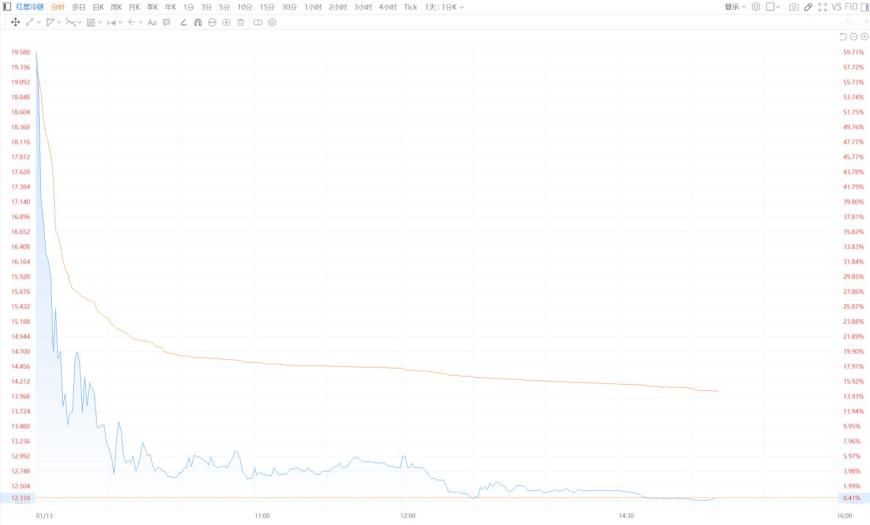
红星冷链破首日上市险些破发 早盘一度大涨60%
Ge Long Hui· 2026-01-13 08:47
Core Viewpoint - Red Star Cold Chain (1641.HK), a frozen food storage service provider, debuted on the Hong Kong Stock Exchange on January 13, 2023, with a significant initial surge in stock price, reflecting strong market interest but also highlighting potential volatility due to concentrated shareholding [1]. Company Overview - Red Star Cold Chain is headquartered in Changsha, Hunan Province, and is the largest provider of frozen food storage services in Central China and Hunan Province, with market shares of 2.6% and 13.6% respectively [1]. - In the frozen food store leasing market, it ranks as the second-largest provider in Central China (8.8% market share) and the largest in Hunan Province (54.7% market share) [1]. IPO Details - The company offered a total of 23.263 million shares, with 10% allocated for public sale in Hong Kong [1]. - The net proceeds from the IPO will be used for constructing a new processing plant, expanding frozen food storage warehouses, upgrading existing equipment and IT infrastructure, investing in artificial intelligence technology, seeking strategic acquisitions, and general corporate purposes [1]. Shareholding Structure - The share distribution indicates a high concentration of ownership, with the largest shareholder holding 20.8% of the international offering shares, and the top five shareholders collectively owning 73.9% [4][5]. - After the IPO, the largest shareholder will still hold 17.7% of the total issued H-shares, while the top five will own 63.0% [6].

道路测试 助力汽车“实战练兵”(专家点评)
Ren Min Ri Bao· 2026-01-10 22:03
Core Viewpoint - The article highlights the development of intelligent connected vehicles in China, emphasizing the role of Chongqing as a testing ground for advanced driving technologies and the integration of various resources to enhance the automotive industry [1] Group 1: Testing and Development - Chongqing's mountainous terrain with complex road conditions serves as an ideal environment for testing and refining assisted and autonomous driving technologies [1] - The Western (Chongqing) Science City integrates road resources to facilitate real-world testing, creating a positive cycle of "testing—research and development—improvement" [1] - China has established 17 national-level intelligent connected vehicle testing demonstration zones, with over 35,000 kilometers of testing roads opened [1] Group 2: Market Penetration and Technology Adoption - From January to July 2025, the penetration rate of L2-level passenger vehicles in China reached 62.58%, with over 3 million units equipped with 5G and cellular vehicle networking [1] - The collaborative effect of the industry chain continues to be released, enhancing the safety and reliability of intelligent connected technologies through real-world testing [1] Group 3: Future Outlook - The integration of artificial intelligence in assisted driving functions allows vehicles to better handle complex situations, making these features available in more affordable cars [1] - Local governments are accelerating the improvement of smart road infrastructure, promoting connectivity among vehicles, roads, and cloud services, leading to new travel services and industry highlights [1] - An increasing number of intelligent connected vehicles are expected to transition from testing environments to everyday use, revitalizing China's automotive industry [1]
今年农业生产支持政策多
Xin Lang Cai Jing· 2026-01-09 18:43
Group 1 - The city will provide a reward of 50,000 yuan for each enterprise that obtains national plant variety rights, promoting a commercial breeding system led by enterprises [1] - Financial subsidies for large-scale grain production will be implemented, including 100 yuan per mu for oilseed planting over 50 mu, 200 yuan per mu for wheat, rice, and corn planting over 50 mu, and 400 yuan per mu for hybrid rice and corn seed production over 100 mu [1] Group 2 - The city will continue to support agricultural managers with financial support policies and pension insurance subsidies, with a contribution rate of 20% based on 60% of the previous year's average provincial salary [2] - Financial assistance for facility agriculture includes a maximum of 40% subsidy for vegetable production facility upgrades, capped at 2 million yuan per project, and 30% for new cold storage facilities, capped at 1 million yuan [2] - For the renovation of cold storage facilities, a subsidy of 40% of the total cost will be provided, with a maximum of 200,000 yuan per entity [2]
模拟深空环境 提升心理韧性
Ke Ji Ri Bao· 2026-01-06 01:13
Core Insights - The first cave training for astronauts in China has been successfully completed, involving 28 astronauts over a period of 6 days and 5 nights in Wulong District, Chongqing [1] Group 1: Cave Training Overview - Cave training simulates extreme conditions similar to space, such as isolation, confinement, and high risk, and was conducted in a selected cave after extensive site assessments across multiple provinces [2] - The training included tasks such as cave exploration, scientific research, resource management, and life support, with astronauts facing challenges like narrow passages, cliff climbing, and psychological stressors [2] Group 2: Objectives of Cave Training - The training aims to enhance astronauts' abilities in danger response, autonomous work, teamwork, emergency decision-making, scientific investigation, physical endurance, and psychological resilience in extreme environments [4] - The training also serves as a comprehensive assessment of astronauts, focusing on fostering their autonomy and psychological resilience through reduced support interventions [4] Group 3: Innovations in Training Methods - The cave training featured over ten subjects, including environmental monitoring and team psychological behavior training, while also conducting seven scientific studies on human interaction with extreme environments [3] - The training model was efficient, with astronauts completing cave and jungle training in a month, optimizing time and human resources [3] - New training methods and technologies have been developed, including mixed reality training devices and psychological endurance training systems, to enhance astronauts' capabilities [6][7]
两部门联合印发《指导意见》—— 加快建设主配微协同的新型电网平台
Ke Ji Ri Bao· 2026-01-05 09:14
Core Insights - The "Guiding Opinions" issued by the National Development and Reform Commission and the National Energy Administration aim to systematically clarify the overall approach and tasks for the development of the power grid in the near future, accelerating the construction of a new type of grid platform that integrates main, distribution, and micro grids to promote high-quality development of the power grid [1][2] Group 1: Development Goals - By 2030, a new type of grid platform will be initially established, with the main grid and distribution grid as the foundation and smart micro grids as a beneficial supplement, enhancing the optimization of power grid resource allocation [1] - The "West-to-East Power Transmission" capacity is expected to exceed 420 million kilowatts, with an additional inter-provincial power exchange capacity of around 40 million kilowatts, supporting renewable energy generation to account for approximately 30% of total generation [1] - By 2035, the development of the main grid, distribution grid, and smart micro grid will be fully coordinated, with improved safety governance mechanisms and enhanced intelligence and digitalization levels throughout the lifecycle of grid facilities [1] Group 2: Planning and Construction - The "Guiding Opinions" emphasize the need for unified planning and construction of power grids at all levels, optimizing the collaborative development of main, distribution, and micro grids [2] - It calls for orderly advancement of cross-provincial and cross-regional transmission channel planning and construction, enhancing the structure of the main grid framework [2] - Increased investment in the power grid is necessary to facilitate the construction of new distribution systems and smart micro grids tailored to local conditions [1][2] Group 3: Power Dispatch System - The "Guiding Opinions" propose strengthening the top-level design of the power dispatch system to enhance flexibility and adaptability, ensuring efficient integration with power market operations [2] - It aims to transition the power grid control model from a focus on the main grid to a collaborative approach involving main, distribution, and micro grids [2] - The development of a comprehensive intelligent perception, centralized analysis and decision-making, distributed monitoring and control, and efficient cloud-edge collaboration power dispatch control system is emphasized [2] Group 4: Technological Innovation - The "Guiding Opinions" require strengthening key technological breakthroughs in the power grid, focusing on stability analysis and control technologies for new power systems, as well as collaborative planning and operational dispatch technologies for main and micro grids [2] - The integration of artificial intelligence and digital technologies into power grid operations is encouraged, promoting their application in planning, equipment management, operational control, supply services, and safety defense [2] - The overall approach includes unified planning, coordinated operational control, comprehensive safety governance, and innovative technology management to support China's modernization efforts [2]