人文经济

Search documents
文化新观察·年度文化亮点丨文旅产业加速蝶变
Xin Hua Wang· 2025-12-29 11:04
Core Viewpoint - The cultural and tourism industry in China is undergoing a significant transformation, with a focus on deep integration of culture and tourism to enhance economic growth and social development [4][8][17]. Group 1: Cultural and Tourism Development - Huanggang Village in Guizhou has been recognized as a "Best Tourism Village" by the UN, leading to a surge in visitors, with 6.14 million tourists and a revenue of 6.403 billion yuan in 2023, marking a 14.97% and 10.26% increase respectively [4][3]. - The national statistics indicate a double-digit growth in retail sales of cultural and recreational services, reflecting a robust demand for service consumption [4][8]. - The integration of cultural heritage and tourism is becoming a key driver for local economies, as seen in regions like Ningxia and Liaoning, where cultural events and tourism routes are being developed to attract visitors [5][7]. Group 2: Economic Impact and Employment - The cultural tourism sector is becoming a major source of employment and entrepreneurship for young people, with significant visitor numbers and spending reported in regions like Xixia District, which welcomed 15.608 million tourists and generated 11.1 billion yuan in revenue [7][5]. - The report from the State Council highlights the mutual benefits of cultural and tourism industries, contributing to the optimization of industrial structures and creating new growth points for the national economy [8][9]. Group 3: Innovation and New Business Models - The rapid growth of new cultural and tourism experiences, such as the LEGO Land in Shanghai, which attracted over 1 million visitors in just four months, showcases the importance of innovative and immersive experiences in attracting tourists [14][16]. - The development of new cultural experiences and digital engagement is reshaping the tourism landscape, with a focus on personalized and diverse cultural leisure resources [16][12]. - The emphasis on cultural empowerment in economic development aims to foster new business models and growth points, enhancing the overall quality of life for citizens [17][13].

以“人文经济”推进常熟乡村全面振兴
Xin Hua Ri Bao· 2025-12-25 23:55
Core Viewpoint - The New Era Humanistic Economics proposed by General Secretary Xi Jinping provides significant theoretical support for the comprehensive revitalization of rural areas in China, with Changshu leveraging its unique geographical advantages and rich cultural heritage to pursue a differentiated path of rural revitalization [1] Group 1: Humanistic Empowerment of Industrial Development - Changshu integrates historical and cultural "soft power" into industrial development, achieving a value transition from "selling products" to "selling culture" [2] - The city activates local specialty products' value through cultural IP, exemplified by the "Yushan Green Tea" brand and related cultural tourism projects [2] - Changshu transforms cultural tourism resources into consumption vitality, creating immersive cultural experiences that engage visitors as participants rather than mere observers [2] - The city repurposes idle assets to cultivate economic growth points, transforming old factories into vibrant cultural consumption hubs that enhance regional tourism revenue [2] Group 2: Cultural Heritage and Spiritual Foundation - Changshu emphasizes the protection and creative transformation of historical cultural heritage, providing strong spiritual motivation for rural revitalization [3] - The city promotes the active transmission of intangible cultural heritage through various educational and celebratory initiatives [3] - Changshu systematically surveys and restores tangible cultural heritage, preserving historical features and cultural essence [3] - The city fosters a new rural civilization by promoting moral values and community engagement through various cultural activities [3] Group 3: Governance and Community Engagement - Changshu utilizes humanistic ties to build a new governance model characterized by multi-party collaboration and shared benefits [4] - The establishment of platforms like "villager councils" empowers residents to participate in decision-making processes related to local development [4] - The city encourages social participation in governance, leveraging local talents for community development and cultural initiatives [4] - Changshu implements a human-centered approach in community services, enhancing social bonds and residents' sense of belonging [4] Group 4: Ecological Sustainability and Coexistence - Changshu practices the philosophy of "lucid waters and lush mountains are invaluable assets," promoting green production and living methods for harmonious coexistence with nature [5] - The city develops ecological agriculture and promotes sustainable practices to protect local ecosystems while enhancing economic and aesthetic values [5] - Changshu focuses on improving rural living environments through landscape and ecological restoration projects [5] - The city advocates for green living through cultural promotion and community engagement, embedding ecological values into local customs and practices [5]
人文经济等多种经济形态屡被提及,有何内涵?丨聚焦河源市委全会
Sou Hu Cai Jing· 2025-12-12 17:48
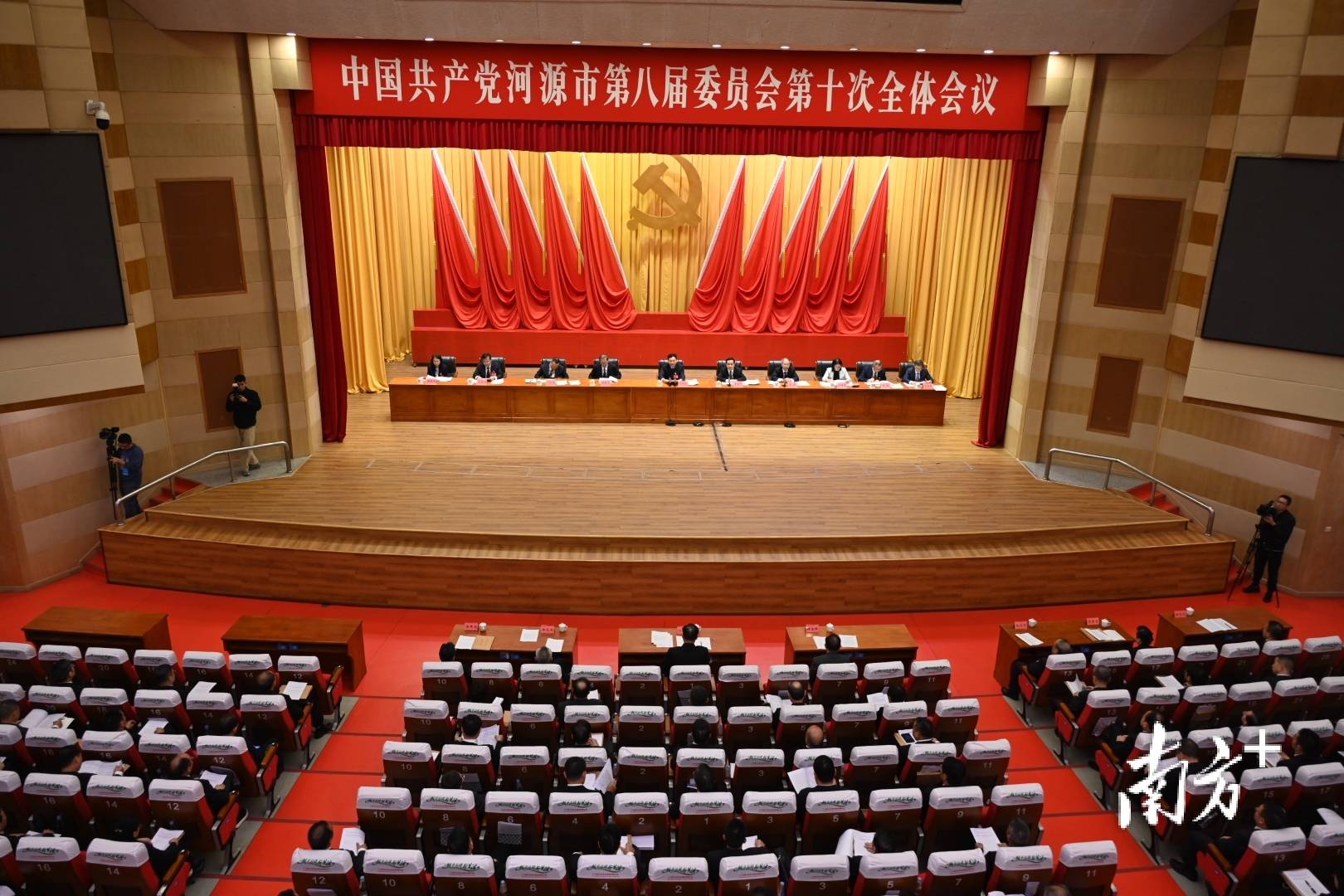
Core Points - The meeting of the Eighth Committee of the Communist Party of China in Heyuan City highlighted the focus on various emerging economic forms, including low-altitude economy, intelligent economy, and others, as part of the "14th Five-Year Plan" [1][4][18] Group 1: Low-altitude Economy - The low-altitude economy is defined as a comprehensive economic form that integrates the research, production, sales, and related infrastructure of civil aviation aircraft operating in low-altitude airspace [4] - Heyuan is actively developing low-altitude economy through practical initiatives, such as establishing a spaceport in Wanlv Lake and creating a low-altitude tourism base [6] - The low-altitude economy aims to address efficiency bottlenecks in logistics, agriculture, and emergency services, facilitating the transition to high-end, intelligent, and new-quality industries [6] Group 2: First-release Economy - The first-release economy refers to economic activities related to the launch of new products, business models, and services by enterprises [7] - Heyuan is fostering the first-release economy by developing a sports and toy industry cluster, attracting over 20 toy manufacturing companies, and achieving a toy manufacturing output value of 5.29 billion yuan, a 40.4% year-on-year increase [8][12] Group 3: Intelligent Economy - The report emphasizes the construction of an innovation framework called "one core, two belts, and three zones" to promote the development of the intelligent economy [13] - The integration of artificial intelligence across various sectors is expected to create new industries and business models, with significant advancements in agricultural productivity through automation [13] Group 4: Green Economy - The report calls for the vigorous development of the green economy, focusing on the integration of digitalization, intelligence, and sustainability [16] - Heyuan's green economy initiatives include the establishment of zero-carbon parks and green factories, leveraging its strong ecological advantages to support high-quality development [16] Group 5: Fly Economy and Fly-Sea Economy - The report discusses the enhancement of "fly economy" and "fly-sea economy" development models to promote resource sharing and collaborative growth between different regions [17] - The establishment of the Heyuan Longchuan (Baoan) Technology Innovation Center exemplifies the practical application of these economic models, with a projected output value of 290 million yuan in 2024 [17] Group 6: Bay Area, River Basin, and Urban Circle Economy - The report highlights the importance of actively participating in the Bay Area, river basin, and urban circle economies to achieve broader resource sharing and market integration [18] - Heyuan's geographical proximity to the Guangdong-Hong Kong-Macao Greater Bay Area positions it favorably for industrial collaboration and innovation [18] Group 7: Cultural and Sports Economy - The report emphasizes the development of the cultural economy, focusing on enhancing the spiritual life of the people and promoting creative rural economies [22] - The sports economy is also highlighted, with initiatives to host various sports events to enhance the region's reputation as a destination for outdoor activities [22]
109次提到产业,广东“十五五”规划抢占8大新风口
2 1 Shi Ji Jing Ji Bao Dao· 2025-12-08 13:21
Core Insights - The Guangdong "14th Five-Year Plan" emphasizes the importance of industrial development, mentioning "industry" 109 times, and introduces eight new economic sectors for future growth [1] - The plan aims to create a modern industrial system with a focus on "technology and industry mutually reinforcing" and "building a modern industrial system" [1] Group 1: New Economic Sectors - The eight new economic sectors include low-altitude economy, smart economy, primary economy, bay area economy, green economy, cultural economy, sports economy, and silver economy, which are designed to foster international competitiveness [1] - The low-altitude economy is highlighted as the first sector, focusing on low-cost, high-frequency, and reliable low-altitude flights, with a goal to develop infrastructure and a smart network system across the province [2] - The smart economy emphasizes the integration of data, computing power, and large models to innovate smart terminal products and promote AI applications, aiming to create a new model of human-machine collaboration [3] Group 2: Strategic Actions - The plan outlines specific actions for modernizing the industrial system, including nurturing emerging industries and future industries, and implementing innovation projects [4] - Key industries targeted for development include new energy, new materials, commercial aerospace, and low-altitude economy, with a focus on strengthening sectors like new energy vehicles, integrated circuits, and medical devices [4] - The plan also aims to explore new economic growth points in quantum technology, biomanufacturing, hydrogen energy, and brain-machine interfaces, while promoting the development of specialized small and medium enterprises [5]
“工业顶流”顺德押宝人文经济,在下一盘什么棋?
2 1 Shi Ji Jing Ji Bao Dao· 2025-11-11 10:11
Core Insights - Shunde is shifting its focus towards a "cultural economy" strategy to address the structural imbalance between its strong manufacturing sector and weak urban development, aiming to create a more attractive living environment for talent [1][2] Group 1: Strategic Initiatives - Shunde plans to implement four key pathways: 1. **Cultural Integration**: Each town will develop unique historical and cultural districts to create a cohesive urban space, breaking the separation between work and living environments [2] 2. **Cultural and Economic Fusion**: Encouraging enterprises to transition from merely producing goods to embedding cultural elements into their products, thus shifting from scale competition to value competition [2] 3. **Cultural Governance**: Integrating Shunde's cultural identity into urban governance, enhancing the human aspect of administrative processes and reducing barriers between government and enterprises [2] 4. **Cultural Branding**: Developing cultural elements such as Cantonese opera and dragon boat racing into major cultural IPs to drive a dual-brand strategy of "industry + culture" [2] Group 2: Economic Context - The shift towards a cultural economy is driven by the increasing importance of emotional value in consumer spending, as China's per capita GDP exceeds $13,000, indicating a transition from material to spiritual consumption [1] - The World Tourism Organization estimates that every unit of cultural investment can yield 3 to 5 times the economic return, highlighting the potential benefits of Shunde's strategy [1] Group 3: Future Vision - Shunde aims to evolve from a "manufacturing node" to a "cultural-manufacturing composite hub," where the city is recognized not only for its production capabilities but also for its livable and experiential urban life [3]
人文经济绘就江南新景
Su Zhou Ri Bao· 2025-11-07 00:16
Core Insights - The article emphasizes the cultural and economic integration in Changshu, particularly in the Yushan area, which is recognized as a hub for outdoor sports and cultural activities [1][5][13] Group 1: Cultural Heritage and Urban Development - Changshu has over 3,000 years of cultural heritage, with Yushan being a significant site for historical figures and cultural movements [2] - The preservation of ancient architecture alongside modern establishments fosters a harmonious coexistence of tradition and innovation [2][3] - Various projects, such as the renovation of historical residences into cultural spaces, enhance the cultural experience while promoting tourism [2][3] Group 2: Economic Growth through Cultural Tourism - The Yushan area has become a new hotspot for cultural and sports tourism, with events like cycling competitions and triathlons attracting participants from around the world [5][6] - The development of hiking trails and cultural creative industries has led to a significant increase in tourist visits, with the "Eagle Line" trail receiving approximately 2.3 million visitors from January to October, a 20% increase year-on-year [6][11] - The integration of local culture with tourism initiatives, such as themed markets and creative workshops, enhances the overall visitor experience [7][8] Group 3: Community Engagement and Economic Ecosystem - The Yushan area is fostering a community of cultural practitioners and outdoor enthusiasts, contributing to a vibrant local economy [12][13] - Initiatives like the "Lake Mountain Life Curator Plan" encourage young entrepreneurs to establish businesses that reflect local culture and lifestyle [12] - The region is building a symbiotic ecosystem that combines culture, urban development, and economic vitality, aiming for a holistic improvement in quality of life [13]
新华时评:“苏超”超越了啥?
Xin Hua She· 2025-11-05 03:26
Core Insights - The "Su Super" league in Jiangsu Province has concluded with significant engagement, including 78 regular matches and 7 knockout matches, attracting over 2 billion online viewers, marking it as a landmark event in China's amateur sports scene for 2025 [1][2] - The league's success is attributed to its focus on community involvement, transforming spectators into participants and enhancing local cultural and economic integration through sports [1] Group 1 - The "Su Super" league has effectively combined competitive sports with urban cultural attributes and tourism economic aspects, creating a new model for cultural economy [1] - The league's players come from diverse professions, including teachers and civil servants, broadening its audience beyond traditional football fans to include ordinary citizens [1] - The emotional connection fostered by the league has become a driving force for urban development, linking individual efforts to collective city goals [1] Group 2 - The phenomenon of "Su Super" reflects a shift in China's consumption structure from product-driven to service-driven consumption, highlighting the importance of cultural supply in meeting public demand [2] - The league has the potential to connect various industries such as tourism, dining, and retail, creating a consumption loop that enhances economic growth [2] - Local cultural resources are being leveraged to create unique brands, with community sports events injecting new vitality into high-quality economic development [2]
人文经济学圆桌对话会举行
Su Zhou Ri Bao· 2025-10-31 23:07
Core Insights - The roundtable dialogue titled "Cultural Creativity Makes Life Better" was held in conjunction with the 2025 Suzhou World Cultural and Creative Conference, focusing on the integration of humanities and economics [1] - Experts discussed how cultural creativity can drive high-quality economic development and contribute "Chinese wisdom" and "Suzhou solutions" to the global cultural and creative industry [1] Group 1: Event Overview - The event took place at the Jinji Lake International Conference Center, attended by key officials including Jin Jie, a member of the municipal standing committee and head of the publicity department [1] - The dialogue featured six top experts from various fields, including John Hawkins, known as the "father of the creative economy," who provided insights on the deep integration of cultural creativity with economy and life [1] Group 2: Key Themes - Discussions covered a range of topics including creative economy, industrial policy, theoretical logic, and cultural consumption, emphasizing the importance of cultural creativity in enhancing life quality [1] - The event included the sharing of the "Humanities Economy 'Suzhou Sample' Research Report" and a recommendation for the new book "Suzhou Humanities Economic Case Library" [1]
资本赋能、资源重构、价值共创——海昌海洋公园与祥源控股开启文旅合作新范式
Xin Lang Cai Jing· 2025-10-18 11:02
Core Insights - The announcement from Haichang Ocean Park Holdings indicates that Xiangyuan Holdings has completed a capital injection of HKD 22.95 billion, acquiring a 38.60% stake and becoming the controlling shareholder, marking a new phase of collaboration in the cultural tourism sector [1][3][5] - This partnership is expected to accelerate Haichang's development and potentially reshape the value chain of China's cultural tourism industry, driving it into a new era of resource integration and innovation [1][3] Group 1: Capital Injection and Shareholding Structure - Haichang Ocean Park issued 5.1 billion shares at a subscription price of HKD 0.45 per share, raising a total of HKD 22.95 billion, with a net amount of HKD 22.84 billion after expenses [3][5] - Following the subscription, Xiangyuan Holdings holds a 38.60% stake, while Zeqiao Holdings maintains a 29.04% stake [3][5] Group 2: Utilization of Funds - The funds raised will be primarily used for daily operations, enhancing core business areas such as theme park operations, operational services, and intellectual property development, as well as repaying part of the debt [5] - The focus will be on upgrading park facilities, strengthening animal conservation capabilities, and expanding light asset output and IP business [5] Group 3: Strategic Collaboration and Governance - The governance structure will remain stable, with a focus on strategic, business, and core team continuity, leveraging both companies' resource advantages for enhanced management and operational efficiency [5][10] - The collaboration is seen as a strategic fit in terms of development philosophy, aiming for long-term growth through resource complementarity and synergy [5][10] Group 4: Market Position and Competitive Advantage - Haichang Ocean Park is recognized as a leading developer and operator of marine-themed parks in China, with a unique three-pronged model of "theme parks + IP ecosystem + OAAS" [6][7] - The company has established several flagship projects and has a strong brand influence, supported by a rich operational management experience [6][7] Group 5: Future Outlook and Innovation - The partnership aims to drive deep integration and innovative development across various aspects of the cultural tourism industry [10][11] - There will be a focus on shared customer resources, innovative product offerings, and the creation of unique cultural tourism experiences through IP collaboration and OAAS business models [11][10]

“双节”同辉!国庆中秋假期交出活力满满“成绩单”
Xin Hua She· 2025-10-09 23:12
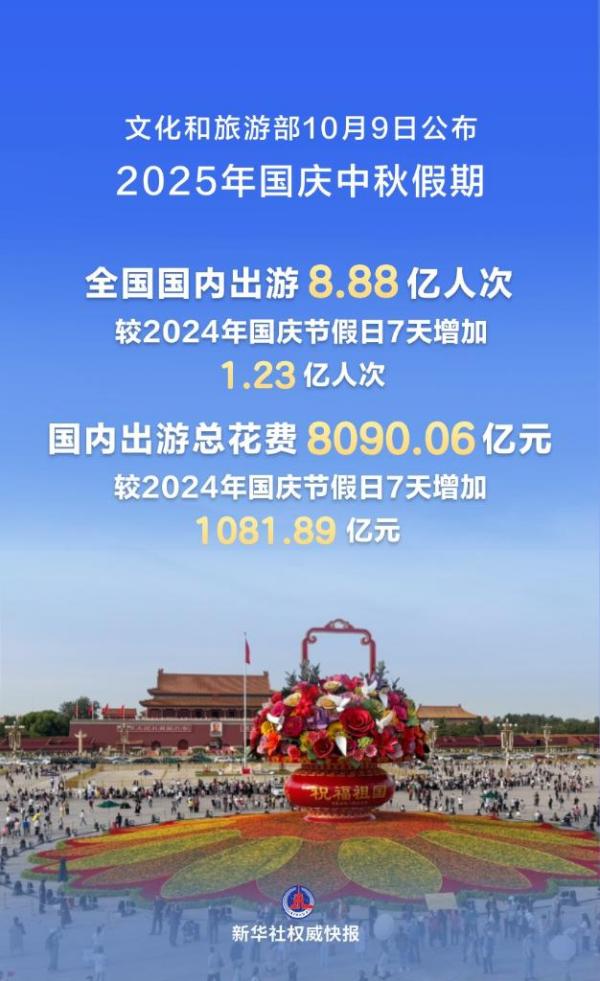
Core Insights - The recent National Day and Mid-Autumn Festival holiday period saw significant increases in travel and tourism activity across China, indicating a robust recovery in consumer behavior and economic activity [1][4][10] Group 1: Travel and Transportation - From October 1 to 8, a total of 2.433 billion people traveled across regions, averaging 304 million daily, which is a 6.3% increase compared to the same period in 2024 [1] - The holiday period recorded 888 million domestic trips, an increase of 123 million compared to the 7-day National Day holiday in 2024 [1] - The introduction of new transportation infrastructure, including highways and high-speed rail, has enhanced travel convenience, contributing to record-high traffic during the holiday [4] Group 2: Economic Impact - Domestic tourism spending reached 809 billion yuan, an increase of 108.2 billion yuan compared to the previous year [1] - The film industry also saw a boost, with box office revenues during the National Day period reaching 1.835 billion yuan, with 50.07 million moviegoers [1][10] - The "night economy" thrived, with night tourism searches on travel platforms increasing over 200%, and venues like museums experiencing a surge in nighttime visitors [6][10] Group 3: Cultural Significance - The holiday period was marked by a strong cultural engagement, with significant attendance at historical sites and cultural events, reflecting a blend of national pride and tourism [6][8] - Films released during the holiday resonated with themes of family and patriotism, driving both box office success and cultural engagement [8][10] - Family travel accounted for over 40% of holiday trips, with younger demographics showing the highest spending growth [10]