医保药品目录调整

Search documents
价格大降!武汉今起执行
Xin Lang Cai Jing· 2026-01-01 02:19
Core Insights - The new National Medical Insurance Drug List and Commercial Health Insurance Innovative Drug List will be implemented in Wuhan starting January 1, 2026, focusing on "clinical urgency, affordability, and diverse coverage" [1] - The updated list includes 114 new drugs, with a significant emphasis on oncology and rare diseases, complementing the basic medical insurance coverage [2][5] Summary by Sections New Drug Inclusion - The revised National Medical Insurance Drug List now includes a total of 3,253 drugs, with 1,857 Western medicines and 1,396 traditional Chinese medicines [2] - Among the 114 newly added drugs, 50 are classified as innovative drugs, achieving a high inclusion success rate of 88%, with over 90% being newly approved in the last five years [2] Price Reductions - The average price reduction for the newly included drugs is 63%, with some high-profile drugs seeing reductions exceeding 70% [3] - For instance, the monthly cost of the drug Tirzepatide, previously between 1,700 to 2,000 yuan, is now reduced to 324.1 yuan for the 2.5 mg dosage and 936.7 yuan for the 10 mg dosage, significantly lowering the annual burden for patients in Wuhan by over 15,000 yuan [3] Commercial Health Insurance Innovations - The first edition of the Commercial Health Insurance Innovative Drug List includes 19 high-value innovative drugs, addressing gaps in basic medical insurance coverage [5] - This list features CAR-T cell therapy drugs and treatments for rare diseases, with some therapies costing over 400,000 yuan annually [5] Dual-Channel System Expansion - The dual-channel drug list has expanded to 621 drugs, significantly increasing from the previous version [7] - This includes 321 drugs for targeted therapies, rare diseases, infectious diseases, and mental health, with specific policies for outpatient special diseases to ensure precise benefit delivery [7] Streamlined Processes - All designated retail pharmacies in Wuhan have implemented electronic prescription systems, allowing patients to choose between hospital pharmacies and designated stores for immediate reimbursement [7] - The new system aims to enhance efficiency and reduce patient wait times, promoting a more convenient healthcare experience [7] Collaboration and Communication - Wuhan is establishing a continuous communication platform between pharmaceutical companies and medical institutions to facilitate the understanding of new drug characteristics and supply [8] - By February 2026, all medical institutions are required to adjust their drug procurement processes to ensure the availability of newly negotiated drugs [8]
——医药生物行业周报:2025年医保药品目录和首个商保药品目录公布-20251214
Guohai Securities· 2025-12-14 10:28
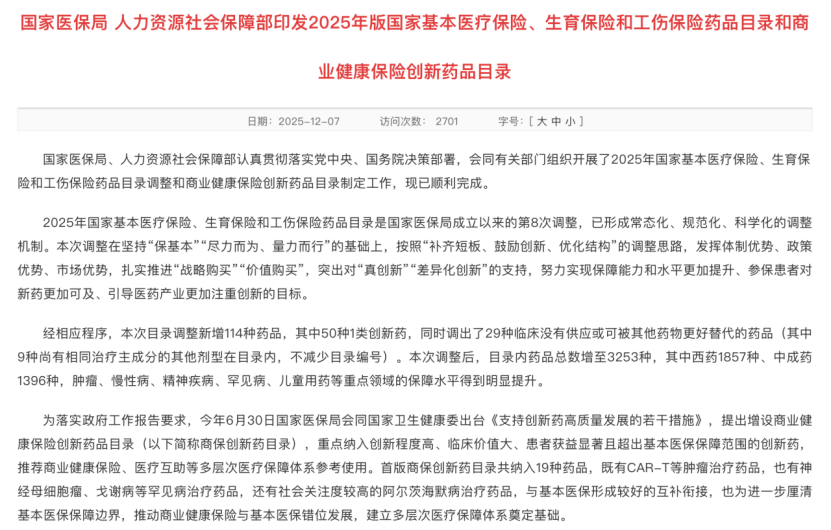
Investment Rating - The report maintains a "Neutral" rating for the pharmaceutical and biotechnology industry [1]. Core Insights - The 2025 National Basic Medical Insurance Drug List has been published, adding 114 new drugs, with a negotiation/competitive bidding success rate of 88%, higher than the 76% in 2024. The total number of drugs in the insurance list has increased to 3,253, including 1,857 Western medicines and 1,396 traditional Chinese medicines [12]. - The pharmaceutical sector has underperformed compared to the CSI 300 index, with a year-to-date return of 14.65% against the CSI 300's 16.43%, resulting in a 1.77 percentage point lag [21]. - The current valuation of the pharmaceutical sector is 33.0 times PE based on 2026 earnings forecasts, representing a 41% premium over the overall A-share market (excluding financials) [21]. Summary by Sections Recent Performance - The pharmaceutical and biotechnology sector has seen a decline of 1.04% in the past week, ranking 17th among 31 primary sub-industries. The sub-sectors of chemical pharmaceuticals, biological products, medical devices, pharmaceutical commerce, traditional Chinese medicine, and medical services have experienced weekly changes of -0.75%, -1.85%, -1.79%, -4.26%, -2.03%, and +1.67%, respectively [11][22]. Market Dynamics - The pharmaceutical sector's performance from the beginning of 2025 to December 12 shows a return of 14.65%, while the CSI 300 index returned 16.43%, indicating a relative underperformance of 1.77 percentage points [21]. Valuation Analysis - The current valuation of the pharmaceutical sector is 29.0 times PE based on trailing twelve months (TTM) earnings, which is below the historical average of 35.0 times PE from January 4, 2010, to December 12, 2025. The sector's premium over the overall A-share market (excluding financials) is 16.3% [21]. Industry Developments - The first commercial health insurance drug list has been established, including 19 drugs that enjoy various policy benefits. This list is effective from January 1, 2026, to December 31, 2027, and includes five CAR-T products [12].
英矽智能港股IPO获中国证监会备案;明基医院通过港交所聆讯
2 1 Shi Ji Jing Ji Bao Dao· 2025-12-10 23:41
Policy Developments - The National Healthcare Security Administration (NHSA) explained the "dual catalog" for the 2025 medical insurance drug list, adding 114 new drugs, including 105 negotiated new drugs, 7 competitive bidding drugs, and 2 directly transferred from national procurement [1] - Among the new drugs, 111 are newly launched within the last five years, accounting for nearly 98%, with 50 being Class 1 new drugs, marking a historical high in both proportion and quantity [1] - The new drugs cover key treatment areas such as oncology, anti-infection, chronic diseases, rare diseases, and mental illnesses [1] - The NHSA also released the first commercial insurance innovative drug catalog, including 19 innovative drugs from 18 companies, with 9 being Class 1 new drugs, approximately 50% of the total [1] Drug and Device Approvals - Fuan Pharmaceutical's subsidiary received a drug registration certificate for injectable isavuconazole, indicated for treating invasive aspergillosis and mucormycosis in adult patients [2] - Zhendong Pharmaceutical's investee company, Longchuang Pharmaceutical, had its new drug application for a vaginal probiotic capsule accepted by the National Medical Products Administration [3] Capital Markets - Mingji Hospital Group passed the listing hearing on the Hong Kong Stock Exchange, with CICC and Citigroup as joint sponsors [4] - Yifang Bio announced plans to issue H-shares and apply for listing on the Hong Kong Stock Exchange [5] - Insilico Medicine received approval from the China Securities Regulatory Commission for its overseas IPO, planning to issue up to 108,894,000 shares [6] - Huatai Medical plans to repurchase shares with a total amount between 200 million and 250 million yuan, with a buyback price not exceeding 315 yuan per share [8] Industry Developments - Nanjing Pharmaceutical's subsidiary plans to invest 398 million yuan in a modern pharmaceutical logistics expansion project, with a construction period of approximately 35 months [9] - Buchang Pharmaceutical's subsidiary plans to establish a new company with a registered capital of 1 million yuan, aimed at expanding its business scope [10] - Fosun Pharma's subsidiary, Yaoyou Pharmaceutical, signed a licensing agreement with Pfizer for a GLP-1 receptor agonist, with potential payments totaling up to 158.5 million dollars based on sales milestones [11] Public Opinion Alerts - Rhein Biotech is planning a change in control and intends to acquire at least 80% of Beijing Jinkangpu's equity, with the stock expected to be suspended for up to 10 trading days starting December 10, 2025 [12]
首版商保创新药目录发布,恒生创新药ETF(159316)获资金持续加仓
Sou Hu Cai Jing· 2025-12-10 11:14
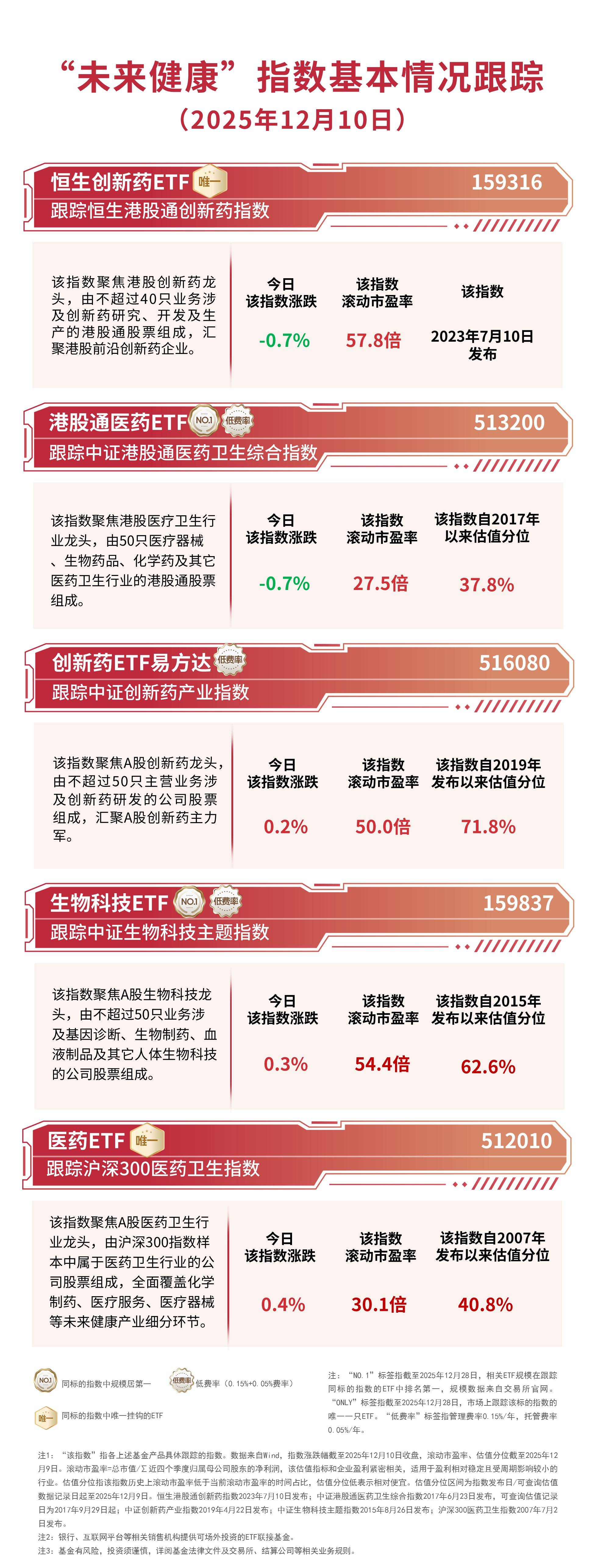
Core Viewpoint - The pharmaceutical sector is experiencing volatility, with Hong Kong stocks continuing to adjust while A-share pharmaceutical stocks saw a slight rebound in the afternoon. The overall market indices for innovative drugs and biotechnology are mixed, indicating varied investor sentiment in the sector [1]. Group 1: Market Performance - The Hang Seng Hong Kong Stock Connect Innovative Drug Index and the CSI Hong Kong Stock Connect Pharmaceutical and Health Comprehensive Index both declined by 0.7% [1]. - The CSI Innovative Drug Industry Index increased by 0.2%, while the CSI Biotechnology Theme Index rose by 0.3% [1]. - The CSI 300 Pharmaceutical and Health Index saw a gain of 0.4%, reflecting continued capital inflow into the sector [1]. Group 2: Fund Flows - The Hang Seng Innovative Drug ETF (159316) attracted a total of 140 million yuan in the previous two trading days, with an additional net subscription of nearly 10 million shares today [1]. Group 3: Policy Updates - The National Medical Insurance Drug List for 2025 and the first version of the Commercial Health Insurance Innovative Drug List (2025) will be released on December 7, marking the 8th adjustment since the establishment of the National Medical Insurance Bureau [1]. - A total of 114 new drugs will be added to the list, including 50 first-class innovative drugs, targeting key areas such as cancer, chronic diseases, mental health, rare diseases, and pediatric medications [1].

中新健康丨“换汤不换药”不是真创新 “4不改”药品难进医保目录
Zhong Guo Xin Wen Wang· 2025-12-09 17:23
Group 1 - The core point of the article is the announcement of the 2025 National Medical Insurance Drug List, which includes a record number of new drugs, emphasizing the focus on genuine innovation in the pharmaceutical sector [1][2] - The 2025 version of the drug list adds 111 new drugs, with 50 classified as first-class new drugs, marking the highest number and proportion in history [1] - The adjustments to the drug list reflect a stricter evaluation process, where drugs that do not meet certain criteria, such as "4 unchanges" drugs and those with exorbitant pricing, are unlikely to pass expert review [1][2] Group 2 - The new drug list includes 114 drugs, with 105 added through negotiations, 7 through competitive bidding, and 2 directly from national procurement, while 29 drugs have been removed due to clinical replacements or long-term supply issues [1] - As of October 2025, the cumulative payment from the medical insurance fund for negotiated drugs exceeds 460 billion yuan, benefiting over 1 billion patients and driving related sales over 670 billion yuan [2] - The evaluation criteria for new drugs emphasize the need for significant clinical value, with a focus on preventing the inclusion of drugs that are expensive or easily abused [2]
“救命药”进医院,最后一公里咋破
Qi Lu Wan Bao· 2025-12-08 21:48
Core Insights - The 2025 version of the National Basic Medical Insurance, Maternity Insurance, and Work Injury Insurance Drug Directory has been officially released, adding 114 new drugs, including 50 innovative drugs, while removing 29 drugs that are either not clinically available or can be replaced by better alternatives [1][2] - The total number of drugs in the directory has increased to 3,253, with significant improvements in coverage for key areas such as cancer, chronic diseases, mental health, rare diseases, and pediatric medications [1] - The new directory will be implemented nationwide starting January 1, 2026 [1] Group 1: Drug Inclusion and Economic Impact - The adjustment of the drug directory is a response to public health needs, with the inclusion of innovative and life-saving drugs for conditions like non-small cell lung cancer and cervical cancer [2] - Experts have assessed the budget impact of the new drugs on the medical insurance fund, suggesting that the overall effect will not be significantly detrimental [2] Group 2: Challenges in Hospital Access - Despite the inclusion of "nationally negotiated drugs" in the insurance directory, there are challenges in their availability in hospitals due to limited capacity in hospital drug lists, which typically accommodate only 1,500 to 2,000 drugs [3] - The rapid increase in the number of "nationally negotiated drugs" complicates decisions for hospitals regarding which drugs to include, especially when alternatives already exist [3][4] Group 3: Financial Management and Policy Recommendations - The current budget control system for hospitals means that higher sales of expensive innovative drugs could lead to reduced surpluses or even budget overruns, making hospitals cautious about purchasing "nationally negotiated drugs" [4] - Experts recommend improving incentive mechanisms for the use of "nationally negotiated drugs" and increasing investment in healthcare resources to alleviate financial pressures on hospitals [4] Group 4: Dual-Channel Policy and Payment Innovations - To address the issue of "drugs available in insurance but hard to find in hospitals," a "dual-channel" policy was introduced, allowing patients to access "nationally negotiated drugs" through designated hospitals and retail pharmacies with equal insurance reimbursement [6] - The sales of "nationally negotiated drugs" have significantly increased, from less than 4 billion yuan in 2020 to nearly 15 billion yuan in 2024 [6] - Sichuan Province has implemented a "single payment" policy for high-cost, clinically necessary "nationally negotiated drugs," allowing direct settlement by the insurance fund without affecting hospital budget assessments, thus reducing cost control pressures on hospitals [6]
西藏药业:新活素纳入新版医保目录并“转常规”,惠及更多心衰患者
Zheng Quan Shi Bao Wang· 2025-12-08 10:52
Core Viewpoint - The announcement regarding the inclusion of the drug Xinhuasuan in the national medical insurance drug list indicates a significant shift for the company, as it transitions from a negotiable agreement drug to a stable inclusion in the regular catalog, enhancing long-term revenue predictability [1][2]. Group 1: Product and Market Impact - Xinhuasuan, developed by the company's subsidiary Chengdu Nuodikan Biopharmaceutical Co., Ltd., is a new biological product for treating acute heart failure, which improves patient symptoms and reduces hospitalization costs [1]. - The sales volume for Xinhuasuan is projected to reach 7.0083 million units in 2024, generating revenue of 2.433 billion yuan, with 4.1672 million units and 1.456 billion yuan expected in the first half of 2025 [2]. - The drug's penetration in the large heart failure market remains low, indicating substantial growth potential following its transition to the regular catalog, which will stabilize pricing and support long-term performance growth [2]. Group 2: Additional Developments - The company’s associate, Chentai Pharmaceutical, has also seen its drug Zorifertinib included in the medical insurance catalog, with a negotiation agreement effective from January 1, 2026, to December 31, 2027 [2]. - Zorifertinib is recognized as the first drug targeting advanced non-small cell lung cancer with central nervous system metastasis, which is expected to accelerate its commercial value realization after being included in the insurance catalog [2].

财经早知道|我国外储连续4个月超3.3万亿美元 央行连续13个月增持黄金
Sou Hu Cai Jing· 2025-12-08 00:56
Macro Economy - The Chairman of the China Securities Regulatory Commission, Wu Qing, stated that during the "14th Five-Year Plan" period, the securities industry will undertake four major missions, including serving the real economy and supporting the construction of a financial power [2] - As of the end of November 2025, China's foreign exchange reserves reached $33,464 billion, an increase of $3 billion from the end of October, marking a continuous four-month stay above the $3.3 trillion mark [2] - The People's Bank of China reported that as of the end of November, gold reserves were 74.12 million ounces, an increase of 30,000 ounces from the previous month [3] Industry Trends - The National Healthcare Security Administration and the Ministry of Human Resources and Social Security issued the 2025 drug directory, which includes 114 new drugs, 50 of which are Class 1 innovative drugs [5] - The real estate market is transitioning from a focus on construction to filling properties with people and industries, with current housing prices under pressure due to insufficient usage value [4] - The storage chip market has seen a significant surge in spot prices, with DDR4x chip prices increasing over four times this year, while manufacturers face low inventory levels [6] Company Dynamics - Wuliangye plans to adjust the price of its 52-degree eighth-generation product to 900 yuan per bottle, with potential costs for distributors dropping to around 800 yuan after discounts and rebates [7] - Apple is experiencing significant executive turnover, with key positions related to AI and design seeing resignations, raising concerns about leadership stability [7] - China Life Insurance announced that its vice president is under investigation for serious violations of discipline and law [10]
先声药业(02096):恩泽舒®与恩度®纳入新版国家医保药品目录
智通财经网· 2025-12-07 23:18
Core Insights - The company, Sihuan Pharmaceutical (02096), announced that its drug Enze Shu (injectable Suweisit monoclonal antibody) has been officially included in the National Medical Insurance Catalog for 2025, effective from January 1, 2026 [1] - Additionally, the drug Endu® (recombinant human vascular endothelial inhibitor injection) has successfully completed the renewal process for the National Medical Insurance Drug List (NRDL) [1] Drug Approvals and Indications - Enze Shu is a next-generation recombinant humanized anti-VEGF monoclonal antibody, approved for market in China on June 30, 2025 [1] - It is indicated for the treatment of adult patients with recurrent ovarian cancer, fallopian tube cancer, or primary peritoneal cancer who have received no more than one prior systemic therapy and are platinum-resistant, in combination with paclitaxel, liposomal doxorubicin, or topotecan [1] Market Position and Historical Context - Endu is recognized as China's first anti-angiogenesis targeted drug and the only endothelial inhibitor approved for sale globally [1] - Since its inclusion in the NRDL in 2017, Endu has become a cornerstone treatment for advanced non-small cell lung cancer [1]
重磅利好!15家A股公司,集体公告
Zheng Quan Shi Bao· 2025-12-07 22:47
Core Points - The National Healthcare Security Administration announced the 2025 National Medical Insurance Drug List, which will take effect on January 1, 2026, adding 114 new drugs, including 50 innovative drugs, while removing 29 drugs that are either unavailable or can be replaced by better alternatives [2][4] Group 1: Drug List Adjustments - The total number of drugs in the directory has increased to 3,253, comprising 1,857 Western medicines and 1,396 traditional Chinese medicines, with significant improvements in coverage for key areas such as cancer, chronic diseases, mental illnesses, rare diseases, and pediatric medications [2][4] - The 2025 adjustment marks the 8th update since the establishment of the National Healthcare Security Administration [7] Group 2: Company Announcements - 15 A-share pharmaceutical companies announced that their products have been included in the new directory, with many innovative drug companies benefiting from this inclusion [4] - Zai Lab's drug, Jikaxitinib, has been included in the directory, which is expected to enhance sales and improve patient accessibility [4] - Junshi Biosciences reported that its products, including Toripalimab and an additional indication for another drug, have been successfully included in the directory [4] - Innovent Biologics' drug, IBI301, has also been added to the new directory, marking a significant milestone for the company [5] - Leading A-share pharmaceutical companies like Fosun Pharma, East China Pharmaceutical, and Heng Rui Medicine have also had several products included, with Heng Rui reporting a combined sales figure of approximately 8.66 billion yuan for the newly added drugs in 2024 [6][7]