半导体超级周期

Search documents
大摩闭门会-韩国未来走向何方?中国政府将如何应对疲软的资本支出?投资者对 2026 年有何期待?
2025-12-04 15:36
大摩闭门会-韩国未来走向何方?中国政府将如何应对疲软 的资本支出?投资者对 2026 年有何期待?20251204 摘要 韩国 2026 年 GDP 预计将实现更均衡的复苏,出口增长的同时,国内消 费和投资也将有所提升。财政扩张、通胀稳定和较低利率环境是推动消 费回升的关键因素,政府预算案中对民生、家庭和就业市场的支持将提 供有力支撑。 预计 2026 年韩国通胀率将维持在 2.1%的稳定水平,得益于全球油价 稳定和政府对公共事业价格的控制。韩国央行已降息 100 个基点,虽宽 松周期结束,但利率仍低于去年,对房地产行业有利。 半导体超级周期预计持续,AI 和传统存储芯片需求旺盛,资本支出推动 需求。韩美贸易协定降低不确定性,汽车及机械制造相关资本品出口预 期向好,对美国及全球市场复苏有利。 韩国政府预计在上半年大幅前置预算支出,占全年 70%-80%,以应对 地方政府选举。税收收入前景改善,可能用于支持经济增长。韩国央行 预计维持利率不变,对消费产生积极影响。 Q&A 2026 年韩国经济的增长和宏观政策展望如何? 我们预计 2026 年韩国经济将实现更广泛的复苏,GDP 增长率将反弹至 1.9%。这一复苏 ...
国际产业新闻早知道:美国制造业活动连续九个月萎缩,欧盟将公布经济安全战略创新
Chan Ye Xin Xi Wang· 2025-12-02 05:24
Group 1: US Manufacturing Activity - The US manufacturing activity has contracted for nine consecutive months, with the Purchasing Managers' Index (PMI) dropping from 48.7 in October to 48.2 in November, below the market consensus of 49 [1][2]. Group 2: US Tariff Policy on South Korea - The US Secretary of Commerce confirmed a 15% tariff on imports from South Korea, effective retroactively from November 1, as South Korea has proposed legislation to fulfill strategic investment commitments to the US [3][4]. - This tariff reduction includes automotive products and aims to release the full benefits of the trade agreement between the US and South Korea [5]. Group 3: EU Economic Security Strategy - The EU plans to announce measures to reduce dependence on critical raw materials from China, with a new economic security strategy set to be unveiled [6][8]. - A proposed budget allocation of €3 billion (approximately $3.2 billion) will be directed towards urgent strategic projects related to rare earth and raw materials [7]. Group 4: Japan's Economic Stimulus - The Japanese Cabinet approved a supplementary budget of ¥18.3 trillion (approximately $151.9 billion) to stimulate the economy and address rising living costs [11][12]. - About 60% of this budget will be financed through the issuance of additional government bonds, raising concerns about the sustainability of fiscal policies [13][14]. Group 5: South Korea's Semiconductor Exports - South Korea's semiconductor exports reached a record high of $17.26 billion in November, marking a 38.6% year-on-year increase [48][51]. - The overall export value for South Korea in November was $61.04 billion, with a year-on-year growth of 8.4% [50]. Group 6: Nvidia's Investment Activities - Nvidia has invested $2 billion in Synopsys, a semiconductor design software provider, expanding its partnerships within the AI ecosystem [56]. - The company has also made significant investments in various AI-related enterprises, including a potential $100 billion investment in OpenAI [56]. Group 7: Micron's AI Chip Factory in Japan - Micron Technology plans to invest $9.6 billion to establish a factory in Japan for producing AI storage chips, with production expected to start around 2028 [57][58]. Group 8: BYD's Automotive Sales - BYD reported a total of 4.18 million vehicle sales from January to November, reflecting an 11.3% year-on-year increase [72][76]. - In November alone, BYD sold 480,186 vehicles, setting a new monthly record for the year [73].





半导体早参 | DeepSeek发布新模型,英伟达投资20亿美元入股EDA霸主新思科技
Mei Ri Jing Ji Xin Wen· 2025-12-02 01:29
Market Overview - On December 1, the Shanghai Composite Index rose by 0.65% to close at 3914.01 points, the Shenzhen Component Index increased by 1.25% to 13146.72 points, and the ChiNext Index gained 1.31% to 3092.50 points [1] - The overnight U.S. market saw the Dow Jones Industrial Average decline by 0.90%, the Nasdaq Composite fell by 0.38%, and the S&P 500 dropped by 0.53% [1] Industry News - DeepSeek released two official model versions, DeepSeek-V3.2 and DeepSeek-V3.2-Speciale, with updates available on their official website, app, and API [2] - NVIDIA invested $2 billion in Synopsys at a share price of $414.79, aiming to enhance GPU-accelerated engineering solutions through collaboration in engineering and marketing activities [2] AI Glasses Market - The AI glasses concept stocks in the A-share market gained renewed attention, with major tech companies entering the space. Alibaba launched Quark AI glasses on November 27, which sold out in the first batch [3] - Li Auto is set to hold a launch event for its first AI glasses on December 3, while Meta's new Ray-Ban smart glasses received positive global feedback, and Google is reviving its AI glasses project, potentially launching in Q4 2026 [3] Semiconductor Supply Chain - Samsung Electronics and SK Hynix have become key players in Google's TPU supply chain, with SK Hynix likely to be the preferred supplier for Google's seventh-generation TPU internal HBM3E 8-layer chips [3] - Huajin Securities remains optimistic about the semiconductor supercycle driven by AI, recommending attention to the entire semiconductor industry chain from design to manufacturing and packaging [3] Related ETFs - The Sci-Tech Semiconductor ETF (588170) and its linked funds track the Sci-Tech Board Semiconductor Materials and Equipment Index, focusing on semiconductor equipment (61%) and materials (23%) [4] - The Semiconductor Materials ETF (562590) also emphasizes semiconductor equipment (61%) and materials (21%), highlighting the importance of domestic substitution in the semiconductor industry [4]
AI芯片热潮助推房价起飞!韩国经济迎来"芯片+地产双重超级周期"
Hua Er Jie Jian Wen· 2025-11-21 06:28
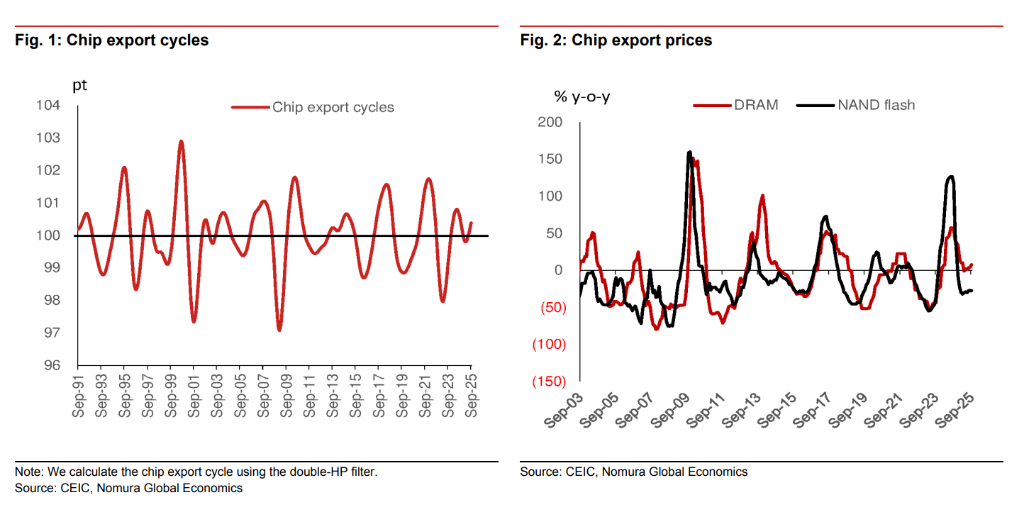
Core Insights - South Korea is experiencing a macroeconomic feast driven by AI, which generates dollars through exports, converting them into domestic liquidity that is ultimately absorbed by the real estate and stock markets [1] Semiconductor Supercycle - The global semiconductor industry is entering a structural uptrend driven by AI computing and cloud infrastructure, marking a significant departure from the cyclical rebounds seen in previous years [1][3] - Nomura forecasts that chip export growth will surge from approximately 25% in 2025 to 50-60% in 2026, indicating a robust demand environment [1][4] Economic Predictions - Nomura maintains a non-consensus view that the Bank of Korea will keep the terminal interest rate at 2.50% for an extended period, dismissing further rate cuts [3][21] - The GDP growth forecast for South Korea has been raised from 1.9% to 2.3% for 2026, surpassing market consensus due to the wealth effect from rising asset prices [3][13] - A significant trade surplus from chip exports is expected to lead to a surge in M1 money supply, resulting in price increases across various asset classes [3][15] Real Estate Supercycle - The real estate market in South Korea is entering a new supercycle, with the Seoul apartment price index surpassing previous highs, driven by low borrowing costs and accumulated savings [7][10] - Despite high nominal prices, the low actual borrowing costs are sustaining the market, as buyers are entering the market due to fear of missing out (FOMO) [10][11] Liquidity and Wealth Effects - The report highlights a self-reinforcing macroeconomic cycle where the global AI narrative translates into domestic asset stories, contributing to the upward pressure on asset prices [11][19] - The expected current account surplus from semiconductor trade could exceed $120 billion in 2026, significantly impacting domestic liquidity [4][15] Investment Strategies - Nomura suggests a bullish stance on capital-intensive tech stocks, particularly in the semiconductor sector and the AI value chain, while recommending a bearish outlook on interest rate cut expectations [14][21] - The automotive sector is expected to benefit from consumer recovery and recent tariff agreements between the U.S. and South Korea [21]

韩半导体公司不认输!
是说芯语· 2025-11-18 03:48
Core Insights - The report by the Federation of Korean Industries (FKI) indicates that by 2030, China is expected to surpass South Korea in all major export industries, including semiconductors, displays, steel, electronics, automotive parts, general machinery, shipbuilding, secondary batteries, petrochemicals, and biopharmaceuticals [3][6]. Industry Competitiveness - Currently, South Korea's competitiveness is rated at a baseline score of 100, while China's score is 102.2, Japan's is 93.5, and the US leads with 107.2. By 2025, China's score is projected to rise to 112.3, nearing the US score of 112.9 [3][6]. - In the semiconductor sector, South Korea currently holds a slight edge with a score of 99.3, but by 2030, China's score is expected to reach 107.1, indicating a significant shift in competitiveness [3][6]. Semiconductor Industry Dynamics - South Korea's semiconductor giants, Samsung and SK Hynix, currently dominate the global market, holding over 50% market share. However, they face increasing competition from Chinese manufacturers, who are rapidly closing the technological gap [6][7]. - Chinese companies have begun mass production of advanced NAND flash memory chips, with expectations to surpass South Korean technology in the near future [6][7]. Investment Strategies - SK Hynix plans to invest over 128 trillion KRW (approximately 85.5 billion USD) in its semiconductor cluster in Yongin by 2028 to enhance its response to the growing demand for AI-related memory chips [9][10]. - Samsung has announced a five-year investment plan of 310 billion USD, focusing on AI-driven technologies and expanding its semiconductor production capabilities [12][13]. AI Integration and Future Prospects - Samsung is collaborating with Nvidia to integrate AI into every stage of semiconductor production, aiming to enhance efficiency and manufacturing capabilities [14][16]. - The partnership is expected to yield significant performance improvements and scalable deployment in the semiconductor manufacturing sector [17].
存储双雄,挣疯了
半导体芯闻· 2025-11-17 10:17
如果您希望可以时常见面,欢迎标星收藏哦~ 来 源 : 内容 编译自 chosun ,谢谢 。 三星电子和SK海力士于16日宣布,将继续推进大规模半导体设施投资。三星电子将在其平泽园区 启动第五座工厂(P5)的建设,计划于2028年竣工,以扩大下一代存储半导体(例如高带宽内存 (HBM))的产能。预计投资额至少为60万亿韩元。SK海力士将在龙仁半导体产业集群投资至少 128万亿韩元,建设共计四座晶圆厂,同样旨在提高高附加值存储产品(例如HBM)的产能。 这些大规模投资的背后,是人工智能(AI)普及带来的内存需求激增。由于人工智能数据中心和 其他基础设施的扩张,大型科技公司持续面临内存短缺的困境,市场普遍预期三星电子和SK海力 士明年的营业利润将远超今年的两倍。科技行业预测,此次"半导体超级周期"并非每七八年一次的 周期性繁荣,而是由结构性因素引发的史无前例的繁荣。 三星+SK海力士预计明年营业利润将超过200万亿韩元 据 科 技 行 业 和 证 券 公 司 预 测 , 三 星 电 子 今 年 的 合 并 营 业 利 润 预 计 将 比 上 年 增 长 15.14% , 达 到 37.6809万亿韩元。SK海力士 ...
第三大硅片厂,不卖了?
半导体芯闻· 2025-10-31 10:18
Group 1 - SK Group has slowed down the sale of its semiconductor wafer expert SK Siltron, commissioning a consulting firm to assess its enterprise value [2] - The chairman of SK Group, Choi Tae-won, has a deep emotional connection to SK Siltron, leading analysts to believe that the group may reconsider the sale [2][3] - SK Group initially planned to sell 70.6% of its management stake in SK Siltron as part of a business restructuring plan, while the chairman's 29.4% stake was not included in the sale [2] Group 2 - The enterprise value (EV) of SK Siltron is estimated to be over 4 trillion KRW, with equity valued between 1 trillion to 2 trillion KRW after deducting 3 trillion KRW in debt [3] - The chairman believes that selling SK Siltron just before a potential semiconductor supercycle would be a missed opportunity [3] - SK Siltron's U.S. subsidiary, SK Siltron CSS, has been expanding its silicon carbide (SiC) factory in Bay City, Michigan, which received a conditional loan of 544 million USD (approximately 770 billion KRW) from the U.S. government in 2022 [3]

超级周期启动!谁是科技板块“最强风口”?丨每日研选
Shang Hai Zheng Quan Bao· 2025-10-28 00:49
Group 1: Semiconductor Sector Insights - The "14th Five-Year Plan" focuses on domestic key core technology areas, with equipment being a direct beneficiary. Short-term AI computing power demand is driving expansion among domestic and foreign logic and storage chip manufacturers, leading to strong demand for etching and thin film deposition equipment. Long-term, the localization process under the "14th Five-Year Plan" technology self-reliance strategy is more solid [1] - The semiconductor supercycle is expected to be driven by general artificial intelligence, with a forecast of a 100,000-fold increase in total computing power by 2035. Continuous optimism for AI driving the semiconductor supercycle across the entire industry chain, with key stocks including SMIC, Hua Hong Semiconductor, and Cambrian [2] - AI-generated massive data is impacting global data center storage facilities, leading to a significant supply shortage of Nearline HDDs. This is prompting flash memory manufacturers to accelerate the production of ultra-large capacity Nearline SSDs, making high-performance SSDs a market focus [3] Group 2: Storage Market Dynamics - AI demand is significantly increasing storage needs, resulting in a substantial rise in storage prices. The transition of storage manufacturers to HBM, DDR5, and large-capacity NAND is causing higher price increases for DDR4 and small-capacity NAND, further driving up storage prices due to downstream stockpiling demand. The storage market's favorable conditions are expected to persist due to strong growth in AI computing power demand [4] - The technology sector, represented by AI, is expected to continue leading the market. Companies like Haiguang Information and Cambrian have reported significant performance increases, with ample inventory reserves, indicating a sustained high growth trend for the year [5]


投资前瞻:10月PMI数据将公布,美联储利率决议来袭
Wind万得· 2025-10-26 22:41
Market News - The October PMI data will be released on October 31, with September's manufacturing PMI at 49.8%, up 0.4 percentage points from the previous month, indicating continued improvement in manufacturing activity. The non-manufacturing business activity index is at 50.0%, down 0.3 percentage points, suggesting overall stability in non-manufacturing sectors. The composite PMI output index is at 50.6%, up 0.1 percentage points, indicating ongoing expansion in business activities [2][6]. - The 2025 Financial Street Forum Annual Meeting will take place from October 27 to 30 in Beijing, focusing on "Innovation, Transformation, and Reshaping Global Financial Development" [3]. - A "Super Central Bank Week" is approaching, with multiple central banks, including the Federal Reserve, expected to announce interest rate decisions. The market anticipates a 25 basis point cut in the Federal Funds Rate to a range of 3.75%-4% [5]. - The A-share market will see the conclusion of the third-quarter report disclosures, with 4,347 companies expected to report between October 27 and 31. As of October 25, 1,087 companies had reported, with 647 showing year-on-year profit growth [6][16]. Sector Events - The 2025 International Agricultural Service Trade Conference will be held on October 28 in Nansha, focusing on global agricultural service trade opportunities [8]. - Domestic oil prices are expected to see their ninth reduction of the year on October 27, with predictions indicating a decrease exceeding 50 yuan per ton [9]. - The NVIDIA GTC conference will feature a keynote speech by CEO Jensen Huang on October 29 [10]. - The 2025 Guangdong International Robotics and Intelligent Equipment Development Conference will take place from October 28 to 30 [11]. Individual Company News - Kangxi Communication expects to maintain a good revenue trend in the second half of the year, with a third-quarter report announcement scheduled for October 30 [13]. - Zhongyuan Qihe will announce its third-quarter report on October 30, amid concerns over its stock price performance [14]. - Several major tech companies, including Microsoft, Meta, and Alphabet, will report quarterly earnings on October 30, with others like Apple and Amazon following on October 31 [16]. Restricted Stock Unlocking - A total of 42 companies will have restricted shares unlocked this week, amounting to 3.598 billion shares with a total market value of approximately 49.092 billion yuan. The peak unlocking day is October 27, with 18 companies unlocking shares worth 28.401 billion yuan [18]. - The companies with the highest unlocking values include Xiamen Bank (9.014 billion yuan), Arrow Home (5.146 billion yuan), and Weic Technology (4.048 billion yuan) [18]. New Stock Calendar - Three new stocks are set to be issued this week, including Fengbei Biological on October 27 and Delijia on October 28, with the latter's subscription code being 732092 [22]. Market Outlook - Huashan Securities anticipates a new round of technology-driven market growth following the completion of third-quarter reports, with expected high growth in earnings [25]. - Minsheng Securities highlights the emphasis on "aerospace power" in the 14th Five-Year Plan, indicating a third wave of commercial aerospace development [26]. - Huajin Securities sees artificial intelligence as a driver for a semiconductor supercycle, predicting significant growth in computing power by 2035 [27].

AI、半导体:人工智能推动半导体超级周期
Huajin Securities· 2025-10-25 12:41
Investment Rating - The industry investment rating is "Outperform the Market" (maintained) [3][36] Core Viewpoints - The report highlights that artificial intelligence (AI) is driving a semiconductor supercycle, with significant investments and collaborations in the sector, such as Anthropic's partnership with Google, which includes a deal for up to one million custom TPU chips [3] - Major memory manufacturers like Samsung and SK Hynix are expected to raise prices of DRAM and NAND storage products by up to 30% in response to the surge in AI-driven demand [3] - Amphenol reported a 53.35% year-on-year increase in revenue for Q3 2025, driven by the growing demand for data center solutions [3] - The report anticipates a substantial increase in overall computing power by 2035, predicting a growth of up to 100,000 times, emphasizing the transformative potential of general artificial intelligence [3] Summary by Sections 1. Market Review - The electronic industry saw a weekly increase of 8.49% from October 20 to October 24, with the communication sector leading at 11.55% [6] - The Philadelphia Semiconductor Index rose from 6,885.03 points to 6,976.94 points during the same period, indicating a positive trend since April 2025 [11] 2. Industry High-Frequency Data Tracking 2.1 Panel Prices - TV panel prices are expected to stabilize due to healthy inventory levels, with no significant changes anticipated for various sizes [17] 2.2 Memory Prices - Prices for DDR5 and DDR4 memory chips have shown an upward trend, with DDR5 increasing from $10.457 to $12.615 and DDR4 from $24.333 to $24.721 between October 20 and October 24 [21]