国产AI芯片

Search documents
巨变2025:国产GPU集体冲线
3 6 Ke· 2025-12-31 03:35
Group 1 - The core point of the article highlights the significant rise of domestic AI chip companies in China, particularly the "Four Little Dragons" of domestic GPUs, driven by the ongoing enthusiasm for domestic large models and the certainty of generative AI trends, with IPOs leading to substantial market valuations [1][3][31] - Companies like Moore Threads and Muxi Co., Ltd. have recently gone public on the Sci-Tech Innovation Board, experiencing market capitalizations that surged 6-7 times post-IPO, indicating a new height of investment enthusiasm in A-shares [1][31] - Barclays' Asia-Pacific executive Matt Toms expressed that if China produces low-cost, competitive chips by 2026 or 2027, it could disrupt Nvidia and its supply chain, emphasizing the critical moment for Chinese AI chips represented by the "Four Little Dragons" [1][3] Group 2 - The "Four Little Dragons" of domestic GPUs include Moore Threads, Muxi Co., Ltd., Suiruan Technology, and Biran Technology, each founded by individuals with backgrounds in major international chip companies like Nvidia and AMD [5][17] - Moore Threads, founded by Zhang Jianzhong, has rapidly developed its GPU technology and established a CUDA-compatible ecosystem called MUSA, positioning itself as the "Chinese version of Nvidia" [7][21] - Muxi Co., Ltd., led by Chen Weiliang, focuses on general-purpose GPU (GPGPU) technology, with products aimed at AI training and inference, emphasizing open-source compatibility with major frameworks [10][23][24] Group 3 - Biran Technology, founded by Zhang Wen, emphasizes high-end GPGPU technology, with its BR100 series chip achieving performance levels surpassing Nvidia's A100, targeting cloud data centers and AI applications [15][26] - Suiruan Technology, founded by Zhao Lidong, specializes in AI training acceleration cards, focusing on large model training and developing proprietary architectures for AI applications [13][28] - The article notes that the domestic GPU sector is experiencing a historical window of opportunity due to Nvidia's exit from the Chinese market, allowing local companies to fill the gap [28] Group 4 - The investment landscape for the "Four Little Dragons" has become increasingly favorable, with significant backing from prominent investment firms and a growing market presence, as evidenced by their recent IPO successes [31][32] - The market capitalization of Moore Threads reached 289 billion yuan and Muxi Co., Ltd. reached 246.1 billion yuan shortly after their IPOs, showcasing the high investor interest in domestic AI chip companies [31][32] - The article concludes that the GPU sector, as a foundational element of artificial intelligence, is poised to be a symbol of the industry's evolution and impact in 2025 [29]


2026科技板块展望
傅里叶的猫· 2025-12-30 16:00
Core Viewpoint - The article discusses the promising sectors in the technology industry for the upcoming year, highlighting the performance of various segments in 2023 and projecting growth opportunities for 2024 [1]. Group 1: Domestic Substitution Chain - The domestic substitution chain, particularly related to the Ascend industry chain, is expected to perform well next year, with companies experiencing significant stock price increases due to recent news [4]. - Confidence in the 950 series and other domestic AI chips like HWJ, Kunlunxin, and PPU is noted, with expectations for increased market share as domestic wafer production capacity and yield improve [4]. Group 2: Autonomous Driving - The autonomous driving sector is divided into Robotaxi and Robovan, with significant growth anticipated in both areas [5][6]. - Recent policy changes encouraging Level 3 autonomous driving indicate a supportive regulatory environment, which could lead to reduced costs and improved profitability for companies in this space [6][7]. Group 3: Aerospace - The aerospace sector is gaining attention, with government policies favoring its development. The success of rocket recovery technology could lead to numerous opportunities in satellite applications [8]. Group 4: Memory - The memory sector has seen a significant market rally, with expectations for the upcoming IPO of CX, which is projected to reach a trillion-dollar market value [9]. - The current market dynamics differ from previous years, with major manufacturers likely to maintain production levels to capitalize on profitability rather than rapidly expanding capacity [9]. Group 5: Liquid Cooling - The liquid cooling market is expected to grow 5-10 times next year, driven by increasing demand from chip manufacturers facing thermal management challenges [10][11]. - Innovations in liquid cooling technologies, such as multi-channel covers and immersion cooling, are being explored to enhance performance [11]. Group 6: AI Power - The AI power sector remains a focus, particularly in the context of stable and continuous power supply, which is more readily available in domestic markets compared to North America [12]. - Opportunities in AI power are identified in areas such as gas turbines and energy-efficient solutions for data centers, with a notable increase in interest in off-grid power technologies [12].

国产AI芯片告别“草莽时代”
财联社· 2025-12-30 01:35
Capital Market Trends - In 2025, the domestic AI chip industry is characterized as reaching a "coming-of-age" stage, with companies like Moer Thread and Muxi Co. successfully listed on the STAR Market, indicating a significant shift driven by policy, capital, and demand [1][2] - The current capabilities of domestic AI chips in inference computing and system-level optimization are now sufficient to meet core industry needs, marking a transition from mere hardware performance to a focus on software and ecosystem development [1][5] Competitive Landscape - The competition in the AI chip market is evolving from a single dominant player to a multi-tiered structure, with various segments developing around inference power and industry customization [4][10] - Despite the entry of NVIDIA's H200 chip, which poses a competitive threat, it is viewed as a strategic move that does not fundamentally disrupt the domestic AI chip market's core areas such as government and finance [3][4] Technological Innovations - The emergence of models like DeepSeek has shifted the focus from merely stacking parameters to enhancing the software ecosystem, indicating that hardware alone is insufficient without a robust software framework [5][6] - The industry is witnessing a split in focus: one side emphasizes high-performance training capabilities, while the other prioritizes cost-effective inference solutions, reflecting a significant change in market dynamics [6][7] Future Outlook - Looking ahead to 2026, the emphasis will be on scaling inference capabilities, with predictions indicating that the growth rate of inference power will surpass that of training power [10] - The market is transitioning from a focus on purchasing chips to acquiring comprehensive computing services, necessitating a shift towards integrated solutions that combine chips, systems, and software [10][11]



国产GPU四小龙之一,通过港交所聆讯,手握超8亿元订单
2 1 Shi Ji Jing Ji Bao Dao· 2025-12-21 12:29
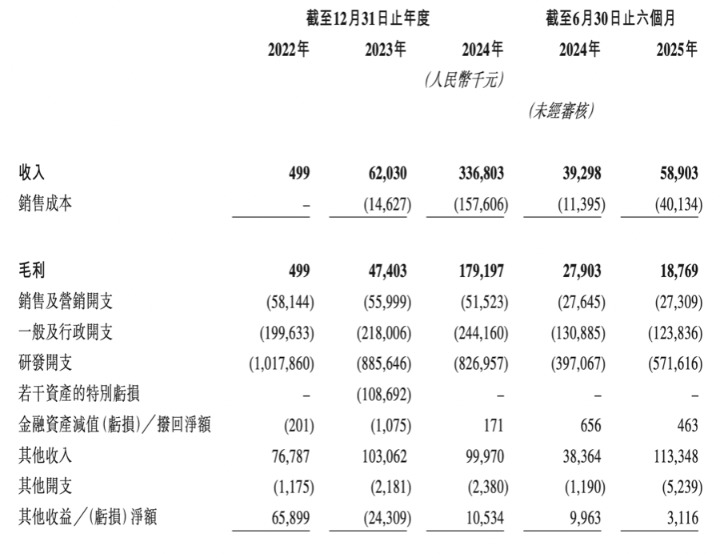
Core Insights - Wallan Technology, one of the "four little dragons" of domestic GPUs, is preparing for an IPO in Hong Kong, showcasing its growth over the past five years [1] - The company reported revenue growth from 62 million RMB in 2023 to 337 million RMB in 2024, with a backlog of 822 million RMB in unfulfilled orders and an additional 1.241 billion RMB in framework agreements and contracts awaiting release [1] - Despite being in a loss-making state, Wallan Technology has launched a series of products based on its first-generation GPGPU architecture and is advancing its second-generation architecture [1] Company Performance - Revenue for Wallan Technology increased from 499 thousand RMB in 2022 to 62 million RMB in 2023, and is projected to reach 337 million RMB in 2024 [5] - The gross profit for 2024 is expected to be 179 million RMB, with a gross margin of 53.2% [6] - The company has seen a significant increase in average transaction value, rising 113.64% year-on-year to 9.4 million RMB [6] Market Position - The domestic AI chip market is currently dominated by Nvidia and Huawei, which together hold 94.4% of the market share, while domestic AI chips have not exceeded 1% market share [1] - Wallan Technology holds a market share of 0.16% in the smart computing chip market and 0.20% in the GPGPU market in China for 2024 [1] Product Development - Wallan Technology has developed its first-generation GPGPU architecture and launched two chips, BR106 and BR110, with the BR166 chip expected to offer double the performance of BR106 [12][15] - The company plans to commercialize the next-generation flagship data center chip, BR20X, by 2026, with further products like BR30X and BR31X planned for 2028 [15] Customer Base and Sales - The number of customers increased from 4 in the first half of 2024 to 12 in the first half of 2025, with transaction numbers rising from 9 to 33 [6][10] - The revenue contribution from the largest customer decreased from 85.7% in 2023 to 33.3% by mid-2025, indicating a diversification of the customer base [9] Financial Overview - Wallan Technology reported net losses of 1.474 billion RMB in 2022, 1.744 billion RMB in 2023, and 1.538 billion RMB in 2024, with cumulative losses exceeding 6.3 billion RMB over three and a half years [9] - R&D expenditures were significant, with 1.018 billion RMB in 2022, 885 million RMB in 2023, and 826 million RMB in 2024, accounting for approximately 79.8%, 76.4%, and 73.7% of total operating expenses respectively [9] Strategic Partnerships - Wallan Technology has formed strategic partnerships to enhance its product offerings and market reach, including a collaboration with an IT company to develop smart computing solutions [14][17] - The company is also focused on building a software ecosystem to support its hardware products, which includes the BIRENSUPA software platform [17]

壁仞科技赴港股IPO通过聆讯 技术迭代路线图浮现
2 1 Shi Ji Jing Ji Bao Dao· 2025-12-21 06:17
Core Viewpoint - The company, Birran Technology, is preparing for an IPO in Hong Kong, showcasing its growth over the past five years, with significant revenue increases and a focus on the AI chip market in China [1]. Financial Performance - Revenue increased from 620,000 RMB in 2023 to 3.37 billion RMB in 2024, with unfulfilled orders totaling 8.22 billion RMB and framework agreements worth 12.41 billion RMB [1]. - The company reported a net loss of 1.474 billion RMB in 2022, 1.744 billion RMB in 2023, and 1.538 billion RMB in 2024, with an estimated loss of around 1.6 billion RMB by mid-2025 [6][7]. - Gross profit for 2024 is projected at 1.79 billion RMB, with a gross margin of 53.2% [4]. Market Position - The Chinese AI chip market is dominated by Nvidia and Huawei, holding a combined market share of 94.4% in 2024, while domestic AI chip companies, including Birran Technology, hold less than 1% [1]. - Birran Technology's market share in the smart computing chip market and GPGPU market is 0.16% and 0.20%, respectively, in 2024 [1]. Product Development - The company has developed its first-generation GPGPU architecture and launched products such as BR106 and BR110, with BR106 being the primary sales driver [8][10]. - The BR166 chip, which offers double the performance of BR106, began mass production in 2024 [9][14]. - Future products include the BR20X series for cloud training and inference, expected to be commercialized by 2026, and BR30X and BR31X for future applications [15]. Customer Base and Sales Strategy - The company is optimizing its customer structure, focusing on specific industries, with revenue primarily from PCIe board sales [4]. - The number of customers increased from 4 in the first half of 2024 to 12 in the first half of 2025, with transaction numbers rising from 9 to 33 [4]. - The contribution from the largest customer decreased from 85.7% in 2023 to 33.3% by mid-2025, indicating a diversification of the customer base [6]. Research and Development - R&D expenditures were 1.018 billion RMB in 2022, 885 million RMB in 2023, and 826 million RMB in 2024, accounting for approximately 79.8%, 76.4%, and 73.7% of total operating expenses, respectively [7]. - The company has 24 binding orders valued at approximately 8.22 billion RMB and five framework sales agreements worth 12.41 billion RMB [7]. Strategic Partnerships - Birran Technology has formed strategic partnerships to enhance its AI infrastructure and has signed significant sales agreements, including a 3.68 billion RMB framework agreement [14][16]. - Collaborations aim to drive technological advancements and improve computing efficiency in AI applications [16].
摩尔线程,发布新一代GPU架构
21世纪经济报道· 2025-12-20 13:32
Core Viewpoint - The article highlights the launch of the "Huagang" GPU architecture by Moer Thread, showcasing its advancements in AI training and high-performance graphics rendering, as well as the company's commitment to developing a comprehensive computing ecosystem based on its MUSA architecture [1][2][11]. Group 1: Product Launches and Innovations - Moer Thread introduced the "Huagang" architecture, which features a new instruction set that enhances computing density by 50% and improves efficiency by 10 times under the same manufacturing conditions [2]. - The "Huashan" chip, designed for AI training and inference, offers floating-point computing power, memory bandwidth, and high-speed interconnect capabilities that are competitive with NVIDIA's Blackwell and Hopper architectures [4][5]. - The "Lushan" chip focuses on high-performance graphics rendering, achieving a 64-fold increase in AI computing performance and a 50% improvement in ray tracing performance [5]. Group 2: Infrastructure and Ecosystem Development - The "Kua'e" supercomputing cluster, based on the "Huagang" architecture, boasts a floating-point computing capability of 10 Exa-Flops, with a 60% utilization rate for Dense models and 40% for MoE models [5][8]. - Moer Thread upgraded its MUSA architecture to version 5.0, achieving over 98% efficiency in core computing libraries and planning to open-source key components [8]. - The company is also developing a MUSA ecosystem center to support research and innovation in cutting-edge fields such as quantum technology and AI for 6G [10]. Group 3: Market Position and Financial Performance - Moer Thread, founded in October 2020, has seen significant market interest, with its stock price increasing by 481% since its debut on the STAR Market at 114.28 CNY per share, reaching approximately 664.10 CNY per share and a market capitalization of about 312.15 billion CNY [11].
摩尔线程发布“花港”架构,力推国产万卡智算生态
2 1 Shi Ji Jing Ji Bao Dao· 2025-12-20 09:47
Core Insights - Moore Threads launched the "Huagang" architecture, emphasizing the development of a domestic AI computing ecosystem at the first MUSA Developer Conference [1][4] - The new architecture features a 50% increase in computing density and a 10-fold improvement in efficiency under the same manufacturing conditions [2] - The company aims to address challenges in chip manufacturing by introducing innovative instruction sets and asynchronous programming models [2] Product Launches - The "Huashan" chip is designed for AI training and inference, providing computational support for intelligent computing clusters, with performance metrics between NVIDIA's Blackwell and Hopper architectures [4] - The "Lushan" chip focuses on high-performance graphics rendering, achieving a 64-fold increase in AI computing performance and a 50% improvement in ray tracing performance [4] - The "Kua'e" computing cluster boasts a floating-point computing capability of 10 Exa-Flops, with a 60% utilization rate for Dense models and 40% for MoE models [4] Software and Ecosystem Development - The MUSA architecture has been upgraded to version 5.0, enhancing core computing libraries and communication efficiency [7] - The company plans to open-source key components of its computing acceleration libraries and system management frameworks [7] - New technologies include the MTX intermediate language for cross-generation GPU compatibility and a quantum computing framework [7][8] Market Context - The domestic AI chip industry is experiencing growth due to international restrictions on high-end chip imports, increasing market opportunities for local manufacturers [9] - Moore Threads, founded in October 2020, has seen its stock price rise by 481% since its debut on the STAR Market, with a current market capitalization of approximately 312.15 billion yuan [9]
资金风向标 | 两融余额较上一日减少19.89亿元 电子行业获融资净买入额居首
Shang Hai Zheng Quan Bao· 2025-12-18 14:40
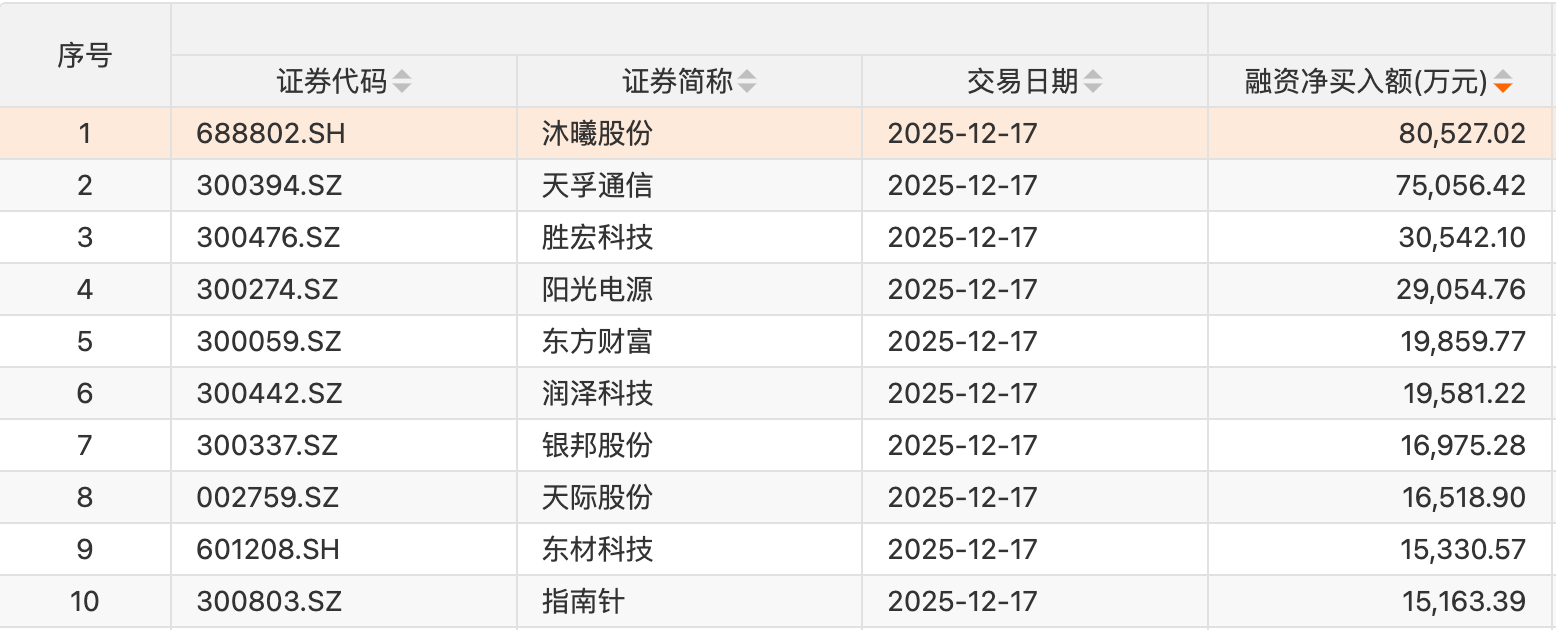
来源:上海证券报·中国证券网 上证报中国证券网讯(刘禹希 记者 徐蔚)截至12月17日,A股两融余额为25028.46亿元,较上一交易日减少19.89亿元,占A股流通市值比例为2.61%。当日 两融交易额为1852.92亿元,较上一交易日增加63.63亿元,占A股成交额的10.09%。 资金流向方面,申万31个一级行业中有9个行业获融资净买入,其中,电子行业获融资净买入额居首,当日净买入10.64亿元;获融资净买入居前的行业还有 通信、非银金融、建筑材料、钢铁等。 个股方面,21只个股获融资净买入额超1亿元。沐曦股份获融资净买入额居首,净买入8.05亿元;融资净买入金额居前的还有天孚通信、胜宏科技、阳光电 源、东方财富、润泽科技、银邦股份、天际股份、东材科技、指南针等。 | 序号 | | | | | --- | --- | --- | --- | | | 证券代码 ◆ | 证券简称 ◆ | 交易日期 ◀ | | 1 | 688802.SH | 沐曦股份 | 2025-12-17 | | 2 | 300394.SZ | 天孚通信 | 2025-12-17 | | ന | 300476.SZ | 胜宏科技 | 2 ...
争相上市的国产GPU厂商市占率都未突破1%
Di Yi Cai Jing Zi Xun· 2025-12-18 07:16
Core Insights - Two GPU stocks, Moer Technology and Muxi, have gained significant attention after their recent listings on the STAR Market, with Moer Technology's stock price increasing over four times on its debut [2] - Both companies, along with another GPU firm, Birun Technology, are yet to achieve profitability despite substantial R&D investments [3][4] - The market share of these domestic GPU companies remains low compared to global leaders like NVIDIA and AMD [7][8] Group 1: Company Performance - Moer Technology, Muxi, and Birun Technology have all seen revenue growth over the past three years but have not turned a profit [3] - Financial data for Moer Technology shows revenues of 0.46 million, 1.24 million, and 4.38 million from 2022 to 2024, with losses of 18.4 billion, 16.73 billion, and 14.92 billion respectively, totaling 50.05 billion in losses [3] - Muxi's revenues for the same period were 42.64 million, 53.02 million, and 743 million, with losses of 7.77 billion, 8.71 billion, and 14.09 billion, accumulating over 32 billion in losses [3] - Birun Technology reported revenues of 49.9 million, 620.3 million, and 3.37 billion, with losses of 14.74 billion, 17.44 billion, and 15.38 billion, totaling 47.5 billion in losses [3] Group 2: R&D Expenditure - Moer Technology has the highest R&D expenses among the three companies, with expenditures of 38.1 billion, 22.47 billion, and 27.3 billion for Muxi and Birun Technology respectively from 2022 to 2024 [4] - In 2022, Moer Technology's R&D expenses accounted for 309.88% of its revenue, while Muxi's was 121.24%, and Birun Technology's was 245.5% [4] - The high R&D costs are a significant factor contributing to the ongoing losses for these GPU manufacturers [4] Group 3: Market Position and Future Outlook - Moer Technology and Muxi have projected timelines for achieving profitability, with Moer Technology aiming for 2027 and Muxi for 2026 [5] - Despite the recent stock price fluctuations, the market share of these domestic GPU companies is still low, with Moer Technology and Muxi's market shares in the domestic AI chip market being less than 1% [6][7] - The AI chip market in China is currently dominated by international players, with NVIDIA holding a 54.4% market share, followed by Huawei and AMD [7] - Birun Technology indicated that the top two players in the Chinese smart computing chip market hold 94.4% of the market share, highlighting the concentration of market power [8]
沐曦股份跌超5%,股价跌破800元
21世纪经济报道· 2025-12-18 02:59
Core Viewpoint - The article discusses the recent performance and market position of Muxi Co., a leading domestic GPU company, highlighting its stock fluctuations, financial results, and competitive landscape in the AI chip market. Group 1: Stock Performance and Market Entry - Muxi Co. opened lower on December 18, with its stock price dropping 5.77% to 782 CNY per share after a significant debut on December 17, where it achieved a 692.95% increase, closing at 829.9 CNY per share and a market capitalization of 3320.43 billion CNY [1][3]. - The company set a record for the most profitable new stock, with investors potentially earning around 395,200 CNY for a single lot of shares [3]. Group 2: Financial Performance and Growth - Muxi Co. is still in a loss-making state but has shown significant improvement, with a revenue of 1.236 billion CNY for the first three quarters of 2025, marking a 453.52% year-on-year increase [8]. - The net loss for the same period was 346 million CNY, a reduction of 55.79% compared to the previous year [8]. - The company anticipates a total revenue of 1.5 billion to 1.98 billion CNY for the year, representing a year-on-year growth of 101.86% to 166.46% [11]. Group 3: Product Development and Market Position - Muxi Co. focuses on GPU technology, with its flagship product, the Xiyun C500 series, contributing significantly to its revenue, accounting for 30.09% in 2023 and projected to reach 97.28% by the first quarter of 2025 [8]. - The company is developing the next-generation Xiyun C600 chip, which is expected to be delivered in October 2024, and aims to establish a fully domestic supply chain [10]. Group 4: Competitive Landscape and Market Share - Muxi Co. currently holds approximately 1% of the AI accelerator market in China, indicating substantial growth potential [13]. - The company has developed a software ecosystem compatible with over 6000 CUDA applications, enhancing its competitive edge in the market [13]. - Muxi Co. is actively engaging with major internet companies and telecom operators to expand its customer base and has secured orders worth 1.43 billion CNY as of September 5 [14][15]. Group 5: Challenges and Future Outlook - Despite the positive growth trajectory, Muxi Co. faces challenges, including ongoing losses and the need to establish a robust ecosystem for its general-purpose GPU chips [5][6]. - The potential re-entry of NVIDIA's H200 chip into the Chinese market raises concerns about competition, although it is noted that the current focus of Muxi Co. is on inference applications, which may not directly compete with NVIDIA's offerings [16].