
地缘经济对抗

Search documents
【环球财经】地缘局势再度升温为贵金属注入新动力 纽约金银价格19日再创新高
Xin Hua Cai Jing· 2026-01-19 23:58
Group 1 - The core viewpoint of the articles highlights the rising prices of precious metals, particularly gold and silver, driven by geopolitical tensions and increased demand for safe-haven assets [1][2]. - On January 19, 2026 gold futures rose by 1.77%, closing at $4,676.70 per ounce, while silver futures for March delivery increased by 6.49%, closing at $94.28 per ounce [1][3]. - The announcement by U.S. President Trump regarding the imposition of tariffs on goods from several European countries has heightened concerns over transatlantic trade relations, further boosting the demand for precious metals [1]. Group 2 - The World Economic Forum's latest report indicates that global economic leaders view geopolitical economic confrontation as the primary risk for the year, which may contribute to sustained strong upward momentum in precious metal prices [2]. - The market sentiment has shifted from focusing solely on growth or inflation to prioritizing policy uncertainty as a key driver, suggesting potential volatility in the precious metals market [1].

1月19日金市晚评:达沃斯美强推议程引全球博弈 黄金沿通道上行剑指4700
Jin Tou Wang· 2026-01-19 09:42
摘要北京时间周一(1月19日)欧洲时段,美元指数高位震荡,交投于99.171附近,金价目前交投于 4663.26美元/盎司,涨幅1.49%,最高触及4689.39美元/盎司,最低触及4594.31美元/盎司。 北京时间周一(1月19日)欧洲时段,美元指数高位震荡,交投于99.171附近,金价目前交投于4663.26美 元/盎司,涨幅1.49%,最高触及4689.39美元/盎司,最低触及4594.31美元/盎司。 今日黄金价格最新查询(2026年1月19日) | 名称 | 最新价 | 单位 | | --- | --- | --- | | 现货黄金 | 4663.26 | 美元/盎司 | | 黄金t+d | 1045.00 | 元/克 | | 纸黄金 | 1043.80 | 元/克 | | 沪金主力 | 1048.88 | 元/克 | 【基本面解析】 国际社会反击升温:央行行长罕见联合声援美联储独立性,北约、欧盟领导人抵达沃斯倡自由贸易;欧 洲抵制美对乌不利和平方案。美国2026财年国防预算破1.01万亿美元(冷战后最大增幅),推高全球军费 至2.7万亿美元(+9.4%),成"地缘经济对抗"主推手。 尽管美国以" ...
世界经济论坛:在动荡与变化的时代坚持对话和沟通
Xin Lang Cai Jing· 2026-01-18 20:33
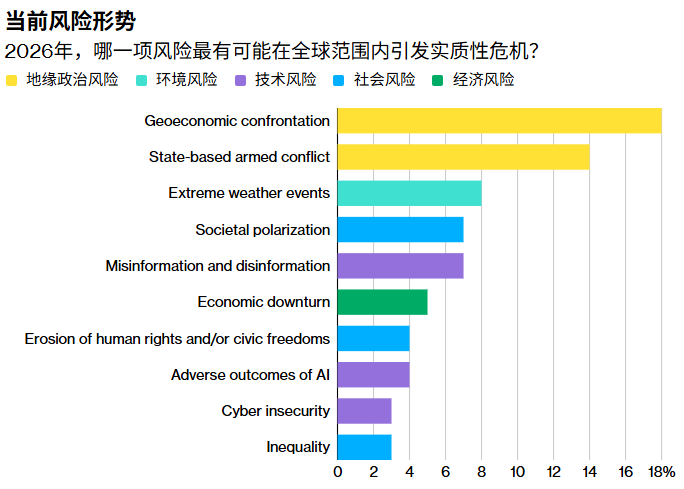
Core Viewpoint - The World Economic Forum's 56th annual meeting highlights the complexities of the current geopolitical landscape, emphasizing the need for dialogue and cooperation amidst rising global risks [1] Group 1: Global Risks - A new era of competition is identified, with global risks becoming interwoven and escalating, as reflected in the 2026 Global Risk Report [2] - Only 1% of respondents believe that the global situation will remain stable in the short and long term, with 50% expecting instability in the next two years, a significant increase from 36% the previous year [2] - Geoeconomic confrontation is seen as the primary risk, with 18% of respondents indicating it could lead to a global crisis by 2026, influenced by U.S. tariff policies disrupting global trade [2][3] Group 2: Geopolitical Tensions - Geoeconomic confrontation has risen in risk ranking, now viewed as the most severe threat, reflecting the weakening of multilateral institutions [3] - Armed conflict between nations remains a high-ranking risk, with recent U.S. military actions underscoring the precarious global situation [3] - Environmental risks, while still significant, are perceived as less urgent in the short term due to ongoing geopolitical tensions [3] Group 3: Cooperation Trends - Despite challenges to multilateralism, cooperation persists in various forms, with climate and technology sectors showing strong collaboration [4] - "Small multilateralism" is emerging as a potential model for future cooperation, as global fragmentation and trade barriers increase [5] - The need for new cooperative frameworks is emphasized, as individual countries cannot address major challenges alone, necessitating proactive international engagement [5]
2026年全球风险报告(英文版)-世界经济论坛
Sou Hu Cai Jing· 2026-01-16 18:11
Core Insights - The Global Risks Report 2026 highlights a turbulent global outlook, with 50% of respondents anticipating a turbulent or stormy situation in the next two years, increasing to 57% over the next decade, while only 1% expect a calm outlook [14][27][29] - Geoeconomic confrontation is identified as the most severe risk for the next two years, with 18% of respondents believing it could trigger a major global crisis, followed by state-based armed conflict at 14% [15][29][85] - Economic risks have seen significant increases in concern, particularly regarding economic downturns, inflation, and asset bubbles, driven by high debt levels and market volatility [15][34][98] - Technological risks, particularly misinformation and disinformation, are also rising, with adverse outcomes of AI technologies moving from 30th to 5th in long-term risk rankings [15][54][90] - Environmental risks are being deprioritized in the short term, with extreme weather events and pollution declining in perceived severity, although they remain significant concerns in the long term [62][67][96] Group 1: Global Risk Landscape - The report indicates a shift towards a multipolar or fragmented global order, with 68% of respondents expecting this trend to continue over the next decade [2][74] - Trust in multilateral systems is declining, with rising protectionism and national interests overshadowing collective action on global challenges [2][29][74] - The interconnectedness of risks is emphasized, with societal polarization and inequality identified as key factors exacerbating other global risks [60][67] Group 2: Economic Risks - Economic downturn and inflation have risen sharply in concern, with both risks moving up eight positions in the rankings, indicating a growing apprehension about economic stability [34][98] - The potential for asset bubbles is also highlighted, with concerns about debt sustainability contributing to fears of economic volatility [34][98] - The report suggests that the economic landscape is becoming increasingly precarious, with high debt levels and market fluctuations posing significant threats to stability [15][34] Group 3: Technological Risks - Misinformation and disinformation are ranked as the second most pressing short-term risk, reflecting the growing impact of technology on information integrity [54][90] - The adverse outcomes of AI technologies are now seen as a major long-term risk, indicating a shift in perception regarding the implications of technological advancements [54][90] - Cybersecurity threats are also highlighted, with increasing sophistication of cyberattacks targeting critical infrastructure [54][94] Group 4: Environmental Risks - Environmental concerns are experiencing a decline in immediate priority, with extreme weather events and pollution falling in perceived severity [62][67] - Despite this short-term deprioritization, environmental risks remain critical in the long-term outlook, with significant concerns about biodiversity loss and critical changes to Earth systems [62][67][96] - The report underscores the need for renewed attention to environmental issues, particularly in the context of aging infrastructure and climate change impacts [67]


地缘经济对抗预计将成为2026年首要威胁
Shang Wu Bu Wang Zhan· 2026-01-16 16:10
Core Insights - The World Economic Forum (WEF) identifies geopolitical economic confrontation as the largest risk for 2026, followed by inter-state conflict, extreme weather, social polarization, and the spread of misinformation [1] Economic Risks - Economic risks are expected to peak in 2026 and 2027, with concerns over economic slowdown, inflation, rising public debt, and asset bubbles under geopolitical tensions [1] Environmental Risks - The overall environmental risks remain severe, with extreme weather events, biodiversity loss, and significant changes in Earth's systems being the primary issues [1] - Approximately 75% of surveyed experts predict that environmental conditions will be extremely unstable in the coming years [1] Artificial Intelligence Risks - The risks associated with artificial intelligence are rapidly increasing, with concerns about its negative impacts on labor, safety, and social structures rising from 30th place in two-year forecasts to 5th place in ten-year outlooks [1]
罕见!金、银、铜、锡,价格同时创新高!接下来怎么走?
Xin Lang Cai Jing· 2026-01-15 13:16
Group 1 - The core viewpoint of the article highlights the significant rise in international gold and silver futures prices, reaching historical highs due to geopolitical tensions and other factors [1] - As of the close on the 14th, gold futures for February delivery on the New York Commodity Exchange settled at $4635.70 per ounce, up 0.80% from the previous trading day [1] - Silver futures for March delivery closed at $91.385 per ounce, marking an increase of 5.85% from the prior day [1] Group 2 - Industrial metals such as copper and tin also reached historical highs, with tin prices surging nearly 11% during trading, closing at $53,462 per ton, an increase of nearly 8% [3] - Copper futures touched a high of $13,400 per ton, ultimately closing at $13,188.5, reflecting a slight increase of about 0.2% [5] - Analysts note that the simultaneous rise of gold, silver, copper, and tin to historical highs is unprecedented in the last 20 years, indicating investor concerns over geopolitical tensions involving countries like Venezuela and Iran [7] Group 3 - Investors are reassessing asset allocations amid geopolitical and trade reshaping, with expectations for further increases in gold and silver prices [9] - A Singapore asset management firm observed that many brokerages are raising their allocations to commodities, particularly gold, as a crucial tool for risk hedging [9] - The current allocation of precious metals in the U.S. market stands at only 0.4%, compared to over 4% in the late 1970s, suggesting significant potential for future increases in precious metal allocations [11] Group 4 - The World Economic Forum's 2026 Global Risks Report indicates that businesses face multiple concurrent crises, with "geoeconomic confrontation" being a primary concern, potentially leading to a noticeable contraction in global trade [13] - The report also highlights the rapid rise of risks associated with artificial intelligence, now ranked fifth among long-term risks, reflecting growing concerns over its adverse consequences [15] - The CEO of a major insurance brokerage emphasized the potential risks to financial markets from the rapid development of AI, particularly regarding misinformation and deepfakes [17]
【环球财经】世界经济论坛报告:地缘经济对抗是2026年首要风险
Xin Hua She· 2026-01-14 22:44
Core Insights - The World Economic Forum's "Global Risks Report 2026" identifies geopolitical and economic risks as escalating in a new competitive era, with geopolitical economic confrontation being the primary risk for 2026 [1][2] - Other significant risks for 2026 include armed conflict between nations, extreme weather, social polarization, and misinformation, with economic risks rising the fastest [1] - The report highlights worsening debt issues and potential asset bubbles, compounded by geopolitical economic conflicts, which could trigger a new wave of turmoil [1] Short to Medium-Term Risk Outlook - Geopolitical economic confrontation is deemed the most severe risk in the short to medium term (next two years) [2] - The World Economic Forum's Executive Director, Sadia Zahidi, states that the world has entered a new competitive era, impacting all subsequent global risks [2] - The President and CEO of the World Economic Forum, Borge Brende, emphasizes that the changing competitive landscape has altered the global cooperation dynamic, underscoring the importance of collaborative pathways and dialogue [2] Expert Contributions - The report consolidates insights from over 1,300 global experts, analyzing current, short-term, and long-term risks faced worldwide [3]
达沃斯论坛“前哨”报告:地缘政治经济对抗跃升头号威胁,全球或进入“动荡两年”
智通财经网· 2026-01-14 11:47
Core Viewpoint - The World Economic Forum's survey indicates that by 2026, global conditions will increasingly be threatened by trade disputes and geopolitical conflicts, with the upcoming meeting in Switzerland focusing on these issues [1][3]. Group 1: Risks Identified - Respondents highlighted "geoeconomic confrontation" and "state-based armed conflict" as the two primary risks, aligning with the geopolitical tone of the upcoming Davos meeting [3]. - The survey reflects decision-makers' anxiety over Trump's aggressive trade and geopolitical tactics, which could intimidate both allies and adversaries, leading to retaliatory actions from sanctioned countries [4]. Group 2: Survey Insights - The report, based on a survey conducted from August 12 to September 22, involved global leaders and experts from academia, business, government, international organizations, and civil society [5]. - Half of the respondents expect a "turbulent" outlook in the next two years, a significant increase compared to the previous year's report, with concerns about economic risks, including recession, inflation, and asset bubbles [8]. Group 3: Upcoming Events - Key figures, including Trump and other G7 leaders, will be the focus of the upcoming meeting, with Trump scheduled to speak on Wednesday afternoon [10].
罗马尼亚前总理痛批美国:不屑于多边主义的行为,导致国际组织被各国无视
Feng Huang Wang Cai Jing· 2025-06-28 02:31
Group 1 - The "2025 China Enterprises Going Global Summit" was held in Shenzhen, focusing on providing a high-end platform for Chinese companies to address challenges in global expansion and explore collaborative transformation paths [1] - The summit was co-hosted by the Global Council for Chinese Enterprises Going Global, emphasizing the need for dialogue on rules and resource connections amid deep restructuring of global industrial chains [1] Group 2 - Former Romanian Prime Minister Peter Roman highlighted the transition between two global orders, indicating a period of governance challenges and uncertainty regarding the future of the world order [3] - Roman criticized the instability and lack of fairness in the current multilateral economic order, suggesting that it is merely a series of expedient arrangements rather than a well-designed system [3] - He pointed out that the neglect of multilateralism by governments, particularly the U.S., has led to the disregard of international organizations like the UN and WTO, which could result in increased global chaos and danger [3] Group 3 - Roman noted the growing sense of division in unequal societies, the resurgence of trade wars, and the intensification of geopolitical economic confrontations, particularly exacerbated by the age of AI [4] - He emphasized that the uncertainties brought by trade wars are damaging investment projects and are unsustainable, as they create barriers rather than fostering cooperation [4]
