大宗商品牛市

Search documents
美国9月CPI低于预期!本周
Xin Lang Cai Jing· 2025-10-27 07:01
Group 1 - The core viewpoint of the news highlights the strong performance of the non-ferrous metal sector, particularly the Non-Ferrous Metal Leader ETF (159876), which saw an intraday increase of 2.96% and a current rise of 2.16%, with a trading volume exceeding 520 million yuan, indicating active trading [1] - Technical analysis indicates that the recovery of the 10-day moving average suggests that short-term bullish forces are strong enough to push the stock price above the "short-term cost line," indicating an advantage for bulls in short-term trading [1] - Key constituent stocks such as Xiamen Tungsten Industry and Jiangxi Copper experienced significant gains, with Xiamen Tungsten hitting the daily limit, and others like Huayu Mining and Western Superconducting rising over 6% [1] Group 2 - The U.S. September CPI data, which came in lower than expected at a year-on-year growth of 3.0% and a core CPI month-on-month increase of 0.2%, provides solid support for the Federal Reserve to consider further interest rate cuts [3] - The impact of potential Fed rate cuts on non-ferrous metal prices is explained through three key points: 1) Rate cuts equate to monetary easing, leading investors to prefer tangible assets; 2) Most non-ferrous metals are priced in USD, and a weaker dollar makes these metals cheaper, boosting global demand; 3) Lower interest rates reduce borrowing costs for companies, increasing demand for industrial metals like copper and aluminum [3] - The outlook for the non-ferrous metal sector is optimistic, driven by long-term capital expenditure cycles and increasing global manufacturing investment, alongside a recovery in domestic macroeconomic conditions, positioning non-ferrous metals as a core component of the current commodity bull market [3] Group 3 - The Non-Ferrous Metal Leader ETF (159876) and its linked funds provide a diversified investment approach by passively tracking the CSI Non-Ferrous Metal Index, which includes significant weights in copper (27.6%), gold (14.5%), aluminum (13.1%), rare earths (10.4%), and lithium (8.4%), thus helping to mitigate risks associated with investing in single metal sectors [5]






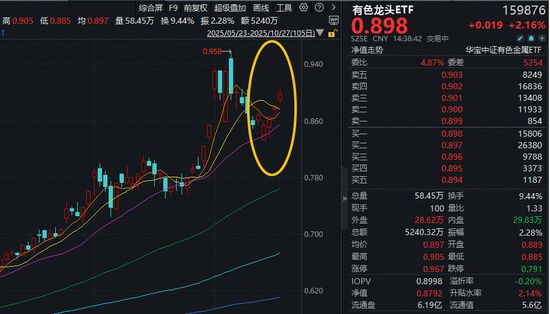
美国9月CPI低于预期!本周,美联储有望进一步降息?有色龙头ETF(159876)盘中涨近3%,厦门钨业涨停
Xin Lang Ji Jin· 2025-10-27 06:53
Group 1 - The core viewpoint of the news highlights the strong performance of the non-ferrous metal sector, particularly the Non-Ferrous Metal Leader ETF (159876), which saw a peak increase of 2.96% and a current rise of 2.16%, indicating active trading with a transaction volume exceeding 520 million yuan [1] - Technical analysis indicates that the ETF has recovered its 10-day moving average, suggesting that short-term bullish forces are in control, and if this recovery is accompanied by increased trading volume, it signals stronger market confidence [1] - Key constituent stocks such as Xiamen Tungsten, Huayu Mining, and Jiangxi Copper have shown significant gains, with Xiamen Tungsten hitting the daily limit and others rising over 5% [1] Group 2 - Recent U.S. economic data shows that the September CPI was lower than expected, providing solid support for the Federal Reserve to consider further interest rate cuts, which could positively impact non-ferrous metal prices [3] - The relationship between Fed rate cuts and non-ferrous metal prices is explained through three points: rate cuts lead to currency devaluation, making metals cheaper in dollar terms; lower interest rates reduce borrowing costs for companies, boosting demand for industrial metals; and overall, non-ferrous metals are positioned as key players in the current commodity bull market [3] - The outlook for non-ferrous metals is optimistic, driven by long-term capital expenditure cycles and increasing global manufacturing investment, alongside a recovery in domestic macroeconomic conditions [3] Group 3 - The Non-Ferrous Metal Leader ETF (159876) and its linked funds provide a diversified investment approach across various non-ferrous metals, including copper, gold, aluminum, rare earths, and lithium, with respective weightings of 27.6%, 14.5%, 13.1%, 10.4%, and 8.4% [5] - This diversified strategy helps mitigate risks associated with investing in a single metal sector, making it suitable for inclusion in investment portfolios [5]
北方稀土拉升5%,跻身A股吸金榜TOP5!有色龙头ETF(159876)盘中涨近3%,日k线或已走出“上行台阶”
Xin Lang Cai Jing· 2025-10-27 04:01
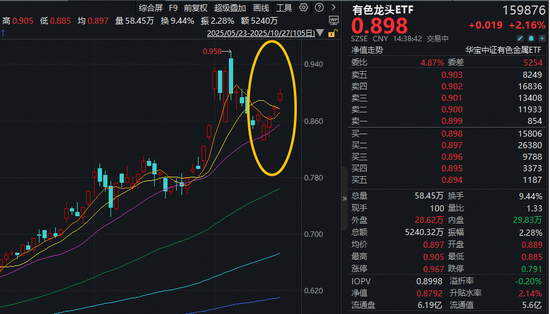
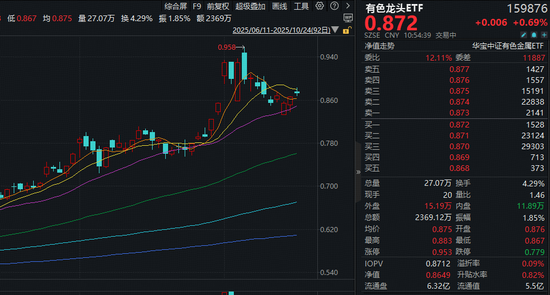
Core Viewpoint - The non-ferrous metal sector is experiencing significant gains, driven by strong market performance and policy support, indicating a positive outlook for the industry [1][2]. Group 1: Market Performance - The non-ferrous metal sector ETF (159876) saw an intraday increase of 2.96%, currently up by 2.28%, with real-time transaction volume exceeding 280 million yuan [1]. - Major stocks in the sector, such as Xiamen Tungsten, Western Superconducting, Northern Rare Earth, and Jiangxi Copper, reported gains of over 5% [1]. - The sector attracted over 5.5 billion yuan in net inflows from main funds, ranking second among 31 primary industries [1]. Group 2: Technical Analysis - The 10-day moving average indicates that the market's average cost over the short term (approximately two weeks) has been recovered, suggesting that bullish forces are currently dominating the short-term trading landscape [1]. Group 3: Policy and Economic Context - The Ministry of Industry and Information Technology, along with eight other departments, has issued a "Work Plan for Stable Growth in the Non-Ferrous Metal Industry (2025-2026)," marking a new phase of institutional support and structural prosperity for the industry [1]. - The Federal Reserve's recent monetary policy changes are expected to reshape the pricing of non-ferrous metals, with a focus on supply constraints and released demand leading to a tight balance in supply and demand [1]. Group 4: Industry Outlook - The non-ferrous metal sector is positioned as a key player in the current commodity bull market, driven by long-term capital expenditure cycles and a shift in demand dynamics away from real estate and infrastructure [2]. - Different non-ferrous metals exhibit varying degrees of market performance and driving factors, suggesting a diversified investment approach may be beneficial for capturing overall sector trends [2].

北方稀土拉升5%,跻身A股吸金榜TOP5!有色龙头ETF(159876)盘中涨近3%,日k线或已走出 “上行台阶”
Xin Lang Ji Jin· 2025-10-27 02:33
Core Viewpoint - The non-ferrous metal sector is experiencing significant gains, with the non-ferrous metal leader ETF (159876) showing a rise of 2.28% and a trading volume exceeding 280 million yuan, indicating a potential increase in market activity [1][3] Market Performance - The non-ferrous metal sector has seen a net inflow of over 5.5 billion yuan from major funds, ranking second among 31 primary industries [3] - Key stocks such as Xiamen Tungsten, Northern Rare Earth, and Jiangxi Copper have shown substantial gains, with Xiamen Tungsten hitting the daily limit and others rising over 5% [1][3] Technical Analysis - The recovery of the 10-day moving average suggests that short-term bullish forces are strong enough to push prices above this key level, indicating a favorable short-term market sentiment [1] - A significant volume increase accompanying the recovery of the 10-day moving average would enhance the reliability of this bullish signal [1] Policy and Economic Environment - The Ministry of Industry and Information Technology and seven other departments have issued a "Work Plan for Stable Growth in the Non-Ferrous Metal Industry (2025-2026)," marking a new phase of institutional support and structural prosperity for the industry [3] - The Federal Reserve has initiated a new round of interest rate cuts, which may improve global liquidity conditions, creating new opportunities for the non-ferrous metal sector [3] Supply and Demand Dynamics - The supply of non-ferrous metals is limited while demand is expected to increase, leading to a tight balance between supply and demand [4] - The shift in demand drivers from real estate and infrastructure to the new energy sector has significantly altered the demand structure for copper and aluminum, with new energy now accounting for over 15% and 20% of copper and aluminum demand, respectively [4] Future Outlook - Non-ferrous metals are positioned as key commodities in the current bull market, driven by long-term capital expenditure cycles and increasing global manufacturing investment [4] - The combination of domestic macroeconomic recovery expectations and strategic resource reserve demands under globalization trends further strengthens the outlook for non-ferrous metals [4] Investment Strategy - A diversified investment approach through the non-ferrous metal leader ETF (159876) and its associated funds is recommended to capture the sector's beta performance while mitigating risks [6] - The ETF tracks the CSI Non-Ferrous Metal Index, which includes significant weights in copper (27.6%), gold (14.5%), aluminum (13.1%), rare earths (10.4%), and lithium (8.4%) [6]
科技创新,材料先行!有色龙头ETF(159876)盘中涨近2%!碳酸锂期价反弹,雅化集团触板!
Xin Lang Ji Jin· 2025-10-24 03:20
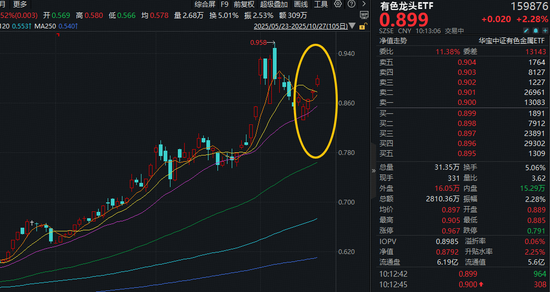
Group 1 - The core viewpoint of the news is that the non-ferrous metal sector is experiencing a resurgence, with the Non-Ferrous Metal Leaders ETF (159876) showing significant gains and attracting attention in the market [1][3] - As of October 23, the Non-Ferrous Metal Leaders ETF (159876) has a total scale of 546 million yuan, making it the largest ETF tracking the same index among three products in the market [1] - Key constituent stocks such as Yahua Group, Zhongmin Resources, and Yongxing Materials have shown substantial price increases, indicating strong performance in the sector [1][3] Group 2 - Lithium carbonate futures prices have rebounded, with the main contract price reaching a new high since September, reflecting a 4.17% increase to 79,940 yuan per ton on October 23 [3] - The supply side is expected to see growth due to new production lines for spodumene and salt lake lithium, while demand is driven by the rapid growth of the new energy vehicle market and strong demand in the energy storage sector [3][4] - The Ministry of Industry and Information Technology and other departments have issued a work plan for the non-ferrous metal industry, marking a new phase of "institutional support + structural prosperity" [3][4] Group 3 - The demand structure for non-ferrous metals has shifted significantly, with the real estate and infrastructure sectors' contribution to copper and aluminum demand decreasing, while the new energy industry now accounts for over 15% of copper demand and over 20% of aluminum demand [4] - Industry experts believe that non-ferrous metals are positioned to be the main drivers of the current commodity bull market, supported by long-term capital expenditure cycles and increasing global manufacturing investment [4][6] - The Non-Ferrous Metal Leaders ETF (159876) provides a diversified investment approach, tracking the CSI Non-Ferrous Metal Index with significant weightings in copper, gold, aluminum, rare earths, and lithium, which helps mitigate risks associated with investing in single metal sectors [6]

黄金巨震!发生了什么?机构:只要美联储维持降息or下周美国CPI数据上涨,金价仍可能上行!
Xin Lang Ji Jin· 2025-10-22 02:41
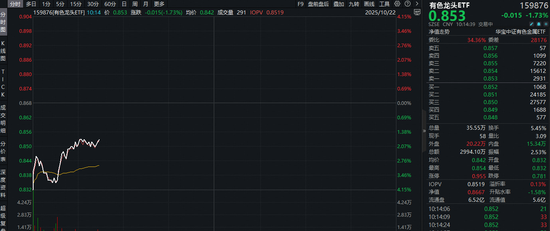
Core Viewpoint - The recent sharp decline in gold prices, attributed to profit-taking and reduced safe-haven demand due to easing geopolitical tensions, has negatively impacted leading companies in the precious metals sector, particularly gold stocks [3]. Summary by Category Market Performance - On October 22, the non-ferrous metal sector ETF (159876) fell by 1.73%, with a trading volume of nearly 300 million yuan, indicating active trading [1]. - As of October 21, the non-ferrous metal sector ETF (159876) had a total size of 565 million yuan, the largest among three ETFs tracking the same index [1]. Stock Movements - Leading gold stocks experienced significant declines, with Western Gold and Hunan Gold dropping over 5%, while Sichuan Gold and Chifeng Gold fell more than 4% [1]. - Conversely, Baotai Co. rose over 2%, and Hailiang Co. and Yun Aluminum gained more than 1%, with several other stocks like Zhongkuang Resources and China Aluminum also performing well [1]. Gold Price Dynamics - Gold prices saw a rare drop of over 6%, marking the largest daily decline since April 2013, primarily due to profit-taking and a stronger dollar making gold more expensive for buyers [3]. - Analysts suggest that while current pressures exist, the long-term outlook for gold remains positive as long as the Federal Reserve maintains its current interest rate path [3]. Sector Outlook - The non-ferrous metals sector is expected to benefit from a long-term supply-demand imbalance, driven by increased capital expenditure and strategic resource reserves amid global manufacturing investment growth [4]. - Specific segments such as rare earths, lithium, and copper are highlighted for their growth potential due to favorable market conditions and technological advancements [3][4]. Investment Strategy - A diversified approach to investing in the non-ferrous metals sector is recommended, utilizing the non-ferrous metal sector ETF (159876) to mitigate risks associated with individual metal investments [6].


重启升势?有色龙头ETF(159876)涨超2.4%!金价冲击4400美元创新高,机构:有色或成为本轮慢牛的核心品种
Xin Lang Ji Jin· 2025-10-21 02:40
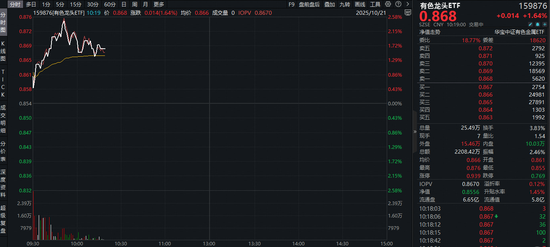
Core Viewpoint - The non-ferrous metal sector is experiencing significant activity, with the Non-Ferrous Metal Leader ETF (159876) showing a price increase of over 2.4% in early trading, currently up by 1.64% as of October 21. The ETF has a total scale of 569 million yuan, leading among three similar products tracking the same index [1]. Group 1: ETF Performance - The Non-Ferrous Metal Leader ETF (159876) is actively traded, with a current price increase of 1.64% [1]. - As of October 20, the ETF's total scale reached 569 million yuan, the highest among its peers [1]. Group 2: Individual Stock Performance - Key stocks in the non-ferrous metal sector include Yun Aluminum Co., Luoyang Molybdenum, Huayou Cobalt, and Tin Industry Co., all rising over 3% [1]. - Other notable performers include Shengxin Lithium Energy, Shenhuo Co., Tianshan Aluminum, and China Aluminum, which have all increased by over 2% [1]. Group 3: Market Trends and Predictions - COMEX gold prices reached a new high of $4,400 per ounce, with institutions remaining optimistic about future gold price trends [3]. - Bank of America predicts that gold prices could reach $6,000 by spring next year, indicating a low allocation of gold assets in global investment portfolios [4]. - The World Gold Council reports that retail gold investment remains below 2% of global assets, suggesting potential for growth [4]. Group 4: Sector Opportunities - The rare earth sector is expected to see significant performance in Q3, with companies like Northern Rare Earth and Shenghe Resources projecting substantial profit increases due to price rises and capacity releases [4]. - In lithium, advancements in solid-state battery technology are anticipated to boost demand, with leading companies maintaining a high self-sufficiency rate in lithium salt production [5]. - Copper supply disruptions, particularly from the Grasberg mine in Indonesia, are expected to tighten global copper supply, driving prices higher [6]. Group 5: Investment Strategy - The Non-Ferrous Metal Leader ETF (159876) provides a diversified investment approach across various metals, including copper, gold, aluminum, rare earths, and lithium, which can help mitigate risks compared to investing in single metal sectors [8].
金价跳水,是倒车接人吗?后市怎么看?中美贸易摩擦缓和+俄乌地缘局势进展,避险情绪减弱!
Xin Lang Ji Jin· 2025-10-20 06:53
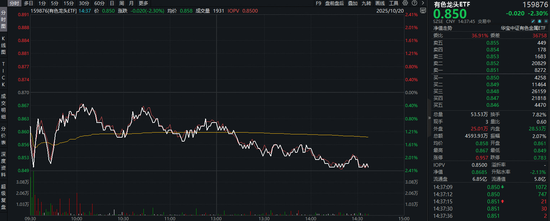
Core Viewpoint - The easing of US-China trade tensions and progress in the Russia-Ukraine situation have led to a decline in gold prices, which fell below $4,300 per ounce, impacting the A-share market and causing significant losses in gold stocks [1][3]. Group 1: Market Reactions - Gold stocks led the decline in the A-share market, with the ETF tracking leading non-ferrous metal companies dropping 2.3% [1]. - Major gold companies such as Western Gold and Chifeng Jilong Gold experienced declines exceeding 9% and 7%, respectively [1]. - Conversely, companies like Chuangjiang New Material and Yahua Group saw gains of over 6% and 1%, respectively [1]. Group 2: Economic Indicators - A video call between US and Chinese trade representatives on October 18 indicated a willingness to resume trade negotiations, contributing to the easing of market tensions [3]. - Ukrainian President Zelensky expressed readiness to participate in a meeting with US President Trump and Russian President Putin, signaling potential diplomatic progress [3]. Group 3: Gold Market Analysis - Despite the recent drop, Bank of America noted that gold assets still represent a low percentage of global investment portfolios, at 2.3% for institutions and 0.5% for private clients, indicating a lack of overcrowding in the market [3]. - The World Gold Council reported that retail gold investment accounts for less than 2% of global assets, and central bank gold reserves are below 30% of total foreign reserves, both far from historical highs [3]. Group 4: Non-Ferrous Metals Outlook - Analysts suggest focusing on the entire non-ferrous metals sector rather than solely on gold, as sectors like rare earths, lithium, and copper show promising growth potential [3][4]. - Rare earth companies are expected to report significant profit increases, with North Rare Earth projecting a net profit growth of 272.54%-287.34% for Q3 [3]. - In lithium, advancements in solid-state battery technology are anticipated to boost demand, with leading companies maintaining a self-sufficiency rate of over 50% in lithium salt production [4]. - Copper prices are expected to rise due to supply disruptions, particularly from the Grasberg mine in Indonesia, which is crucial for energy transition and new production capabilities [4]. Group 5: Investment Strategy - The non-ferrous metals sector is viewed as a key player in the current commodity bull market, driven by long-term capital expenditure cycles and increasing demand for strategic metal resources [4][6]. - The non-ferrous metal ETF (159876) offers a diversified investment approach, tracking an index with significant weightings in copper, gold, aluminum, rare earths, and lithium, thus reducing risk compared to investing in a single metal [6].
三大因素驱动金价暴走!华尔街惊呼,金价可能还不是终点!有色龙头ETF(159876)一度涨超2%
Xin Lang Ji Jin· 2025-10-19 12:10
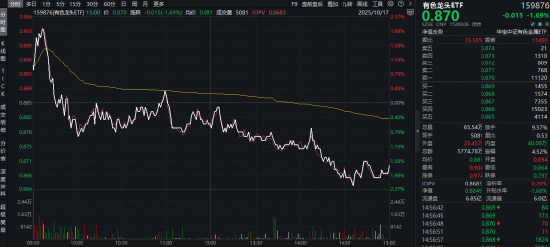
Core Viewpoint - The market is experiencing fluctuations, with the Nonferrous Metal Leader ETF (159876) showing a high of over 2% before closing down 1.69% on October 17, 2023, indicating volatility in the sector [1]. Market Performance - The Nonferrous Metal Leader ETF (159876) had a total trading volume of 57.74 million yuan and a current scale of 606 million yuan as of October 16, 2023, with an average daily trading volume of 12.2 million yuan in October [1]. - Among the top-performing stocks, silver nonferrous leader Baiyin Nonferrous hit the daily limit, while lithium leaders Shengxin Lithium and Zhongfu Industrial both rose over 2% [3]. Key Stocks and Trends - The top ten stocks in the ETF's index include five gold leaders, with Western Gold rising over 3% and Zhongjin Gold increasing over 2% [3]. - Conversely, stocks like Bowei Alloy and Chuangjiang New Materials saw declines exceeding 6%, negatively impacting the index [3]. Gold Price Influences - International gold prices are approaching 4,400 USD/ounce, driven by three main factors: 1. The historical performance of gold during the Federal Reserve's interest rate cut cycles, with an average increase of 6% within 60 days of such announcements [4]. 2. Increased demand for gold due to heightened risk aversion from the U.S. government shutdown, which began on October 1, 2023 [5]. 3. Ongoing de-dollarization trends and credit risks associated with U.S. debt, leading to increased gold purchases by central banks, with global official gold reserves reaching a record high of 36,274 tons by June 2023 [5]. Future Gold Price Predictions - Some institutions, including Bank of America, predict that gold prices could reach 6,000 USD in the spring of 2024, citing low current allocations of gold in investment portfolios [6]. - The World Gold Council indicates that both retail and central bank gold holdings remain significantly below historical highs, suggesting potential for future growth [6]. Sector Opportunities - The rare earth sector is expected to perform well, with companies like Northern Rare Earth and Shenghe Resources projecting substantial profit increases in their upcoming quarterly reports [7]. - In the lithium sector, advancements in solid-state lithium battery technology are anticipated to boost demand, with leading companies maintaining a high self-sufficiency rate in lithium production [7]. - The copper market is facing supply disruptions, particularly from the Grasberg mine in Indonesia, which may tighten global copper supply and drive prices higher [7]. Investment Strategy - The Nonferrous Metal Leader ETF (159876) offers a diversified exposure to various nonferrous metals, including copper, gold, aluminum, rare earths, and lithium, which can mitigate risks compared to investing in single metal sectors [9].
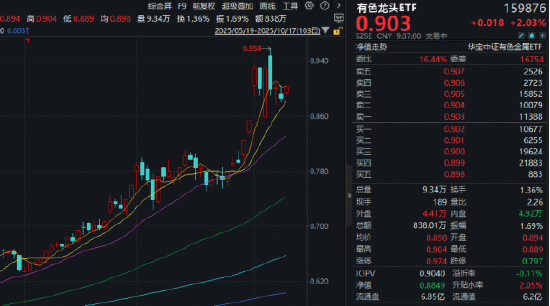
太强了!可能还有一波行情?金价冲击4400美元!有色龙头ETF(159876)逆市劲涨2%,西部黄金拉升6%
Xin Lang Ji Jin· 2025-10-17 01:52
Core Viewpoint - International gold prices have reached new highs, with COMEX gold approaching $4400 per ounce, leading to significant gains in the A-share market, particularly in the non-ferrous metal sector [1] Group 1: Market Performance - Gold stocks led the surge in the A-share market on October 17, with the non-ferrous metal sector ETF (159876) rising over 2% during intraday trading [1] - Key stocks such as Shengxin Lithium Energy increased by over 8%, while Western Gold and Silver Nonferrous rose by more than 6% [1] Group 2: Policy and Economic Environment - The Ministry of Industry and Information Technology, along with eight other departments, has issued a "Work Plan for Stable Growth in the Non-Ferrous Metal Industry (2025-2026)," marking a new phase of institutional support and structural prosperity for the industry [3] - The Federal Reserve has initiated a new round of interest rate cuts, potentially transforming the global liquidity environment [3] Group 3: Supply and Demand Dynamics - Supply constraints are evident, with limited new copper mine discoveries and slow capital expenditure leading to tightened global copper supply, which is expected to push prices higher [4] - Demand is being driven by sectors such as AI, new energy, and infrastructure upgrades, with significant increases in the demand for copper, aluminum, lithium, and rare earths [4] Group 4: Future Outlook - Non-ferrous metals are positioned as key players in the current commodity bull market, supported by long-term capital expenditure cycles and rising global manufacturing investment [5] - The industry is expected to experience a core bull market over the next one to two years, particularly in industrial non-ferrous metals, small metals, and gold [5] Group 5: Investment Strategy - A diversified investment approach through the non-ferrous metal sector ETF (159876) and its associated funds is recommended to capture the overall sector performance while mitigating risks [7]