
太空计算

Search documents
广东宏大:对太空计算等前沿领域的长期战略价值保持关注
Zheng Quan Ri Bao Wang· 2026-01-13 14:12
证券日报网讯1月13日,广东宏大(002683)在互动平台回答投资者提问时表示,公司始终坚信科技创 新是驱动发展的核心动力,并对太空计算等前沿领域的长期战略价值保持关注。未来业务布局方面,公 司将继续聚焦主业,严格遵循审慎评估、风险可控原则有序推进。 ...

推动AI在太空应用
Xin Lang Cai Jing· 2026-01-04 21:06
Core Insights - The "Trinity Computing Constellation" has successfully launched and is operational, enhancing satellite data processing efficiency through inter-satellite communication and advanced AI applications [1][2][3] Group 1: Satellite Operations - The "Trinity Computing Constellation" consists of 12 operational satellites that have been in orbit for over six months, with plans for a full constellation of 12 satellites to achieve complete interconnectivity [1] - The constellation has achieved "Earth-Space Networking" and is currently working on "Six-Star Networking" to enhance data processing capabilities [1] Group 2: Data Processing Efficiency - Traditional satellite operations had low efficiency, with less than 10% of effective satellite data returned to Earth; the new system allows for data processing in space, significantly improving efficiency to minutes or even seconds [2] - Seven models, including astronomical, meteorological, and road detection models, are currently being tested in space, promising substantial improvements in efficiency and accuracy for smart cities and environmental management [2] Group 3: Advanced Communication Technologies - The constellation supports laser communication, which can enhance data transmission rates by 10 to 100 times compared to traditional microwave methods, enabling real-time data processing and transmission back to Earth [3] - The "Trinity Computing Constellation" includes 24 laser communication terminals on its first satellite, facilitating in-orbit networking and computation [3] Group 4: Future Developments - Plans are in place to collaborate with multiple satellite companies to deploy over 50 additional computing satellites by 2026, further advancing the application of AI in space [3] - The initiative reflects a shift in China's AI industry from "technology catching up" to "model innovation," indicating a synchronization of technological breakthroughs with societal needs [3]
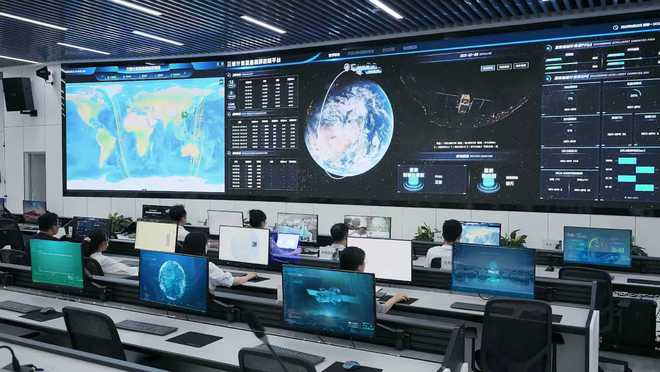
推动AI在太空应用——探访“三体计算星座”指挥中心
Xin Hua She· 2025-12-30 09:25
Core Insights - The "Trinity Computing Constellation" has successfully launched and is operational, consisting of 12 satellites that enhance data processing efficiency in space [1][2] - The constellation aims to achieve full interconnectivity among all 12 satellites, significantly improving data transmission and processing capabilities [2][4] Group 1: Technological Advancements - The "Trinity Computing Constellation" has implemented "Earth-Space Networking" and is progressing towards "Six-Star Networking," with plans for full constellation interconnectivity [2] - The system allows for real-time data processing in space, reducing the time for data delivery to users from hours to minutes or even seconds [2][3] - Seven models, including astronomical and meteorological models, are currently being tested in space, promising significant improvements in efficiency and accuracy for smart cities and environmental management [3] Group 2: Applications and Future Developments - The constellation supports advanced applications such as laser communication, which can enhance data transmission rates by 10 to 100 times compared to traditional microwave methods [3] - The initiative reflects a shift in China's artificial intelligence industry from technology catch-up to model innovation, aligning technological breakthroughs with societal needs [4] - Plans are in place to collaborate with multiple satellite companies to deploy over 50 additional computing satellites by 2026, further advancing AI applications in space [4]

算力的尽头,是“星辰大海”吗?
经济观察报· 2025-12-25 11:49
Core Viewpoint - The article discusses the emerging field of space computing, highlighting its potential advantages, current developments, and the challenges it faces in becoming a viable alternative to traditional computing methods [3][5][6]. Group 1: Definition and Importance of Space Computing - Space computing refers to the deployment of computational resources in space, allowing for data processing and AI model training in a unique environment [8][10]. - The recent successful training of AI models in space by Starcloud marks a significant milestone, indicating the beginning of serious competition in the space computing sector [4][5]. - Major tech companies and countries are investing in space computing, with initiatives from SpaceX, Blue Origin, and Google, reflecting a growing interest in this area [5][6]. Group 2: Advantages of Space Computing - Space computing can overcome three major bottlenecks faced by traditional computing: energy consumption, water resource limitations, and spatial constraints [15][18]. - The abundance of solar energy in space can significantly reduce energy limitations for AI computations [15]. - The vacuum of space allows for efficient heat dissipation, eliminating the need for extensive cooling systems that consume water [16]. - Space offers virtually unlimited room for data centers, avoiding the social resistance faced by ground-based facilities [17]. Group 3: Engineering Forms and Business Models - Three potential engineering forms for space computing are identified: orbital computing nodes, modular computing clusters, and hybrid space-ground computing systems [19][20]. - Modular computing clusters could serve large-scale, low-latency tasks, appealing to sectors like astrophysics and materials science that require extensive computational resources [22]. - The hybrid model integrates space computing with existing cloud services, allowing for a division of labor where energy-intensive tasks are offloaded to space [24]. Group 4: Challenges Facing Space Computing - Technical challenges include the harsh conditions of space, such as radiation and temperature extremes, which complicate the reliability of computing systems [27]. - Economic uncertainties arise from the high initial investment and long return periods associated with space computing infrastructure [28]. - The potential for resource congestion in space could lead to increased risks of collisions and environmental instability in orbit [29]. - Regulatory issues regarding governance and accountability for space-based computing systems remain unresolved [30]. Group 5: Conclusion and Future Outlook - The future of space computing is uncertain, but its development could parallel historical advancements like the railway system, potentially transforming the AI landscape [33].



12月19日热门路演速递 | 人工智能、AI算力、周期与韧性的2026新蓝图
Wind万得· 2025-12-18 22:45
Group 1 - The core focus of the 2026 Annual Conference is on the impact of artificial intelligence (AI) from technological breakthroughs to societal reconstruction, exploring how embodied intelligence drives industrial transformation and seeks paths for AI to align with low-carbon goals during the critical period of the "14th Five-Year Plan" [2][3] - The conference features prominent guests including Terrence Sejnowski, a member of the National Academies of Sciences, Engineering, and Medicine, and Xue Lan, Director of the National New Generation Artificial Intelligence Governance Professional Committee [3] Group 2 - Insights from the industry highlight how breakthroughs in AI models in 2026 will reshape investment logic in computing power, applications, and aerospace computing, with models like DeepSeek driving advancements in China [5][6] - The long-term improvement in the A-share market environment is expected to stem from a decline in interest rates and increased liquidity, with the CSI A500 index providing balanced industry allocation and core asset selection [8] Group 3 - The 2026 Annual Strategy Conference will focus on the restructuring and opportunities in cyclical industries under the "anti-involution" policy, discussing how construction materials can accelerate clearing at the bottom, and how new chemical materials can benefit from supply-demand improvements [10] - The investment outlook for 2026 emphasizes resilience and rebalancing, with global investment patterns influenced by geopolitical uncertainties and expectations of interest rate cuts by the Federal Reserve, alongside China's fiscal policies potentially boosting economic growth [13][14]

计算机行业周报:小米发布开源大模型,AI应用布局有望深化-20251218
BOHAI SECURITIES· 2025-12-18 09:42
Investment Rating - The investment rating for the computer industry has been downgraded from "Positive" to "Neutral," while maintaining a "Buy" rating for Hongsoft Technology (688088) [2][29] Core Insights - Xiaomi has released an open-source MoE model and launched a web-based AI chat service, which is expected to deepen its AI application layout [13] - The AI application sector is experiencing high prosperity, with major domestic companies accelerating their C-end application layouts [27] - The recent release of OpenAI's GPT-5.2 model is aimed at unlocking more economic value and enhancing capabilities in various tasks [14] Industry News - Xiaomi's new open-source MoE model, Xiaomi MiMo-V2-Flash, features 309 billion parameters and is designed for AI agents, achieving significant efficiency improvements [13] - The first domestic space computing joint laboratory is set to be established, focusing on autonomous and controllable space computing chip development [13] - OpenAI's GPT-5.2 model is now available for developers and professional users, with different versions tailored for various tasks [14] Market Review - From December 11 to December 17, the Shanghai Composite Index fell by 0.26%, while the Shenwan Computer Industry Index dropped by 2.01%, with all sub-sectors experiencing declines [20][21] - The current price-to-earnings ratio for the Shenwan Computer Industry is 201.44 times, with a valuation premium of 1416.92% compared to the Shanghai Composite Index [21] Weekly Strategy - The ongoing iteration and upgrade of large model products by leading domestic and international companies are expected to accelerate technological innovation and application landing [27] - Companies like Google are expanding their computing power to meet the rising demand for AI services, while domestic chip companies are leveraging financing channels to enhance their product development [27]
龙虎榜复盘丨航天板块继续强势,大消费也有表现
Xuan Gu Bao· 2025-12-15 10:34
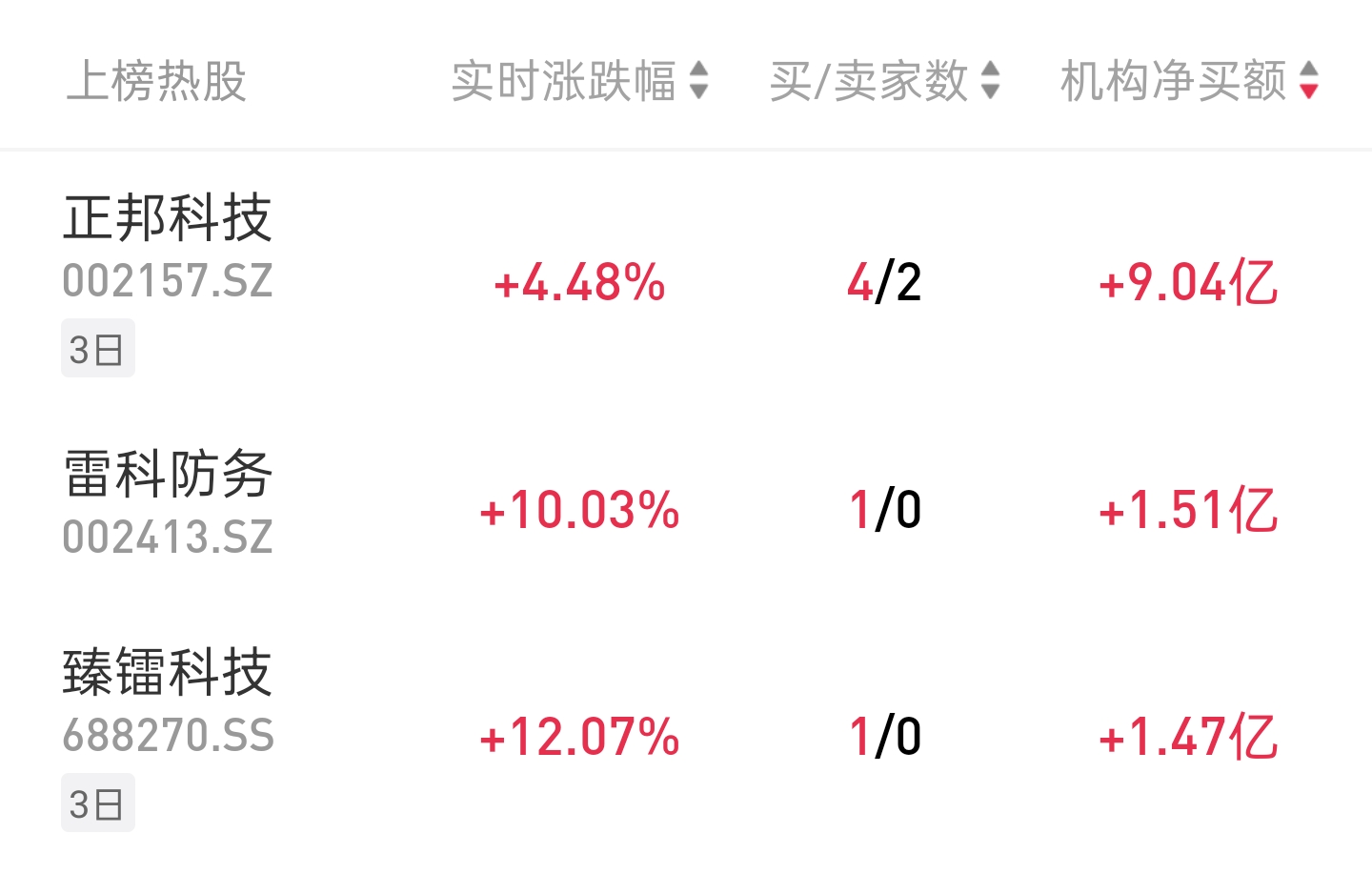
Group 1: Institutional Trading Insights - On the day, 43 stocks were listed on the institutional trading leaderboard, with 23 seeing net purchases and 20 experiencing net sales [1] - The top three stocks with the highest net purchases were Zhengbang Technology (900 million), Leike Defense (151 million), and Zhenlei Technology (147 million) [1] - Leike Defense's satellite application business has established a comprehensive technology system, providing remote sensing data solutions for key national economic sectors [1] Group 2: Aerospace Industry Developments - Shanghai Jiao Tong University and Guoxing Aerospace signed an agreement to establish China's first space computing joint laboratory, focusing on the demand for space-based computing networks [2] - The collaboration aims to form a globally influential space computing industry cluster [2] - The aerospace industry in Shenyang is set to expand, with plans to enhance capabilities in large aircraft assembly and develop a complete industry chain covering manufacturing and operational services [2] Group 3: Consumer Sector Trends - Dongbai Group focuses on retail and commercial real estate development [4] - The core product of Huanlejia is fruit canned goods, particularly orange and peach cans [4] - Recent reports indicate a price increase for high-end liquor, with the wholesale price of a 25-year-old Flying Moutai bottle rising by 20 yuan to 1500 yuan, reflecting a cumulative increase of 6% over two days [4][5] - Huachuang Securities suggests that service consumption could be a key driver for domestic demand in 2026, with significant potential in holiday policy optimization and consumption voucher issuance [4] Group 4: High-End Liquor Market Dynamics - Moutai's supply-side reform is seen as a significant change in the high-end liquor industry, focusing on stabilizing prices and reshaping the channel ecosystem [5] - The food and beverage sector is currently valued at historical lows, with the potential for investment opportunities as market sentiment shifts [5]


今天,A股三大主线逆势走强
Zhong Guo Zheng Quan Bao· 2025-12-15 08:32
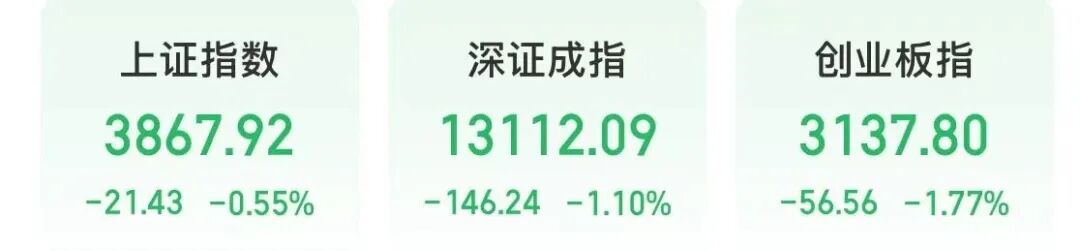
Group 1: Market Overview - The cyclical market showed significant activity today, with major consumption sectors like dairy and retail experiencing substantial gains, while financial sectors such as insurance, banking, and securities also performed well [1] - Some cyclical sectors, including pork, steel, and construction materials, saw increases [1] - Technology stocks experienced a pullback, particularly in computing and semiconductor sectors, with the Shanghai Composite Index down 0.55%, Shenzhen Component Index down 1.1%, and ChiNext Index down 1.77% [1] Group 2: Retail and Commercial Aerospace Sectors - Recent trading data indicates that retail and commercial aerospace sectors are attracting active market funds, with retail benefiting from favorable policies and aerospace seeing event-driven catalysts [2] - Specific retail stocks such as Hongqi Chain (002697), Quanxinhao (000007), and Baida Group (600865) reached their daily limit up, with Baida Group achieving three consecutive limit-ups [2][3] Group 3: Consumption and Policy Support - The retail sector index rose by 2.75%, with notable stocks like Hongqi Chain increasing by 10.07% and Baida Group by 10.02% [3] - The Ministry of Commerce and other regulatory bodies announced measures to enhance collaboration between commerce and finance, aiming to boost consumption through 11 specific initiatives [4] - A recent plan from the Ministry of Industry and Information Technology aims to create three trillion-level consumption areas and ten billion-level consumption hotspots by 2027, with a focus on high-quality development by 2030 [5] Group 4: Aerospace Sector Developments - The commercial aerospace sector is currently very popular, with stocks like Aerospace Electronics (600879) and Aerospace Information (600271) experiencing significant gains [5] - A recent successful satellite launch using the Lijian-1 rocket demonstrated the sector's capability to serve international clients, contributing to a positive cycle in the industry [8] Group 5: Steel Sector Performance - The steel sector saw gains today, with stocks like Fushun Special Steel (600399) and Taiyuan Iron & Steel (000825) achieving limit-ups [9] - The Ministry of Commerce and the General Administration of Customs announced export license management for certain steel products starting January 1, 2026, which may positively influence the industry [11] - Analysts suggest that the steel industry is expected to stabilize and improve, with structural investment opportunities available in companies with advanced equipment and strong growth potential [11]


【太平洋科技-每日观点&资讯】(2025-12-15)
远峰电子· 2025-12-14 12:06
Market Performance - The main board saw significant gains with notable stocks such as Copper Peak Electronics (+10.04%), Xilong Science (+10.00%), and Dongfang Communication (+9.98%) leading the charge [1] - The ChiNext board experienced a surge, highlighted by Guoci Materials (+20.02%) and LianTe Technology (+15.87%) [1] - The Sci-Tech Innovation board also performed well, with Jingfeng Mingyuan (+20.00%) and Yandong Micro (+16.84%) among the top gainers [1] - Active sub-industries included SW Electronic Chemicals III (+4.36%) and SW Semiconductor Equipment (+3.55%) [1] Domestic News - Taiwan's Industrial Technology Research Institute announced the development of the region's first full-color high-resolution Micro LED AI smart glasses, featuring a 0.49-inch display with 1920x1080 FULL HD resolution and over 3000 nits brightness [1] - Shanghai Jiao Tong University and Guoxing Aerospace signed an agreement to establish China's first space computing joint laboratory, focusing on autonomous space computing chip development and related technologies [1] - Goer Group and Haier Group signed a strategic cooperation agreement to collaborate on smart home, health, and digital economy sectors, leveraging Goer's expertise in precision components and smart manufacturing [1] - According to BCI's report, Huawei's smartphone market share is projected to reach 27.81% by the 48th week of 2025, significantly ahead of Apple's 17.12% [1] Company Announcements - Electric Science and Technology Network announced a significant decrease in expected daily related transactions for 2026, with actual transactions for 2025 being 283.25 million yuan compared to an expected 1.17385 billion yuan [3] - Chip Origin announced progress in acquiring Zhudian Semiconductor, with a capital increase of 350 million yuan for the acquisition [3] - Yunding Technology projected daily related transactions for 2026 to be approximately 1.355 billion yuan, with actual transactions expected to be around 1.484 billion yuan [3] - Aisino Security reported receiving a government subsidy of 1 million yuan, classified as a revenue-related government grant [3] International News - Dell plans to increase prices for its commercial product line by approximately 10%-30% starting December 17, depending on computer configuration [1] - STMicroelectronics secured a new credit line of 1 billion euros from the European Investment Bank, with 60% allocated for enhancing manufacturing capabilities [1] - SK Hynix ordered seven sets of thermal compression bonding machines from ASMPT for HBM4 production, a critical technology for ensuring product yield and performance [1] - Kioxia plans to start producing next-generation NAND flash memory chips in Iwate Prefecture in 2026, increasing storage capacity by 59% and data transfer speed by 33% [1]




“押注”太空计算,国内首个太空计算联合实验室落地上海
Xin Lang Cai Jing· 2025-12-14 09:04
Core Insights - Guoxing Aerospace and Shanghai Jiao Tong University have signed a cooperation agreement to jointly establish a Space Computing Joint Laboratory, focusing on the development of autonomous and controllable space computing chips, robotic satellites, and in-orbit additive manufacturing [1] Group 1 - The laboratory aims to address the demand for space-based computing networks and is committed to creating a leading technology and autonomous controllable space computing network [1] - The initiative is expected to promote the formation of a globally influential space computing industry cluster [1] Group 2 - On the same day, the Oriental TianSuan Company, an industrialization platform for the Space Computing Joint Laboratory, was officially established at Shanghai Jiao Tong University under the guidance of the Shanghai Municipal Science and Technology Commission [1]