
扩内需政策

Search documents
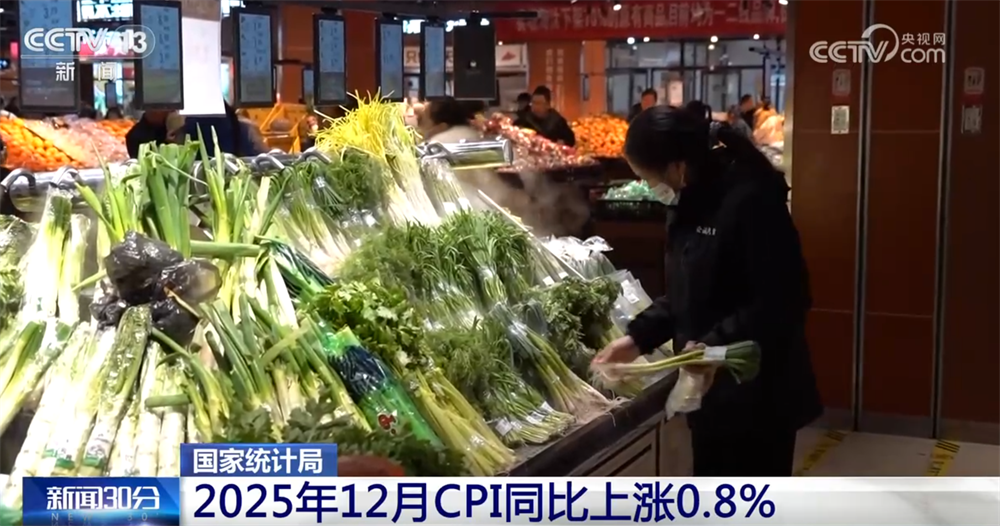
从CPI同比上涨0.8%看中国经济的“稳”与“进”
Yang Shi Wang· 2026-01-09 07:25
Core Insights - The Consumer Price Index (CPI) for December 2025 increased by 0.8% year-on-year, marking the highest level since March 2023, with a month-on-month increase of 0.2% after a previous decline [1] - The core CPI, excluding food and energy, rose by 1.2% year-on-year, maintaining a growth rate above 1% for four consecutive months [1] - The increase in consumer demand, driven by policy incentives and seasonal factors, has led to price increases in various categories, including fresh fruits and seafood [1] Economic Policies and Consumer Behavior - The implementation of major policies aimed at expanding domestic demand has positively impacted consumer sentiment, with initiatives such as the trade-in policy for consumer goods and targeted consumption promotion actions [1] - There has been a notable increase in the consumption of automobiles, mobile phones, and home appliances, with price trends significantly better than in previous years [1] Annual Overview - For the entire year of 2025, the national CPI remained flat compared to the previous year, while the core CPI saw a modest increase of 0.7% [1]
从CPI同比上涨0.8%看中国经济的“稳”与“进” 提振消费政策效果持续显现
Yang Shi Wang· 2026-01-09 05:28
Group 1 - The core viewpoint of the news is that the Consumer Price Index (CPI) in December 2025 increased by 0.8% year-on-year, marking the highest level since March 2023, driven by increased consumer demand and policy incentives [1][3]. - In December 2025, the month-on-month CPI shifted from a decrease of 0.1% in the previous month to an increase of 0.2%, influenced by heightened consumer demand before the holiday season [3]. - The core CPI, excluding food and energy prices, rose by 1.2% year-on-year, maintaining a growth rate above 1% for four consecutive months [1][3]. Group 2 - The National Development and Reform Commission highlighted that the implementation of major policies aimed at expanding domestic demand, such as the trade-in policy for consumer goods, has effectively boosted consumer willingness and potential [5]. - There has been a notable increase in the consumption of related goods such as automobiles, mobile phones, and home appliances, with price trends significantly better than in previous years [5]. - For the entire year of 2025, the national CPI remained flat compared to the previous year, while the core CPI increased by 0.7% [8].

2025年12月多项指标稳中有升 高频数据折射市场活力
Xin Lang Cai Jing· 2026-01-08 21:02
Group 1: Consumer Market Growth - The consumer market in China is steadily growing, with December 2025 showing a 0.9% year-on-year increase in consumption, driven by a 1.3% rise in goods consumption and a 0.4% rise in service consumption [1] - During the New Year holiday from January 1 to 3, 2026, consumption surged by 6.1% year-on-year, with goods consumption increasing by 9.3% and service consumption by 1.1% [1] - The National Development and Reform Commission (NDRC) indicates that ongoing policies to promote consumption and expand domestic demand are effectively stimulating market vitality [1] Group 2: Infrastructure Investment - In December 2025, the amount of project bids nationwide increased by 28% month-on-month, reflecting the positive impact of newly introduced policy financial tools and special bond quotas [2] - The NDRC announced an early batch of "two heavy" construction projects and a central budget investment plan totaling approximately 295 billion yuan, alongside approvals for major infrastructure projects with total investments exceeding 400 billion yuan [2] - The operational rates of petroleum asphalt facilities and cement mills turned positive compared to November, indicating a rebound in construction activity [2] Group 3: Foreign Trade and Export Dynamics - China's goods trade has maintained growth for ten consecutive months since February 2025, showcasing resilience and vitality in foreign trade [2] - The export container freight index for routes to Southeast Asia, South Korea, and Europe increased by 17.8%, 5.2%, and 4.6% respectively in December 2025, indicating a deepening diversification in foreign trade [2] - The average number of international cargo flights per day rose by 13.8% year-on-year, reflecting accelerated exports of high-value products [2] Group 4: Innovation and Business Vitality - The operational vitality index for startups and technology innovation enterprises grew by 17.9% and 20.4% year-on-year in December 2025, respectively, indicating a positive trend in corporate innovation [3] - The export structure in China is continuously upgrading, with over 60% of exports consisting of electromechanical and high-tech products, particularly benefiting emerging markets [3]
轻工、美护2026年年度策略:内需筑底深挖潜力,出海突围打开新局
HUAXI Securities· 2026-01-07 02:30
Group 1: Industry Overview - The light industry and beauty sector is expected to stabilize and improve due to the dual drivers of domestic demand policies and steady export growth [3] - The "14th Five-Year Plan" marks a year of enhanced domestic demand policies, coupled with consumers' increasing pursuit of high-quality living, creating significant growth opportunities for the industry [3] - The penetration rate of cross-border e-commerce has ample room for improvement, and the recovery of international relations and demand from emerging markets will further drive market expansion [3] Group 2: Beauty Sector - The cosmetics market is projected to grow steadily, with the skincare segment being the largest, reaching a market size of 4,619 billion yuan in 2024, and expected to grow at a CAGR of 8.6% from 2024 to 2029 [19] - The high-end cosmetics market is rapidly expanding, with the market size for high-end skincare products increasing from 749 billion yuan in 2019 to 1,144 billion yuan in 2024, reflecting a CAGR of 8.84% [19] - Key companies in the beauty sector include: - **Mao Geping**: Revenue reached 25.88 billion yuan in H1 2025, with a growth rate of 31.28% [23] - **Lin Qingxuan**: Revenue grew to 10.52 billion yuan in H1 2025, marking a 98.28% increase [27] - **Marubi**: Revenue is expected to reach 29.70 billion yuan in 2024, recovering from previous declines [32] Group 3: Medical Aesthetics - The medical aesthetics sector is facing short-term pressure due to cautious consumer spending, but the long-term growth potential remains strong, with a projected CAGR of 10%-15% from 2024 to 2027 [36] - The market penetration rate for medical aesthetics in China is currently at 4-5%, indicating a growth potential of 2-5 times compared to countries like the US and South Korea [36] - Key companies in the medical aesthetics sector include: - **Jinbo Biological**: Achieved revenue of 12.96 billion yuan in Q1-Q3 2025, with a year-on-year growth of 31.10% [45] Group 4: Daily Chemicals - The daily chemical industry is benefiting from domestic demand policies, with local brands poised to capture market share [49] - Companies such as **Dengkang Oral Care** and **Runben** are highlighted for their strong market positions and growth potential [51][55] - **Shanghai Jahwa** has shown significant growth, with revenue reaching 49.61 billion yuan in Q1-Q3 2025, reflecting a 10.83% increase [59] Group 5: Home Furnishing - The home furnishing sector is under pressure due to weak real estate sales, with a 15% decline in residential investment in 2025 [65] - National subsidies for home appliances and furnishings have provided some support, but the long-term effects are limited [65] - Leading companies such as **Oppein Home** and **Kuka Home** are noted for their strong channel capabilities and multi-category layouts [65]




光大期货:1月5日金融日报
Sou Hu Cai Jing· 2026-01-05 01:49
Group 1: Market Trends and Expectations - The likelihood of a "cross-year market" in January is low, with indices expected to continue oscillating within a central range due to insufficient conditions for a breakout [1][2] - Historical data shows that January indices have often recorded negative growth, with significant declines in 2022 and 2024 due to tightening liquidity [2] - The adjustment of index constituents in December has increased the weight of growth sectors, particularly in the tech and AI industries, indicating a market expectation aligned with current trends [3] Group 2: Bond Market Dynamics - The bond market has shown a continued oscillating pattern, with a steepening yield curve influenced by a combination of loose funding and rising risk appetite [4] - The People's Bank of China conducted significant reverse repo operations to maintain liquidity, with a net injection of 653 billion yuan in December [5] - Government bond issuance in December totaled 21,048 billion yuan, with a net issuance of 5,002 billion yuan, indicating a robust supply in the bond market [6] Group 3: Manufacturing and Economic Indicators - The official manufacturing PMI for December was reported at 50.1, indicating a return to expansion territory, with notable improvements in production and new orders [7] - The service sector also showed slight recovery, with the business activity index rising to 49.7, driven by favorable weather and increased construction activity [7][8] Group 4: Precious Metals Market - Gold and silver prices experienced significant increases in December, with gold reaching a monthly high of 4,550.52 USD/oz and silver rising by 26.92% [9][10] - The market for precious metals is influenced by factors such as the Federal Reserve's monetary policy shifts and ongoing geopolitical tensions, which have heightened demand for safe-haven assets [10][11] - The outlook for January suggests a high volatility environment for platinum and palladium, with potential buying opportunities following price corrections [11]
固定收益点评报告:制造业PMI重返扩张区间
Huaxin Securities· 2025-12-31 10:33
Report Overview - The report is a fixed - income review report focusing on the PMI data in December 2025 [1] Industry Investment Rating - No industry investment rating is provided in the report Core Viewpoints - In December, the manufacturing PMI reached 50.1, rising by 0.9 and returning to the expansion range for the first time since April; the non - manufacturing PMI was 50.2, up 0.7 month - on - month. The PMI data shows that under the influence of pre - holiday effects, domestic demand expansion policies, and price transmission due to anti - involution deepening, enterprises' operating pressure, production expectations, demand side, and production expansion willingness have all improved. It is necessary to continuously monitor the sustainability of domestic demand improvement and policy strength [2][4] Section Summaries Manufacturing - **Business Conditions**: The production index increased significantly by 1.7 to 51.7, and the new order index rose by 1.6 to 50.8, with the new export order index up 1.4 to 49. Enterprises' production and operation enthusiasm increased notably, with the raw material inventory rising 0.5 to 47.8, the procurement volume up 0.6 to 51.1, and the production and operation activity expectation up 2.4 to 55.5. From an industry perspective, industries such as农副 food processing, textile and clothing, and computer communication and electronic equipment had both production and demand above 53, while industries like non - metallic mineral products and ferrous metal smelting and rolling processing had both indexes below the critical point [3] - **Profitability**: The purchase price of raw materials decreased by 0.5, and the ex - factory price index increased by 0.7, indicating marginal improvement in corporate profits [3] - **Enterprise Size**: The business conditions of large enterprises rebounded above the boom - bust line. In December, the PMIs of large, medium, and small enterprises changed by 1.5, 0.9, and - 0.5 respectively, reaching 50.8, 49.8, and 48.6 [3] - **Key Industries**: The PMIs of high - tech manufacturing, equipment manufacturing, consumer goods industries, and raw material industries changed by 2.4, 0.6, 1.0, and 0.5 respectively, reaching 52.5, 50.4, 50.4, and 48.9 [3] Non - manufacturing - **Construction Industry**: In December, the business activity index of the construction industry was 52.8, up 3.2 month - on - month, and returned above the boom - bust line, showing strong resilience [3] - **Service Industry**: The business activity index of the service industry was 49.7, up 0.2, indicating some pressure [3] Investment Suggestions - The December PMI data shows comprehensive improvement in enterprises' operating pressure, production expectations, demand side, and production expansion willingness. It is recommended to continuously monitor the sustainability of domestic demand improvement and policy strength [4]
铅周度总结:供应刚性与需求弹性共振 跨年行情将延续涨势?
Xin Lang Cai Jing· 2025-12-26 09:52
Core Viewpoint - The lead price in the Changjiang spot market has shown a healthy upward trend, closing at 17,350 CNY/ton, marking a cumulative increase of 400 CNY/ton over the week, with an average price of 17,190 CNY/ton, up 80 CNY from the previous week, driven by macroeconomic factors and fundamental support [4][5]. Macroeconomic Factors - The strong rise in lead prices is attributed to four macroeconomic drivers: 1. Strengthened expectations for Federal Reserve interest rate cuts, reducing the opportunity cost of holding non-yielding assets like metals [5]. 2. Significant appreciation of the RMB, lowering import costs for raw materials and enhancing domestic investors' preference for RMB-denominated assets [5]. 3. Continuous supportive policies from the government, including signals of monetary easing and initiatives to boost consumption, which have bolstered confidence in economic recovery and industrial demand [5]. 4. Improvement in initial jobless claims data in the U.S., alleviating concerns about a deep global economic recession and increasing risk appetite [5]. Supply and Demand Dynamics - The lead market is currently in a "weak balance" state, characterized by rigid supply and elastic demand: - Supply constraints are due to structural shortages in lead concentrate and challenges in recycling during winter, leading to insufficient supply elasticity and low social inventory, which supports prices [6]. - Demand shows a mixed picture, with traditional sectors like electric bicycles and automotive batteries remaining stable, while new energy vehicles pose long-term replacement pressure on lead-acid batteries. Emerging sectors like energy storage are expected to provide incremental space but have not yet significantly impacted the overall demand [6]. - The industry's profit is shifting towards upstream mining, while midstream and downstream sectors face challenges balancing cost pressures and end prices [6]. Market Outlook - Looking ahead, the market will navigate through the interplay of policy, liquidity, and reality: - The focus will be on the Federal Reserve's December FOMC meeting minutes to validate the interest rate cut path for 2026, with any dovish signals likely to reinforce the narrative of a weak dollar and ample liquidity [7]. - Domestic policies under the "14th Five-Year Plan" are expected to drive growth, with a dual focus on "new productive forces" and expanding domestic demand, serving as key engines for the market [7]. - The lead market is anticipated to remain in a typical "weak balance" state, with supply constraints and low social inventory supporting price floors, while demand lacks explosive drivers. The lead price is expected to fluctuate within the range of 17,500 to 17,900 CNY/ton, exhibiting characteristics of "top and bottom" [7]. Investment Strategy - For investors, this period represents a critical window for positioning in 2026: - A "barbell strategy" is recommended, focusing on offensive investments in sectors aligned with "new productive forces" such as AI and commercial aerospace, while defensive allocations should include high-dividend blue-chip stocks to mitigate volatility [8]. - The trading logic is shifting from mere expectation-based speculation to a deeper validation of policy effectiveness and fundamental data, emphasizing the need for sensitivity to reality while embracing trends to seize opportunities in the year-end market [8].

长江有色:26日锡价上涨 高价位下交投谨慎买方静待逢低机会
Xin Lang Cai Jing· 2025-12-26 08:49
Group 1: Market Performance - The Shanghai tin contract 2602 increased by 4,590 yuan, or 1.37%, closing at 338,550 yuan per ton after reaching a high of 344,470 yuan and a low of 332,820 yuan during the day [1] - The trading volume for the main contract was 369,071 lots, with an open interest of 52,276 lots, showing a decrease of 968 lots from the previous day [1] - The average price of 1 tin in the Changjiang market rose by 1,800 yuan to 333,900 yuan per ton, while the average price in the spot market was 334,000 yuan, up by 1,750 yuan from the previous trading day [1] Group 2: Macro Factors - Tin prices are being driven by a combination of macroeconomic policies, exchange rates, and liquidity, with expectations of a Federal Reserve interest rate cut due to unexpectedly slowing U.S. CPI data [1] - The strong appreciation of the RMB has effectively reduced domestic import costs, enhancing optimistic market expectations for Chinese demand [1] - Continuous signals for "stabilizing growth and expanding domestic demand" policies are boosting market confidence, although the transmission to the real economy may take time [1] Group 3: Supply and Demand Dynamics - The tin market is at a critical juncture characterized by a "supply crisis, demand negotiation, and industrial chain restructuring" [2] - Supply is under "epic tension" due to slow recovery in Myanmar, strict crackdowns on illegal mining in Indonesia, and escalating conflicts in the Democratic Republic of Congo, leading to a shortage of concentrates that restricts smelting capacity [2] - Demand is showing "structural differentiation," with short-term support from holiday stocking and electronic product surges, but high prices are suppressing actual purchases, leading to a "high price, low market" scenario [2] Group 4: Future Price Outlook - The future price of tin will depend on the "rigid supply contraction" and the "demand response to high prices" [2] - In the short term, tin prices are likely to maintain a high oscillation within the core range of 330,000 to 350,000 yuan per ton, with increasing pressure for a pullback [2] - If pre-holiday stocking does not meet expectations, prices may test the lower end of this range, with rebound momentum constrained by weak spot transactions [2]
11月CPI继续回升,食品饮料板块转正
Sou Hu Cai Jing· 2025-12-19 02:38
行业目前仍处于深度调整期,龙头公司纷纷采取措施稳价格、稳渠道,有利于加速行业筑底出清。中短 期来看,2025Q4—2026Q1受2026年春节较晚,酒企报表端、渠道端继续出清等影响,预计2026Q2龙头 公司将在低基数下迎来触底回升。经过前期调整,目前白酒板块估值处于近10年来10%左右分位数水 平;龙头公司注重股东回报,加大分红,板块中长期投资价值逐步显现。建议关注贵州茅台、五粮液、 泸州老窖、山西汾酒、今世缘、古井贡酒等。 大众品方面,10月CPI同比转正,11月CPI食品项转正;社零受益国庆中秋双节影响,餐饮、文旅等服 务消费表现较为亮眼。乳制品、调味品、啤酒等传统板块龙头表现平稳,行业需求端虽有压力,但成本 端仍保持低位;零食、软饮料等新消费板块依然保持较快增速,景气持续。未来,随着扩内需政策的逐 步落地,若CPI延续10月、11月趋势逐步上行,物价走出通缩,传统消费龙头有望迎来触底回升。建议 关注海天味业、伊利股份、青岛啤酒、东鹏饮料、安琪酵母、妙可蓝多等。 (以上内容仅供参考,不作为投资决策依据。投资有风险,入市需谨慎。) 晨报讯(南京晨报/爱南京记者 许崇静)近期,中央经济工作会议明确将"坚持内 ...



建信期货股指日评-20251218
Jian Xin Qi Huo· 2025-12-18 03:18
报告类型 股指日评 日期 2025 年 12 月 18 日 研究员:聂嘉怡(股指) 021-60635735 niejiayi@ccb.ccbfutures.com 期货从业资格号:F03124070 研究员:何卓乔(宏观贵金属) 18665641296 hezhuoqiao@ccb.ccbfutures.com 期货从业资格号:F3008762 研究员:黄雯昕(宏观国债集运) 021-60635739 huangwenxin@ccb.ccbfutures.com 期货从业资格号:F3051589 宏观金融团队 请阅读正文后的声明 #summary# 每日报告 一、行情回顾与后市展望 1.1 行情回顾: 12 月 17 日,万得全 A 放量上涨,开盘后震荡运行,午后快速拉涨,收涨 1.54%, 全市超 6 成个股上涨;沪深 300、上证 50、中证 500、中证 1000 收盘分别上涨 1.83%、 1.25%、1.95%、1.49%,中小盘股表现更优。期货方面,IF、IH、IC、IM 主力合 约(2603)分别收涨 1.81%、1.25%、2.23%、1.64%,表现强于现货(按收盘价计 算)。 | 表1: ...