投资组合

Search documents
[10月27日]指数估值数据(A股港股继续上涨,回到4.1星)
银行螺丝钉· 2025-10-27 14:22
Core Viewpoint - The overall market has shown a recovery, with significant increases in both A-shares and Hong Kong stocks, indicating a positive trend in the investment landscape [1][10][13]. Market Performance - The Shanghai Composite Index is approaching 4000 points, while the CSI All Share Index has reached 5913 points, nearing its post-National Day level of 5967 points [3][4]. - Both large-cap and small-cap stocks have risen, with large-cap stocks showing slightly more growth [5]. - Growth and value styles have both experienced increases, with the STAR Market showing particularly strong performance [6][7]. - The Hang Seng Index has also risen, led by technology stocks [10]. Economic Indicators - The U.S. Consumer Price Index for September indicated a slowdown in inflation, which was below market expectations [11]. - The likelihood of a continued decline in U.S. dollar interest rates has increased, contributing to a global stock market rally [12]. Investment Strategies - The article highlights that despite market fluctuations, many investors have seen profits, with over 94% of holders in the actively selected portfolio being profitable [17][18]. - It discusses the importance of maintaining a long-term investment perspective and avoiding panic selling during market downturns [32][33]. - The article emphasizes that a majority of investors who engaged in regular investments or increased their positions during market lows have benefited from reduced costs and earlier profits [34][35]. Upcoming Events - A live session is scheduled for October 28 to discuss the reasons behind the recent significant increases in A-shares and Hong Kong stocks, the valuation advantages of RMB assets, and future market prospects [39].


Which Will Rally: HON Stock or MMM Stock?
Forbes· 2025-10-22 13:50
Core Insights - 3M stock experienced a 7.7% increase in a single day due to positive quarterly performance and guidance, but Honeywell International may present a more attractive investment option due to superior revenue growth, better profitability, and lower valuation [2][3] Company Comparison - 3M provides a range of products including industrial abrasives, healthcare coding software, and consumer health products, while Honeywell is a diversified technology and manufacturing company offering building control software and personal protective equipment [2] - Honeywell's performance metrics indicate it has consistently outperformed 3M in key financial areas, suggesting a stronger investment case for Honeywell [2][3] Investment Strategy - For investors seeking less volatility, the High Quality Portfolio has outperformed its benchmark, achieving returns exceeding 105% since inception, indicating a more stable investment approach compared to individual stocks [2][7] - The Trefis Reinforced Value (RV) Portfolio has also shown strong returns by balancing large-, mid-, and small-cap stocks, providing a responsive investment strategy [7]



达利欧密集讨论黄金投资比例
Di Yi Cai Jing· 2025-10-21 11:55
Core Insights - Ray Dalio, founder of Bridgewater Associates, emphasizes the importance of gold in investment portfolios, suggesting a holding of 10% to 15% in gold as a strategic asset allocation [2][7] - Dalio argues that gold is increasingly replacing U.S. Treasury bonds as a risk-free asset in many investment portfolios, particularly among central banks and large institutional investors [2][8][9] Group 1: Gold as an Investment - Dalio believes that many people mistakenly view gold merely as a metal rather than as a mature form of currency, which has historical significance as a store of value [3] - He asserts that unlike fiat currency, gold does not carry inherent credit risk or devaluation risk, making it a better hedge during economic downturns [5][6] - Gold's unique position as a universally accepted medium of exchange and store of wealth distinguishes it from other metals like silver and platinum, which are more influenced by industrial demand [6] Group 2: Market Dynamics and Trends - The relative supply and demand dynamics between debt currency and gold currency are shifting, with increasing interest in gold as a hedge against inflation and economic instability [4][7] - The rise of gold ETFs has improved liquidity and transparency in the gold market, although they remain smaller than traditional physical gold investments [8] - Dalio notes that gold is now the second-largest currency held by central banks, demonstrating its lower risk compared to government debt assets [9] Group 3: Strategic Asset Allocation - Dalio advises that investors should consider a strategic allocation to gold based on historical performance and its negative correlation with stocks and bonds during downturns [7] - He emphasizes the importance of diversification in investment portfolios, particularly in light of potential economic downturns and the performance of high-growth stocks [7][8] - The recommendation for a 10% to 15% allocation to gold is based on its ability to enhance the risk-return profile of an investment portfolio [7]

How Will Philip Morris Stock React To Its Upcoming Earnings?
Forbes· 2025-10-18 11:50
Core Insights - Philip Morris International is expected to announce earnings of $2.10 per share and sales of $10.66 billion, surpassing last year's results of $1.91 per share and $9.91 billion in sales [3] - The company has a market capitalization of $243 billion and generated $39 billion in revenue over the last twelve months, with operating profits of $14 billion and a net income of $8.2 billion [4] Historical Earnings Performance - Over the past five years, Philip Morris has recorded 20 earnings data points, with positive one-day returns occurring in 55% of cases, yielding a median positive return of 2.5% and a maximum return of 10.9% [7] - The percentage of positive one-day returns drops to 50% when considering the last three years, with the median of negative returns at -2.7% [7] Post-Earnings Trading Strategies - Event-driven traders can utilize historical trends to create strategic positions before and after earnings announcements, analyzing the correlation between immediate and medium-term returns [6][8] - A less risky approach involves understanding the correlation between 1D and 5D returns post-earnings, allowing traders to position themselves accordingly based on positive 1D returns [8]


Bath & Body Works Stock To $10?
Forbes· 2025-10-16 09:40
Core Viewpoint - Bath & Body Works (BBWI) stock has decreased by 33% year to date, contrasting with a 13% increase in the S&P 500, driven by waning consumer demand, margin pressure, and investor fatigue [2][6] Valuation Metrics - BBWI appears inexpensive, trading at 7.7 times earnings, 0.7 times sales, and 6.9 times free cash flow, significantly lower than S&P 500 averages of 23.6x earnings, 3.2x sales, and 20.6x free cash flow [3] Historical Performance - Historically, BBWI has experienced dramatic declines during economic downturns, including a 67% drop during the inflation shock in 2022 and a 79% decline during the 2008 financial crisis [7][10] Revenue and Margin Analysis - Revenue has stagnated, with a decline of 1.8% on average over three years and only 0.2% over the last twelve months on $7.4 billion in sales, indicating insufficient growth momentum [6][14] - Operating margin stands at 17.1%, net margin at 9.9%, and cash flow margin at 13.6%, suggesting that minor revenue declines can significantly impact earnings [6][14] Debt and Financial Health - BBWI has $5 billion in debt against a $5.4 billion market cap, with only $364 million in cash, indicating a thin balance sheet and limited flexibility during downturns [6][14] Consumer Sensitivity - The company is heavily reliant on discretionary spending, making it vulnerable to changes in consumer confidence and spending habits [14] Alternative Investment Options - For investors seeking reduced volatility, the High Quality Portfolio has outperformed its benchmark with returns exceeding 105% since its establishment, offering superior returns with diminished risk [5][13]


摩根大通CEO戴蒙:在投资组合中持有黄金是“半理性”的选择
Ge Long Hui A P P· 2025-10-14 23:41
Core Viewpoint - JPMorgan CEO Jamie Dimon acknowledges the logic of holding gold but refrains from commenting on whether gold is overvalued after its historic surge. He suggests that in the current environment, gold prices could easily rise to $5,000 or $10,000, indicating a rare moment where holding some gold in an investment portfolio seems "half reasonable" [1] Group 1: Gold Investment Perspective - Dimon states that he is not a gold buyer, citing a holding cost of 4% [1] - He emphasizes that asset prices are generally high, affecting nearly all asset classes [1] Group 2: Market Sentiment - Citadel founder Ken Griffin notes that investors are beginning to view gold as a safer asset compared to the dollar, which he describes as a concerning development [1]

X @外汇交易员
外汇交易员· 2025-09-30 08:08
Price Target & Forecast - UBS forecasts gold price to reach $4,200/ounce by the end of June 2026, a $300 increase from the previous expectation [1] - UBS raised its gold target price to $3,800/ounce by the end of 2025, a $300 increase [1] - UBS also increased its gold target price to $3,900/ounce by the end of June 2026, a $200 increase [1] Market Drivers - A weaker dollar, substantial central bank gold purchases, and increased ETF investment are seen as favorable factors for gold prices [1] Investment Strategy - UBS suggests allocating approximately 5% of investment portfolios to gold [1] Risk Management - Gold has a low correlation with stocks and bonds, serving as a hedge against inflation and geopolitical risks [1] - Investors should consider risks associated with price volatility and potential shifts in US monetary policy [1]
市场天天在变,但左右你收益的这点从没变过
雪球· 2025-09-29 07:47
Core Viewpoint - The article discusses the cyclical nature of market fluctuations and emphasizes that despite the unique triggers for each crisis, the underlying principles of investing remain consistent. It highlights the importance of maintaining a long-term perspective and sticking to a well-defined investment plan rather than reacting to market noise [5][10]. Group 1: Market Behavior and Investor Psychology - Historical market crises, such as the 1973-1974 stock market crash and the 2020 pandemic, illustrate that investors often perceive each crisis as unprecedented, leading to panic and irrational behavior [5][10]. - The author, Nick Murray, argues that the most significant factor affecting investor returns is not economic conditions or market trends, but rather the behavior of the investors themselves [8][9]. - A key insight is that human nature often leads investors to act against their best interests, particularly in the context of price movements and perceived value [9][10]. Group 2: Investment Planning and Strategy - Establishing a clear financial plan is crucial for investors, which includes understanding core financial goals and creating a pathway to achieve them [8][12]. - The article stresses the importance of constructing an investment portfolio aimed at long-term returns, ensuring that it aligns with the established financial plan [8][12]. - Investors should focus on executing their plans consistently, rather than being swayed by market fluctuations or current events [11][12]. Group 3: Role of Investment Advisors - Investment advisors should guide clients to resist the urge to react to market volatility and instead concentrate on long-term goals and strategies [11][12]. - The article suggests that a significant portion of an advisor's role is to help clients overcome behavioral biases that can hinder their investment success [9][13]. - Advisors are encouraged to minimize discussions about current market events, as these can distract from the core investment strategy and lead to unnecessary anxiety [11][12].

股票涨的时候买,还是跌的时候买?
Hu Xiu· 2025-09-24 08:32
Core Insights - The article discusses the criteria for identifying stocks worth buying, including the timing of purchases and investment strategies [1] Group 1: Stock Selection Criteria - The article raises questions about what characteristics make a stock a good buy [1] - It emphasizes the importance of determining the appropriate purchase price for stocks [1] - The article suggests that investors should consider whether to buy stocks when they are rising or falling [1] Group 2: Investment Strategies - The article explores different methods for purchasing stocks and constructing a diversified investment portfolio [1]
罕见!黄金今年36次、美股28次,同创新高,什么信号?如何交易?
Sou Hu Cai Jing· 2025-09-23 11:54
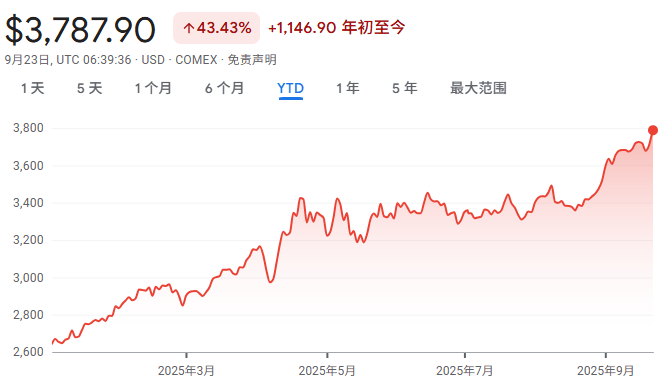
Core Viewpoint - The Federal Reserve is initiating interest rate cuts, leading to a surge in global asset prices, with significant movements in both risk and safe-haven assets [1][5]. Group 1: Market Performance - Nvidia's substantial investment in OpenAI has reignited the AI boom, pushing the three major U.S. stock indices to new highs, with the S&P 500 index hitting its 28th record high this year [2]. - COMEX gold prices closed at $3,775.10, marking the 36th record high of the year, with a year-to-date increase of approximately 43% [2]. Group 2: Market Dynamics - The simultaneous rise of risk and safe-haven assets has led to skepticism among investors regarding whether the market has reached "perfect pricing" [5]. - Bank of America strategist Michael Hartnett suggests that the combination of tariff cuts, tax reductions, and interest rate cuts creates a "run-it-hot" policy environment, providing implicit guarantees for the economy and stock market [5]. - Deutsche Bank's report indicates that the market has not yet reached a "perfect pricing" state, suggesting that concerns about future risks may actually provide room for potential market increases [5][6]. Group 3: Investment Strategies - Hartnett proposes a five-point trading strategy to navigate the current market conditions, including investing directly in bubble assets, constructing a "barbell" portfolio, shorting corporate bonds of bubble companies, shorting U.S. bonds, and trading volatility [10][11]. - The current market sentiment is characterized by a belief that "money is depreciating, and holding it is less favorable than consumption or investment," driving funds into risk assets [6]. Group 4: Gold Market Analysis - The rise in gold prices is attributed to geopolitical uncertainties, inflation concerns, and expectations of interest rate cuts, creating a "perfect storm" for gold [13][14]. - Deutsche Bank notes that the high gold prices reflect market fear rather than extreme optimism, indicating a typical sign of investors seeking safe-haven assets [13]. - Despite concerns about a potential bubble, key market indicators have not shown signs of irrational exuberance, suggesting that the current gold market may be in a sustained bull phase rather than a bubble [14][15].