
教育强国

Search documents
教育强国背景下地方综合性大学发展定位与思考
Xin Hua Ri Bao· 2025-12-08 23:42
Core Viewpoint - The article emphasizes the critical role of local comprehensive universities in China's journey towards becoming an education powerhouse, highlighting the need for these institutions to align their goals with national educational strategies and pursue differentiated, characteristic, and collaborative development paths [1][2]. Group 1: Educational Strategy and Requirements - The "Education Powerhouse" strategy aims to modernize the education system as a foundation for national revitalization, focusing on quality improvement and system enhancement rather than mere quantitative expansion [2][3]. - Local comprehensive universities are essential in this strategy, serving as key players in talent cultivation, regional technological innovation, and cultural prosperity [2][3]. Group 2: Historical Mission and Challenges - Local comprehensive universities are tasked with supporting regional industrial innovation and socio-economic development, leveraging their unique advantages in interdisciplinary innovation and applied research [3][4]. - The classification of universities into research-oriented and application-oriented poses challenges for local comprehensive universities, which must navigate their dual characteristics of being both local and comprehensive while determining their core mission [4][5]. Group 3: Strategic Positioning and Development - A clear positioning of "rooted in the local, serving the nation" is essential, with a focus on becoming integral to local innovation systems and optimizing academic disciplines to support both research and application-oriented development [5][6]. - Local comprehensive universities should adopt a differentiated development strategy, aligning their academic strengths with regional resources and national strategic initiatives to enhance their influence at both local and national levels [6].
丁薛祥在卓越工程师培养改革座谈会上强调 加大卓越工程师培养力度 为建设教育强国、科技强国、人才强国提供有力支撑
Zheng Quan Shi Bao Wang· 2025-12-04 11:55
Core Points - The meeting on the reform of the training of outstanding engineers was held, emphasizing the importance of engineers as key drivers of engineering technology development and national strategic talent [1][2] - The Chinese government aims to enhance the training of engineering talent to support the construction of a strong education, technology, and talent nation [1] Group 1 - The training reform for outstanding engineers has made positive progress, promoting collaborative education between industry, academia, and research, and improving the quality of engineering education [1][2] - The meeting highlighted the need to deepen engineering education reform and increase the training of outstanding engineers to meet national strategic needs [1][2] Group 2 - There is a call to improve the training system for outstanding engineers, ensuring a mechanism for regular and systematic training involving top universities and enterprises [2] - The focus is on optimizing training layouts to align with modern industrial systems and engineering construction needs, expanding into urgently needed fields [2] - The meeting emphasized the importance of internationalizing engineering education and mutual recognition of engineering qualifications and standards to better support enterprises going global [2]
中国民航管理干部学院发布2026年度培训计划
Zhong Guo Min Hang Wang· 2025-12-02 10:41
Core Insights - The China Civil Aviation Management Cadre College has released its training plan for 2026, focusing on enhancing the integration of technological and industrial innovation, as well as the development of human resources [1][2] Group 1: Training Plan Overview - The 2026 training plan includes eight new courses, such as "Interpretation and Promotion of the Spirit of the 20th CPC Central Committee," with an overall project update rate of 53% [1] - The plan emphasizes a demand-oriented approach, aiming to improve competency through customized training services in party school training, safety management, and teaching models [1][2] Group 2: Party School Training - The training plan enhances the party school training framework, focusing on theoretical education, party character education, and job competency training [2] - New projects include training for party branch secretaries of the pilot team and the introduction of red education resources from regions like Xinjiang, Jiaxing, and Xiamen [2] Group 3: Safety Management - The college is conducting research on safety management theories and developing competency models for various job levels, aiming to create tailored training solutions [2] - The 2026 plan introduces practical workshops for safety personnel and optimizes existing course content to meet diverse safety training needs across the industry [2] Group 4: Teaching Methodology - The college adheres to a learner-centered, outcome-based, and continuous improvement quality philosophy, implementing a mixed teaching model [3] - Innovative training methods include immersive classrooms for emergency management and leveraging key laboratories for research in low-altitude economy and smart aviation [3]
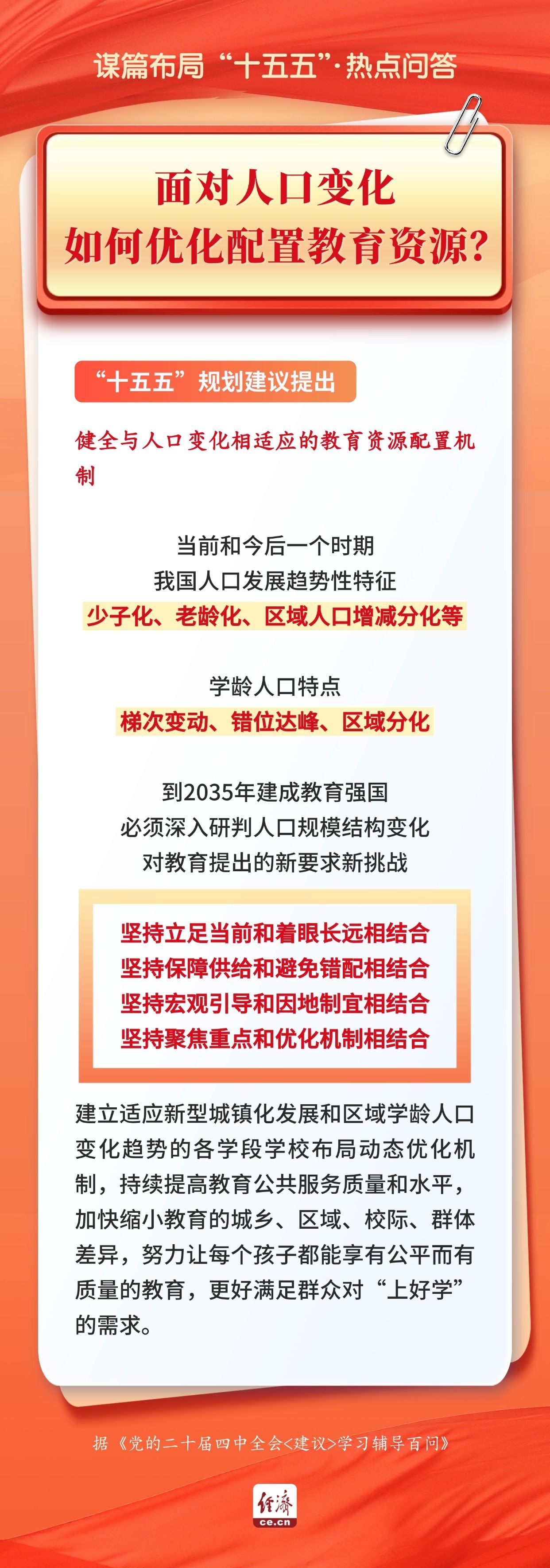
面对人口变化,如何优化配置教育资源?
Zhong Guo Jing Ji Wang· 2025-12-02 03:17
Core Viewpoint - The article emphasizes the need for optimizing the allocation of educational resources in response to demographic changes, including declining birth rates, aging population, and regional population disparities in China [2][3]. Group 1: Educational Resource Allocation - The "14th Five-Year Plan" suggests establishing a mechanism for educational resource allocation that aligns with population changes [2]. - It highlights the importance of adapting educational strategies to the characteristics of school-age populations, which are influenced by demographic trends [2]. Group 2: Challenges and Requirements - By 2035, the goal is to build a strong education system that meets new demands and challenges posed by changes in population size and structure [3]. - The article outlines several principles for educational planning, including balancing immediate needs with long-term goals, ensuring supply while avoiding mismatches, and combining macro guidance with localized strategies [3]. Group 3: Quality and Equity in Education - There is a focus on improving the quality and level of public educational services, aiming to reduce disparities in education across urban-rural, regional, inter-school, and demographic lines [3]. - The ultimate objective is to ensure that every child has access to quality education, thereby better meeting public demand for good schooling [3].

中央美术学院:锚定双强国战略,绘就高等美术教育发展新蓝图
Xin Jing Bao· 2025-12-01 13:23
Core Viewpoint - The "15th Five-Year Plan" serves as a guiding document for China's economic and social development from 2026 to 2030, emphasizing the need for high-quality development and cultural advancement in higher education, particularly in fine arts [1][2]. Group 1: Development Strategy - The Central Academy of Fine Arts aims to establish a higher education system in fine arts that reflects Chinese characteristics and meets global standards, aligning with the "15th Five-Year Plan" and the "Education Strong Nation Construction Plan Outline (2024-2035)" [1][2]. - The institution has a historical mission to lead the development of Chinese fine arts and education, focusing on nurturing innovative talents who can contribute to national rejuvenation [2][3]. Group 2: Educational Reform - The academy is reforming its training model to integrate art and technology, promoting interdisciplinary collaboration and breaking down professional barriers to enhance practical skills and critical thinking [3][4]. - Emphasis is placed on cultivating talents with a solid artistic foundation and innovative thinking, particularly in emerging fields such as digital art and intelligent design [3][4]. Group 3: Cultural Integration - The plan highlights the importance of integrating aesthetic education with the new economy, fostering a robust cultural talent pool, and enhancing cultural originality [4][5]. - The Central Academy of Fine Arts is committed to serving national cultural needs and contributing to the development of Chinese fine arts and culture through various initiatives, including the "Mei Run China" action plan [5][6]. Group 4: National and International Collaboration - The academy aims to leverage its strengths in fine arts and design to contribute to national strategies such as rural revitalization and urban development [5][6]. - It seeks to enhance international cultural exchanges and explore pathways for the global dissemination of Chinese aesthetic education [5][6].
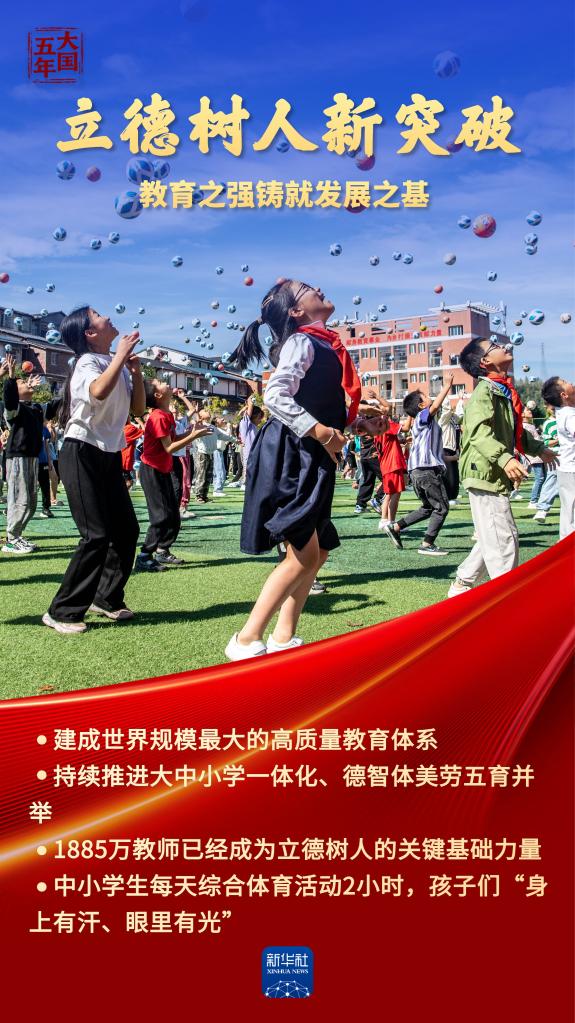
大国五年丨立德树人,夯实民族复兴之基
Xin Hua She· 2025-12-01 08:25
Group 1 - The article emphasizes the establishment of the world's largest and high-quality education system in China, highlighting the importance of education for national development and the future of the nation [1][2] - It mentions that 18.85 million teachers have become a key foundational force in moral education [2] - The integration of physical education into daily routines is noted, with students engaging in two hours of comprehensive physical activity each day [2] Group 2 - Basic education has achieved balanced development across 2,895 counties, with a gross enrollment rate in preschool education reaching 92%, benefiting over 12 million children [4] - By the end of 2024, the enrollment rate for disabled children in compulsory education is expected to reach 97% [4] Group 3 - The gross enrollment rate in higher education has increased from 30% in 2012 to 60.8% currently, indicating a significant rise in accessibility [6] - Higher education institutions have produced 55 million graduates, contributing to over 75% of national natural science awards and technology invention awards [6] Group 4 - China has built the world's largest vocational education system, supplying over 70% of new high-quality skilled talent for modern industries [8] - More than 44 million individuals have obtained vocational skill certificates, with over 6,000 recognized as top-level technicians [8] Group 5 - The "Double First-Class" initiative has led to universities producing over 50% of the nation's master's degrees and 80% of doctoral degrees, fulfilling over 90% of national high-level talent training tasks [11] - The focus on cultivating innovative talent aligns with national strategic development goals [11] Group 6 - Teacher salaries in compulsory education are maintained at or above the average salary of local civil servants, with rural teachers in central and western regions receiving additional living subsidies [13] - Policies have been implemented to enhance teachers' social status and benefits, including digital empowerment initiatives [13] Group 7 - A comprehensive digital education platform has been established, covering over 200 countries and regions, with more than 170 million learners [15] - The platform includes a lifelong learning center offering 1,000 micro-majors and 1,000 vocational training courses, along with over 5,000 high-quality courses [15] Group 8 - China has expanded its educational influence globally, collaborating with 183 countries and regions, and establishing educational cooperation mechanisms with ASEAN and Central Asian countries [17] - The establishment of the Global Teacher Development Academy aims to share Chinese educational philosophies and practices internationally [17]
促进老年教育高质量发展
Ren Min Ri Bao· 2025-11-25 22:42
Core Viewpoint - The development of high-quality elderly education is essential for enhancing the quality of life for the elderly population in China, which is projected to exceed 310 million by the end of 2024, accounting for 22% of the total population [2][3]. Group 1: Importance of Elderly Education - Elderly education is a crucial component of lifelong education and reflects the level of a learning society [2]. - It is vital for improving the quality of life for the elderly, fostering family harmony, and promoting social stability [2][3]. - The emphasis on elderly education aligns with the broader goal of transforming the challenges of an aging population into a demographic dividend [2]. Group 2: Policy and Structural Support - The government is urged to enhance the institutional framework for elderly education, ensuring it is recognized in national education and aging development strategies [4]. - There is a need for specific regulations and responsibilities for various levels of government regarding planning, resource allocation, and evaluation of elderly education [4][5]. - A comprehensive service system for elderly education should be established, covering urban and rural areas [4]. Group 3: Collaborative Efforts and Resource Allocation - The government should mobilize social forces, including universities and community organizations, to participate in elderly education [5]. - Initiatives such as establishing local branches of elderly universities and providing tax incentives for educational investments are recommended [5][6]. - Optimizing resource distribution is crucial to ensure that quality educational services reach elderly individuals in remote and underserved areas [6]. Group 4: Educational Content and Methodology - Elderly education should focus on both knowledge and personal development, incorporating various subjects such as arts, health, and civic education [6][7]. - Innovative teaching methods that cater to the learning preferences of the elderly, such as experiential and discussion-based learning, should be explored [6]. - Establishing a certification system for elderly learners, like a "silver age diploma," can enhance their motivation and sense of achievement [6]. Group 5: Integration with Social and Economic Development - Elderly education should be integrated with the silver economy, promoting synergies with health management and elder care services [7]. - Programs that encourage elderly participation in community governance and volunteer activities can enhance their social value and sense of purpose [7].
国际中文教育南方论坛举行:中文教育的老问题,AI时代的新解法
2 1 Shi Ji Jing Ji Bao Dao· 2025-11-24 14:40
Core Insights - The article discusses the significance of international Chinese education in enhancing the influence of Chinese civilization and fostering cultural communication and cooperation [1][2] - The Fourth International Chinese Education Southern Forum was held on November 21-22, 2025, focusing on the development of international Chinese education and its alignment with national strategies [1][3] Group 1: Forum Overview - The Fourth International Chinese Education Southern Forum was organized by the International Chinese Education Southern Alliance and hosted by various educational institutions [1] - The forum serves as a key annual event for the Southern Alliance, aimed at strengthening the capabilities of international Chinese teachers [2] Group 2: Alliance Development - Since its establishment in 2022, the Southern Alliance has grown to include 58 member organizations, focusing on international Chinese education and cross-disciplinary collaboration [2] - The alliance aims to create a high-quality international Chinese education community through shared resources and cooperative efforts [2] Group 3: Forum Themes and Discussions - The forum's main theme was "Discipline Construction of International Chinese Education under the Background of a Strong Education Nation," addressing the current needs and future directions of the field [3][4] - Various academic reports were presented, covering topics such as the challenges and opportunities posed by artificial intelligence in language education and strategies for talent cultivation in the digital age [4]
发展向前 民生向暖|下好教育这步重要先手棋
Zhong Guo Jing Ji Wang· 2025-11-21 06:33
Core Viewpoint - The "15th Five-Year Plan" emphasizes the importance of education in enhancing national strength and individual well-being, aiming to build a strong education system that meets the needs of the people and supports national modernization [1][2]. Group 1: Education Development Goals - The plan outlines the implementation of the "New Era Moral Education Project" and the establishment of a resource allocation mechanism that adapts to population changes, which will strengthen the foundation of national prosperity through education [1]. - The "14th Five-Year Plan" has successfully achieved basic balanced development in compulsory education across all 2,895 counties, with higher education having produced 55 million graduates, showcasing the contribution of education to China's modernization [2]. Group 2: Quality and Equity in Education - The focus is shifting from the quantity of education to the quality, addressing the urgent need for improved educational standards as the demand for quality education rises [2]. - The plan proposes to expand the scope of free education and explore extending the duration of compulsory education, aiming to provide more equitable and high-quality educational services [3]. Group 3: Higher Education and Talent Development - Higher education is identified as a key driver for building an education powerhouse, with plans to enhance the quality and capacity of higher education and increase the enrollment of quality undergraduate programs [3]. - The strategy aims to cultivate innovative and versatile talents to meet major national strategic needs, thereby injecting new momentum into the development of top-tier innovative talent [3]. Group 4: Future Outlook - The goal is to establish a strong education system by 2035, requiring proactive planning and a commitment to providing continuous intellectual support and talent resources for the modernization process [3].
第七届中国教育创新成果公益博览会在广东珠海开幕
Zhong Guo Jing Ji Wang· 2025-11-19 00:01
Core Insights - The 7th China Education Innovation Achievement Public Expo (referred to as "Edu Expo") opened on November 15 in Zhuhai, Guangdong, focusing on educational reform and showcasing over a thousand innovative educational achievements [1][2] - The theme of this year's expo is "Gathering, Sharing, Innovation - Promoting Educational Innovation Development, Serving the Construction of a Strong Educational Nation" [1] - The event aims to create a collaborative innovation ecosystem involving government, schools, enterprises, research institutions, social organizations, and international resources [2] Group 1 - The Edu Expo serves as a significant platform for promoting educational reform and innovation, with a focus on high-quality educational development [2] - Beijing Normal University (BNU) is implementing initiatives such as the "Strong Teacher Project" and "Digital Education Strategy Demonstration Project" to enhance educational quality and international cooperation [2] - The expo is expected to facilitate the exchange of innovative ideas and practices, contributing to the construction of a high-quality basic education system in China [2][3] Group 2 - The event has become a key platform for educational exchange and cooperation in Guangdong since its permanent establishment in Zhuhai in 2018 [3] - Zhuhai is committed to prioritizing education and has collaborated with BNU on various projects, including the establishment of educational innovation transformation bases and teacher development centers [3] - A notable highlight of the expo is the launch of the "Doing Airplanes" aviation science course, developed in collaboration with several universities, which integrates technology and education through immersive practices [3][4] Group 3 - The expo features an exhibition area of over 30,000 square meters, with nearly 2,000 participating units and more than 50 forums and over 1,000 workshops planned [4] - Key focus areas include integrated innovation in moral education, talent discovery and cultivation, educational collaboration in the Guangdong-Hong Kong-Macao Greater Bay Area, and the development of high-quality professional teacher teams [4] - The event encompasses five major sections: comprehensive exhibitions, thematic exhibitions, regional achievement exhibitions, university achievement exhibitions, and a series of forums, workshops, and roadshow activities [4]