
新兴市场投资

Search documents
全球化时代,找到下一只独角鲸的最好投资路径是什么?
Sou Hu Cai Jing· 2026-01-04 07:05
Core Insights - The article discusses the historical significance of a 1620 investment in the Mayflower voyage, which is viewed as a classic example of successful risk investment, leading to the establishment of the United States and its current GDP of $30 trillion [3] - ATM Capital, founded by Qutian, has emerged as a prominent player in the venture capital space, particularly focusing on Southeast Asia, and has successfully invested in companies like J&T Express [4][6] - The firm aims to replicate its successful investment strategies in Southeast Asia across other emerging markets such as Latin America and the Middle East, leveraging a combined population of nearly 2 billion and a GDP of $14.7 trillion [4][9] Company Overview - ATM Capital was established in 2017 and has quickly gained recognition for its investments in high-potential markets, with J&T Express being its first project [4] - The firm emphasizes a systematic approach to investment, focusing on the entire lifecycle of global enterprises and adapting its strategies to various emerging markets [4][14] - Qutian's background in technology and product management has shaped ATM Capital's investment philosophy, prioritizing early-stage opportunities in markets with significant growth potential [6][10] Market Insights - Emerging markets are characterized by high growth potential, a large young consumer base, and structural advantages in offline channel development [7] - The digital economy in these markets is transitioning into a new phase focused on quality improvement and profitability, with increasing e-commerce penetration and innovative retail formats like live-streaming commerce [7] - ATM Capital's strategy includes identifying and addressing supply gaps in emerging markets, which share structural similarities with Southeast Asia [9] Investment Strategy - The firm believes that successful venture capital relies on entering markets at the right time and accurately identifying significant opportunities [9][10] - Qutian emphasizes the importance of thorough research and planning before entering new markets, advocating for a strategic approach rather than blind expansion [11] - ATM Capital has developed a localized knowledge database to provide precise market guidance and support for companies in key markets like Indonesia, Mexico, and Brazil [14]


2026年全球各类核心资产如何演绎?
Di Yi Cai Jing Zi Xun· 2026-01-01 14:01
Group 1: Market Predictions - The S&P 500 index has increased by 17.41% year-to-date, closing at 6905.74 on December 29, 2025, with most institutions predicting further growth in 2026 [1][2] - The European Stoxx 600 index has also seen a year-to-date increase of 17.01%, with a median forecast suggesting a further rise to approximately 620 points by the end of 2026 [13][14] Group 2: Technology Sector Performance - The performance of the "Tech Seven" companies shows significant divergence, with Google leading at a 66.29% increase, followed by Nvidia at 40.20%, while Amazon only increased by 5.78% [3] - OpenAI plans to invest $1.4 trillion over the coming years but is expected to incur cumulative losses of $115 billion by 2029, raising concerns about its high valuation [4] Group 3: Economic Outlook and Currency Predictions - Morgan Stanley predicts a potential 5% decline in the US dollar in the first half of 2026, while Deutsche Bank suggests the dollar is currently overvalued by 10%-15% [7][8] - Citigroup and Société Générale foresee a rebound in the dollar in the latter half of 2026, driven by the resilience of the US economy and AI investments [9][10] Group 4: Emerging Markets Insights - UBS forecasts an 8% return for the MSCI Emerging Markets index in 2026, with a focus on Chinese companies in the AI sector due to their unique consumer-facing positions [17] - JPMorgan anticipates that emerging markets will outperform developed markets for the second consecutive year, with the MSCI China index having nearly 20% upside potential [18]

财经早报:商务部回应美将对中国半导体加征301关税,白银LOF套利者可能还有超2个跌停丨2025年12月26日
Xin Lang Zheng Quan· 2025-12-25 23:41
Group 1 - The Ministry of Commerce firmly opposes the U.S. decision to impose 301 tariffs on certain Chinese semiconductor products, stating that it has lodged a serious representation through the China-U.S. economic and trade consultation mechanism [2] - The Ministry of Commerce emphasizes its commitment to maintaining global supply chain security and facilitating compliant trade, responding to inquiries about potential relaxation of export restrictions on rare earth magnets to the U.S. [3] - The Ministry of Commerce comments on TikTok's establishment of a joint venture in the U.S., highlighting the importance of reaching a solution that aligns with Chinese laws and regulations [5][6] Group 2 - The Chinese Ministry of Defense criticizes a U.S. Pentagon report that allegedly seeks to sow discord between China and India, asserting that such claims distort China's defense policy [4] - The Chinese government expresses its desire for a fair and transparent business environment for Chinese companies operating in the U.S., urging the U.S. to fulfill its commitments [6] - The People's Bank of China continues to inject liquidity into the market through Medium-term Lending Facility (MLF) operations, with a net injection exceeding 1 trillion yuan for the year [14] Group 3 - The A-share market shows a strong performance with the Shanghai Composite Index recording seven consecutive days of gains, driven by sectors such as commercial aerospace and satellite navigation [10] - The offshore renminbi exchange rate against the U.S. dollar has returned to the "6" level for the first time in 15 months, with expectations of a moderate appreciation in the future [9] - The silver LOF fund experiences a significant drop in premium rates, falling from 68.19% to 45.45%, indicating a shift in market sentiment [11][12]

沪指七连阳 外资看好新兴市场投资机遇
Zhong Guo Zheng Quan Bao· 2025-12-25 21:11
Group 1 - The A-share market continues to rise, with the Shanghai Composite Index recording a seven-day increase, supported by sectors such as commercial aerospace, large aircraft, satellite navigation, and satellite internet [1][2] - The MSCI Emerging Markets Index has shown a cumulative increase of nearly 30% this year, outperforming major US stock indices, indicating a favorable environment for emerging market assets [1][2] - The commercial aerospace sector has seen significant stock price increases, with companies like Superjet Co. and Guanglian Aviation reaching the 20% limit up, reflecting strong market interest and policy support [2] Group 2 - Emerging market fixed income assets have also performed well, with the issuance of hard currency bonds by emerging market governments growing from approximately $700 billion to $1.4 trillion over the past decade [3] - UBS forecasts that with the Federal Reserve's interest rate cuts and a weaker dollar, emerging market assets will present a favorable allocation opportunity [3] - Morgan Stanley's chief equity strategist for China anticipates continued net inflows into the Chinese stock market, highlighting significant opportunities in high-quality companies and sectors aligned with China's 14th Five-Year Plan [4]
印度基金业资产规模达80.8万亿卢比,国际机构看好股市中期走势
Huan Qiu Wang· 2025-12-22 01:07
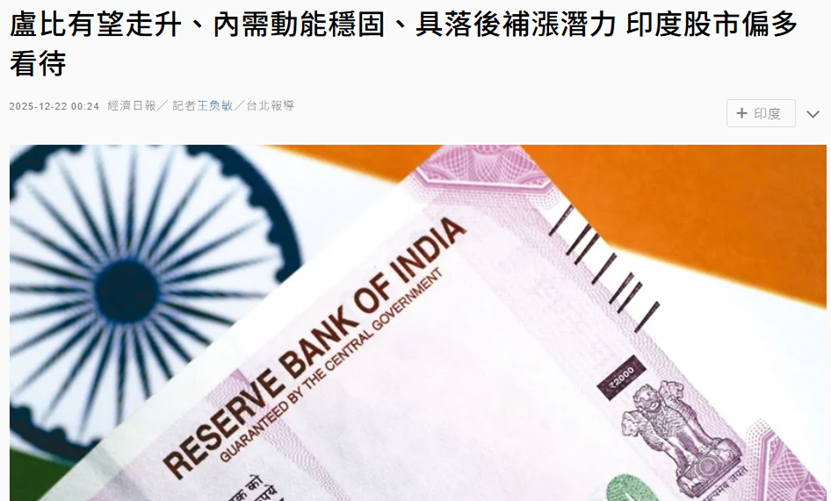
Core Viewpoint - The Indian stock market is gaining attention due to significant growth in mutual fund assets and remarkable stock performance, indicating a positive mid-term outlook despite short-term volatility [1][4]. Group 1: Market Performance - As of November 30, the total assets under management in Indian mutual funds reached 80.8 trillion rupees, showing substantial growth over the past five years [1]. - The stock RRP Semiconductor has surged over 55,000% in the last 20 months, highlighting extreme stock performance within the market [1]. Group 2: Future Outlook - The Indian stock market is expected to show improved performance compared to other emerging markets in the Asia-Pacific region by 2026, despite being the most lagging market in the past 30 years [4]. - There are limited downside risks currently, with opportunities for catch-up growth emerging [4]. - Investment in Indian funds through a systematic investment plan is recommended for investors looking to capitalize on the market's potential [4]. Group 3: Regulatory Developments - The Securities and Exchange Board of India (Sebi) is collaborating with the Reserve Bank of India (RBI) and insurance regulators to allow banks and insurance companies to participate in the commodity derivatives market [4]. - Sebi has established a working group to propose measures for deepening the agricultural derivatives ecosystem and will soon announce a review group for non-agricultural derivatives [4]. Group 4: Economic Fundamentals - India possesses a strong talent base and innovation capabilities, supported by significant government reforms over the past decade, including tax unification, technology promotion, and foreign investment attraction [4].
悲观论者“绝迹”!新兴市场证券创16年来最佳表现 华尔街押注“资金回流大周期”开启
智通财经网· 2025-12-22 00:34
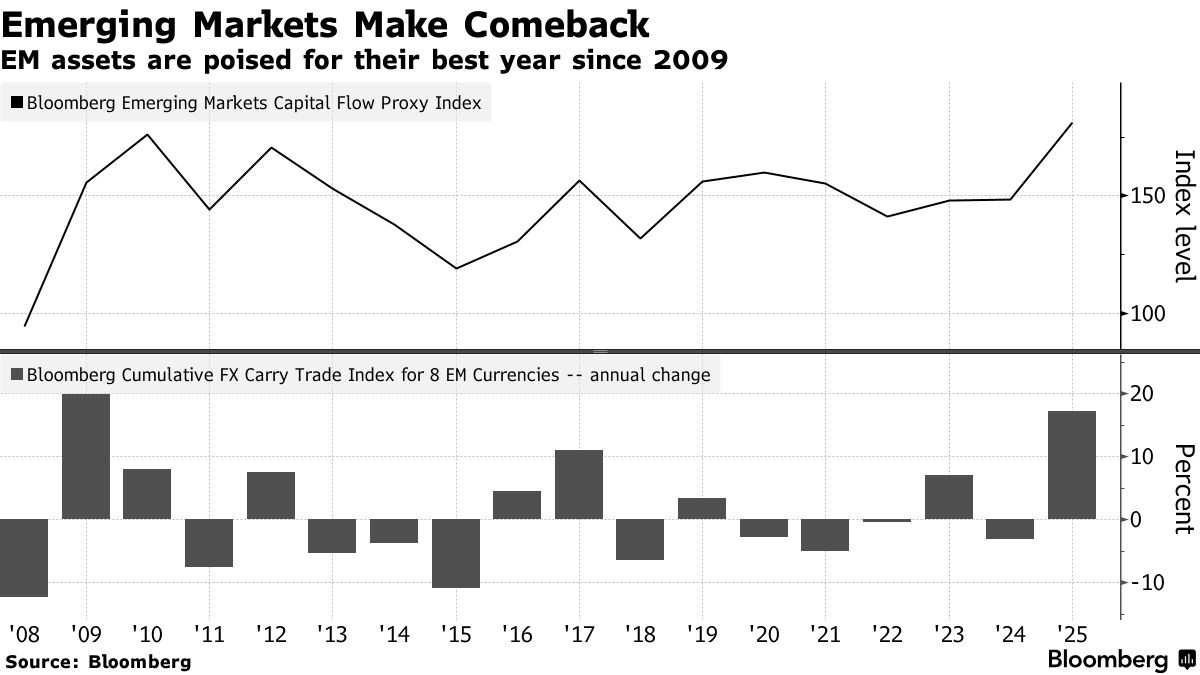
Core Viewpoint - Emerging markets are expected to become favored by Wall Street by early 2026, with asset management firms betting on a prolonged inflow cycle that has already begun [1][3] Group 1: Market Performance - Capital inflows into emerging markets this year have reached the best performance since 2009, indicating a shift in investor sentiment towards this previously underperforming asset class [1] - Emerging market stocks have outperformed U.S. stocks for the first time since 2017, and the yield spread between emerging market bonds and U.S. Treasuries has narrowed to the lowest level in 11 years [1] - JPMorgan forecasts that emerging market bond funds could see inflows of up to $50 billion next year, with expectations of price appreciation and yield benefits from local currency bonds [4] Group 2: Investor Sentiment - A recent investment conference by Bank of America revealed that nearly all investors are optimistic about emerging markets, with no significant pessimism reported [3] - AllianceBernstein's Sammy Suzuki noted a shift in perception, stating that questions about the investment value of emerging markets have diminished [3] - Gama Asset Management's Rajeev De Mello believes there is still room for significant over-allocation towards emerging markets [5] Group 3: Global Capital Flows - There is a potential fundamental shift in global capital flows, with portfolio managers eager to diversify away from the U.S. and attracted by progress in debt reduction and inflation control in developing countries [3] - Despite recent rebounds, the overall scale of capital inflows remains relatively small compared to previous outflows, indicating that emerging markets still have insufficient representation in global portfolios [4] Group 4: Risks and Challenges - The recent rebound in emerging markets may mask underlying vulnerabilities, particularly concerning the U.S. dollar, which has declined by 8% this year, providing support for emerging market assets [6] - Citigroup suggests that investors should only buy emerging market assets that can withstand a potential strengthening of the dollar [6] - As of mid-December, emerging market bond funds saw a significant inflow of $4 billion, marking the largest weekly inflow since July [7]


普徕仕2026年环球金融市场展望:新兴市场投资前景向好 中国市场仍存在具吸引力投资机会
Zhi Tong Cai Jing· 2025-12-02 11:22
Core Viewpoint - T. Rowe Price forecasts a positive outlook for emerging markets in 2026, influenced by a potentially dovish stance from the new Federal Reserve chair, which may lead to lower mid-term U.S. interest rates and a weaker dollar [1] Group 1: Economic Outlook - The economic growth environment in 2026 is expected to be more stable compared to 2025, supported by global fiscal and monetary policies, despite ongoing high inflation and a weak job market [1] - The dual support from monetary and fiscal measures in 2026 may provide much-needed support to struggling sectors, potentially driving broader economic growth [2] Group 2: Investment Opportunities - Emerging market stocks and Chinese stocks have demonstrated their ability to diversify risk in global investment portfolios in 2025, and their investment outlook remains positive for 2026 [2] - Emerging market corporate earnings are expected to improve, offering better prospects at attractive valuations, with many companies playing key roles in the AI infrastructure supply chain [2] - In the Chinese market, despite challenges in the real estate sector, there are still attractive investment opportunities due to improved policies supporting private enterprises and a shift towards experience-based consumption [2]

富国银行策略师:科技股估值已高 资金正轮动至防御及金融板块
Zhi Tong Cai Jing· 2025-11-26 03:21
Core Viewpoint - The growth prospects in the AI sector remain sustainable for several years, but investors are advised to diversify their investment portfolios [1] Group 1: Sector Rotation and Investment Strategy - The company has recently rotated out of certain technology (XLK) and communication services (XLC) stocks, reallocating funds to more reasonably valued sectors while still capturing technology trends [1] - The communication services sector has been reduced due to perceived overvaluation, with funds shifted to the utilities sector (XLU), which has a price-to-earnings ratio of only 20 times compared to over 30 times for information technology (XLK) and communication services (XLC) [1] - This tactical adjustment is not a complete abandonment of the technology theme, as emerging markets are highlighted as attractive alternatives for technology investments [1] Group 2: Emerging Markets and Defensive Sectors - Emerging markets, particularly South Korea and Taiwan, are suggested as viable options for technology investment, focusing on semiconductor and hardware manufacturers to mitigate short-term concentration risks [1] - A diversified approach is recommended, maintaining positions in the U.S. market while allocating a small percentage to a broad emerging market portfolio [1] - There is a noted shift in the market towards broader sector rotation, with investors moving from technology to defensive sectors [1] Group 3: Financial Sector Appeal - Financial stocks (XLF) are particularly attractive in the current interest rate environment, providing a good option for diversifying portfolios away from technology [2] - The investment rationale is based on expectations of declining short-term rates while long-term yields remain stable or slightly increase, leading to lower financing costs for financial institutions [2]
重新考虑新兴市场的三个理由
Guo Ji Jin Rong Bao· 2025-11-13 13:54
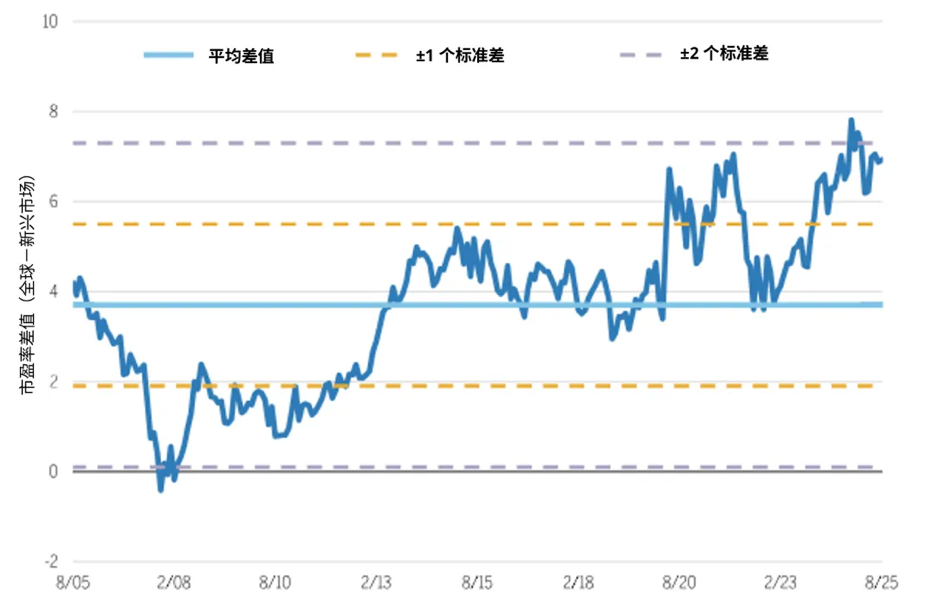
Core Viewpoint - Emerging markets have shown strong performance in both stocks and bonds as of 2025, with emerging market stocks recording their best performance in nearly seven years, indicating heightened investor interest and enthusiasm [1]. Group 1: Valuation and Investment Logic - The price-to-earnings (P/E) ratio difference indicates that emerging market stocks are relatively undervalued compared to developed markets, with the current P/E ratio difference exceeding its 20-year historical average by nearly two standard deviations, suggesting an attractive entry point despite recent strong performance [1]. Group 2: Fund Flows - Over the past three years, the net inflow of funds into emerging market equity funds has lagged behind that of U.S. funds relative to their asset management scale. However, the strong performance of emerging market stocks in 2025, partly aided by a weaker dollar, shows signs of a potential reversal, as emerging market funds are beginning to attract more capital, reflecting a shift in investor sentiment [4][6]. Group 3: Central Bank Policies - Emerging market central banks maintain significantly higher real interest rates compared to the Federal Reserve, indicating greater monetary policy flexibility. This suggests that emerging markets have more room to implement interest rate cuts, which could structurally benefit emerging market assets, while the Federal Reserve remains cautious amid labor market weaknesses and rising inflation risks [6]. Group 4: Investment Strategy Recommendations - Investors are encouraged to reassess their allocations to avoid missing potential opportunities in emerging markets, which have been structurally underweighted due to poor performance in recent years [7]. - Selective stock picking is advised, as there is significant differentiation among countries due to political, social, and industrial factors. Potential winners include regions involved in the AI supply chain and Central European countries benefiting from automotive trends [7]. - Active management strategies are recommended over passive management, as active managers may better identify attractive companies in emerging markets and avoid those with risks outweighing potential returns [7]. Group 5: Conclusion - The attractive relative valuation of emerging markets provides an excellent entry point for investors. The rebound in capital inflows into emerging market stocks confirms a recovery in investor sentiment, and the higher real interest rates compared to developed markets offer greater flexibility for structural policy adjustments, making emerging markets worthy of increased investor attention [8].
全球央行走向“十字路口” 新兴市场资产吸引力凸显
Shang Hai Zheng Quan Bao· 2025-11-11 16:57
Global Central Bank Policy Divergence - Major developed economies are experiencing varied interest rate policies, with the Federal Reserve cautiously lowering rates, the European Central Bank pausing actions, and the Bank of Japan signaling potential rate hikes [1][3] - The Federal Reserve's future rate cuts remain uncertain due to a lack of key economic data amid a prolonged government shutdown [1][2] - The European Central Bank has maintained its deposit rate at 2% for the third consecutive time, with expectations to keep rates unchanged in December [1][2] Emerging Market Rate Cuts - Several emerging market countries are accelerating their rate cuts, with Mexico's central bank lowering rates by 25 basis points to 7.25%, the lowest since May 2022 [2] - Poland's central bank also announced its fifth rate cut of the year, while other countries like the UAE, Qatar, Bahrain, and Saudi Arabia followed suit with similar reductions [2] - Analysts expect the Federal Reserve to cut rates by 25 basis points in December, with further cuts anticipated by the end of 2026 [2] Investment Opportunities in Emerging Markets - Emerging markets are seen as benefiting from the Federal Reserve's rate cuts, with greater room for monetary easing and resilient economic growth prospects [4][6] - The consumer price index in emerging markets has shown a rare reversal, with an average inflation rate dropping to 2.47% from July to September, compared to 3.32% in developed economies [4] - The decline in inflation pressure in emerging markets allows for more supportive monetary policies, enhancing investment opportunities in local currency bonds and equities [4][6] Capital Flows and Dollar Dynamics - The divergence in monetary policy reflects changes in interest rate differentials, influencing global capital flows towards emerging markets [5][6] - Emerging markets generally maintain higher interest rates than developed economies, providing significant potential for economic growth through rate cuts [6] - The weakening dollar is expected to favor emerging market assets, as capital seeks regions with greater potential for returns [6] Future Outlook for Emerging Markets - Market sentiment is optimistic regarding the investment potential in emerging markets, particularly in the bond sector, supported by improving fundamentals and attractive yields [7] - Despite warnings of potential market corrections, structural opportunities in markets like China, Japan, and India are highlighted as key areas for investment [7] - The recent performance of emerging market stocks has been strong, driven by a search for value and safe havens amid global risk asset sell-offs [7]