
无人化

Search documents
“追声猎手”缘何仍有“一席之地”
Xin Lang Cai Jing· 2025-12-21 01:10
(来源:新安晚报) 转自:新安晚报 先看两则消息。 今年10月,印度尼西亚首艘国产无人潜航器在深海区域发射了一枚"食人鱼"轻型声自导鱼雷。 也是在今年,据美国海军2026财年预算计划,其拟投入5千万美元,开发一种代号为"解放者"的集装箱 式MK48mod7声自导鱼雷发射系统,并集成到无人水面舰艇上。 这再次印证了声自导鱼雷在现代海战中仍占有"一席之地",人们的目光被再次引向这一古老而又常青的 武器。 为何常青 说古老,是因为自第一枚声自导鱼雷问世时起,该类武器已拥有80多年的发展历史;说常青,是因为无 论岁月如何变换,它始终活跃在水下战场。从潜艇的发射管,到水面舰艇的甲板,再到战机的翼下,乃 至今日的一些无人平台,都能看到声自导鱼雷的身影。 声自导鱼雷之所以能成为海战武器中的常青树,源于其在技术、战术、成本方面具有一定优势。 作为鱼雷的一种,声自导鱼雷在水下作战中,通过声呐系统接收声信号,再经制导控制系统分析后生成 指令,驱动舵机调整航向,直至命中目标,素有"追声猎手"之称。这种基于声波的制导机制,赋予了声 自导鱼雷得天独厚的技术优势。作战行动中,其通过主动发射声波搜索,或被动接收目标噪声,可实 现"自动索敌 ...
机构:看好快递行业两条投资主线
Zheng Quan Shi Bao Wang· 2025-12-17 00:48
Core Insights - The Chinese postal industry has seen a significant increase in delivery volume and revenue in the first 11 months, with a total of 196.75 billion items delivered, marking a year-on-year growth of 12.9% [1] - The express delivery sector specifically achieved a volume of 180.74 billion items, reflecting a year-on-year growth of 14.9% [1] - Total revenue for the postal industry reached 1,632.73 billion yuan, with express delivery revenue at 1,355.06 billion yuan, showing growth rates of 6.7% and 7.1% respectively [1] Group 1: Investment Opportunities - Guosheng Securities identifies two main investment themes in the express delivery sector: 1) International expansion, driven by explosive growth in overseas e-commerce GMV, which is expected to boost delivery volumes significantly [1] 2) "Anti-involution" dynamics, where the slowing growth rate due to increased competition and rising prices is leading to a concentration of market share among leading companies, enhancing their competitive strength and profitability [1] Group 2: Industry Trends - Zhongtai Securities highlights that the combination of "anti-involution" and automation is improving operational quality in the express delivery industry, with expectations for enhanced profitability due to potential policy support [2] - The trend towards automation, particularly in the deployment of unmanned vehicles by major logistics players like JD, Cainiao, and SF Express, is anticipated to accelerate industry transformation, supported by policy initiatives, technological advancements, and capital investment [2]
国防军工行业2026年投资策略:“全球化、AI+”,高质量发展兼顾价值与成长
GF SECURITIES· 2025-12-15 14:50
Core Insights - The report emphasizes the importance of "globalization and AI+" in advancing high-quality development in the defense and military industry, highlighting the need for modernization and efficiency improvements in military systems [5][30][34] - The investment strategy focuses on balancing value and growth, with traditional sectors entering an S-curve evolution phase while new demands and replacements coexist [5][30] Section Summaries 1. Current Development Stage from the S-Curve Perspective - The defense and military industry is in a growth phase, with traditional sectors experiencing rapid development during the previous five-year plan, but not yet entering a slowdown [16][26] - The S-curve model indicates that the industry lifecycle includes multiple product lifecycles, with the current focus on extending product lifespans through innovation [23][24] 2. S-Curve Cycle Expansion - Global military trade remains robust, emphasizing the importance of lifecycle management from equipment to services [9][18] - The report anticipates that the demand for large aircraft and low-altitude economic activities will accelerate due to supportive policies [9][28] 3. S-Curve Cycle Evolution - Supply chain reforms are crucial for reducing costs and complexity, enhancing the focus on maintenance and repair services [9][33] - The integration of unmanned systems and intelligent technologies is expected to drive significant advancements in military capabilities [9][51] 4. New Cycle of the S-Curve: Emerging Industries - The report identifies commercial aerospace, AI, controllable nuclear fusion, quantum information, and deep-sea technology as key areas for future growth [9][57][65] - The acceleration of technological advancements and policy support is expected to unlock new market opportunities in these sectors [9][58] 5. Investment Recommendations - The report recommends focusing on companies that align with the evolving S-curve, particularly those involved in supply chain reform, maintenance, and unmanned systems [5][30] - Specific companies highlighted for investment include 航发动力, 中航高科, and 国睿科技, among others, which are positioned to benefit from these trends [6][9]


成长与周期共舞
HTSC· 2025-12-11 05:47
Group 1: Engineering Machinery - Domestic demand for excavators is expected to recover to around 120,000 units in 2025, with a year-on-year increase of 19.6% in the first ten months of 2025 [1][15] - The export of excavators reached 93,800 units in the first ten months of 2025, showing a year-on-year increase of 14.4%, with an expected annual growth rate of around 15% [1][29] - The recovery in domestic demand is primarily driven by small excavators, reflecting increased demand for machinery in rural and small-scale water conservancy projects [15][20] Group 2: Shipbuilding and Offshore Engineering - The global shipbuilding industry saw a decline in new orders, with a total of 9,483.31 million deadweight tons in the first ten months of 2025, down 44.67% year-on-year [2] - The shipbuilding price index has shown a general decline, but there is a recovery in orders for bulk carriers and oil tankers in October 2025 [2] - The upcoming replacement cycle in shipbuilding, combined with tightening global environmental policies, is expected to drive a new round of demand growth [2] Group 3: Cyclical Industries - The cyclical sector is showing signs of recovery in 2025, supported by low baselines and the expansion into new industries [3] - The industrial control market is rebounding, with a notable increase in the OEM market, while project-based markets are showing weaker performance [3] - The industrial robot market is expected to grow by over 10% year-on-year in 2025, indicating a sustained recovery [3] Group 4: AI and Robotics - The AI sector is driving significant changes in various industries, with a focus on humanoid robots, data center equipment, and vertical applications [4] - The demand for data center backup power sources is increasing due to global capacity shortages, with domestic alternatives expected to accelerate [4] - The introduction of humanoid robots is becoming a reality, with significant production plans announced by companies like Tesla for 2026 [4] Group 5: Investment Recommendations - The report recommends focusing on the engineering machinery sector, particularly companies like SANY Heavy Industry, XCMG, and LiuGong, which are expected to benefit from domestic and international demand [5][9] - In the shipbuilding and offshore engineering sector, China International Marine Containers (CIMC) is highlighted as a potential beneficiary of the recovery [5][9] - The AI and robotics sector presents investment opportunities in companies like Weichuang Electric and Jack Technology, which are positioned to benefit from the ongoing industrial transformation [5][9]





无人化重塑搬运生态
Jing Ji Ri Bao· 2025-12-05 21:56
Core Insights - SANY Robotics is innovating in the electric forklift market by developing autonomous electric forklifts that address safety and efficiency issues associated with traditional forklifts [1][2] - The company has introduced a high-voltage lithium battery platform that enhances the performance of electric forklifts, allowing for a maximum load capacity of 2 tons and a lifting height of up to 5 layers [1][2] - SANY Robotics aims to expand its international presence, targeting a sales goal of 4 billion yuan by 2035, with a current forecast of 10 billion yuan in sales for the year [2][4] Group 1: Product Development - SANY Robotics has developed a high-pressure lithium battery forklift that utilizes automotive-grade technology, achieving a maximum climbing gradient of 25% and a charging efficiency that allows for 8 hours of work after just 1 hour of charging [2] - The electric forklifts have been successfully deployed in over 50 countries and regions, with applications in extreme working conditions [2][3] Group 2: Market Expansion - The company has upgraded its production lines to increase monthly capacity by 300% to meet growing market demand, with a projected order volume of 5,000 units for the year [2][4] - SANY Robotics has established a dealer network of over 150, covering major domestic provinces and key overseas markets [4] Group 3: Future Vision - The company is focusing on becoming a leading provider of smart logistics solutions, integrating high-performance electric forklifts with autonomous driving technology and AI algorithms [4] - SANY Robotics is committed to creating a low-carbon intelligent logistics ecosystem that encompasses warehousing, handling, sorting, and loading processes [4]
X @外汇交易员
外汇交易员· 2025-12-05 03:24
任正非在ICPC讲话内容要点:• AI在华为有重要地位,但最重要的还是CT。• 无人化富余出的员工怎么办?要发展再教育工程,例如实行学券制,给下岗人员一些学券补贴,把一些已经空着的学校、工厂变成职业学校,对下岗人员进行职业再教育。• AI辅助计算机软件编程已经释放了约30%的软件工程师的工作量,未来可能达到60-70%。• 无人化进展速度不能太快,要使社会结构发展稳定。• 算力过剩的时代一定会到来。• 量子科学迟早是要突破的,量子用于计算机一定能实现的。• 美国的土壤是适合种庄稼的,大量人才到美国成长这是好事情,并不是坏事情。现在中国也有人才的土壤和机会,但追赶美国的速度还是慢的。外汇交易员 (@myfxtrader):https://t.co/BTeje2T494 ...
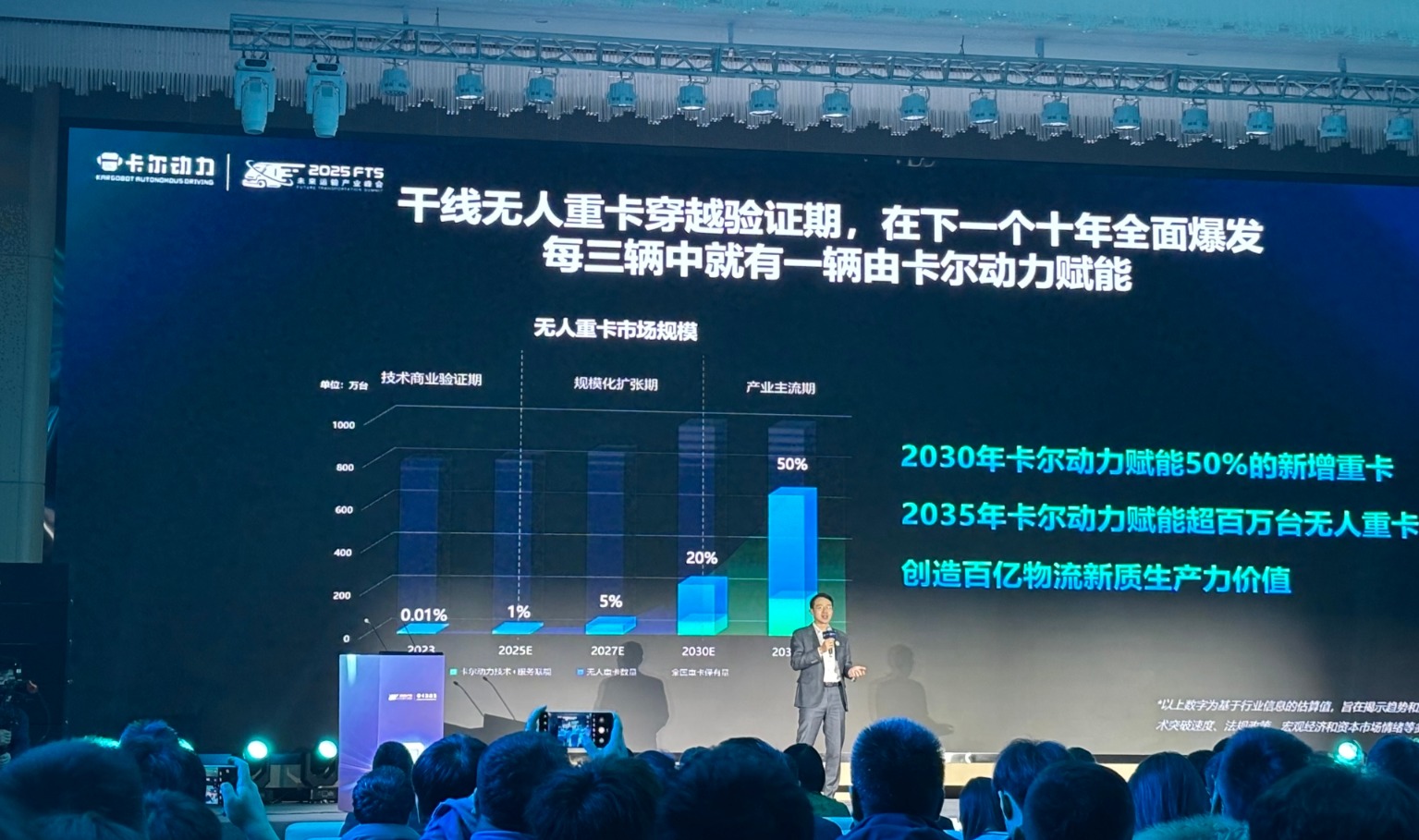
自动驾驶重卡商业价值远超Robotaxi?卡尔动力韦峻青:不追求100%无人化,更关注路线级盈利
Mei Ri Jing Ji Xin Wen· 2025-12-02 09:08
Core Insights - The focus of the industry is shifting towards L4 autonomous driving, particularly in the heavy-duty truck sector, which is seen as a high-value market with significant potential for commercialization [1][5] - The global market for autonomous trucks is expected to exceed 400 billion yuan by 2030, with full automation entering a validation phase by 2025 [1][5] - The company emphasizes that achieving profitability and scaling operations is more critical than pursuing 100% automation [1][4] Company Overview - The company, established in 2021 and incubated by Didi, has built a fleet of over 400 autonomous trucks, accumulating over 35 million kilometers in operational mileage and transporting a total of 1.2 billion tons [3][5] - The annual revenue of the company is approximately 500 million yuan, with a hardware cost of about 90,000 yuan per unit, offset by savings of over 100,000 yuan in driver costs annually [3][5] - The company aims to reduce overall logistics costs by 20% to 25% through autonomous driving technology and expects further efficiency gains from warehouse transport robots [3][5] Market Strategy - The company plans to focus on practical applications of autonomous driving, targeting a 50% to 80% reduction in labor costs while achieving scalable operations [4][5] - The company has received the first commercial operation qualification for autonomous freight transport in the country and aims to validate profitability on specific routes before scaling up [3][6] - The company has completed approximately 300 million yuan in Series A+ financing and does not currently face funding pressures, indicating strong market confidence in the potential of the autonomous truck sector [5][6] Future Projections - The company expects to add over 50 autonomous driving licenses by the end of the year, with plans to reach hundreds in the following year [6] - The company anticipates that the penetration rate of autonomous vehicles will double annually, with the potential for rapid scaling of profitable routes [6] - The company has developed seven mass-produced vehicle models and is accelerating the replication of successful operational models in new markets [6]

我国快递年业务量首破1800亿件
Xin Hua She· 2025-12-02 03:15
Group 1 - The core point of the article is that China's express delivery business volume has surpassed 180 billion packages for the first time, reflecting the robust vitality of the Chinese economy [1] - As of November 30, 2025, the annual express delivery volume in China is projected to exceed 180 billion packages, with an average monthly volume of over 16 billion packages and a single-day peak of 777 million packages [1] - The delivery of the 180 billionth package was achieved through a highly automated process, showcasing advancements in technology within the logistics sector [1] Group 2 - The State Post Bureau indicated that the scale economic effect of the postal and express delivery sector has significantly increased, becoming a crucial support for promoting consumption, expanding domestic demand, and stabilizing growth [2] - The postal and express delivery industry has adapted to new business models and increased investment in technology research and development, enhancing innovation capabilities and application levels [2] - Automation technologies such as robots and AI models are being implemented across various logistics stages, significantly improving efficiency and reducing costs in warehousing, sorting, transportation, and delivery [2]
中国工程机械行业以绿色和数智化“破局”出海
Zhong Guo Xin Wen Wang· 2025-11-27 14:02
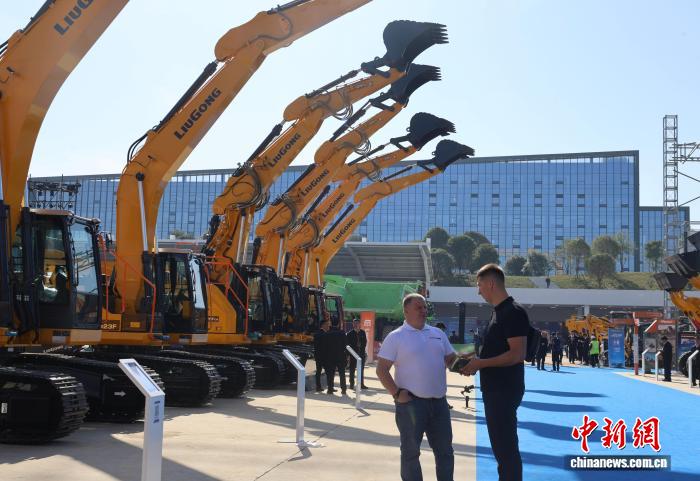
Group 1 - The core viewpoint of the article highlights the significant advancements in electric construction machinery by LiuGong, showcasing its appeal to international customers and the potential for cost savings in operations [1][3][5] - LiuGong introduced a comprehensive electric product charging solution, which includes three main charging paths: mobile power supply, rapid battery swapping, and external power sources, aimed at enhancing energy supply flexibility [3][5] - The company has launched over 100 electric products, establishing a complete electric product matrix, and is advancing automation and artificial intelligence in its operations, including regular operations of unmanned electric loaders [3][5] Group 2 - LiuGong's overseas performance reached a historical high in the first three quarters of the year, with electric products being particularly popular in international markets, contributing to sustained growth in overseas business [5] - The Chinese construction machinery industry is facing intense competition, with overseas markets seen as a crucial avenue for growth. The industry has established advantages in the electric product supply chain, aligning with the accelerating trend of electrification in Western markets [5][6] - Data from the China Construction Machinery Industry Association indicates that from January to September 2025, China sold 174,039 excavators, marking an 18.1% year-on-year increase, with exports accounting for 48.4% of total sales [6]
泰豪科技:公司始终紧跟国防现代化建设需求
Zheng Quan Ri Bao Wang· 2025-11-21 11:41
Group 1 - The company, Taihao Technology, is actively aligning with the demands of national defense modernization [1] - The company is focusing on the intelligent and unmanned sectors and is continuously investing in research and development resources [1]
