
汽车以旧换新政策

Search documents
多家车企公布2026销量目标:“双新”政策调整延续下传统车企审慎、新势力乐观
Xin Lang Cai Jing· 2026-01-07 11:36
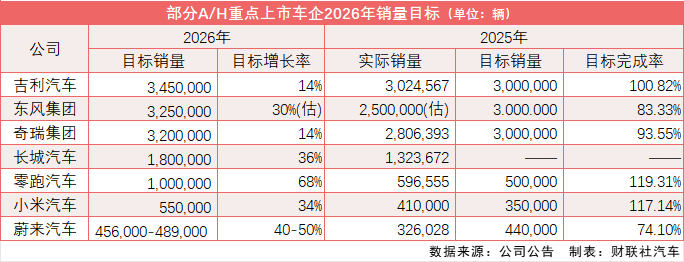
Core Viewpoint - The implementation of the half-price purchase tax policy for new energy vehicles and the adjustment of the "two new" subsidy policies have introduced new variables for the domestic automotive market in 2026, leading to divergent sales targets among various automakers [1] Group 1: Traditional Automakers - Geely has set the highest sales target for 2026 at 3.45 million units, with a growth rate of 14%, including 2.75 million for the Geely brand, 300,000 for Zeekr, and 400,000 for Lynk & Co [2] - Dongfeng Group aims for a total sales target of 3.25 million units in 2026, with an estimated growth rate of over 30%, including 1.7 million for new energy vehicles, representing a 63% increase [3] - Chery Group has set a sales target of 3.2 million units for 2026, reflecting a 14% increase from 2025, with its five brands aiming for a total of 3 million units [3] - Great Wall Motors has lowered its 2026 sales target from 2.49 million to 1.8 million units, indicating a 36% growth from the previous year, while maintaining its net profit target [4] Group 2: New Energy Vehicle Startups - Leap Motor has set an ambitious sales target of 1 million units for 2026, following a record of 597,000 units sold in 2025, which is a 103.1% increase [5] - Xiaomi Auto aims for a sales target of 550,000 units in 2026, representing a 34% increase from the previous year, with new models expected to launch [5] - NIO has set a sales target of 456,000 to 489,000 units for 2026, with a growth rate of 40-50%, following a total of 326,000 units sold in 2025 [5] Group 3: Market Outlook - The automotive market is expected to experience a "front low and back high" trend in 2026, with overall growth driven by supportive national policies, countering previous expectations of negative growth [6] - The new policies, including the early implementation of replacement subsidies, are anticipated to positively impact market growth and consumer upgrades [6]






【整车主线周报】2026年以旧换新政策落地,景气度向上
东吴汽车黄细里团队· 2026-01-05 13:30
Investment Highlights - The automotive industry is expected to see a recovery in passenger vehicle demand in Q1 2026 due to the implementation of subsidy policies, with a focus on high-end electric vehicles and established export-oriented companies [3][4][5][34] - The heavy truck sector benefits from a new policy that maintains subsidy levels, with expectations of 800,000 to 850,000 units sold domestically in 2026, reflecting a 3% year-on-year increase [4][29][38] - The bus sector anticipates a slight increase in sales to 40,000 units in 2026, supported by the continuation of subsidy policies [4][28][38] - The motorcycle market is projected to grow, with total industry sales expected to reach 19.38 million units in 2026, a 14% increase year-on-year, driven by strong export growth [5][35] Passenger Vehicle Sector - The implementation of subsidy policies is expected to convert pent-up demand into sales, with a focus on companies less sensitive to policy changes, such as Jianghuai Automobile and high-end brands like Geely and Great Wall [3][34] - The domestic market is expected to prioritize stability, while exports will focus on companies with proven execution capabilities, such as BYD and Changan [3][34] Heavy Truck Sector - The new policy for heavy trucks has exceeded expectations, maintaining subsidy levels from 2025, which is anticipated to accelerate the rollout compared to previous years [4][29][38] - The domestic sales forecast for heavy trucks in 2026 is optimistic, with expectations of 80,000 to 85,000 units sold, reflecting a 3% increase year-on-year [4][29][38] Bus Sector - The bus sector's subsidy policy has also exceeded expectations, with sales projected to reach 40,000 units in 2026, a 5% increase year-on-year [4][28][38] - The market anticipates a continued push for electric buses, supported by government incentives [28][38] Motorcycle Sector - The motorcycle market is expected to see significant growth, particularly in the large-displacement segment, with total sales projected at 1.26 million units in 2026, a 31% increase year-on-year [5][35] - Exports are expected to rise significantly, with a forecast of 830,000 units in 2026, reflecting a 50% increase [5][35] Overall Market Outlook - The overall automotive market is projected to grow, with total industry sales expected to reach 19.38 million units in 2026, a 14% increase year-on-year [5][35] - The heavy truck and motorcycle sectors are particularly well-positioned for growth due to favorable policy environments and increasing export opportunities [4][5][35]



汽车早报|特斯拉在韩国大幅下调电动车售价 保时捷将在美召回超17.3万辆汽车
Xin Lang Cai Jing· 2026-01-01 00:39
Group 1: Automotive Industry Regulations and Initiatives - The Ministry of Industry and Information Technology has initiated a carbon footprint declaration for automotive power batteries, aiming to establish accounting rules and a management system by the end of 2026 [1] - The National Development and Reform Commission has released a plan to promote the use of recycled materials in automotive manufacturing, encouraging the use of recycled steel, non-ferrous metals, and plastics in various vehicle components [1] Group 2: Market Trends and Consumer Incentives - The China Automobile Circulation Association estimates that over 12 million passenger cars will qualify for subsidies in 2026, potentially driving new car consumption by nearly 1.5 million vehicles [2] - The retail sales of passenger cars in China from December 1-28 were 1.928 million units, a year-on-year decrease of 17%, while wholesale sales also saw a decline of 19% [4] Group 3: Company Developments - SAIC Group is progressing with the approval application for its L3 vehicle models [5] - Seres has obtained a testing license for its L3 vehicles [6] - Evergrande Auto continues to suspend trading as it explores cash management strategies and faces bankruptcy proceedings for several subsidiaries [8] - Tesla has significantly reduced prices for its Model 3 and Model Y vehicles in South Korea, with discounts reaching up to 6,490 USD [9][10] - Porsche is recalling over 173,000 vehicles in the U.S. due to a fault with the rearview camera system [11]
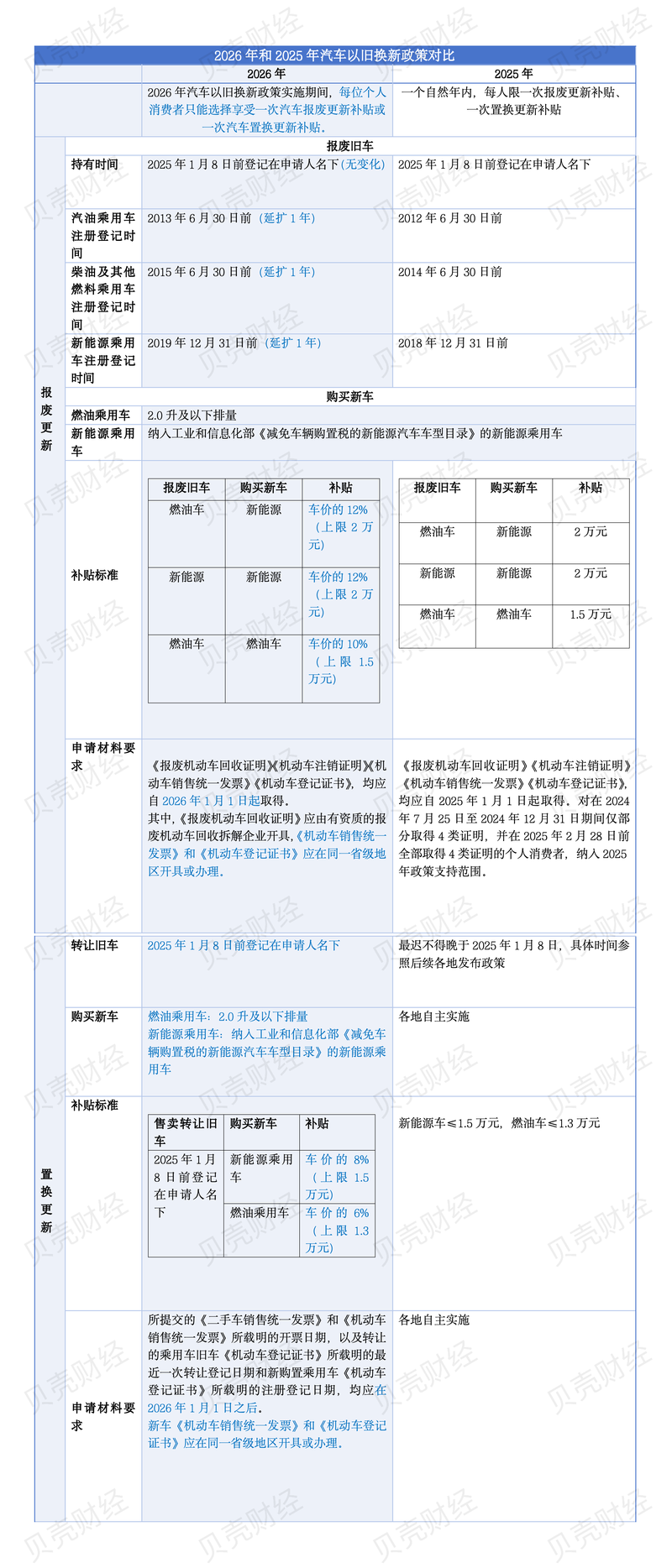
2026国补细节来了!汽车以旧换新按比例补贴,最高2万元
2 1 Shi Ji Jing Ji Bao Dao· 2025-12-31 10:26
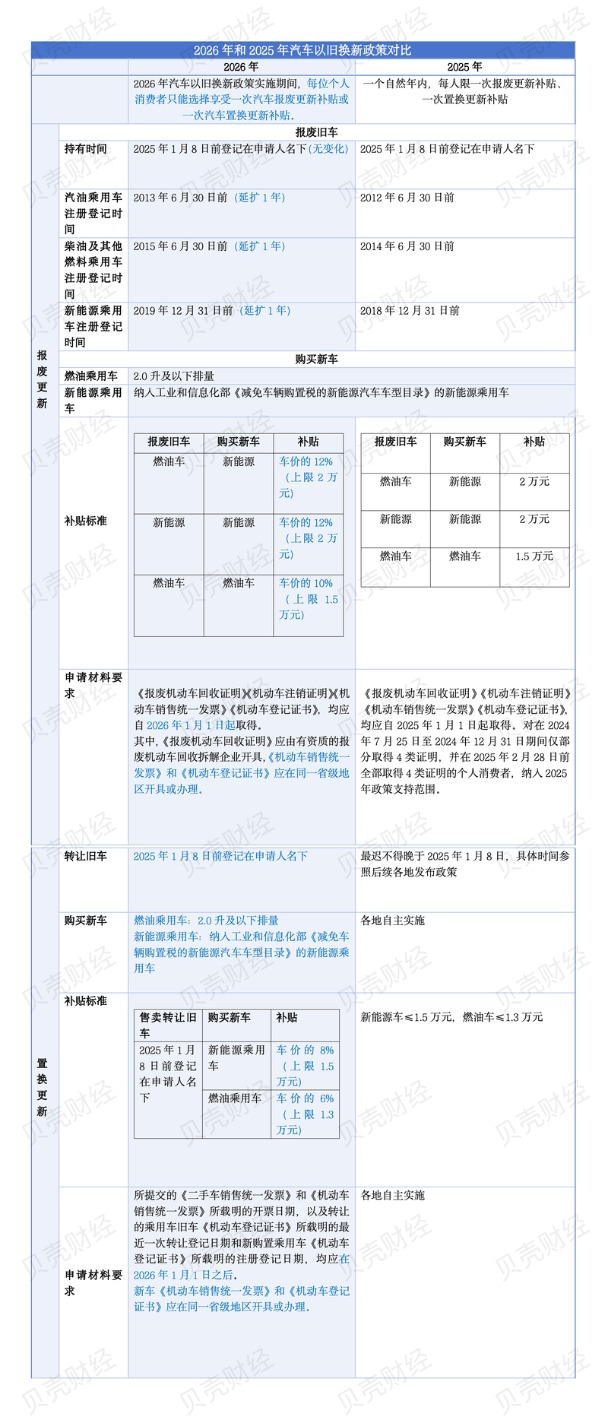
Core Viewpoint - The new round of vehicle trade-in policy for 2026 has been implemented, adjusting the subsidy method and amount compared to 2025, aiming to stimulate consumption and stabilize the automotive market [1][4]. Group 1: Policy Changes - The 2026 vehicle trade-in subsidy will shift from a fixed amount to a percentage of the new car price, with a maximum subsidy of 20,000 yuan [1][4]. - For new energy vehicles, the scrapping subsidy will be 12% of the new car price (up to 20,000 yuan), while the replacement subsidy will be 8% (up to 15,000 yuan). For fuel vehicles, the corresponding rates are 10% and 6%, with limits of 15,000 yuan and 13,000 yuan respectively [1][4]. Group 2: Market Impact - The trade-in policy has significantly influenced the automotive market, with over 11.5 million vehicles traded in 2025, generating over 1.6 trillion yuan in new car sales [2]. - More than 55% of domestic passenger car retail sales in 2025 involved trade-ins, with new energy vehicles accounting for 57.2% of trade-ins, leading to a 19.6% year-on-year increase in retail sales of new energy passenger vehicles [2]. Group 3: Industry Growth - In the first 11 months of 2023, China's automotive production and sales reached 31.23 million and 31.13 million units, respectively, with year-on-year growth of 11.9% and 11.4% [3]. - New energy vehicles have become a core growth driver, with their sales volume reaching 47.5% of total automotive sales, nearing the 50% threshold [3]. Group 4: Implementation and Efficiency - The Ministry of Commerce aims to streamline the subsidy application process, with a principle of completing reviews within 15 working days and subsidy payments within 30 working days [6]. - The adjustments in the subsidy structure are designed to encourage the purchase of higher-priced vehicles while preventing excessive subsidies for luxury cars, thus maintaining policy continuity and addressing the needs of essential consumer groups [6].
美国一特斯拉车主创下连续“自动驾驶”1万英里的纪录;曹操出行宣布收购耀出行和吉利商旅丨汽车交通日报
创业邦· 2025-12-31 09:48
Group 1 - XPeng Motors announced that the second-generation VLA model will start mass production in Q1 2026, with the 2026 P7+ and G7 models featuring this new technology architecture, which boasts 2250 TOPS of effective computing power [2] - The 2026 XPeng P7+ will be launched simultaneously in 36 countries globally, while the G7 will have a comprehensive range of 1704 kilometers [2] Group 2 - The China Automobile Circulation Association estimates that over 12 million passenger vehicles will benefit from subsidies in 2026, potentially driving new car consumption by nearly 1.5 million units [4] - The new policy for 2026 will relax the registration deadline for old vehicles eligible for subsidies, expanding the consumer base and accelerating the replacement of old vehicles [4] Group 3 - Cao Cao Mobility announced the acquisition of 100% equity in Yao Travel and plans to acquire 100% equity in Geely Business Travel, marking its entry into the business travel service sector [4]

2026年汽车“国补”哪些车能申请?补贴金额是多少?一文说清楚
Jin Rong Jie· 2025-12-31 08:59
Core Viewpoint - The 2026 automobile trade-in policy has been clarified by the National Development and Reform Commission and the Ministry of Finance, with changes in the form and method of subsidies compared to 2025, while the maximum amount of "national subsidies" remains unchanged [1] Subsidy Amounts - A one-time subsidy is available for those who scrap their old vehicles and purchase eligible new energy passenger cars or fuel passenger cars with an engine displacement of 2.0 liters or less. The subsidy for new energy vehicles is 12% of the vehicle price, capped at 20,000 yuan, while for fuel vehicles, it is 10% of the vehicle price, capped at 15,000 yuan [3] - If the old vehicle is sold instead of scrapped, the subsidy for new energy vehicles is 8% of the vehicle price, capped at 15,000 yuan, and for fuel vehicles, it is 6% of the vehicle price, capped at 13,000 yuan [3] Subsidy Conditions - For scrapping, the gasoline passenger vehicle must be registered before June 30, 2013, while diesel and other fuel vehicles must be registered before June 30, 2015. New energy vehicles must be registered before December 31, 2019. For vehicle transfer, there are no specific registration date requirements, but the old vehicle must be registered in the applicant's name before January 8, 2025 [4] Overall Impact - The 2026 trade-in policy is more detailed, and the subsidy method based on vehicle price is expected to promote the sales of higher-end models. It is estimated that over 12 million passenger vehicles will benefit from the subsidies in 2026, driving new car consumption by nearly 1.5 million units [6] - The new subsidy policy is seen as a way to utilize the same amount of funding to support more vehicles, facilitating a smooth transition of policies and promoting consumption upgrades. The market is expected to show a "low first, high later" trend in 2026, with a strong start in January [6]
国泰海通|汽车:2026年汽车“以旧换新”政策延续
国泰海通证券研究· 2025-12-31 08:48
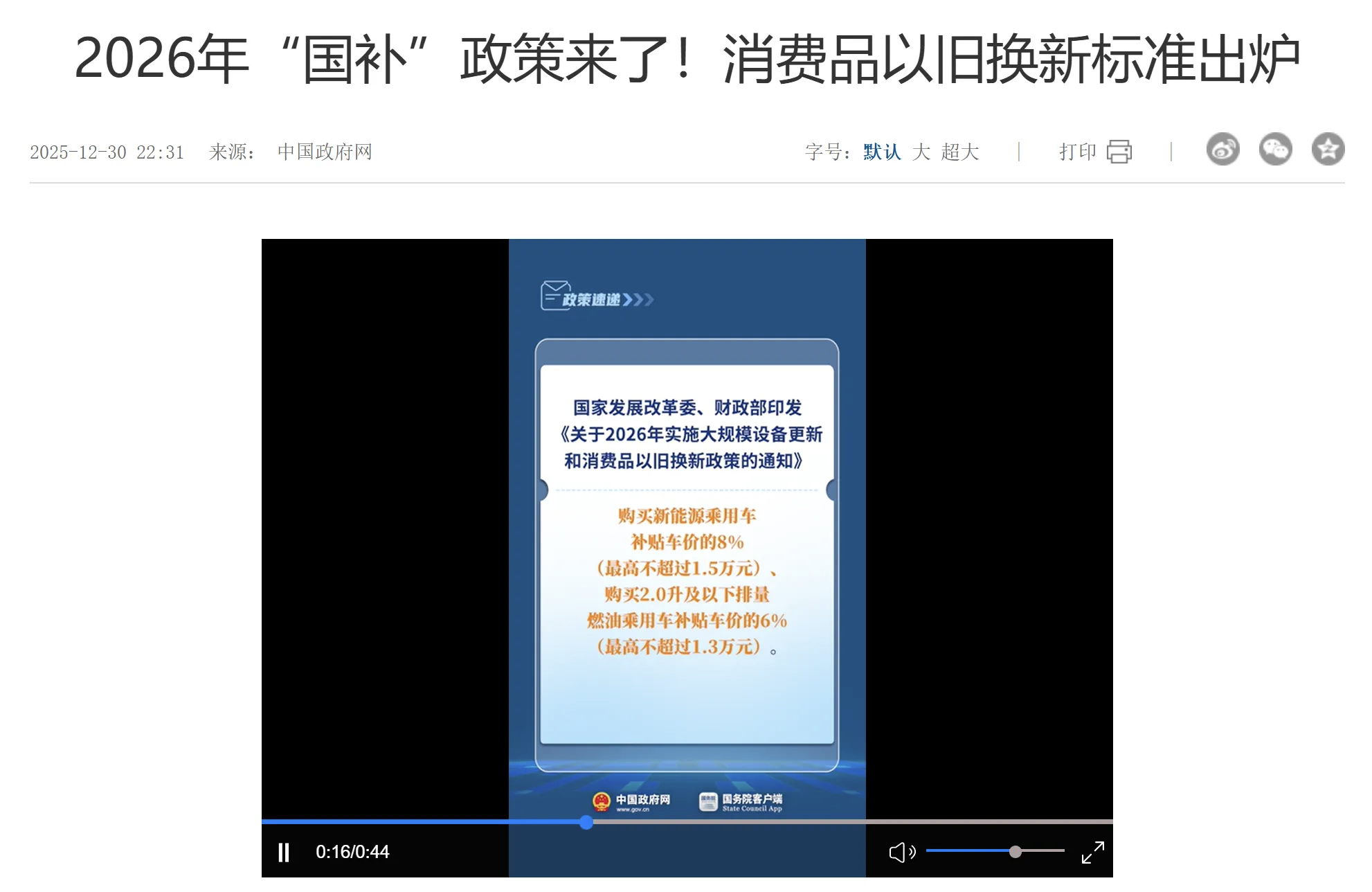
报告导读: 2025 年 12 月 30 日,国家发展改革委、财政部印发《关于 2026 年实施大 规模设备更新和消费品以旧换新政策的通知》,明确延续汽车报废更新与置换更新补贴。 事件: 2025 年 12 月 30 日,国家发展改革委、财政部印发《关于 2026 年实施大规模设备更新和消费品以旧换新政策的通知》 , 明确延续汽车报废更新 与置换更新补贴。 《通知》继续支持汽车报废更新: 个人消费者报废本人名下乘用车,并购买纳入《减免车辆购置税的新能源汽车车型目录》的新能源乘用车或 2.0 升及以下 排量燃油乘用车的,给予汽车报废更新补贴支持,购买新能源乘用车补贴车价的 12% (最高不超过 2 万元)、购买 2.0 升及以下排量燃油乘用车补贴车价 的 10% (最高不超过 1.5 万元)。 《通知》继续支持汽车置换更新: 个人消费者转让本人名下乘用车,并购买符合上述目录要求的新能源乘用车或 2.0 升及以下排量燃油乘用车的,给予汽车 置换更新补贴支持,购买新能源乘用车补贴车价的 8% (最高不超过 1.5 万元)、购买 2.0 升及以下排量燃油乘用车补贴车价的 6% (最高不超过 1.3 万 元)。 202 ...

2026年汽车以旧换新补贴出炉:与车价挂钩 中高端车最受益
Xin Jing Bao· 2025-12-31 06:31
Core Viewpoint - The 2026 "old-for-new" vehicle policy introduces new subsidy measures aimed at promoting the purchase of new energy vehicles and low-emission fuel vehicles, with specific subsidy amounts tied to the vehicle price, maintaining the maximum subsidy limits from 2025. Group 1: Subsidy Details - Consumers scrapping a vehicle registered in their name can receive a subsidy of 12% of the vehicle price, capped at 20,000 yuan for new energy vehicles, and 10% of the vehicle price, capped at 15,000 yuan for fuel vehicles with an engine size not exceeding 2.0 liters [1] - For vehicle trade-ins, consumers can receive a subsidy of 8% of the vehicle price, capped at 15,000 yuan for new energy vehicles, and 6% of the vehicle price, capped at 13,000 yuan for fuel vehicles with an engine size not exceeding 2.0 liters [1] - The subsidy amounts for 2026 remain consistent with those of 2025, but the method of calculation has shifted from fixed amounts to a percentage of the vehicle price [1][4] Group 2: Policy Changes and Impact - The eligibility for scrapping old vehicles has been extended by one year, allowing more consumers to qualify for subsidies [4] - The 2026 policy is expected to benefit over 1,200 million vehicles, potentially driving new car consumption by nearly 1.5 million units [7] - The shift to a percentage-based subsidy is designed to better allocate fiscal resources and encourage the purchase of higher-value, environmentally friendly vehicles [7][8] Group 3: Market Dynamics - The previous fixed subsidy structure led to increased sales of lower-priced models, while the new policy may shift consumer preferences towards mid to high-end vehicles [5][8] - The change in subsidy structure is anticipated to alleviate the pressure of consumption downgrade in the automotive market, particularly benefiting vehicles priced around 150,000 yuan and above [8]
2026年汽车以旧换新补贴出炉:与车价挂钩,中高端车最受益
Xin Jing Bao· 2025-12-31 06:29
Core Viewpoint - The 2026 "old-for-new" vehicle policy introduces new subsidy measures aimed at promoting the purchase of new energy vehicles and fuel-efficient cars, with subsidies linked to vehicle prices rather than fixed amounts, maintaining the maximum subsidy limits from 2025 [1][4]. Subsidy Details - Consumers scrapping vehicles registered in their name can receive a subsidy of 12% of the vehicle price, capped at 20,000 yuan for new energy vehicles, and 10% of the vehicle price, capped at 15,000 yuan for fuel vehicles with an engine size of 2.0 liters or less [1]. - For vehicle trade-ins, consumers can receive 8% of the vehicle price, capped at 15,000 yuan for new energy vehicles, and 6% of the vehicle price, capped at 13,000 yuan for fuel vehicles with an engine size of 2.0 liters or less [1][4]. Policy Changes Compared to 2025 - The eligibility for scrapping subsidies has been extended by one year, allowing gasoline vehicles registered before June 30, 2013, and diesel vehicles registered before June 30, 2015, to qualify [4]. - The subsidy structure has shifted from fixed amounts to a percentage of the vehicle price, allowing for more precise targeting of subsidies based on vehicle value [4][6]. Impact on Vehicle Sales - The 2025 policy led to over 11.5 million vehicles being traded in, generating new car sales exceeding 1.6 trillion yuan, with more than half of retail sales in the passenger car market participating in the "old-for-new" program [5]. - The shift in subsidy structure is expected to drive sales of mid to high-end vehicles, as the subsidy for lower-priced models may decrease, potentially alleviating pressure on the automotive market from consumer downgrading [7]. Environmental and Structural Benefits - The new subsidy design aims to promote greener, low-carbon, and intelligent vehicle consumption, effectively guiding consumer behavior towards more advanced and environmentally friendly vehicles [6]. - The policy is projected to benefit over 12 million vehicles, stimulating new car consumption by nearly 1.5 million units in 2026, thus expanding the reach of the subsidy program compared to 2025 [6].
中国汽车流通协会:2026年汽车以旧换新政策有望持续激发消费活力
Zheng Quan Shi Bao Wang· 2025-12-31 03:27
Core Viewpoint - The 2026 automobile trade-in policy aims to enhance the efficiency of subsidy distribution, ensuring that limited funds benefit more consumers, particularly those with urgent needs [1] Group 1: Policy Implementation - The policy emphasizes a coordinated approach to streamline the subsidy process, making it more accessible and efficient for consumers [1] - There is a clear focus on encouraging the elimination of old vehicles and promoting the purchase of energy-efficient and new energy vehicles [1] - The implementation will leverage market mechanisms to align subsidies more closely with actual consumer demand [1] Group 2: Consumer Impact - The range of beneficiaries is expected to expand, allowing more consumers to take advantage of the trade-in subsidies [1] - The policy aims to stimulate consumer spending, thereby contributing to the transformation and high-quality development of the automotive industry [1] Group 3: Administrative Improvements - The procedures for applying for subsidies will be simplified, making it easier for consumers to participate [1] - Enhanced supervision and management mechanisms will be established to ensure the effective implementation of the policy [1]