
涨价链

Search documents
A股市场逐步切换向绩优方向 | 券商晨会
Sou Hu Cai Jing· 2026-01-27 00:20
Group 1 - Huatai Securities indicates that since mid-January, despite high outflows from broad-based ETFs, there remains incremental investment from insurance funds and an arbitrage demand from investors, suggesting continued market momentum [1] - The rotation of investment focus is expected to shift from thematic stocks to those with performance verification, particularly in industries with sustainable recovery capabilities, such as the price increase chain, high-end manufacturing, and AI chain [1] - Specific sectors to consider for allocation include electric equipment, basic chemicals, and semiconductor equipment, with a moderate increase in allocation towards cyclical dividends [1] Group 2 - CITIC Securities reports that the Indonesian government is expected to reduce nickel ore production quotas for 2026 to 250 million to 260 million tons, a significant decrease from 2025 [2] - If the 2026 production quota is implemented, Indonesia's nickel output may decline to 2.6 million to 2.7 million tons, leading to a global nickel supply shortage of 200,000 tons, which could push LME nickel prices up to $22,000 per ton [2] - The tightening regulatory stance of Indonesia towards the mining industry is likely to slow the growth rate of nickel production, indicating a gradual recovery in nickel prices from the bottom [2] Group 3 - Huatai Securities anticipates that the Federal Reserve is likely to pause interest rate cuts in January, maintaining its forward guidance for December 2025, with limited new information expected [3] - Attention is drawn to Powell's statements regarding the interest rate path, the independence of the Federal Reserve, and whether he will remain as a board member [3]


A股市场逐步切换向绩优方向
Mei Ri Jing Ji Xin Wen· 2026-01-27 00:16
Group 1 - Huatai Securities indicates that since mid-January, despite high outflows from broad-based ETFs, there remains incremental investment from insurance funds and arbitrage demand, suggesting continued market momentum [1] - The rotation of investment focus is expected to shift from thematic sectors to those with performance verification, particularly in industries with sustainable recovery capabilities, such as the price increase chain, high-end manufacturing, and AI chain [1] - Specific sectors to consider for allocation include electric power equipment, basic chemicals, and semiconductor equipment, with a recommendation for moderate allocation to cyclical dividends [1] Group 2 - CITIC Securities reports that the Indonesian government is expected to reduce nickel ore production quotas for 2026 to 250 million to 260 million tons, significantly lower than the 2025 quota [2] - If the 2026 production quota is implemented, Indonesia's nickel output is projected to decline to 2.6 million to 2.7 million tons, leading to a global nickel supply shortage of 200,000 tons, which may drive LME nickel prices up to $22,000 per ton [2] - The long-term regulatory stance of Indonesia towards the mining industry is becoming stricter, which is likely to slow the growth rate of nickel production and support a gradual recovery in nickel prices from the bottom [2] Group 3 - Huatai Securities anticipates that the Federal Reserve is likely to pause interest rate cuts in January, maintaining its forward guidance for December 2025, with minimal new information expected [3] - Attention is drawn to Powell's statements regarding the interest rate path, the independence of the Federal Reserve, and whether he will remain as a board member [3]
金银狂飙,A股、期市相关标的齐涨
Di Yi Cai Jing Zi Xun· 2026-01-26 17:06
Core Viewpoint - The surge in metal prices, particularly gold and silver, is driven by a combination of geopolitical risks, monetary policy expectations, and structural weaknesses in the dollar credit system, leading to significant investment opportunities in the precious metals sector [4][10]. Group 1: Metal Price Movements - On January 26, gold prices surpassed $5100 per ounce, while silver prices reached over $110 per ounce, marking a significant increase in the precious metals market [4][5]. - The A-share market saw the precious metals sector lead with a 7.3% increase, while basic metals also experienced a rise of 2.73% [2][3]. - Analysts predict that the overall strong trend in the precious metals market will continue, although caution is advised due to high volatility [4][10]. Group 2: Company Performance and Earnings - As of January 26, 73% of the 26 listed companies in the non-ferrous metals sector have reported positive earnings forecasts for 2025, largely attributed to rising metal prices [6][8]. - Companies like Zhao Jin Gold and Hunan Gold expect significant profit increases due to higher gold and other metal prices [7][8]. - The acquisition of gold mines by companies such as Luoyang Molybdenum indicates a strategic move to enhance production capabilities amid rising prices [8]. Group 3: Market Dynamics and Future Outlook - The current market dynamics suggest a potential for further price increases in metals, driven by global economic conditions and supply constraints [9][10]. - Analysts recommend a cautious approach to investment, suggesting strategies that include dollar-cost averaging and careful risk management [10][11]. - Regulatory measures may be implemented to curb excessive speculation in the metals market, emphasizing the need for compliance with trading rules [11].



金银狂飙,A股、期市相关标的齐涨,高波动下谨防高杠杆与非理性追高
Di Yi Cai Jing· 2026-01-26 12:40
Group 1: Market Performance - On January 26, gold and silver prices surged, with platinum and palladium also experiencing significant increases, leading to a strong performance in the precious metals sector of the A-share market, which rose by 7.3% [1][2] - The London spot gold price broke through the $5,100 per ounce mark, while silver prices continued to set new highs after first closing above $100 per ounce [1][3] - The A-share market saw individual stocks in the precious metals sector, such as Hunan Gold and Zhaojin Mining, hit the daily limit up [2] Group 2: Price Drivers - The price surge in metals is driven by a shift from traditional supply-demand dynamics to a focus on global financial capital allocation amid policy stimuli and geopolitical tensions [1][3] - Analysts expect a strong price trend for precious metals, with a focus on the profitability of the price increase chain in the medium to long term [1][9] Group 3: Company Performance - As of January 26, 73% of the 26 listed companies in the non-ferrous metals sector have issued positive earnings forecasts for 2025, largely due to rising metal prices [6] - Companies like Zhaojin Mining and Xianglu Tungsten are expected to turn losses into profits, with significant year-on-year increases in net profit attributed to rising metal prices [7][8] Group 4: Regulatory Environment - The Shanghai Futures Exchange has implemented regulatory measures to curb excessive speculation in tin and silver futures, indicating a commitment to maintaining market order [4][5] - Analysts suggest that the recent regulatory signals reflect a proactive approach to managing market volatility and protecting investors [5][11] Group 5: Future Outlook - Analysts predict that gold prices may challenge the $6,000 per ounce mark by 2026, driven by ongoing geopolitical uncertainties and a weakening dollar credit system [10] - The overall strong market for precious metals is expected to continue, with strategies recommended for cautious participation in the current high-volatility environment [11]
景气投资占优 坚守“科技+资源品”双主线
Mei Ri Jing Ji Xin Wen· 2026-01-26 02:22
Group 1 - The core viewpoint of the reports emphasizes the resilience of industrial production and the rapid growth of exports, while domestic demand indicators such as consumption and investment remain weak [1][2][3] - The macroeconomic environment is compared to the investment peak period of 2020-2021, highlighting a combination of weak macro demand and loose liquidity, which favors structural investment in thriving sectors [1] - Key sectors identified for investment include technology, particularly AI semiconductors and new energy, as well as resource products, with a positive outlook for the non-ferrous metals industry by 2025 [1] Group 2 - The A-share market is gradually shifting towards high-performance stocks, with small-cap stocks showing significant gains amid ongoing sector rotation [2] - Despite high outflows from broad-based ETFs, there remains potential for market support from institutional investors and arbitrage opportunities, indicating continued market momentum [2] - Focus areas for investment include sectors with sustainable recovery signals, particularly in price increase chains, high-end manufacturing, and the AI sector, with recommendations to consider electric equipment, basic chemicals, and semiconductor equipment [2] Group 3 - The market is expected to remain volatile before the Spring Festival, with historical data indicating a less than 50% probability of major index gains in the 20 trading days leading up to the holiday [3] - Post-Spring Festival, a new upward momentum is anticipated, with higher probabilities of index gains in the following 20 trading days [3] - Recommended sectors for attention include electronics, electric equipment, and non-ferrous metals, with a focus on commercial aerospace as a theme [3]
策略周报:牛市中期放量后的风格变化-20260125
Xinda Securities· 2026-01-25 05:29
Core Insights - The report indicates that since mid-January, the market's growth rate has slowed due to policy cooling signals, outflows of counter-cyclical funds, and a deceleration in the inflow of leveraged funds. The turnover rate of the entire A-share market peaked at 3.78% on January 14, followed by a decline from that high [2][8] - Historical instances of high turnover rates during bull markets have shown two patterns: style switching, where leading sectors weaken, and style diffusion, where strong sectors continue to perform well and expand into other thriving sectors. The report suggests that if the previous leading sectors were based on themes or policy speculation, they are likely to revert to stronger industrial trends after a high turnover rate [2][8] - The report identifies sectors with strong industrial trends and performance certainty, such as AI computing power, semiconductors, and non-ferrous metals, as likely to maintain strong performance post-high turnover. Conversely, sectors driven mainly by thematic catalysts without clear fundamental improvements may face challenges [2][8] Market Changes - The report notes that since late December 2025, the spring market has accelerated due to the resolution of overseas liquidity disturbances and the influx of configuration funds, particularly in industries like AI and commercial aerospace. However, the sustainability of previously strong-performing sectors such as media, military industry, non-ferrous metals, and computers is questioned as the market enters the latter half of the spring rally [8][29] - The report highlights that the leading sectors during previous high turnover periods have included financials, consumer goods, and technology, with shifts observed in 2007, 2009, 2014, 2020, and 2025. For instance, in 2007, the leading sectors shifted from real estate and consumer to financials and resources, while in 2020, the focus moved from consumption to cyclical and new energy sectors [2][8][12] Sector Analysis - The report emphasizes that sectors such as non-ferrous metals, semiconductors, and AI computing power are expected to continue their strong performance due to their solid industrial trends and earnings realization. Additionally, sectors benefiting from price increases, such as basic chemicals and new energy materials, are also highlighted as having potential for improvement [2][8][34] - The report suggests that the financial sector, particularly non-bank financials, is likely to show increasing elasticity as the market conditions improve. The potential for significant inflows from long-term funds, such as insurance and mutual funds, is also noted as a positive factor for the financial sector [34][36] - The report indicates that the consumer sector may see investment opportunities primarily in new consumption models and high-dividend attributes, particularly in service consumption areas that could benefit from policy catalysts and base effect reversals [34][36]

【申万宏源策略】涨价链和非银开门红可期—— A股行业中观景气跟踪月报(2025年12月)
申万宏源证券上海北京西路营业部· 2026-01-08 02:49
Core Viewpoint - The article discusses the anticipated positive performance of the A-share market, particularly focusing on the price increase chain and the promising outlook for non-bank financial institutions in December 2025 [2] Group 1: Price Increase Chain - The price increase chain is expected to contribute significantly to the overall market performance, with various sectors showing signs of recovery and growth [2] - Specific industries are highlighted as benefiting from this trend, indicating a broader economic recovery that could enhance investor sentiment [2] Group 2: Non-Bank Financial Institutions - Non-bank financial institutions are projected to have a strong start in December 2025, driven by favorable market conditions and increased demand for financial services [2] - The article emphasizes the potential for these institutions to capitalize on market opportunities, suggesting a robust growth trajectory in the near term [2]

兴业证券:95%个股仍待新高 市场或存在结构性机会
智通财经网· 2026-01-06 12:43
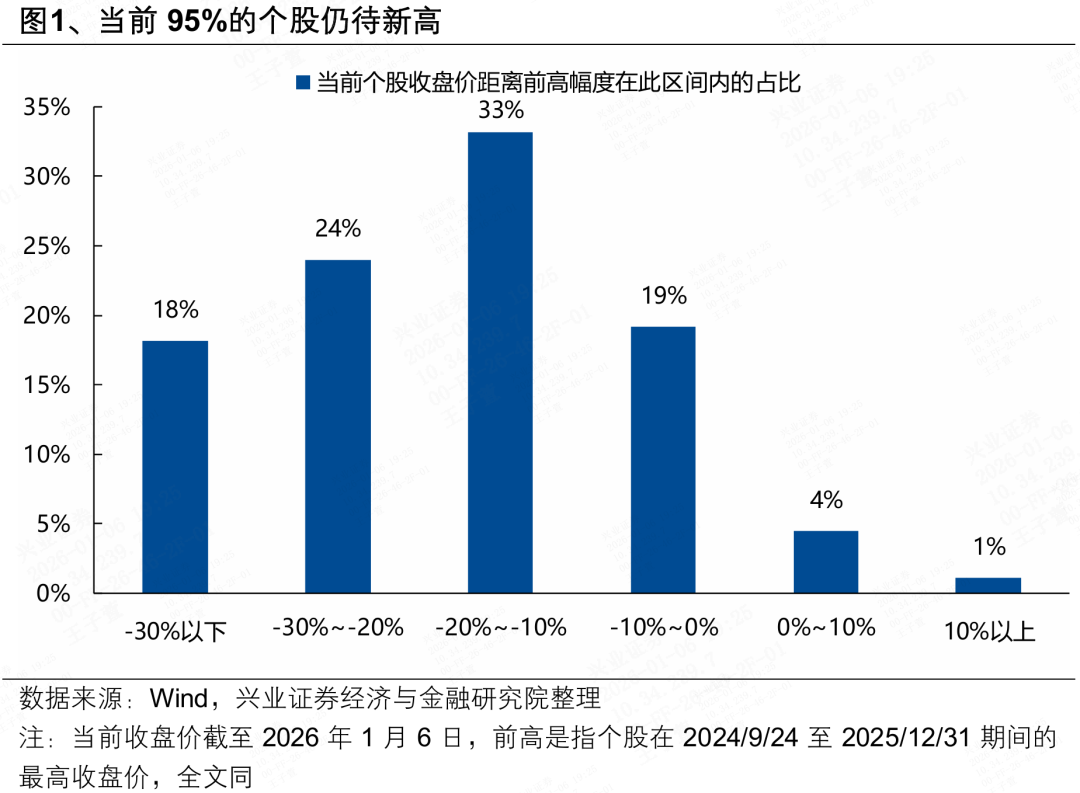
Core Viewpoint - As of January 6, 95% of individual stocks have not broken their previous highs, despite major indices reaching new highs, indicating potential structural opportunities in the market [1][2]. Group 1: Market Overview - Major indices such as the Shanghai Composite Index, All A-shares, CSI 300, and CSI 800 have all reached new highs, but only 5% of individual stocks have surpassed their previous highs [2]. - The previous high for individual stocks is defined as the highest closing price from September 24, 2024, to December 31, 2025, with most stocks still down by over 10% from these highs [2]. Group 2: Sector Performance - The sectors that have broken through previous highs are concentrated in a few segments, particularly in large financials represented by insurance, and sectors benefiting from price increases such as non-ferrous metals, chemicals, petrochemicals, and construction materials [1][5]. - Other sectors that have seen new highs include military, machinery, and home appliance components driven by commercial aerospace and robotics [1][5]. Group 3: Sectors Near Previous Highs - Sectors that have not yet broken their previous highs but are close include technology growth (commercial vehicles, semiconductors, communication equipment), cyclical industries (steel raw materials, renovation materials), and consumer sectors (animal health, textiles, agriculture) [10]. - Industries with significant gaps to their previous highs include technology growth (motors, software, batteries, photovoltaics), dividend sectors (electricity, white goods, banks), and consumer sectors (food and beverage, social services, retail) [13].

兴业证券张启尧:更多行业步入盈利复苏通道
Zheng Quan Shi Bao· 2026-01-04 17:40
Core Viewpoint - The chief strategist of Industrial Securities, Zhang Qiyao, indicates that the recovery of fundamentals is expected to support further market growth by 2026 [1] Group 1: Market Performance - By analyzing the performance of listed companies in the first three quarters of 2025, it is observed that revenue has stabilized, but gross margins are still declining, indicating that pricing remains a major drag on profitability [1] - Since the second half of 2025, policies promoting "de-involution" have led to a rebound in prices in resource sectors, which has improved gross margins [1] Group 2: Economic Outlook - For 2026, nominal economic recovery and price increases are projected to be the most evident trends in the market [1] - According to the latest IMF forecast, China's nominal GDP growth rate in USD terms is expected to reach 6.45% in 2026, significantly higher than in 2025, with continued improvement in listed company profits [1] - The ongoing global liquidity easing is likely to result in a sustained upward trend in the A-share market in 2026 [1] Group 3: Industry Configuration - The market is currently in a structural recovery phase in 2025, with significant differentiation in industry prosperity, leading to a focus on eliminating weaker sectors [1] - As more industries enter the profitability recovery phase in 2026, the market allocation logic may shift from internal competition within sectors to identifying leading industries [1] - Key areas of focus include trends in the AI industry, the "price increase chain," the "overseas expansion chain," and the structural recovery of domestic demand [1]
更多行业步入盈利复苏通道
Zheng Quan Shi Bao· 2026-01-04 17:30
Core Viewpoint - The chief strategist of Industrial Securities, Zhang Qiyao, indicates that the recovery of fundamentals is expected to support further market growth by 2026 [1] Group 1: Market Performance - By analyzing the performance of listed companies in the first three quarters of 2025, it is observed that revenue has stabilized, but gross margins are still declining, indicating that pricing remains a major drag on profitability [1] - Since the second half of 2025, policies promoting "de-involution" have led to a rebound in prices in resource sectors, which has contributed to an improvement in gross margins [1] Group 2: Economic Outlook - For 2026, nominal economic recovery and price increases are expected to be the most evident trends in the market [1] - According to the latest IMF forecast, China's nominal GDP growth rate in USD terms is projected to reach 6.45% in 2026, significantly higher than in 2025, with continued improvement in listed company profits [1] - The ongoing global liquidity easing is likely to result in a sustained upward trend in the A-share market in 2026 [1] Group 3: Industry Configuration - The market is currently in a structural recovery phase in 2025, with significant differentiation in industry prosperity, leading to a focus on eliminating weaker sectors [1] - As more industries enter the profitability recovery phase in 2026, the market allocation logic may shift from internal competition within sectors to identifying superior industries [1] - Key areas of focus for investment include trends in the AI industry, the "price increase chain," the "overseas expansion chain," and the structural recovery of domestic demand [1]
