美国经济增长

Search documents
回应一切!刚刚,特朗普发声!
证券时报· 2026-01-21 15:19
Economic Overview - The U.S. inflation has been defeated, with a core inflation rate of 1.5%, and an expected economic growth rate of 5.4% by Q4 2025, indicating a growth rate twice that of the IMF's forecast [3] - The U.S. has increased its oil production by 730,000 barrels per day, which is expected to help Venezuela and lead to gasoline prices dropping below $2 per gallon [4] Federal Budget and Trade - The federal budget deficit has been reduced by $100 billion, while U.S. exports have increased by $150 billion [5] - The new tariff proposals by President Trump have been criticized by EU leaders, indicating potential retaliatory measures that could affect U.S. businesses and trade agreements [8] Market Reactions - Following Trump's remarks about not using military force regarding Greenland, the U.S. 10-year Treasury bond prices rose, yields fell, and the U.S. dollar index increased, while major U.S. stock indices opened higher [5]


美国商务部长卢特尼克:美国第一季度经济增幅将超过5%。如果美联储降息,美国2026年有可能实现6%的增长。
Sou Hu Cai Jing· 2026-01-21 11:42
如果美联储降息,美国2026年有可能实现6%的增长。 美国商务部长卢特尼克:美国第一季度经济增幅将超过5%。 ...
卢特尼克:如果美联储降息,美国2026年有可能实现6%的增长。
Sou Hu Cai Jing· 2026-01-21 11:36
卢特尼克:如果美联储降息,美国2026年有可能实现6%的增长。 来源:滚动播报 ...
美国史上最强阵容力挺经济前景,贝森特喊出5%增长目标
Jin Shi Shu Ju· 2026-01-20 13:43
尽管外界对美国总统不断膨胀的野心普遍感到担忧,但美国为给达沃斯与会者留下印象而做出的史上最 大规模官方努力,还是得到了与会者对经济乐观言论的回应。 世界经济论坛的首个完整日以财政部长贝森特对今年美国繁荣改善的大胆预测拉开序幕,紧随其后的是 国际货币基金组织(IMF)对这一世界最大经济体更高的增长展望。银行家们也随声附和,对其扩张前 景表达了谨慎的热情。 道富银行首席执行官Ron O'Hanley观察到,许多因素可能会维持美国的增长势头,并自然而然地带动世 界其他地区。他似乎同意贝森特关于财政之风有助于消费者的观点,并指出了其他可能支撑扩张的因 素。 "你看美元贬值,这应该有助于出口,甚至像世界杯来到美国和北美这一广泛地区也将推动大量支 出,"他表示。"美国的顺风相当强劲。" 对美国的企业乐观情绪在2025年也有所体现,经常出席会议的荷兰国际集团(ING)首席经济学家 Marieke Blom上周观察到,虽然这种乐观在某种程度上是合理的,但也可能被夸大了。 她指出,实际上去年美国经济的表现相比预测"略显逊色",且与欧洲的差距"比达沃斯的共识所暗示的 要小得多"。 "有理由对美国经济持相对乐观的态度,"她在一份报 ...
摩根士丹利-跨资产对话-美联储未来路径-晚于早-时间表
摩根· 2026-01-19 02:29
Investment Rating - The report indicates an upward adjustment of the U.S. economic growth forecast to 2.4% for 2026, primarily driven by improved trade contributions, AI-related business spending, and potential fiscal stimulus measures [1][2]. Core Insights - The Federal Reserve's interest rate cut is expected to be delayed until the second half of 2026 due to strong economic growth in 2026, enhanced momentum by the end of 2025, and a stable labor market reducing the likelihood of cuts based on employment factors [1][3]. - If the labor market remains robust and inflation does not effectively slow down, the Federal Reserve may maintain interest rates throughout 2026 or even cancel any planned cuts [5]. - The tariff transmission effect is anticipated to be completed by the end of Q1, which will alleviate the growth rate of commodity prices and overall inflation pressure, thereby enhancing purchasing power for middle- and low-income households [6]. Summary by Sections Economic Growth Forecast - The upward revision of the U.S. economic growth forecast is attributed to significantly improved economic activity data, particularly strong consumer spending in the services sector, increased trade contributions, and support from AI-related business expenditures and upcoming fiscal stimulus measures [2]. Federal Reserve Interest Rate Outlook - The delay in the Federal Reserve's interest rate cut is influenced by stronger economic growth projections for 2026 and improved labor market conditions, with the unemployment rate decreasing from 4.5% in November to 4.4% in December [3][5]. - There is a 10% probability that the Federal Reserve's policy response function may change, which could lead to more significant policy adjustments, including additional rate cuts, depending on a Supreme Court ruling regarding presidential authority over board members [7]. Inflation and Consumer Impact - Evidence suggests significant upward risks to inflation, which may lead the Federal Reserve to consider rate cuts later in the year [4]. - The tariff transmission effect is expected to slow commodity price growth and alleviate inflation pressure, improving purchasing power for middle- and low-income households, although overheating consumption could hinder inflation reduction [6].
贝莱德CEO芬克:现在的投资比一年前更安全
Ge Long Hui A P P· 2026-01-15 14:56
格隆汇1月15日|贝莱德CEO芬克:未来几年美国经济将"高于趋势"增长,现在的投资比一年前更安 全。 ...

2025年12月美国CPI数据点评:扰动结束后,美国Q1通胀料将反弹
Soochow Securities· 2026-01-14 05:14
Group 1: Inflation Overview - The overall CPI for December 2025 in the U.S. was +0.31%, in line with expectations, while core CPI was +0.24%, below the expected +0.30%[3] - Year-on-year CPI increased by 2.68%, matching expectations, while core CPI rose by 2.64%, slightly below the expected 2.70%[3] - The weaker-than-expected core CPI was primarily influenced by declines in used car prices, a price war among telecom companies, and seasonal factors, which are expected to have a short-term impact[3] Group 2: Economic Projections - For Q1 2026, there are upward risks to U.S. non-farm payroll and inflation data due to fiscal and monetary impulses, as well as seasonal factors[2] - The fiscal impulse for Q1 2026 is estimated to boost U.S. GDP by 2.79%, largely due to the end of government shutdowns[2] - Cumulative interest rate cuts of 75 basis points since September 2025 are expected to stimulate the economy in Q1 2026[2] Group 3: Market Reactions - Following the release of the weaker core CPI, market expectations for interest rate cuts increased, leading to rises in U.S. stocks and gold, while U.S. Treasury yields and the dollar index fell[3] - However, asset prices later partially retraced the volatility caused by the monetary easing trades[3] Group 4: Risk Factors - Potential risks include unexpected policy actions from Trump, excessive interest rate cuts by the Federal Reserve leading to inflation rebound, and prolonged high interest rates causing liquidity crises in the financial system[4]
美联储官员穆萨勒姆:预计2026年美国经济将实现潜在增长或高于潜在水平增长。
Sou Hu Cai Jing· 2026-01-13 15:11
美联储官员穆萨勒姆:预计2026年美国经济将实现潜在增长或高于潜在水平增长。 来源:滚动播报 ...
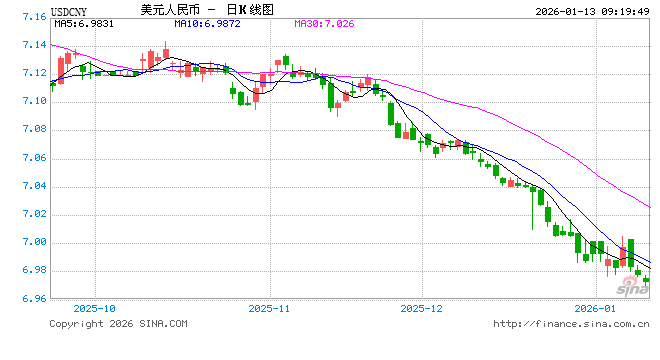
人民币兑美元中间价报7.0103,上调5点
Xin Lang Cai Jing· 2026-01-13 01:20
Core Viewpoint - The Federal Reserve is unlikely to lower interest rates in the short term, with a strong probability of maintaining current rates, as indicated by recent statements from officials and market expectations [4][10]. Group 1: Federal Reserve Interest Rate Outlook - The probability of the Federal Reserve maintaining interest rates in January is 95%, while the chance of a 25 basis point cut is only 5% [3][9]. - By March, the cumulative probability of a 25 basis point cut rises to 26%, with a 72.8% chance of rates remaining unchanged [3][9]. - The likelihood of a 50 basis point cut by March is minimal at 1.2% [3][9]. Group 2: Economic Projections by Federal Reserve Officials - New York Fed President Williams suggests that the U.S. economy will remain healthy through 2026, indicating no immediate need for rate cuts [4][10]. - He states that current monetary policy is well-positioned to support labor market stability and help bring inflation back to the 2% target [4][10]. - Williams projects GDP growth for the year to be between 2.5% and 2.75%, with unemployment rates stabilizing and expected to decline in subsequent years [4][10]. - Inflation is anticipated to peak between 2.75% and 3% in the first half of the year, averaging 2.5% for the year, and returning to 2% by 2027 [4][10].
布米普特拉北京投资基金管理有限公司:生产率与AI驱动增长 高盛预测美国经济前景乐观
Sou Hu Cai Jing· 2026-01-12 09:56
Group 1 - Goldman Sachs economists predict multiple positive factors will boost the US economy this year, including tax cuts, rising real wages, and accumulated household wealth [1] - The report forecasts that the Federal Reserve will likely implement two rate cuts of 25 basis points each in mid-year and the second half of the year due to increased uncertainty in the labor market [4] - The structure of GDP growth in the US is expected to differ from previous cycles, relying more on productivity improvements rather than labor supply growth, with productivity showing signs of rebound driven by technology [4] Group 2 - Core inflation is predicted to decline to near long-term target levels by year-end, indicating a trend of easing price growth [6] - The unemployment rate is expected to remain relatively stable, although there is a potential risk of "no job growth" as companies may optimize costs using AI technologies [6] - Consumer spending is anticipated to grow steadily due to the dual support of tax cuts and real income growth, while corporate investment is expected to be the strongest driver of annual economic growth [6]