财富分配

Search documents
若个人存款高出“这个数”,恭喜!你已经超过了我国大多数家庭
Sou Hu Cai Jing· 2025-07-04 06:12
Core Insights - The significant increase in household savings in China, with new household deposits reaching 11.09 trillion yuan from January to July this year, resulting in a total household deposit balance exceeding 131.09 trillion yuan by the end of July [1][5] - The disparity in wealth distribution is highlighted by the fact that only 0.37% of households have savings exceeding 500,000 yuan, indicating that a large portion of families have savings well below this threshold [3][6] - Various factors contribute to the low savings among many families, including high mortgage debts, inflation pressures, and changing consumption habits among younger generations [5][8] Group 1: Savings Trends - The total household deposit balance in China has surpassed 131.09 trillion yuan, with an average per capita savings of 92,800 yuan [1] - The proportion of families with savings over 500,000 yuan is only 0.37%, equating to approximately 5.18 million households [3] Group 2: Contributing Factors - High mortgage debts, with a total residential mortgage scale of nearly 39 trillion yuan, significantly impact families' ability to save, as over 400 million people are involved in mortgage repayments [5] - The low interest rates on bank deposits, which fail to keep pace with inflation, have led many families to seek higher returns through investments in stocks, funds, and other financial products [5] - The average monthly income for most workers ranges from 3,000 to 6,000 yuan, making it challenging to save 500,000 yuan, which would take over eight years even for dual-income households [6] Group 3: Young Generation's Impact - The younger generation's consumption patterns, characterized by "debt consumption," have further strained their savings capacity, with nearly 90% of individuals born in the 1990s carrying debt averaging 127,000 yuan [8] - The combination of high housing prices, inflation, diverse investment channels, and evolving consumption habits has created a complex landscape for household savings in China [8]


超越马斯克!科技富豪捐精生100+子女,每个分1.7亿美元
首席商业评论· 2025-06-29 04:23
Core Viewpoint - The article discusses the unconventional life of Pavel Durov, the founder of Telegram, who has fathered over 100 children through anonymous sperm donation, highlighting his unique approach to wealth distribution and family dynamics [2][4][11]. Group 1: Durov's Wealth and Family - Pavel Durov's net worth is reported to be $13.9 billion, with plans to leave $170 million to each of his children [4][19]. - Durov has fathered over 100 children in 12 countries through 15 years of sperm donation, starting as a favor to a friend [11][12]. - He emphasizes that all his children, regardless of their conception method, will have equal rights to his wealth [7][20]. Group 2: Durov's Lifestyle and Health Practices - Durov maintains a strict health regimen, including daily exercise, a disciplined sleep schedule, and a unique diet that excludes alcohol, coffee, and meat [15][16]. - He has experimented with extreme fasting, claiming it enhances mental clarity, although he advises against others blindly following his practices [18][16]. Group 3: Durov's Public Perception and Controversies - Durov is often compared to Elon Musk due to his unconventional lifestyle and approach to parenthood, with media dubbing him "Russia's Musk" [20][36]. - He has faced legal challenges, including arrest in France for alleged mismanagement of Telegram, which has been criticized for facilitating illegal activities [30][33]. - Despite controversies, Durov remains committed to his principles of privacy and freedom, often clashing with governmental authorities [33][36].

巨大变化出现!未来几年要好好存钱
大胡子说房· 2025-06-21 05:22
Core Viewpoint - The current monetary policy has not led to inflation despite significant increases in the money supply, indicating a disconnect between monetary expansion and consumer price increases [1][3][6]. Group 1: Economic Indicators - In May, the Consumer Price Index (CPI) decreased by 0.2% month-on-month, while the Producer Price Index (PPI) fell by 0.4% month-on-month and 3.3% year-on-year, showing a lack of price increases in both consumer and producer levels [1][2]. - The broad money supply has increased from 200 trillion to 300 trillion over the past 4-5 years, indicating a substantial monetary expansion without corresponding inflation [1][2]. Group 2: Global Trade and Tariffs - The trade tensions between China and the U.S. have disrupted the traditional economic model where China produces goods and the U.S. consumes them, leading to a surplus of goods in China and downward pressure on prices [7][12][13]. - The ongoing tariff disputes are expected to maintain this pressure, preventing inflation from rising as goods remain unsold and prices continue to drop [15]. Group 3: Consumer Behavior - Current government subsidies and consumption incentives are merely shifting future demand forward rather than creating new demand, as consumers with existing purchasing power are not incentivized to spend more [16][20]. - The wealth distribution issue is significant, as a small number of wealthy individuals hold a disproportionate amount of wealth, limiting overall consumer spending from the broader population [22][24]. Group 4: Investment Opportunities - Companies should focus on catering to the wealthy consumer segment, as there is potential for new consumption patterns among affluent individuals, despite their overall limited spending capacity [27][30]. - Exploring international markets for growth opportunities is crucial, as domestic growth becomes increasingly challenging; companies are encouraged to seek expansion in developing countries [37][41]. - In a deflationary environment, maintaining cash reserves in interest-bearing assets is advisable, as money is expected to retain or increase its value over the coming years [43][44].

澳洲年度富豪榜最新变化!看看富豪们的财富都来自于哪些行业?
Sou Hu Cai Jing· 2025-06-19 02:25
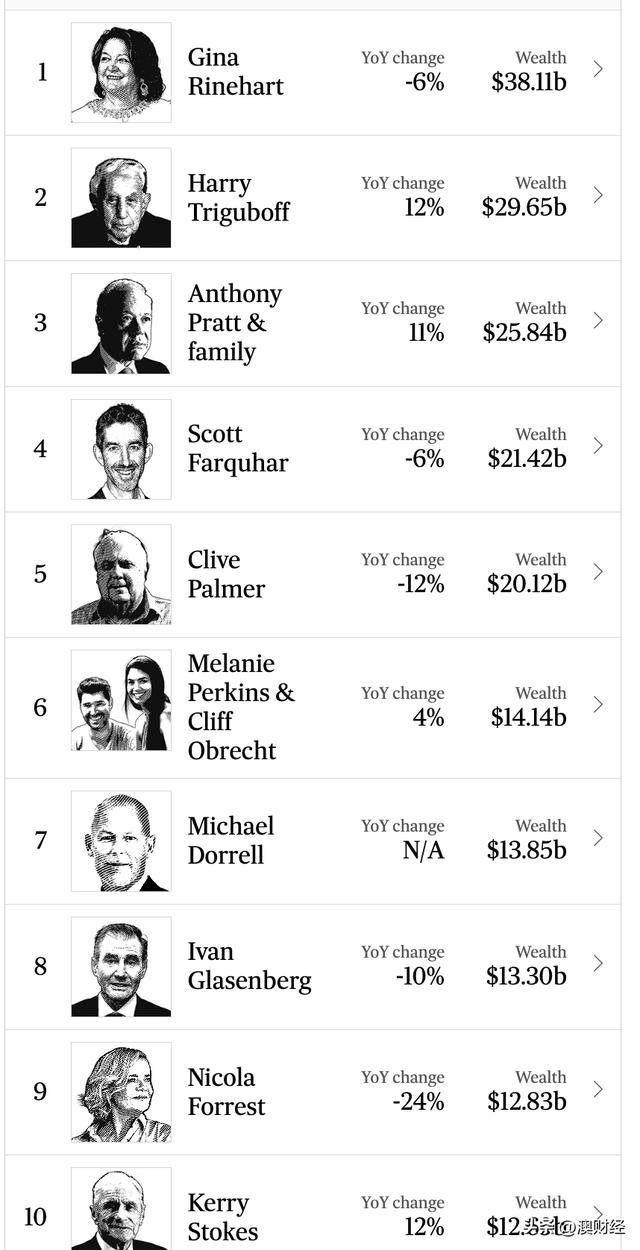
Summary of the 2025 Australian Rich List Core Insights - The total wealth of Australia's top 200 billionaires increased by 6.9% to AUD 667.8 billion despite a challenging economic environment. The top ten billionaires hold a combined wealth of AUD 202 billion, representing 11% of Australia's GDP [1]. Group 1: Wealth Distribution and Industry Representation - The threshold to enter the top 200 list reached a record high of AUD 747 million, with ten newcomers, of which only one inherited wealth [3]. - The mining and resources sector remains dominant, with 24 billionaires in this field, accumulating AUD 141.3 billion, although this represents a 4.6% decline from the previous year [4]. - The top ten billionaires include four from the mining sector, with Gina Rinehart leading at AUD 38.1 billion, while others like Clive Palmer and Ivan Glasenberg saw significant wealth reductions due to falling commodity prices [4]. Group 2: Emerging Industries - The technology sector is rapidly becoming a new wealth engine, with 22 billionaires and a total valuation of AUD 105.9 billion, ranking third among industries [6]. - Notable tech figures include Melanie Perkins and Cliff Obrecht of Canva, who rose to sixth place with AUD 14.1 billion, and Scott Farquhar of Atlassian, who ranked fourth with AUD 21.4 billion [7]. Group 3: Real Estate Sector - The real estate sector has the highest number of billionaires at 48, contributing AUD 125.8 billion, with Harry Triguboff of Meriton Group ranking second overall with AUD 29.65 billion [9][12]. - Triguboff's company is recognized for its significant contributions to high-density residential development in Australia [12]. Group 4: Newcomers and Notable Investments - Michael Dorrell, co-founder of Stonepeak, entered the list at seventh place with AUD 13.85 billion, marking the highest valuation for a newcomer in the list's history [13]. - Stonepeak's recent investments in energy infrastructure, including a significant stake in LNG facilities, highlight the growing importance of energy investments [13]. Group 5: Manufacturing and Diversified Businesses - Anthony Pratt, ranked third, has a wealth of AUD 25.85 billion from Visy Industries and Pratt Industries, focusing on sustainable products and significant investments in the U.S. manufacturing sector [16]. - Kerry Stokes, with a diversified business empire through Seven Group Holdings, returned to the top ten with a net worth of AUD 12.69 billion, despite challenges in energy and media sectors [18].
打工人的悲歌:为什么普通美国人在财富上落伍了?
虎嗅APP· 2025-05-14 23:42
Core Viewpoint - The article highlights the growing disparity between ordinary workers and capital holders in wealth accumulation, emphasizing that relying solely on labor income is increasingly insufficient to keep pace with capital appreciation. Group 1: Economic Changes and Wealth Disparity - The gap between ordinary workers and capital holders has expanded significantly, with a 7.8 times difference in wealth accumulation [2][3]. - The long-term low interest rate policies and monetary easing have inflated asset prices without significantly increasing wages, leading to a situation where nominal wealth rises but purchasing power diminishes for wage earners [5][7][8]. - The return on capital has accelerated, with capital returns typically outpacing economic growth and wage growth over the long term [9][10][11]. Group 2: Impact of Compounding and Technology - The power of compounding favors asset holders, with an investment of $10,000 in the S&P 500 in 1971 potentially growing to approximately $1.7 million by 2024, compared to a mere $55,000 if saved as wages [15][16][17]. - Technological advancements have created significant wealth but have also widened the wealth gap, benefiting high-skilled workers while adversely affecting low-skilled laborers [18][19][20][21][22]. Group 3: Industry and Globalization Effects - High-return industries like technology and finance have exacerbated wealth accumulation disparities compared to traditional sectors [23][24]. - Globalization has suppressed wage growth for ordinary workers in developed countries due to competition from lower-cost labor markets, further diminishing their bargaining power [25]. Group 4: Barriers to Wealth Accumulation - The efficiency of converting labor income into passive income has decreased, with the required market value of the S&P 500 to replace annual salary rising from 25 times in 1971 to 33 times in 2024 [26][27][28]. - The path to financial freedom has become longer and more challenging, necessitating a dual approach of earning both wage and capital income [30][32].

打工人的悲歌:为什么普通美国人在财富上落伍了?
Hu Xiu· 2025-05-14 09:16
Core Insights - The article highlights the growing disparity between ordinary workers and capital holders in wealth accumulation, emphasizing that it now takes significantly more labor hours for an average worker to purchase a share of the S&P 500 index compared to 1971 [2][4]. Economic Factors - The era of loose monetary policy and low interest rates has inflated asset prices, with cheap capital flowing into stock and real estate markets rather than significantly increasing wages [6][8]. - Over the past 20 years, quantitative easing and money printing in the U.S. have led to soaring asset prices, while real wages have stagnated when adjusted for inflation [10][11]. Capital Returns - Historically, the return on capital tends to exceed economic growth rates and wage growth rates, leading to a widening gap between capital accumulation and labor income [12][13]. - From 1971 to 2024, the S&P 500 index surged from approximately 10 points to around 5000 points, a nearly 50-fold increase, while average weekly wages only increased tenfold from about $120 to $1200 [14][15]. Compounding Effects - An investment of $10,000 in the S&P 500 in 1971 would grow to about $500,000 by 2024, and with reinvested dividends, it could reach approximately $1.7 million, contrasting sharply with the modest growth of savings from wages [18][19]. Technological Impact - Technological advancements have created significant wealth but have also exacerbated the wealth gap, as high-skilled workers benefit more than low-skilled laborers [22][24]. - The technology sector has outperformed traditional service industries, further widening the wealth accumulation gap [25][26]. Globalization and Industry Disparities - High-return industries like technology and finance have consistently outperformed traditional sectors, contributing to wealth inequality [28]. - Globalization has pressured wages in developed countries, as capital seeks lower costs while local labor faces increased competition [30][31]. Barriers to Wealth Accumulation - The efficiency of converting labor income into passive income has decreased, with the required market value of the S&P 500 to replace annual salary rising from 25 times in 1971 to about 33 times in 2024 [33]. - The time needed to accumulate passive income equivalent to one year’s salary has increased from approximately 16 years in 1971 to about 25 years in 2024 [34]. Investment Strategy - Ordinary individuals are encouraged to recognize the importance of combining wage income with capital income to navigate the growing wealth gap [36][38].
在一个生产力过剩的时代,为什么我们还要内卷
集思录· 2025-05-12 14:24
Core Viewpoint - The article discusses the phenomenon of "involution" in China, attributing it to the country's transformation into an "economic machine" since the reform and opening-up in 1980, driven by GDP-centric performance evaluations and competition with foreign brands [2][3]. Group 1: Economic Machine and Involution - China has become an economic machine characterized by societal mobilization for economic gain, with a focus on GDP as a performance metric for local governments [2]. - The first phase of this economic machine involved domestic brands competing against foreign brands across various industries, leading to a focus on import substitution [2]. - Post-2018, the U.S. redefined China as a strategic competitor, prompting the need for China to enhance its economic capabilities, particularly in technology and manufacturing sectors [3]. Group 2: Strategies and Outcomes - The strategy of "involution" was adopted to foster competitiveness in emerging industries like electric vehicles, renewable energy, and semiconductor manufacturing, with local governments providing support to their enterprises [3]. - This approach aims to produce a few highly competitive companies that can dominate international markets, despite the high number of failures among supported firms [3]. - The article argues that this internal competition has significantly increased efficiency, although it raises concerns about fairness and social balance [3]. Group 3: Fairness and Distribution - The government has implemented policies to ensure relative fairness, such as maintaining public ownership and monopolies in critical industries, which do not participate in involution [4]. - The distribution system in China is portrayed as more equitable than that of the U.S., with various social welfare programs aimed at improving living standards and reducing poverty [5]. - The article emphasizes that the current system, which combines state capitalism in production with socialist principles in distribution, is superior in addressing social issues compared to the U.S. model [5].