
贸易政策不确定性

Search documents
商务部回应美最高法院关税案裁决:正对相关内容和影响进行全面评估
Di Yi Cai Jing· 2026-02-23 03:31
Group 1 - The U.S. Supreme Court ruled that the tariffs imposed by the Trump administration under the International Emergency Economic Powers Act (IEEPA) were illegal, significantly reducing the effective tariff rate from 12.8% to 8.3% [4] - The ruling is expected to impact the U.S. and global economy, contributing to a slowdown in economic growth, affecting the job market, and increasing inflationary pressures due to cost pass-through to consumers [4] - The average American household is estimated to have lost $1,681 annually due to these tariffs, highlighting the financial burden on families [4] Group 2 - The Chinese government has urged the U.S. to cancel unilateral tariff measures, emphasizing that trade wars have no winners and that protectionism is not a viable solution [2] - The Chinese government is closely monitoring the U.S. plans to potentially implement trade investigations as alternative measures to maintain tariffs, indicating a commitment to protect its interests [2] - The Oxford Economics Institute suggests that even if the current administration finds ways to replicate the existing tariff levels, the impacts on specific industries and countries could vary significantly, leading to new uncertainties for businesses, investors, and households [6]

全球媒体聚焦 | 美媒:美法院裁定关税政策违法 开启了另一个不确定性
Yang Shi Xin Wen Ke Hu Duan· 2026-02-22 08:01
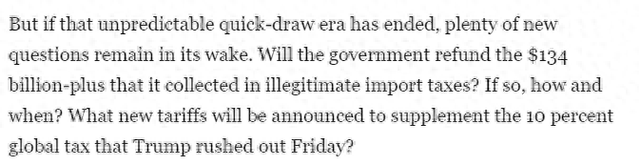
《华盛顿邮报》网站报道截图 文章称,尽管美国最高法院裁定特朗普总统对几乎所有国家的商品加征关税的做法超越了他的权限,但 特朗普在白宫新闻发布会上明确表示,他决心动用"其他选项",继续推行关税政策,而制定"B计划"需 要数月时间,这意味着关税引发的混乱局面将继续影响经济。特朗普已于2月20日迈出了第一步,下令 根据1974年贸易法第122条对所有进口商品加征10%的新关税。当地时间2月21日早上,他又将关税提高 到15%。 最高法院的这项裁决终结了一年多来总统"自由行事"的局面。但随之而来的还有许多新问题。政府是否 会退还其非法征收的超过1340亿美元的进口税?如果会,将如何退还?何时退还?除了新推出的加征全 球关税之外,还会宣布哪些新的关税措施? 《华盛顿邮报》网站报道截图 当地时间2月21日,美国《华盛顿邮报》发文称,美最高法院近日裁决美政府紧急关税政策无效,这结 束了一个经济不确定性的"篇章",同时也开启了另一个不确定性的"篇章"。 文章说,美国司法部去年在法庭文件中表示,如果关税被推翻,政府将提供退款。但最高法院的裁决并 未就此问题提供任何指导,特朗普政府警告说,进口商和政府"最终将在未来五年里为此对簿 ...

美媒:美法院裁定关税政策违法,开启了另一个不确定性
Xin Lang Cai Jing· 2026-02-22 03:30
当地时间2月21日,美国《华盛顿邮报》发文称,美最高法院近日裁决美政府紧急关税政策无效,这结 束了一个经济不确定性的"篇章",同时也开启了另一个不确定性的"篇章"。 《华盛顿 邮报》网站报道截图 《华盛顿邮报》网站报道截图 文章称,尽管美国最高法院裁定特朗普总统对几乎所有国家的商品加征关税的做法超越了他的权限,但 特朗普在白宫新闻发布会上明确表示,他决心动用"其他选项",继续推行关税政策,而制定"B计划"需 要数月时间,这意味着关税引发的混乱局面将继续影响经济。特朗普已于2月20日迈出了第一步,下令 根据1974年贸易法第122条对所有进口商品加征10%的新关税。当地时间2月21日早上,他又将关税提高 到15%。 最高法院的这项裁决终结了一年多来总统"自由行事"的局面。但随之而来的还有许多新问题。政府是否 会退还其非法征收的超过1340亿美元的进口税?如果会,将如何退还?何时退还?除了新推出的加征全 球关税之外,还会宣布哪些新的关税措施? 文章说,美国司法部去年在法庭文件中表示,如果关税被推翻,政府将提供退款。但最高法院的裁决并 未就此问题提供任何指导,特朗普政府警告说,进口商和政府"最终将在未来五年里为此对 ...
美国最高法院裁定特朗普政府大规模关税政策违法,多家机构分析经济影响
Sou Hu Cai Jing· 2026-02-21 01:16
此案由一些美国企业团体提起,并有12个州加入,他们声称关税损害了他们的利益。特朗普政府在去年 4月曾宣布了所谓的"对等关税",引发了金融市场数周动荡,并令美国盟友感到担忧。 此前市场曾怀疑美国最高法院一直"爽约"判决,越拖其判决结果恐怕越对特朗普政府有利。但英国杜伦 大学法学院副院长、跨国法教授兼全球政策研究所联合主任杜明近期则对第一财经记者表示,法律规定 留下的'扯皮'空间不大,法院可以晚出判决,但特朗普政府基本是输。 来源:第一财经 据新华社快讯,美国最高法院20日公布裁决,认定特朗普政府援引《国际紧急经济权力法》实施的大规 模关税政策违法。 第一财经记者看到了美国最高法院在周五发布的裁决文件。在其中美国最高法院表示:"我们今天的任 务仅仅是裁定,根据IEEPA授予总统的'监管……进口'权力是否包含征收关税的权力。答案是否定的。" 他并对记者表示,不过要警惕即使特朗普政府输掉最高法院的官司,他们也可能会通过其他法规重新征 收关税。 不过,该裁决保留了针对汽车和钢铁等特定商品的关税,因为这些关税是根据另一项授权,即1962年 《贸易扩张法》第232条征收的。 裁决书称:"总统在和平时期不享有征收关税的固有权 ...
特朗普暗示违法征收的关税不退了,美财长称关税收入将“基本保持不变”
Hua Er Jie Jian Wen· 2026-02-20 23:52
Core Viewpoint - The Trump administration is determined to maintain tariff barriers despite a Supreme Court ruling declaring most of the tariffs illegal, indicating a shift to new tariffs under different legal provisions to replace those struck down [1][2][3]. Group 1: Tariff Changes and Legal Framework - President Trump announced plans to impose a 10% import tariff on global goods, replacing the tariffs deemed illegal by the Supreme Court [1]. - Treasury Secretary Becerra stated that the government will utilize alternative legal powers granted by Congress, including provisions from the Trade Act of 1974 and the Trade Expansion Act of 1962, to establish a new tariff system [1][2]. - Becerra emphasized that no reduction in tariff revenue is expected, projecting that tariff income will remain "basically unchanged" by 2026 [2]. Group 2: Financial Implications and Refunds - The Supreme Court's ruling could lead to a significant refund battle, with estimates suggesting that over $170 billion in tariffs may need to be refunded to importers [3][4]. - The U.S. government’s actual tariff revenue is closer to $130 billion, contrary to estimates suggesting $175 billion, indicating potential discrepancies in financial expectations [2]. - The refund process is expected to be complex and lengthy, potentially taking weeks to months, or even exceeding a year [5]. Group 3: Industry Reactions and Market Impact - Various industries, including textiles, toys, and food and beverage, are significantly affected by the tariff changes, with many companies already filing lawsuits to reclaim paid tariffs [3][4]. - The National Retail Federation has called for a streamlined refund process, highlighting the economic boost that tariff reductions could provide [5]. - Analysts predict that while the ruling may offer short-term relief, broader trade policy uncertainties will continue to impact retail sales, with benefits expected to diminish by 2028 [5][6].
219票赞成:211票反对!美国投票结果已出,特朗普或再次退群
Sou Hu Cai Jing· 2026-02-15 06:57
紧接着,彭博社于投票后的第二天爆料称,特朗普正在考虑退出《美墨加协定》。该协定是特朗普第一任期推动的成果,于2020年生效,取代了原有的北美 自由贸易协定,并增设了汽车原产地规则以限制外部零部件进入北美市场。特朗普此举意图通过退群施压加拿大和墨西哥,要求它们在移民、毒品管控以及 国防开支等方面做出让步。若美国退出《美墨加协定》,将对北美三国间超过2万亿美元的贸易额造成严重冲击,尤其是加拿大80%的出口依赖美国市场, 墨西哥的制造业也高度依赖该协定。特朗普此举显示出他在中期选举前力求通过强硬的贸易政策来提升支持率,而他的支持率目前约为43%,反对率则高达 51%。 美国中期选举的前夕,美国众议院在一场关键投票中以微弱的票数通过了决议,决定终止特朗普政府对加拿大加征的关税。2026年2月11日,众议院以219票 赞成、211票反对的结果,叫停了特朗普于2025年2月基于国家紧急状态对加拿大进口商品征收的25%关税。自特朗普重返白宫以来,他以打击芬太尼非法流 入为由,几乎对加拿大的所有商品加征了25%的关税,只有能源和石油类产品除外,税率为10%。这一政策迅速恶化了美加之间的贸易关系,加拿大向美国 出口的木材、汽车 ...
2026年美国进口开局“暴跌”,贸易前景堪忧?
Sou Hu Cai Jing· 2026-02-10 10:26
据媒体报道,尽管有迹象表明美国集装箱进口流量趋于正常化,且提前备货的影响减弱,但 预计至少在2026年前四个月,进口量将继续下滑。 Descartes也指出,由于美国最高法院尚未就关税问题作出裁决,"进口商面临的政策不确定性仍然较 高,关税条件短期内不会改变"。特朗普政府还威胁称,如果美国最高法院推翻其现行关税政策,将采 取新的行动。 美国全国零售联合会和Descartes Global均指出,2026年进口量开局疲软。Descartes估算,1月份集装箱 总量为230万标准箱(TEU),较12月增加逾9万标准箱,但同比减少近7%。去年,进口商被认为是在 特朗普重返白宫前提前备货。 零售联合会预测,1月份零售进口量为211万标准箱,同比下降逾5%。该协会表示,进口量环比增加是 因为进口商提前下订单,以赶在将于下周开始的农历新年假期前到货,届时亚洲各地的工厂将停工。 "由于关税问题仍在法院和国会中争论不休,其对进口的影响已显而易见,"美国全国零售联合会负责供 应链和海关政策的副总裁Jonathan Gold表示,"这一情况凸显了制定清晰、可预测的贸易政策的必要 性,以支持供应链的确定性和可靠性、商业规划以及消费 ...
华源证券:关税不确定性制约全球央行降息路径 商品超级周期有望到来
智通财经网· 2026-02-10 03:06
Group 1 - The IMF has raised its short-term global economic growth forecast, but challenges remain for medium-term growth, which relies on credible, predictable, and sustainable policy actions [1][2] - The IMF projects global economic growth to decline from 3.3% in 2024 to 3.2% in 2025 and 3.1% in 2026, with developed economies growing at approximately 1.6% and emerging markets slightly above 4% [1] - Current economic resilience appears to stem from temporary factors rather than robust fundamentals, with signs of weakening economic conditions as these factors fade [1] Group 2 - Long-term policy uncertainty may suppress consumption and investment, while protectionist measures could disrupt supply chains and hinder productivity growth [2] - Breakthroughs in trade negotiations could lower tariffs and reduce uncertainty, potentially boosting medium-term growth [2] - The rapid growth of productivity driven by artificial intelligence may positively impact the overall economy [2] Group 3 - Tariff uncertainty is constraining the path for global central bank interest rate cuts, despite many economies being in a monetary easing cycle [3] - The front-loading effects of trade and investment due to tariffs have resulted in resilient economic activity and labor markets, delaying the pace of interest rate cuts [3] Group 4 - Inflation rates in the Eurozone, the US, and the UK are expected to remain around 3%, with tariffs and supply chain adjustments having a limited impact on inflation pressure so far [4] - The pricing effects of tariffs indicate broader implications for pricing and supply chains, which may eventually lead to cost increases being passed on to consumers [4] - The interplay between inflation and interest rate cuts is a significant variable, potentially benefiting commodity prices [4] Group 5 - Fiscal policies in developed economies are expected to maintain a neutral to slightly accommodative stance, with debt risks persisting under high financing rates [5] - Despite lower deficit forecasts for 2025 compared to record levels in 2020-2021, deficits remain significantly above pre-pandemic levels [5] - The debt-to-GDP ratio in the US is projected to rise from 122% in 2024 to 143% by 2030, while the Eurozone's ratio is expected to reach 92% by 2030 [5] Group 6 - The WTO forecasts that trade volume growth will slow from 2.8% in 2024 to 2.4% in 2025 and 0.5% in 2026 due to higher tariff rates and increased trade policy uncertainty [6] - The risks associated with trade restrictions and policy uncertainty are expected to affect more economies and sectors [6] - On a positive note, the continued growth of AI-related goods and services trade may provide a boost to global trade in the medium term [7]
闪耀的贵金属
Shang Hai Zheng Quan Bao· 2026-01-25 18:54
Core Viewpoint - The global precious metals market remains strong due to macro geopolitical risks and uncertainties in trade policies, with gold and silver prices reaching historical highs [1]. Group 1: Gold Market - On January 23, COMEX gold prices reached $4991.4 per ounce, marking a historical peak for the contract [1]. Group 2: Silver Market - On the same day, both London spot silver and New York silver futures prices surpassed $100 per ounce, setting new historical records [1].

“黑天鹅”突袭!欧洲股市,开盘暴跌
Xin Lang Cai Jing· 2026-01-19 09:24
Core Viewpoint - The European stock market experienced a significant decline due to U.S. President Donald Trump's tariff threats regarding the acquisition of Greenland, leading to a swift reaction from traders and a drop in major stock indices [1][6][7]. Market Impact - The Stoxx 50 index fell by 1.64%, the French CAC 40 index decreased by 1.73%, the Italian FTSE MIB index dropped by 1.6%, and the UK FTSE 100 index declined by 0.37% [7]. - The cryptocurrency market also faced a downturn, with Bitcoin's price dropping by 3.6% to below $92,000, while Ethereum fell by 4.9% and Solana by 8.6% [1][6]. Geopolitical Reactions - Eight NATO member countries, including Denmark, Norway, Sweden, France, Germany, the UK, the Netherlands, and Finland, were listed for potential tariffs, with European leaders expressing that the tariff threats are "unacceptable" and pledging support for Denmark [3][8]. - French President Macron emphasized the need for European unity in response to the threats, stating that any intimidation would not sway their stance [3][8]. - Norwegian Prime Minister Støre and Finnish President Stubb also voiced their support for Denmark, highlighting the importance of dialogue over pressure [3][9]. Upcoming Events - The World Economic Forum (WEF) is set to begin in Davos, Switzerland, with President Trump scheduled to speak, raising market anticipation regarding his policy positions [10].