市场恐慌情绪

Search documents
隐波冲高回落,短期情绪底或基本显现:股指期权周度观察-20260329
Guo Lian Qi Huo· 2026-03-29 11:39
Report Industry Investment Rating - Not provided Core Viewpoints - Last week, the implied volatility of each option showed a significant upward and then downward trend. The declines on Monday and Thursday both led to an obvious upward trend in volatility. The at-the-money implied volatility of MO reached a very high level of 39%. Currently, the average at-the-money implied volatilities of April IO, HO, and MO options are around 16.85%, 17%, and 25.22% respectively, with premiums of -0.33 percentage points, 0.2 percentage points, and -2.97 percentage points compared to the 30-day historical volatility. The 30-day historical volatility of the underlying is still above the 60-day historical volatility, and technically, the volatility is still in an upward cycle. Due to the uncertainty in the Middle East situation, the downside space of implied volatility may still be relatively limited under the low premium [3]. - In terms of the relationship between implied volatility and the underlying index, the decline of the underlying index is more likely to drive the synchronous increase of implied volatility, while the rise of the index brings about the decline of volatility. Coupled with the decline of the position PCR value to a relatively low level in the past year, it indicates that the trend of put option sellers increasing positions is still restrained, and the market is still relatively cautious in the short term [3]. - In terms of position distribution, the contract with the highest call option position of MO has moved down to the 8000-point level, with the current position reaching more than 9000 lots. From the perspective of selling options, it is expected that the CSI 1000 Index will still face relatively large pressure above in the short term. The contract with the highest put option position is at the strike price of 7000 points, and there is a trend of increasing positions, indicating that the CSI 1000 Index will also face strong support below this area in the short term [3]. - In general, the market may digest panic through bottom - range oscillations. The significant upward and then downward movement of implied volatility last week indicates that the short - term emotional bottom may have basically emerged. It is recommended that investors can consider selling out - of - the - money MO call options with a strike price above 8000 points at high prices to collect certain option premiums. On the other hand, if the market experiences a panic decline again, it is advisable to consider selling MO put options with a strike price below 7000 points at an appropriate time for strategic long - position allocation [3]. Summary by Directory 01 Index Option Data Tracking - **Main Indicator Overview**: Not provided - **Trading Volume and Position Situation**: Not provided - **PCR Value and Underlying Index Trend**: Not provided - **Position Distribution Situation**: The contract with the highest call option position of MO has moved down to the 8000 - point level, with the current position reaching more than 9000 lots. The contract with the highest put option position is at the strike price of 7000 points, and there is a trend of increasing positions [3]. - **One - Year Volatility Cone**: Not provided - **Implied Volatility and Historical Volatility**: Last week, the implied volatility of each option showed a significant upward and then downward trend. The at - the - money implied volatility of MO reached 39%. Currently, the average at - the - money implied volatilities of April IO, HO, and MO options are around 16.85%, 17%, and 25.22% respectively, with premiums of - 0.33 percentage points, 0.2 percentage points, and - 2.97 percentage points compared to the 30 - day historical volatility. The 30 - day historical volatility of the underlying is still above the 60 - day historical volatility [3]. - **Volatility Surface Structure**: Not provided - **Skewness and Underlying Index Trend**: Not provided
刚刚!暴涨,熔断!亚太股市,大反攻!特朗普宣布:将取消制裁!
券商中国· 2026-03-10 00:48
Core Viewpoint - The article discusses the significant market rally following President Trump's announcement that the conflict is "basically over," leading to a surge in Asian stock markets and a collective rise in U.S. stock indices [1][2]. Market Reaction - Following Trump's comments, the Korean Composite Index surged over 5%, and the Nikkei 225 Index rose by more than 3% [1][2]. - The MSCI Asia-Pacific Index increased by 1.3% to 238.80 points, indicating a broad recovery in risk assets as market panic subsided [2]. Trump's Statements - Trump announced plans to lift some oil-related sanctions to stabilize oil prices, responding to market volatility caused by U.S. and Israeli attacks on Iran [2][3]. - He indicated that the conflict with Iran would "soon" end but clarified it would not conclude within the week [3]. - Trump also mentioned that if Iran disrupts global oil supply, the U.S. would respond with stronger measures, including potential naval escorts in the Strait of Hormuz [3]. Geopolitical Context - Iranian officials warned that security in the Strait of Hormuz cannot be restored as long as the U.S. and Israel continue military actions against Iran [8]. - The Iranian military has claimed responsibility for multiple attacks on U.S. and Israeli assets, including the downing of drones and aircraft [9]. Historical Perspective - Analysts noted that significant geopolitical events typically lead to short-term market volatility, but markets often recover within 12 months, presenting potential buying opportunities [6].


长江有色:6日铝价大跌 交投状况一般
Xin Lang Cai Jing· 2026-02-06 08:34
Group 1 - LME aluminum prices faced resistance, with three-month contracts reported at $3019.5 per ton, down $6.5 or 0.23% from the previous trading day [1] - Domestic futures for aluminum showed a decline, with the main contract for March 2603 closing at 23,315 yuan per ton, down 310 yuan or 1.31% [1] - The overall trading volume for the main March 2603 contract decreased by 90,289 contracts, with open interest also declining by 7,889 contracts [1] Group 2 - The macroeconomic environment is influenced by Kevin Warsh's nomination, which temporarily alleviated concerns regarding the independence of the Federal Reserve, helping to stabilize market expectations [1] - The geopolitical situation has escalated, with the U.S. advising citizens to evacuate Iran, leading to increased safe-haven buying and impacting aluminum prices [2] - Domestic electrolytic aluminum production capacity is expected to see slight growth, but demand is weakening due to seasonal consumption slowdowns and early holiday breaks [3] Group 3 - Aluminum inventories in China increased by 24,000 tons to 853,000 tons, which is exerting downward pressure on aluminum prices [3] - The current market sentiment is characterized by fear, driven by a strong dollar rebound and geopolitical risks not easing as expected, leading to significant sell-offs in risk assets [3] - Despite short-term pressures, the medium to long-term outlook for aluminum remains positive, supported by demand from downstream sectors during low-price periods [3]

金货期业弘:市场极度恐慌,铝价走势偏弱
Hong Ye Qi Huo· 2026-02-02 09:33
1. Report Industry Investment Rating - No relevant information provided. 2. Core View of the Report - The aluminum market is currently in a state of extreme panic, with weak aluminum price trends. After a sharp short - term decline in aluminum prices, the weak trend may continue. The market should pay attention to market sentiment and spot demand. If copper prices continue to fall, it may drive aluminum prices to remain weak [4][5]. 3. Summary According to Related Data Market Panic and Price Movements - The U.S. federal government partial shutdown and Trump's nomination of Walsh as the successor to the Federal Reserve Chairman, along with concerns about his hawkish stance, led to a sharp rise in the dollar. Panic spread in the market, causing a full - scale decline in capital markets. A - shares, the Hang Seng Index, and Asian stock markets all fell, with the South Korean stock market triggering a trading halt. Non - ferrous metals, including copper, aluminum, tin, and nickel, all hit the daily limit down, with LME aluminum and domestic spot aluminum also dropping significantly [4]. Aluminum Price and Inventory - Today, the closing price of SHFE aluminum was 23,035, and the spot price was 23,700, with a spot premium of 665 points over the futures. This week, SHFE aluminum rose first and then fell, and the spot discount widened to - 220 yuan. After the sharp decline, spot trading improved. Domestic electrolytic aluminum social inventories increased significantly, alumina inventories increased slightly, and SHFE aluminum inventories increased significantly. In the off - season, spot demand at the high level was poor. LME inventories increased slightly, and the LME spot market turned to a discount of - 27 dollars, indicating poor overseas spot demand [4]. Exchange Rate and Price Ratio - This week, the RMB exchange rate dropped significantly, and the SHFE - LME aluminum price ratio rose to 7.84, with the domestic and overseas markets showing similar trends [4]. Technical Analysis - Today, U.S. natural gas prices plunged, U.S. crude oil prices fell, and LME aluminum fell, trading around 3,020 dollars. SHFE aluminum hit the daily limit down, closing at 23,035, and its technical form weakened. The trading volume was high while the open interest of SHFE aluminum decreased significantly, and market sentiment was panicked [5].
国泰君安期货:有色贵金属多米诺式下跌,短期勿轻言抄底
Xin Lang Cai Jing· 2026-02-02 07:22
Market Overview - The domestic precious metals market experienced significant declines today, with most contracts hitting the limit down, indicating a worsening situation in the afternoon compared to the morning [2][11] - Key contracts and their price changes include: - Silver (沪银2604) at 24,832, down 17.00% - Palladium (把2606) at 413.70, down 16.00% - Platinum (辑2606) at 552.15, down 16.00% - Gold (沪金2604) at 1,020.40, down 14.75% - Lithium Carbonate (碳酸锂2605) at 134,140, down 12.88% [2][11] Trading Volume and Pressure - The trading volume for the main silver contract (Ag2604) has significantly shrunk, indicating heavy selling pressure with nearly 42,000 sell orders piled up at the limit down price [3][5][11] - The overall market sentiment is marked by fear, as related sectors failed to stabilize, further exacerbating the situation [7][14] Technical Analysis - The gold contract (Au2604) is approaching a critical support level around 1,000. A breakdown below this level could signal further weakness in the market [7][14] - Current market conditions do not show any clear signs of recovery, and if the weak trend continues, there is a possibility of further declines in the night session [9][17] Geopolitical Factors - Recent developments regarding the Epstein case have heightened concerns about political uncertainty in the U.S., which may lead to increased market volatility [9][17] - Investors are advised to monitor the U.S.-Iran situation closely, as any escalation could trigger risk-off sentiment that might provide some relief for precious metals [9][17] Investment Strategy - The company recommends that investors remain cautious, prioritize position protection, and avoid blind trading in a volatile environment [9][17]

VIX指数失灵 恐慌转向大宗商品与汇率战场:黄金创80年代来最大单日跌幅、1999年来最大月度涨幅
Sou Hu Cai Jing· 2026-02-02 04:28
Group 1 - The global asset classes have shown significant divergence this year, with stock market volatility remaining low while volatility in precious metals, foreign exchange, and commodities has increased [1] - The Chicago Board Options Exchange Volatility Index (VIX) has not adequately reflected current macro-level risk signals, indicating a shift in market fear from equities to commodities and currencies [1] - Gold prices reached a historical high earlier this year but experienced the largest single-day drop since the 1980s last week, while the dollar's exchange rate saw its largest single-day decline since April [1] Group 2 - Despite concerns over an artificial intelligence stock bubble, core volatility has concentrated in non-equity areas, with gold and oil prices showing significant fluctuations [1][2] - The volatility in individual stocks has decreased overall market correlation, leading to a lower overall volatility index, as investors focus on earnings and the sustainability of AI trading [2] - The demand for gold ETFs has surged, with a growth of over $20 billion in the past eight months, although the safe-haven attribute of precious metals has weakened due to significant price fluctuations [2]
Dow Cuts Loss in Half As Volatile Week Continues
Barrons· 2026-01-30 19:06
Market Performance - The Dow Jones Industrial Average decreased by 217 points, or 0.5%, after experiencing a drop of over 500 points earlier in the session [1] - The S&P 500 index fell by 0.4%, while the Nasdaq Composite declined by 0.7% [1] Volatility Indicators - The CBOE Volatility Index (VIX) reached a high of 19.27 before retracting, indicating increased market volatility [1] - A VIX level above 20 is considered a threshold that signals heightened levels of market fear and volatility [1]
站稳5000美元!黄金牛途全速前进,地缘风险+货币贬值点燃市场
Sou Hu Cai Jing· 2026-01-26 07:08
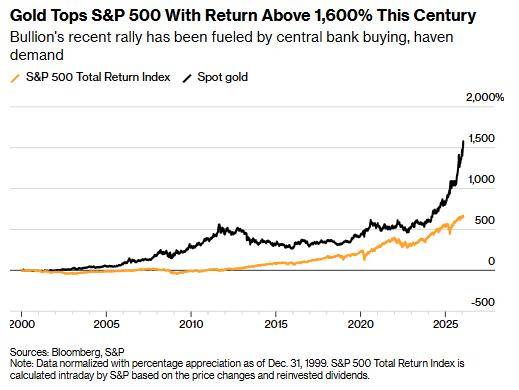
Core Viewpoint - The international gold price has surpassed $5,000 per ounce for the first time, driven by geopolitical shifts under President Trump and a significant withdrawal of investors from sovereign bonds and currencies [1][4]. Group 1: Gold Market Dynamics - Gold prices have doubled over the past two years, with a year-to-date increase of over 17%, primarily driven by "currency devaluation trades" as investors exit fiat currencies and U.S. Treasury markets [4][7]. - The recent decline of the U.S. dollar, with a cumulative drop of nearly 2% over the past six trading days, has further boosted gold demand, pushing spot gold prices close to $5,100 per ounce [1][4]. - The appeal of gold as a safe-haven asset has reached unprecedented levels amid current market uncertainties, with significant geopolitical risks and inflation concerns driving investment [4][8]. Group 2: Investor Sentiment and Behavior - Long-term investors are increasingly concerned about public debt in developed economies, viewing inflation as a potential solution for debt repayment, leading to a substantial increase in gold holdings [7]. - Family offices are particularly sensitive to currency devaluation and debt issues, focusing on preserving intergenerational wealth rather than short-term market gains [7]. - The net long positions in gold among hedge funds and large speculators have reached the highest level in 16 weeks, indicating strong investor interest [8]. Group 3: Geopolitical Influences - Trump's threats regarding trade agreements and domestic political uncertainties, including potential government shutdowns, are contributing to market volatility and enhancing gold's attractiveness [7][8]. - The anticipated appointment of a more dovish Federal Reserve chair could lead to further interest rate cuts, which would benefit non-yielding gold [8].
摩通:市场抛售是对特朗普的警告
Ge Long Hui A P P· 2026-01-21 01:51
Core Viewpoint - The market sell-off is seen as a signal to the Trump administration to take action to restore calm, similar to past responses to investor concerns [1] Group 1: Market Reactions - The current market is experiencing some chaos and panic, as noted by the Chief Investment Officer of JPMorgan Asset Management, Bob Michele [1] - The S&P 500 index has erased its gains for the year to date, indicating a significant market downturn [1] - Bond prices and the dollar have also declined in response to market conditions [1] Group 2: Political Context - The sell-off was triggered by President Trump's threat to impose tariffs on several European countries opposing his Greenland acquisition plan [1] - There is a historical precedent where market volatility was calmed by official communications following investor unrest, as seen in April [1]
相差34票,最新表决结果出炉,特朗普清除内患,美联储有惊涛骇浪
Sou Hu Cai Jing· 2026-01-15 03:46
Group 1 - The core issue revolves around the extension of enhanced subsidies under the Affordable Care Act (ACA), which has become a significant point of contention in U.S. politics, affecting over 20 million insured individuals facing rising premiums due to subsidy expiration [3][5] - The internal division within the Republican Party is highlighted, as some members recognize the political costs of continued opposition to healthcare subsidies, leading to a forced vote that bypassed party leadership [5][9] - The vote on January 8, 2026, resulted in 230 votes in favor and 196 against, with 17 Republican members siding with Democrats, indicating a shift in party dynamics and a test of Trump's control over the party [5][9] Group 2 - The criminal investigation into Federal Reserve Chairman Powell, initiated on January 9, 2026, has caused significant market turmoil, raising concerns about the stability of the financial system and the independence of the Federal Reserve [7][11] - Powell's strong public response to the investigation, asserting that monetary policy decisions should be based on data rather than political pressure, has escalated the situation into a broader institutional confrontation [9][11] - The investigation and subsequent political tensions have led to a sell-off of U.S. assets, as investors reassess risks associated with the potential erosion of the Federal Reserve's independence and the implications for interest rates and market stability [11][13]