轨道数据中心

Search documents
马斯克大动作!SpaceX申请部署100万颗卫星!重磅数据首次曝光
Mei Ri Jing Ji Xin Wen· 2026-02-02 00:20
Group 1 - SpaceX has submitted an application to the FCC to launch and operate a satellite network consisting of up to 1 million satellites, aimed at creating an "orbital data center" to support advanced AI models and applications [1] - The proposed system is expected to utilize solar energy in space, significantly reducing operational and maintenance costs compared to traditional data centers on Earth, leading to a revolutionary increase in energy efficiency [1] - Elon Musk is considering integrating SpaceX with his AI company xAI or Tesla to enhance the capabilities of the orbital data center, potentially using Tesla's energy storage systems to power these data centers [8] Group 2 - SpaceX is projected to achieve revenues between $15 billion and $16 billion in 2025, with an estimated EBITDA of around $8 billion (approximately 56 billion RMB), which has prompted investment banks to reassess the company's IPO potential [8][9] - The IPO is tentatively scheduled for mid-June 2024, with a target fundraising of up to $50 billion and a valuation of approximately $1.5 trillion, which would make it the largest IPO in history [9] - Major investment banks, including Bank of America, Goldman Sachs, JPMorgan Chase, and Morgan Stanley, have been appointed as lead underwriters for this significant transaction [9] Group 3 - Musk's motivation for pushing SpaceX towards an IPO is to secure additional funding for the development of the Starship rocket system, which aims to reach Mars [11] - The company is also developing technology for deploying data centers in space, connected through its existing Starlink satellite network of 9,400 satellites, which is crucial for competing in the AI sector against companies like Google and OpenAI [11] - The timing of the IPO may also coincide with Musk's birthday on June 28, reflecting his personal influence on business decisions [12]

马斯克大动作!SpaceX申请部署100万颗卫星!重磅数据,首次曝光
Mei Ri Jing Ji Xin Wen· 2026-02-02 00:13
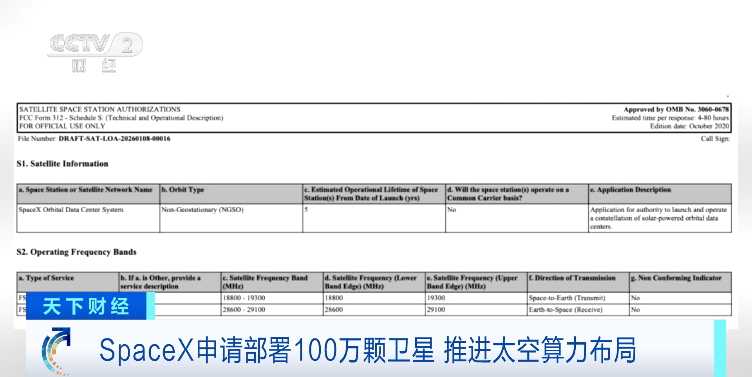
每经编辑|金冥羽 宋思艰 据央视财经援引路透社1月31日报道,美国太空探索技术公司也就是SpaceX,于1月30日向美国联邦通信委员会提交申请,计划发射多达100万颗卫星,以 打造"轨道数据中心"。与此同时,近期频繁传出消息称SpaceX公司正考虑IPO。市场正密切关注企业家马斯克推进太空算力布局的最新动态。 SpaceX提交给美国联邦通信委员会的文件中显示,SpaceX申请发射并运营一个由多达100万颗卫星组成的卫星网络。根据SpaceX的描述,这将是一个拥有 前所未有计算能力的"轨道数据中心系统",可为先进的AI模型及相关应用提供支持。SpaceX认为,相比于在地球上建设传统的AI算力数据中心,利用太 空中的太阳能,运营或维护成本极低,借此可实现能源效率的革命性提升。 马斯克在社交平台X上转发了关于SpaceX申请发射多达100万颗卫星的报道。 据知情人士向美国彭博新闻社披露,马斯克正考虑合并太空探索技术公司(SpaceX)和他旗下人工智能企业xAI公司的可能性,或是合并太空探索技术公 司和特斯拉公司。 报道称,马斯克在太空部署人工智能数据中心的设想将可能通过上述不同路径实现。如果工程技术允许,其中一个方 ...
国泰海通:SpaceX申请百万卫星布局轨道 AI数据中心、太空光伏与设备环节有望率先受益
智通财经网· 2026-02-01 23:03
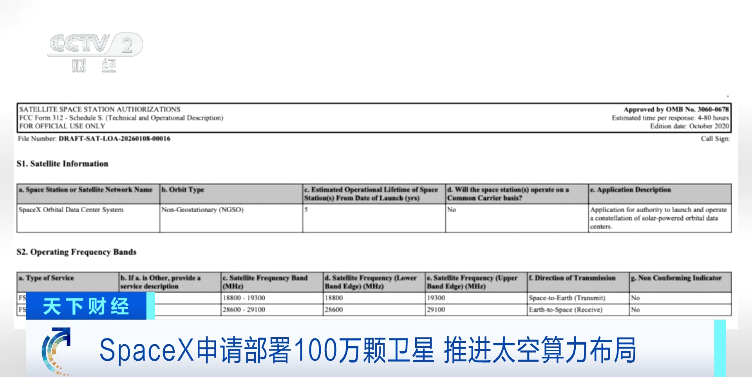
智通财经APP获悉,国泰海通发布研报称,随着SpaceX 推进卫星发射及相关在轨应用布局,轨道AI数 据中心的探索趋势逐步显现。作为太空场景的重要能源供给方式,光伏有望在轨道数据中心建设过程中 获得更多应用机会,相关光伏设备厂商将持续受益。 国泰海通主要观点如下: SpaceX申请部署百万颗卫星,拟建轨道AI数据中心网络。 数据中心光储配套与太空光伏有望成为新一轮设备扩产的重要催化因素。 (1)算力需求提升推动数据中心对稳定、低成本、可复制的光伏+储能方案需求加速增长,地面光伏装机 逻辑从电力驱动逐渐转向算力驱动。(2)低轨卫星与太空算力发展带动太空光伏进入产业化验证阶段, 对高效率、轻薄柔性等提出更高要求,打开高端制造及定制化设备增量空间。 风险提示:商业航天产业发展不及预期、光伏电池新技术发展不及预期等。 1月31日,美国联邦通信委员会(FCC)的一份新文件显示,SpaceX正在申请发射并运营一个由至多100万 颗卫星组成的星座,这些卫星具备前所未有的计算能力(轨道数据中心),以支持先进的人工智能。 SpaceX此举主要为了提供支持全球数十亿用户的大规模AI推理及数据中心应用所需的计算能力,这些 卫星将在 ...

周日市场传来4大消息!
Sou Hu Cai Jing· 2026-02-01 06:36
第一:SpaceX申请部署100万颗卫星 据最新消息,世界首富埃隆·马斯克旗下的商业航天公司SpaceX近日向美监管提交申请,计划发射多达100万颗卫 星以构建"轨道数据中心"。 本来年初就异常火爆的商业航天,看来下周又有一些新鲜血液注入了。 第二:芝加哥商品交易所出手上调保证金 在黄金、白银等贵金属价格遭遇史诗级暴跌后,芝加哥商品交易所集团(CME Group)紧急上调贵金属期货保 证金,黄金保证金率从6%升至8%,白银从11%升至15%,新规下周一收盘后生效。 这意思是说下周的贵金属交易需要的保证金会更多,估计下周开盘市场还是会继续大跌。 第三:31省公布GDP 1月29日,西藏发布,2025年,全区实现生产总值3031.89亿元,按不变价格计算,同比增长7.0%,增速连续四个 季度位居全国前列。 排名前三的依旧是广东14.58万亿,增速3.9%(全国倒数第二);江苏14.24万亿,增速5.3%;山东10.32万亿, 增速5.5%。 广东和江苏总量很近,江苏增速更快,估计很快就能当状元了。 第四:周末愉快 临近年底了,从下周开始,准备好好复盘下过去一年的商业进展,做个复盘总结,为明年怎么干,先打好基 础。 ...

刷屏!SpaceX,突传重磅!
券商中国· 2026-01-31 14:41
Core Viewpoint - The commercial space industry is experiencing significant developments, particularly with SpaceX's ambitious plan to launch up to 1 million satellites to create an "Orbital Data Center" [2][3][4]. Group 1: SpaceX's Satellite Deployment Plan - SpaceX has submitted an application to the FCC to deploy a satellite network consisting of up to 1 million satellites, which will operate at altitudes ranging from 500 km to 2000 km [3][4]. - The proposed "Orbital Data Center system" aims to provide unprecedented computational power to support advanced AI models and applications, addressing the growing demand for AI computing capabilities [4][5]. - The satellites will be arranged in narrow orbital shells with a width of no more than 50 km to minimize interference with other systems [4]. Group 2: Regulatory and Market Implications - The scale of the proposed satellite deployment raises concerns regarding SpaceX's future capital expenditures, execution capabilities, and regulatory challenges, particularly from the FCC [4][7]. - The FCC previously approved SpaceX's application for 7,500 satellites for its second-generation Starlink network but did not approve the full request for 22,488 satellites, indicating potential scrutiny for the new application [7]. - Analysts predict that the environmental impact and orbital congestion risks associated with deploying 1 million satellites will face rigorous examination, possibly leading to objections from other space-faring nations [7]. Group 3: Advancements in AI and Space Exploration - NASA's Perseverance rover successfully completed its first autonomous driving task on Mars, utilizing AI to plan its route based on terrain analysis, marking a significant advancement in space exploration technology [8][9]. - The rover has traveled over 42.2 kilometers on Mars, with more than 90% of its distance covered through autonomous driving, showcasing the importance of remote autonomous technology for future missions [9].

马斯克曝出新料:我希望SpaceX在7月前上市
Sou Hu Cai Jing· 2026-01-22 08:52
Core Viewpoint - Elon Musk has indicated that SpaceX aims to complete its IPO by July, which has garnered significant global attention and led to a surge in the commercial aerospace sector in the A-share market [2][4]. Group 1: IPO Timeline and Market Reaction - SpaceX's IPO was previously rumored to be set for 2026, but Musk has now confirmed a more immediate timeline, suggesting that the company will soon select underwriters for the stock issuance [4]. - Following the announcement, the commercial aerospace sector saw a notable increase, with multiple stocks, including JunDa Co., reaching their daily limit up [2][3]. Group 2: Strategic Reasons for IPO - Musk's decision to pursue an IPO this year is driven by two main factors: the ambition to be the first company to deploy data centers in space and the need to secure funding for large-scale satellite launches [5][6]. - The deployment of solar-powered AI satellites is a key goal, with plans to launch 8,000 times a year and establish a satellite factory on the Moon, aiming to generate 100 GW of solar energy annually [5]. Group 3: Financial Implications and Investor Sentiment - The IPO is seen as a crucial move to raise hundreds of billions of dollars needed for SpaceX's ambitious projects, especially as the U.S. IPO market shows signs of recovery [8][7]. - Investors view SpaceX's IPO as a potential "cash cow" that could significantly support the growth of xAI, Musk's AI venture, which is currently lagging behind competitors [13][10]. Group 4: Market Predictions and Future Trends - Analysts predict that SpaceX's market capitalization post-IPO could reach $1.5 trillion, potentially sparking a wave of interest in commercial aerospace listings in the Chinese A-share market [16][15]. - Companies in the Chinese market, such as Xinghe Power, are already preparing for IPOs, indicating a growing trend in the commercial aerospace sector [18][17].
消息称马斯克拟加速SpaceX上市进程
Xin Lang Cai Jing· 2026-01-22 06:52
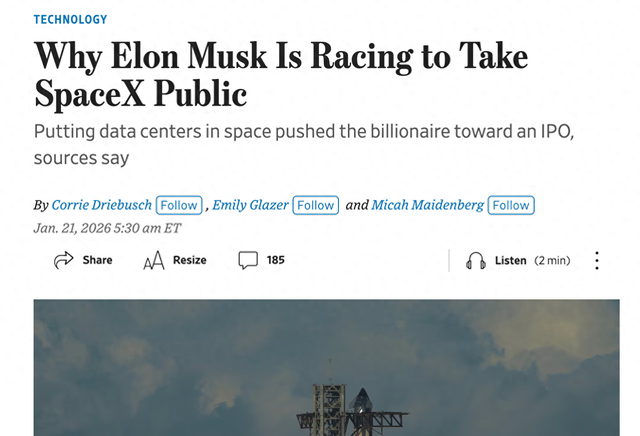
来源:环球网 此前SpaceX一直宣称会保持私有化状态。2018年,该公司总裁格温·肖特韦尔就曾表示,不应等到定期 火星飞行任务建立后再考虑上市。马斯克本人也多次抱怨,成为上市公司会让他在管理特斯拉时面临诸 多掣肘。然而,去年马斯克对SpaceX潜在首次公开募股(IPO)的态度突然转变,令业界许多人感到意 外。 《华尔街日报》分析指出,这一转变源于当下火热的人工智能热潮。各公司纷纷考虑构建一个由太阳能 驱动的轨道数据中心网络,尽管由于技术复杂性,许多工程师对这一想法持怀疑态度,但竞争的态势已 悄然形成。亿万富翁杰夫·贝佐斯旗下SpaceX的竞争对手蓝色起源公司,已经在这一相关技术研发上投 入了一年多时间。而且,与马斯克长期存在竞争关系的OpenAI首席执行官萨姆·奥特曼也曾考虑收购 SpaceX,以实现在太空建造数据中心的计划。 面对激烈的竞争,马斯克决心成为这一领域的先驱。据《华尔街日报》采访对象透露,轨道数据中心的 开发原本只是SpaceX的中长期目标,如今却已成为马斯克的首要任务。消息人士称,到了秋季, SpaceX投入了更多资源来解决技术难题,在研发用于在太空建造和发射数据中心的技术方面取得了显 著进 ...
马斯克2026最新访谈:未来3-7年,一场“超音速海啸”变革将至
Sou Hu Cai Jing· 2026-01-20 15:48
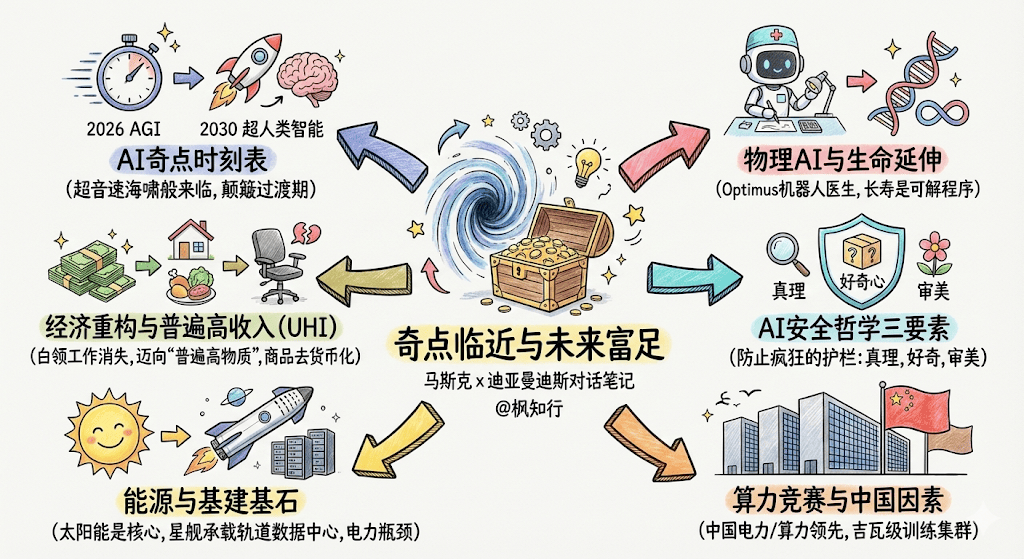
Core Insights - Elon Musk predicts that humanity is currently at a "singularity" moment, transitioning from a scarcity economy to an abundance economy over the next 3-7 years [3][4][16] - Musk emphasizes the importance of AI and robotics as a "supersonic tidal wave" that will drastically change the landscape of work and society [4][9] - The conversation highlights a shift in Musk's perspective on AI safety, advocating for core values of truth, curiosity, and aesthetics to guide AI development [8][93] AI and Robotics - Musk believes that by 2026, general artificial intelligence (AGI) will be achieved, which is a more aggressive timeline than most experts predict [4][6][90] - By 2030, the total intelligence of AI is expected to surpass that of all humanity combined [5][21][92] - The transition period will be turbulent, with many white-collar jobs being replaced by AI, particularly those that do not involve physical tasks [9][10][12] Economic Paradigm Shift - Musk introduces the concept of "Universal High Stuff" as a solution for a future where jobs may disappear, contrasting it with the traditional idea of universal basic income (UBI) [16][87] - As labor and intelligence costs approach zero, the prices of goods will drop significantly, leading to a potential economic transformation [17][18][21] - The future wealth gap may shift from basic survival needs to ownership of scarce resources [21][22] Energy and Infrastructure - Musk identifies electricity supply as the new physical bottleneck for AI development, rather than chip production [22][23][98] - The concept of "orbital data centers" is proposed to leverage solar energy in space, which could provide a sustainable solution for high-energy AI computations [25][26][29][72] - Musk predicts that China will surpass the U.S. in AI capabilities due to its superior energy output and solar infrastructure [30][31][98] Healthcare and Robotics - Musk forecasts that humanoid robots will surpass human surgeons in precision and knowledge within 3-5 years [32][94] - The cost of medical services is expected to decrease significantly as robotics and AI take over surgical tasks, making high-quality healthcare accessible to all [33][35][94] Future Timeline - A timeline of key predictions includes: - 2025: Launch of Starship V3 and Colossus 2 supercomputing cluster [37] - 2026: Birth of AGI [90] - 2030: AI intelligence surpasses that of humanity [5][21] - 2030s: Deployment of orbital data centers and emergence of a society characterized by abundance [37]
太空光伏与"轨道数据中心": 为什么下一代能源与算力的战场,会在800km的高空?
Hua Er Jie Jian Wen· 2026-01-12 04:12
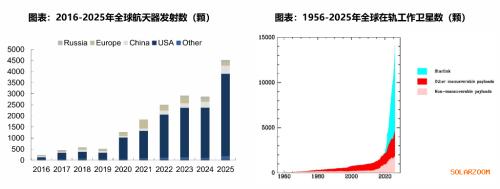
Core Viewpoint - Space photovoltaic technology is evolving from being merely "solar panels on satellites" to becoming a crucial component for the next generation of computing power (space computing/orbital data centers) [1][2] Group 1: Industry Trends - The application for orbital resources and satellite deployment plans is reshaping the supply-demand dynamics of the space industry, with a significant increase in satellite launches expected [2][3] - The number of global spacecraft launches has surged from 237 in 2016 to over 4,300 expected by 2025, reflecting a compound annual growth rate of approximately 34% [3] - The market for solar wings is transitioning from a niche to a mass production model due to the increasing number of satellites [5][6] Group 2: Cost Comparisons - A comparison of costs shows that deploying a data center in space can be significantly cheaper than on the ground, with a projected total cost of approximately $8.2 million in space versus $167 million on the ground over ten years [16] - The primary cost difference arises from energy expenses, where ground energy costs are estimated at $140 million over ten years, while space energy costs are nearly zero after initial deployment [16] Group 3: Technological Developments - The demand for solar wings is driven by the increasing power requirements of satellites, with examples showing significant growth in solar wing area from 22.68 m² to 256.94 m² for different satellite versions [9][12] - The report indicates a shift in technology from gallium arsenide (GaAs) to silicon-based technologies, particularly HJT (Heterojunction Technology), which offers advantages in weight, cost, and flexibility [25][27] Group 4: Market Potential - The solar wing market could reach approximately 200 billion yuan if annual satellite launches reach 10,000, with prices expected to decrease from 1,200 yuan/W to 622 yuan/W [10][11] - The space computing market is defined as deploying modular server nodes on low/mid-orbit satellites, transforming them into orbital data centers with significant computational capabilities [12][14] Group 5: Competitive Landscape - The competition for orbital resources is intensifying, with a total of over 100,000 low-orbit satellites planned globally, including approximately 45,000 from the U.S. and 53,000 from China [6][18] - The choice of technology and materials for solar wings will be influenced by launch costs, with SpaceX's lower costs allowing for different material choices compared to higher-cost Chinese rockets [22][23]
华尔街见闻早餐FM-Radio|2026年1月12日
Sou Hu Cai Jing· 2026-01-11 23:28
Market Overview - The U.S. Supreme Court has not yet announced its ruling on Trump's tariffs, while mixed non-farm employment data led to a 0.6% increase in the S&P 500, reaching a new high, and a 1% rise in the Nasdaq 100 [1] - Stocks closely related to tariffs experienced declines during the day, with Intel surging over 10% after its CEO met with Trump, and Oracle rising nearly 5% [1] - The non-farm report reinforced market expectations for the Federal Reserve to maintain interest rates unchanged in January, with the 2-year U.S. Treasury yield rising by 4.39 basis points [2] Currency and Commodities - The U.S. dollar has risen for four consecutive days, reaching a one-month high, with the dollar against the yen briefly surpassing 158 amid reports of Japan's Prime Minister planning to dissolve the parliament for early elections [3] - Cryptocurrencies fell on Friday, with Bitcoin dipping below $90,000 after a strong rise earlier in the week, while spot gold prices increased by 0.7%, surpassing $4,500, and silver rose by 3.8% for the week [4] - WTI crude oil saw a brief increase of 2.3% before narrowing to a 0.6% gain due to heightened tensions in Iran and Trump's threats against protesters [4] Stock Market Performance - The S&P 500 closed up 0.65% at 6966.28 points, with a weekly increase of 1.57%. The Dow Jones rose 0.48% to 49504.07 points, up 2.32% for the week, while the Nasdaq gained 0.82% to 23671.346 points, with a weekly rise of 1.88% [18] - In the A-share market, the Shanghai Composite Index closed at 4120.43 points, up 0.92%, and the Shenzhen Component rose 1.15% to 14120.15 points [19] Industry Developments - China's Ministry of Commerce has tightened controls on dual-use items to counter Japan's militaristic ambitions, emphasizing that these measures do not affect normal civilian trade [23] - The U.S. has withdrawn its plan to restrict imports of Chinese drones, following strong domestic opposition and the recognition of the necessity of Chinese drones in the market [33] - The Chinese Academy of Sciences has achieved a significant breakthrough in lithium extraction technology from salt lakes, which is expected to enhance production efficiency and reduce costs [45] Company News - Walmart is set to be included in the Nasdaq 100 index on January 20, replacing AstraZeneca [38] - SanDisk has proposed a new contract requiring full cash prepayment from customers to secure future supply quotas, reflecting the high demand for storage devices driven by AI infrastructure [43]