轨道数据中心系统

Search documents
卫网君:中国商业航天瓶颈不在复用火箭,而在"兼容性"缺失;马斯克"空天地一体"生态如何重构AI算力版图;太空光伏技术路线全解析
Sou Hu Cai Jing· 2026-02-08 13:31
Core Insights - SpaceX has submitted a groundbreaking application to the FCC to launch an "Orbital Data Center System" consisting of up to 1 million satellites, which would be 100 times the current number of satellites in orbit, marking a significant advancement in space infrastructure [3] - The proposed satellite constellation will operate at altitudes between 500 to 2000 kilometers, utilizing a mixed scheme of 30-degree inclination and sun-synchronous orbits to maximize solar energy efficiency [3] - Unlike Starlink, this system is not intended for direct ground communication but is speculated to serve as an AI computing infrastructure, leveraging inter-satellite laser links to create a space-based network powered by solar energy [3] - SpaceX aims to address concerns about space debris by implementing a "design for demise" standard, ensuring that satellites burn up upon failure, with ground casualty risks below 0.01% [3] - If approved, this initiative could usher in a new era of "space as computing power," providing energy and computational support for large-scale AI models and Tesla's Optimus robot network [3] Industry Overview - The space computing industry is transitioning from concept to engineering practice, with SpaceX leveraging its Starlink communication network and Starship launch capabilities to create an integrated "space-earth intelligent internet" [17] - The industry ecosystem includes satellite manufacturing, laser communication, on-orbit computing, and ground gateways, with key players such as SpaceX, Amazon Kuiper, and Telesat [17] - The supply chain involves critical technologies such as spacecraft platforms, efficient energy systems, inter-satellite links, and thermal management in space [17] Technological Developments - SpaceX's plan highlights the potential of space photovoltaics as a solution to energy supply challenges, with advancements in solar technology expected to evolve from gallium arsenide to HJT and ultimately to perovskite tandem cells [20] - Current space power systems primarily use three-junction gallium arsenide, which has high efficiency but is costly; HJT cells are anticipated to dominate low Earth orbit satellites and space data centers from 2026 to 2030 due to their lower cost and strong radiation resistance [20] - The cost of space photovoltaic power supply could be reduced by 22 times compared to ground data centers, making it a promising area for SpaceX's supply chain [20] Competitive Landscape - The competitive landscape includes various players with distinct technological focuses, such as SpaceX's Starlink V3, Google's radiation-resistant TPU chips, and Blue Origin's TeraWave multi-track network [12] - Amazon's Kuiper project faces significant challenges, including a lack of autonomous launch capacity, leading to a reliance on SpaceX for satellite deployment [30] - Blue Origin has shifted its focus from suborbital tourism to lunar exploration, indicating a strategic pivot in response to competitive pressures from SpaceX [33]

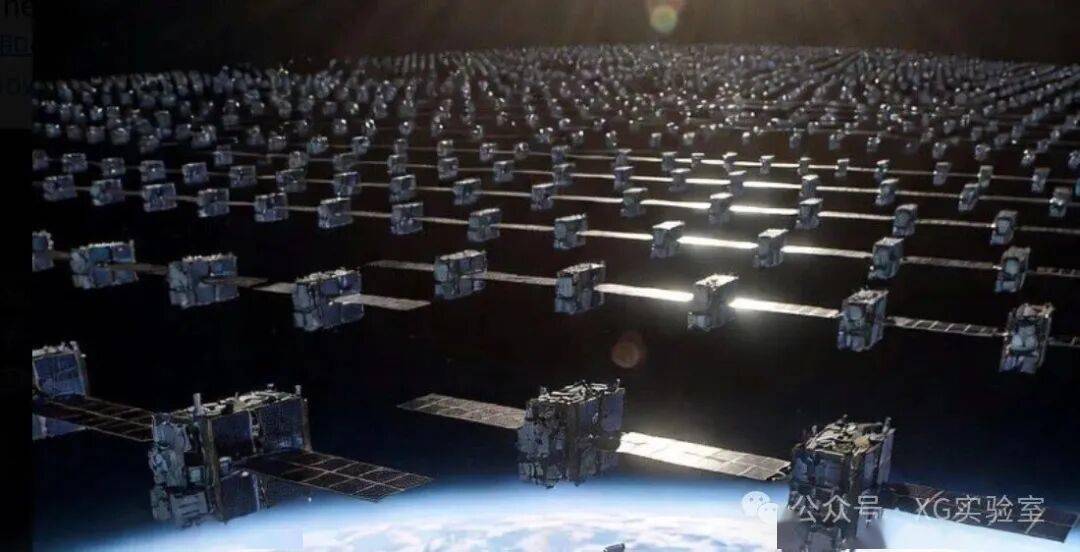
太空数据中心,如何散热?
3 6 Ke· 2026-02-05 04:47
Core Viewpoint - Elon Musk's plan to integrate SpaceX, Tesla, and xAI to deploy one million satellites for a "orbital data center system" aims to provide computational power for future artificial intelligence [1][3]. Group 1: Feasibility and Challenges - The concept of space computing is not new, with similar projects proposed in the US, Europe, and China, but Musk's plan is significantly larger in scale [3]. - Space data centers can utilize solar energy, greatly reducing energy costs, but face numerous engineering and commercialization challenges, including rocket launch capabilities, satellite lifespan (approximately 5 years), radiation issues, on-orbit maintenance, communication bandwidth, and business model concerns [3][19]. - A critical challenge is heat dissipation, as a large-scale data center will generate substantial heat, requiring advanced thermal management solutions [3][5]. Group 2: Thermal Management Techniques - Heat collection at the chip level involves using high-performance thermal interface materials and microchannel liquid cooling to efficiently transfer heat away from chips [6][10]. - Internal heat transfer can utilize heat pipes for passive heat transfer, while active thermal control systems like mechanical pump fluid loops (MPFL) are necessary for managing large thermal loads [11][13]. - Heat radiation is the final method for heat dissipation, relying on radiators that emit heat as infrared electromagnetic waves, with efficiency dependent on the radiator's area and surface properties [14][16]. Group 3: Innovative Cooling Solutions - New thermal management technologies proposed for space data centers include phase change materials for thermal buffering, spectrally selective radiators to enhance radiation efficiency, and evaporative cooling methods for extreme conditions [20][21][22]. - AI-driven systems can optimize thermal management by predicting heat loads and dynamically adjusting cooling mechanisms [23]. - The potential scale of Musk's space data center could provide 100 gigawatts (GW) of AI computing power, equivalent to the capacity of approximately 4.5 Three Gorges Dam power stations, presenting significant engineering challenges for heat dissipation [19]. Group 4: Industry Implications - As space computing becomes a trending topic, thermal control technologies for space data centers are expected to gain more attention, leading to accelerated innovation and development in this field [30].

SpaceX计划部署由100万颗卫星组成的「轨道数据中心系统」
Xin Lang Cai Jing· 2026-02-03 12:24
Group 1 - SpaceX has submitted its initial public offering (IPO) application, aiming to enhance its competitive position in the AI sector through a potential merger with xAI [1] - The company plans to deploy a satellite network consisting of up to 1 million satellites to provide solar-powered data centers, addressing the growing demand for AI computing capabilities [2][3] - Currently, there are approximately 15,000 satellites in orbit globally, making the feasibility of launching 1 million satellites relatively low, as previous applications for satellite launches have exceeded actual deployment [5] Group 2 - The proposed orbital data center system aims to significantly reduce operational and maintenance costs by utilizing near-continuous solar energy, thus improving cost and energy efficiency while minimizing environmental impact [5] - SpaceX emphasizes that the orbital data center will be the most effective way to meet the increasing demand for AI computing power, especially as energy costs for terrestrial data centers continue to rise [5][6] - The Starship rocket program, which has completed 11 test flights since 2023, is crucial for launching advanced satellites and expanding the Starlink network, potentially alleviating ground power shortages and reducing carbon footprints [6]

SpaceX申请发射百万AI算力卫星 太空掀起数据中心建设潮
2 1 Shi Ji Jing Ji Bao Dao· 2026-02-02 12:07
Core Viewpoint - SpaceX proposes the "Orbital Data Center System" to deploy up to 1 million satellites in low Earth orbit, aiming to provide computational power for AI models using solar energy, which is seen as a more economical and energy-efficient solution compared to traditional ground-based data centers [1][3][4]. Group 1: SpaceX's Proposal - SpaceX's application to the FCC highlights the rapid growth in demand for AI, machine learning, and edge computing, which exceeds the processing capabilities of ground infrastructure [3][4]. - The projected global data center electricity demand is expected to more than double by 2035, reaching approximately 1200-1700 terawatt-hours (TWh), potentially accounting for up to 4% of total global electricity consumption [3][4]. - The orbital data centers will operate at altitudes between 500 to 2000 kilometers, utilizing solar energy to minimize operational costs and environmental impact compared to terrestrial data centers [3][4]. Group 2: Technical Aspects - SpaceX plans to design various satellite hardware versions to optimize operational efficiency, with each satellite equipped with heat dissipation panels and a lifespan of five years [4]. - The new satellite constellation will feature high-speed laser links for data transmission, connecting to both the proposed system and existing Starlink satellites [4]. - SpaceX's reusable rocket technology, particularly the Starship, is expected to significantly reduce launch costs, enabling the deployment of substantial amounts of computational power in space [4][6]. Group 3: Competitive Landscape - Other companies, such as Google and Nvidia-supported Starcloud, are also exploring space-based computing solutions, with Google planning to launch its TPU satellites by 2027 and Starcloud having already sent satellites equipped with H100 chips into orbit [7][8]. - China's initiatives include the launch of 12 computing satellites by Zhijiang Laboratory, which will form a network capable of 1000 Peta Operations Per Second (POPS) [10]. - Beijing's plan for a space data center aims to establish a large-scale system with over 1 gigawatt (GW) of power, designed to host a million servers and provide AI computing capabilities in space [11].
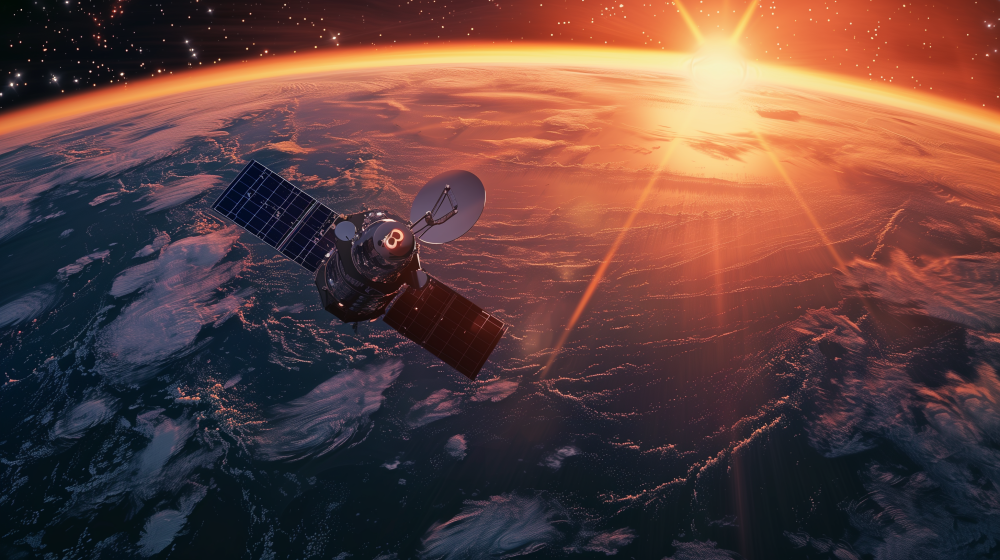
商业航天行业点评:SpaceX百万颗算力卫星申请,太空光伏、激光通信产业迎来新机遇
Guoxin Securities· 2026-02-02 05:09
Investment Rating - The investment rating for the defense and military industry is "Outperform the Market" [2][6]. Core Insights - SpaceX's application to launch over 1 million satellites aims to establish the world's first "orbital data center system," targeting global AI computing infrastructure and services for billions of users [3][5]. - The focus of commercial aerospace is shifting from satellite internet to space computing, with significant growth expected in space photovoltaic and laser communication sectors due to the high energy demands of space computing [3][8]. - The development of space computing is anticipated to ignite a new wave of rocket launches, leading to substantial growth in the entire rocket manufacturing and launching industry [9]. Summary by Sections SpaceX's Satellite Launch Application - SpaceX plans to deploy over 1 million satellites to create an orbital data center, providing AI computing capabilities and utilizing solar energy to reduce costs [3][5]. - The satellites will be deployed in layers at altitudes of 500 km, 1000 km, and 2000 km, using laser links for inter-satellite and ground communication [3]. Market Opportunities - The space photovoltaic market is expected to expand significantly, with gallium arsenide batteries being the mainstream technology, while silicon and perovskite batteries may also play crucial roles [7]. - Laser communication is essential for large-scale satellite constellations, with recent advancements in China indicating a shift from technology validation to practical applications [7]. Rocket Launch Demand - To support the deployment of space computing, the demand for rocket launches is projected to grow explosively, with estimates suggesting thousands of new rockets will be needed [9].
商业航天行业点评报告:SpaceX申请部署百万颗卫星,商业航天受益全球太空资源竞速
ZHESHANG SECURITIES· 2026-02-01 06:24
Investment Rating - The industry investment rating is "Positive" (maintained) [8] Core Insights - SpaceX has applied to deploy up to 1 million satellites to create a large-scale space data center, aiming to provide AI inference, machine learning, and edge computing services to billions of users globally [1] - The space data center will utilize solar power and operate in various orbital shells between 500 km and 2000 km, leveraging the low-temperature environment of space for natural cooling, which will significantly reduce energy and infrastructure costs [2] - Compared to ground data centers, space-based data centers can achieve a 95% reduction in operational costs, with a projected total cost of approximately $8.2 million for a 40MW center in space over ten years, versus $167 million for a ground facility [3] - The scalability of space data centers is virtually unlimited, allowing for rapid deployment without the physical or regulatory constraints faced on Earth [3] Summary by Sections Rocket Sector - In the next five years, approximately 13,000 satellites are expected to be launched, with the number of launches increasing from 54 in 2025 to 860 in 2030, representing a CAGR of about 74% [4] - By 2029, China's computing power is projected to reach 5457 EFLOPS, with 2% potentially moving to space, necessitating around 6,800 rocket launches [4] Satellite Sector - The competition for global space orbits and frequency resources is intensifying, with countries racing to launch satellites [5] - China has submitted over 200,000 new satellite applications, aiming to secure frequency and orbital resources, thereby strengthening the domestic commercial space industry [5] - The growth of satellite internet and computing satellites is expected to drive rapid increases in satellite launches [5] Investment Recommendations - Focus on leading companies in the rocket sector such as Hangyang Co., Srey New Materials, Aerospace Power, and others [6] - In the satellite sector, attention should be given to companies like China Satellite, Maiwei Co., Zhenyou Technology, and others [6]
商业航天系列报告(二):SpaceX申请轨道数据中心,加速布局低轨道星座
Western Securities· 2026-02-01 03:42
Investment Rating - The industry investment rating is "Overweight" [4] Core Insights - SpaceX has applied to the FCC for the "Orbital Data Center system," which will consist of up to 1 million satellites operating at altitudes between 500 km and 2000 km to meet the growing demand for AI computing power and energy consumption [1] - The construction of low Earth orbit satellite constellations is expected to drive significant business demand for reusable rocket launch service providers, with companies that achieve technological breakthroughs gaining a competitive advantage [2] - The acceleration of low Earth orbit satellite constellation construction is anticipated to create new revenue opportunities for domestic leading rocket launch service providers, particularly in upstream supply chain segments such as manufacturing equipment and satellite payloads [3] Summary by Sections Industry Overview - The report highlights the importance of reusable rocket manufacturing and launch capabilities as a foundation for large-scale low Earth orbit satellite constellation construction [2] - The cost reduction potential of reusable rockets could decrease total launch costs by 40%-60%, significantly impacting the economics of satellite constellation deployment [2] Market Performance - As of December 2025, SpaceX's Starlink is projected to have approximately 9,300 satellites in orbit, making it the largest near-Earth satellite network in history [3] - SpaceX's total revenue for 2025 is estimated to be around $18.2 billion, with Starlink contributing approximately $12.8 billion, accounting for 70.3% of total revenue [3] Investment Opportunities - The report suggests focusing on 3D printing equipment companies such as Huashu High-Tech and Plater, which may benefit from the developments in the satellite constellation and rocket launch service sectors [3]
SpaceX大动作!申请部署100万颗卫星
2 1 Shi Ji Jing Ji Bao Dao· 2026-02-01 02:27
Core Viewpoint - SpaceX has applied to launch up to 1 million satellites to create an orbital data center network around Earth, aimed at supporting advanced AI models and applications [1][10]. Group 1: Project Overview - SpaceX submitted an application to the FCC on January 30, describing the project as a satellite constellation with unprecedented computing power [1]. - The proposed "orbital data center system" is designed to handle explosive data growth from AI, machine learning, and edge computing, providing necessary computing capabilities for billions of users globally [1]. - The satellites will operate in a narrow orbital shell with a width of no more than 50 kilometers to avoid conflicts with other systems [1]. Group 2: Technical Specifications - The satellites will operate in a sun-synchronous orbit at altitudes between 500 kilometers and 2000 kilometers, utilizing nearly constant solar energy, which will significantly reduce operational and maintenance costs [2]. - The system will rely on high-bandwidth optical communication links and will connect with the existing Starlink constellation for data transmission to ground stations [3]. Group 3: Strategic Developments - Elon Musk is considering integrating SpaceX with his AI company xAI or Tesla to enhance space computing capabilities [7][10]. - The potential merger could create a "super ecosystem" combining rocket launches, satellite networks, electric vehicles, social media, and generative AI technologies [10]. - SpaceX is planning an IPO in June, aiming to raise up to $50 billion, with an estimated valuation of around $1.5 trillion, potentially making it the largest IPO in history [10].
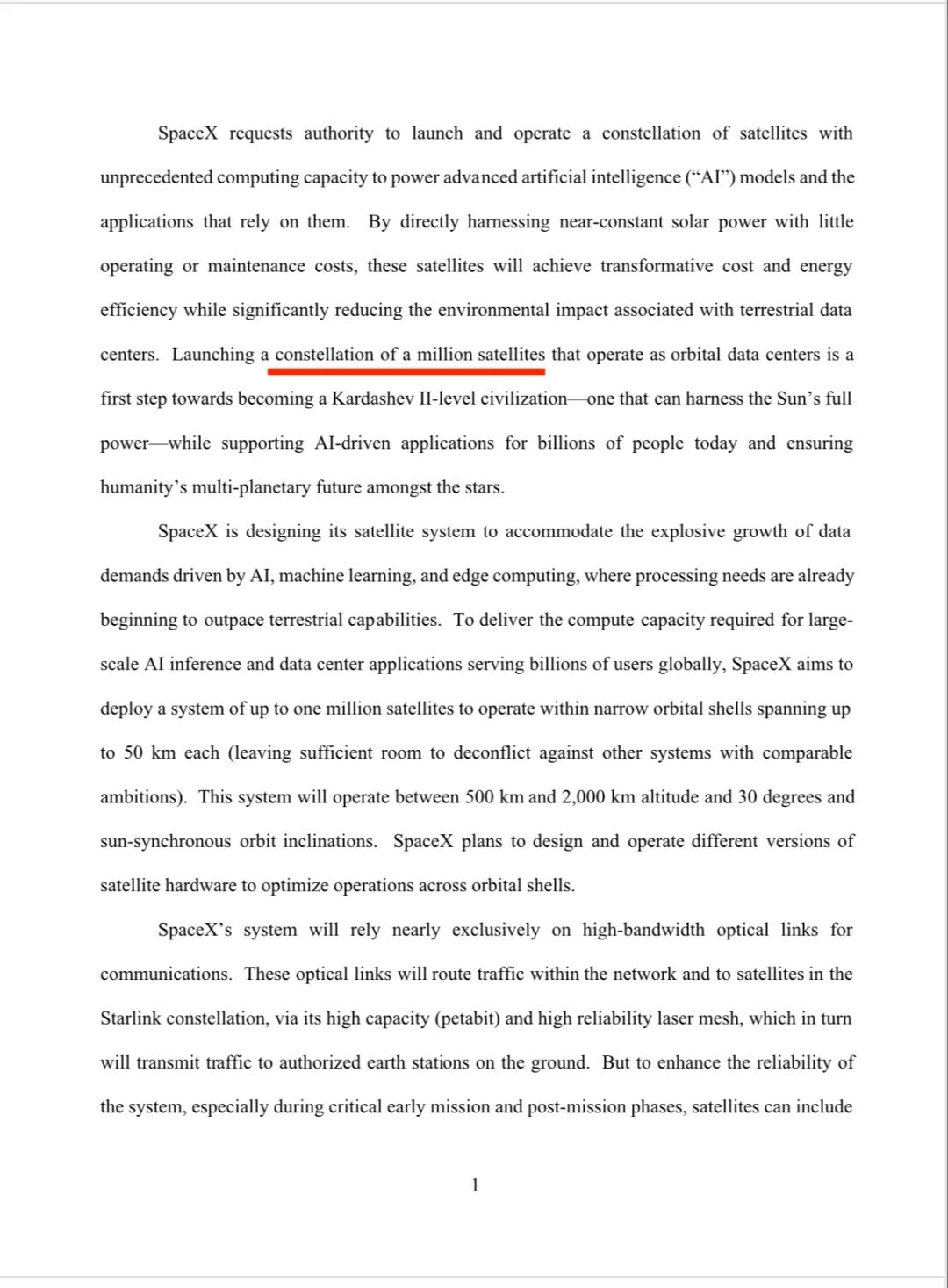
SpaceX申请部署100万颗卫星,打造太空数据中心
美股IPO· 2026-01-31 16:03
Core Viewpoint - SpaceX has submitted an application to the FCC to launch up to 1 million satellites to create an "Orbital Data Center," marking a historic first in space exploration [1][3][4]. Group 1: Project Overview - The proposed satellite network, named the "Orbital Data Center system," aims to operate a constellation of up to 1 million satellites at altitudes ranging from 500 km to 2000 km [3]. - This system is designed to provide unprecedented computational power to support advanced AI models and applications, addressing the growing demand for AI computing capabilities globally [5]. - The satellites will operate in narrow orbital shells not exceeding 50 km in width, ensuring sufficient space to avoid conflicts with other systems [5]. Group 2: Strategic Support - The feasibility of this ambitious plan is closely tied to SpaceX's core capabilities, particularly the Starship system, which enables high-frequency and large-scale satellite launches at low costs [7]. Group 3: Capital Market Implications - SpaceX is reportedly preparing for an initial public offering (IPO), with one of the primary objectives being to raise funds for the costly "Orbital Data Center" project [8]. Group 4: Regulatory Challenges - The recent approval of 15,000 second-generation Starlink satellites by the FCC highlights the regulatory hurdles SpaceX faces, as the new application for 1 million satellites represents a significant increase in scale [9][10]. - The FCC has previously expressed concerns regarding orbital debris and space safety, indicating that the approval process for the proposed 1 million satellites will be subject to rigorous scrutiny [10].
刷屏!SpaceX,突传重磅!
券商中国· 2026-01-31 14:41
Core Viewpoint - The commercial space industry is experiencing significant developments, particularly with SpaceX's ambitious plan to launch up to 1 million satellites to create an "Orbital Data Center" [2][3][4]. Group 1: SpaceX's Satellite Deployment Plan - SpaceX has submitted an application to the FCC to deploy a satellite network consisting of up to 1 million satellites, which will operate at altitudes ranging from 500 km to 2000 km [3][4]. - The proposed "Orbital Data Center system" aims to provide unprecedented computational power to support advanced AI models and applications, addressing the growing demand for AI computing capabilities [4][5]. - The satellites will be arranged in narrow orbital shells with a width of no more than 50 km to minimize interference with other systems [4]. Group 2: Regulatory and Market Implications - The scale of the proposed satellite deployment raises concerns regarding SpaceX's future capital expenditures, execution capabilities, and regulatory challenges, particularly from the FCC [4][7]. - The FCC previously approved SpaceX's application for 7,500 satellites for its second-generation Starlink network but did not approve the full request for 22,488 satellites, indicating potential scrutiny for the new application [7]. - Analysts predict that the environmental impact and orbital congestion risks associated with deploying 1 million satellites will face rigorous examination, possibly leading to objections from other space-faring nations [7]. Group 3: Advancements in AI and Space Exploration - NASA's Perseverance rover successfully completed its first autonomous driving task on Mars, utilizing AI to plan its route based on terrain analysis, marking a significant advancement in space exploration technology [8][9]. - The rover has traveled over 42.2 kilometers on Mars, with more than 90% of its distance covered through autonomous driving, showcasing the importance of remote autonomous technology for future missions [9].