
AI智能化

Search documents
奇瑞尹同跃:对标特斯拉FSD,更要实现“算力自由”;全球最大汽车供应商预警利润跌破2%丨汽车交通日报
创业邦· 2026-01-18 10:23
Group 1 - Chery is benchmarking against Tesla's FSD and aims to achieve "computing power freedom" by rapidly closing the gap in autonomous driving technology [2] - Chery's AI strategy has entered the 2.0 (AI+) era, showcasing core AI achievements such as the super AI assistant "Xiao Qi," Falcon Intelligent Driving, Lingxi Smart Cabin, and Mocha Robot [2] - The Falcon Intelligent Driving series is set to evolve and plans to be equipped in over 35 models by 2026, accelerating the adoption of advanced intelligent driving [2] Group 2 - Bosch, the world's largest automotive parts supplier, has warned of a profit margin dropping below 2% in 2025, significantly below expectations [2] - Bosch's operating profit margin is projected to decline from 4.8% in 2023 to 3.5% in 2024, primarily due to restructuring costs of €3.1 billion, which accounts for approximately 3.5% of sales [2] - Bosch's revenue for 2025 is estimated at €91 billion, slightly above €90 billion in 2024, with growth largely attributed to the acquisition of Johnson Controls-Hitachi, contributing around €4 billion [2] Group 3 - Li Auto released its 2025 travel report, indicating a user activity rate of 99.5% and a total driving distance exceeding 6 billion kilometers [2] - The report highlights that Li Auto's assisted driving system has accumulated 1.505 million users and recorded 3.07 billion kilometers driven in the past year [2] - Notable metrics include 36,643 instances of daily assisted driving exceeding 1,000 kilometers and a maximum individual user driving distance of 119,000 kilometers [2]


豆包手机引发热议 AI端侧迎来“首个吃螃蟹者”
Shang Hai Zheng Quan Bao· 2026-01-07 17:52
Core Insights - The launch of the AI assistant phone by Doubao and ZTE Nubia is seen as a significant shift in the AI industry, marking the beginning of a new era in smart devices [1][2] - Experts believe that this innovation could lead to a rapid growth in related sectors such as chip manufacturing and cloud computing, driven by the need for enhanced computing power [2][4] Industry Trends - The introduction of the AI assistant phone signifies a competitive race for transformation within the industry, prompting all players to engage in this emerging market [4] - The product is expected to redefine the business model for smartphone manufacturers, shifting from a one-time hardware sale to ongoing service revenue opportunities [5] Consumer Impact - The success of AI assistant devices will ultimately depend on consumer acceptance, similar to past technological shifts where user preference dictated market leaders [3][4] - The integration of AI into mobile systems is anticipated to enhance user experience and operational efficiency, making it a compelling offering for consumers [2][3]

2026,四大消费赛道丨尼尔森IQ年度报告同步首发
吴晓波频道· 2026-01-06 00:29
Core Insights - The article discusses the evolving consumer landscape in China, particularly focusing on the dual strategy of "first-time purchases + upgrade activation" in the context of county-level economies and the growing significance of lower-tier markets [3][14][16]. Group 1: Consumer Trends - During the New Year holiday, domestic tourism revenue reached 847.89 billion yuan, recovering to 112.3% of 2019 levels, with 1.35 billion domestic tourists, reflecting a strong rebound in consumer activity [3]. - In Hainan, post-"closure," tourism revenue surged to 32.8 billion yuan, a 28.9% year-on-year increase, with duty-free shopping reaching 7.12 billion yuan, up 128.9% [4]. - The consumer base is increasingly divided into "carefree" and "cautious spending" types, with 24% and 39% of the population respectively identified in 2024, and the "carefree" segment expected to grow to 31% by 2025 [7][9]. Group 2: Market Dynamics - The lower-tier cities are experiencing significant growth in tourism, with cities like Jingzhou and Huaihua seeing over 30% year-on-year increases in visitor numbers, outpacing first-tier cities [5]. - The report highlights that 68% of companies in lower-tier markets have seen stagnant or negative growth in market share over the past two years, indicating challenges in maintaining momentum [16]. - The demand for durable goods in lower-tier markets is growing, with a 12% year-on-year increase in sales, and the importance of these markets is rising by 38% [16]. Group 3: Product and Brand Strategies - The report emphasizes the importance of "first-time purchases" and "upgrade activation," suggesting that brands should focus on attracting consumers making their first significant purchases, such as smart appliances and electric vehicles [17]. - 57% of consumers in lower-tier markets have not upgraded their appliances in over three years, indicating a need for strategies to stimulate replacement purchases through trade-in programs and experiential upgrades [17]. - Key consumer preferences include price sensitivity, product performance, and the desire for smart technology, with a notable increase in sales of energy-efficient appliances by 38% on platforms like JD.com [4][21]. Group 4: Sales Channels - Emerging sales channels are gaining traction, with content e-commerce and membership warehouse stores showing significant growth, while traditional channels like hypermarkets are declining [24][25]. - The top five sales channels with year-on-year growth include content e-commerce (27%), membership warehouse stores (25%), and snack stores (20%) [24]. - The shift in consumer behavior is towards valuing unique products and experiences, with 69% of consumers believing private label brands offer better value [27]. Group 5: Future Outlook - The article suggests that the next growth wave in consumer goods will be driven by AI and smart technology, with a focus on health and convenience [43][44]. - The new round of national subsidies will target high-efficiency products, particularly in the tech and appliance sectors, which are expected to stimulate further growth [34]. - The report concludes that brands that can adapt to consumer preferences and provide meaningful experiences will define the future of the market [56].

北汽蓝谷子公司2025年销售汽车20.96万辆,同比大增84.06%
Ju Chao Zi Xun· 2026-01-04 09:33
Group 1 - The core viewpoint of the article highlights the significant growth in production and sales of Beijing Electric Vehicle Co., Ltd. in December 2025, with production reaching 35,581 units, a year-on-year increase of 208.84%, and sales of 35,205 units, up 114.56% compared to the same month last year [2][3] - For the entire year of 2025, the cumulative production of the company reached 206,284 units, representing a 127.17% increase from the previous year's 90,808 units, while cumulative sales reached 209,576 units, an 84.06% increase from 113,860 units in the previous year [2][3] Group 2 - On November 24, 2025, the company received approval from the China Securities Regulatory Commission for a stock issuance to specific investors, with a total fundraising amount not exceeding 6 billion yuan, aimed at developing new energy vehicle projects and AI intelligent platform and smart driving systems [2][3]

浩瀚深度:公司经营一切正常
Zheng Quan Ri Bao Wang· 2025-12-30 13:14
Core Viewpoint - The decline in the company's convertible bond price is attributed to a combination of market conditions, fluctuations in the company's underlying stock price, and the supply-demand dynamics of the convertible bonds [1] Group 1: Company Operations - The company's operations are reported to be normal despite the recent decline in bond prices [1] - The actual controller of the company has not engaged in any trading of the bonds recently [1] Group 2: Future Focus and Investments - In 2025, the company plans to focus on areas such as network visualization, large-scale cybersecurity, big data processing, and AI intelligence [1] - The company aims to increase research and development investments in these areas and actively expand its market presence, achieving certain results [1]

长征十二号甲运载火箭首飞!商业航天题材分歧加剧,航天电子领跌!军工ETF华宝(512810)四连阳后首度回调
Xin Lang Cai Jing· 2025-12-23 06:05
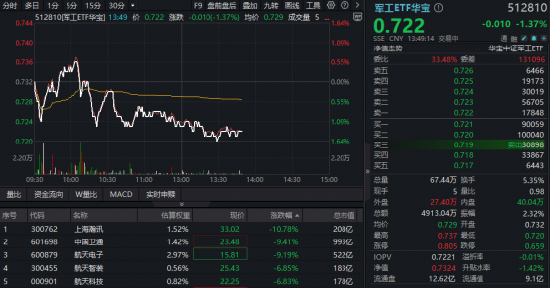
Core Viewpoint - The successful first flight of the Long March 12A rocket has led to mixed reactions in the commercial aerospace sector, with significant declines in related stocks despite achieving its second-stage orbital goal [1][7]. Market Reaction - Following the rocket's launch, stocks in the commercial aerospace sector experienced notable declines, with Shanghai Hanxun dropping over 10%, and China Satellite Communications and Aerospace Electronics falling more than 9% [1][7]. - The Huabao military ETF (512810), which passively tracks the CSI Military Index, saw a decline of 1.64% during the afternoon session, halting a four-day upward trend, with real-time transactions exceeding 49 million yuan [1][7]. Future Outlook - Analysts suggest that the market should be viewed as having a fluctuating structure, with potential opportunities for low-cost acquisitions during the adjustment phase of popular themes [3][9]. - The military industry is expected to benefit from multiple policies and strategic catalysts, including the 14th Five-Year Plan and the centenary goals of the military, leading to synchronized growth in both domestic and foreign demand from 2026 to 2027 [3][9]. - Emerging themes such as commercial aerospace, AI intelligence, nuclear fusion, deep-sea technology, and unmanned systems are anticipated to drive the military industry towards higher-end and intelligent development [3][9]. Investment Tools - The Huabao military ETF (512810), previously known as the National Defense Military ETF, covers various popular themes including commercial aerospace, controllable nuclear fusion, low-altitude economy, large aircraft, deep-sea technology, and military AI, serving as an efficient tool for investing in core military assets [3][9].

高景气高热度板块!军工ETF华宝(512810)放量四连阳,再创阶段新高!商业航天继续点火,融资客连买3周
Xin Lang Cai Jing· 2025-12-22 13:00
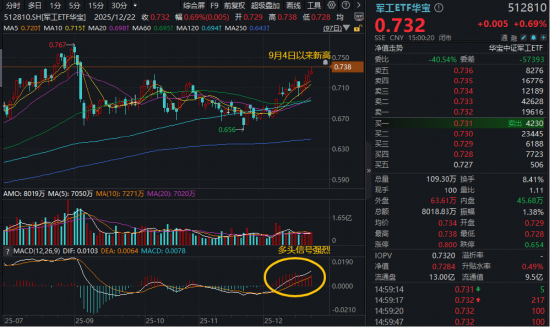
Core Viewpoint - The military industry continues to rise, with the popular military ETF Huabao (512810) reaching a new high since September 4, with a 1.5% increase and a trading volume of 80.19 million yuan [1][9]. Group 1: Market Performance - The military ETF Huabao (512810) has shown a four-day consecutive increase, remaining above all moving averages, indicating strong bullish momentum as reflected by the MACD indicator [3][11]. - Commercial aerospace stocks are the main drivers of the market, with notable gains from companies like Highde Infrared and Beidou Star Communication, while China Satellite reached a 10-year high with an 8% increase [1][9]. Group 2: Funding Trends - There has been a continuous increase in leveraged funds in the military sector, with financing purchases rising for three consecutive weeks, indicating a positive outlook for future financing trends [3][12]. - Huafu Securities anticipates a strong demand recovery in the military industry by 2026, supporting the ongoing increase in financing purchases [3][12]. Group 3: Industry Developments - The commercial aerospace sector is experiencing rapid growth due to policy support, with significant advancements in reusable rocket testing and satellite constellation networking [4][14]. - The Long March 12A reusable launch vehicle is scheduled for its historic first launch in December 2025, marking a significant milestone in China's aerospace capabilities [4][14]. Group 4: Strategic Insights - The military industry is expected to benefit from multiple policies and strategies, including the 14th Five-Year Plan and the centenary goals of the military, leading to synchronized growth in both domestic and international demand [5][14]. - Emerging themes such as commercial aerospace, AI intelligence, nuclear fusion, deep-sea technology, and unmanned systems are driving the military industry towards higher-end and intelligent development [5][14]. - Securities firms like Dongfang Securities and Huatai Securities are optimistic about the military sector, suggesting that investors should focus on this area as the new phase of equipment construction planning approaches [5][14][6].
研判2025!中国网络附加存储(NAS)行业产业链、市场规模及重点企业分析:行业双轨转型提速,消费级市场崛起开启增长新引擎[图]
Chan Ye Xin Xi Wang· 2025-12-18 01:43
Core Insights - The Chinese Network Attached Storage (NAS) industry is transitioning from a single structure focused on the enterprise market to a dual-track structure that includes both enterprise and consumer markets. The market size is projected to reach approximately 28.64 billion yuan in 2024, reflecting a year-on-year growth of 8.28% [1][9]. Industry Overview - Disk storage technology records data using magnetic media, with major types including Direct Attached Storage (DAS), Storage Area Network (SAN), and Network Attached Storage (NAS). NAS provides centralized management, file sharing, data backup, and elastic expansion, making it ideal for unstructured data storage [3][5]. Market Size - The NAS market in China is expected to grow significantly, driven by the digital transformation of enterprises and the increasing demand from individual and family users for data management, entertainment, and privacy security. Emerging consumer brands like Ugreen and Jikong are facilitating the penetration of NAS devices into ordinary households [1][9]. Key Companies - Ugreen Technology and Hikvision are notable players in the NAS market. Ugreen has rapidly expanded its presence with products like the DXP4800 series, while Hikvision leverages its security technology to offer NAS products that combine high security and usability [10][12]. Industry Development Trends 1. **AI and Edge Computing Integration**: The NAS industry is expected to integrate AI and edge computing, transitioning from passive storage to active service. This includes features like intelligent content generation and real-time video monitoring [13]. 2. **Vertical Market Penetration**: NAS applications are moving towards vertical markets, enhancing product customization and specialized solutions for sectors like smart homes and enterprise security [14]. 3. **Ecosystem Competition and Domestic Substitution**: The competition will focus on technology, ecosystem, and service, with international brands dominating the high-end market while local companies like Ugreen and Jikong expand in the mid-to-low end [15][16].


零售板块掀涨停潮!百大集团四连板,永辉超市涨停
2 1 Shi Ji Jing Ji Bao Dao· 2025-12-16 11:46
Core Viewpoint - The A-share market experienced a decline on December 16, with a notable surge in the retail sector driven by new policies aimed at boosting consumption [1] Group 1: Market Performance - The three major A-share indices opened lower and continued to decline throughout the day, with the retail sector witnessing a significant rally [1] - Several retail stocks, including Baida Group, Yonghui Supermarket, Eurasia Group, Central Mall, and Guangbai Co., reached their daily price limits [1] Group 2: Policy Measures - The Ministry of Commerce, the People's Bank of China, and the Financial Regulatory Bureau jointly issued a notification to enhance collaboration between commerce and finance to stimulate consumption [1] - The notification includes 11 policy measures across three main areas: deepening cooperation between commerce and finance, increasing financial support for key consumption sectors, and expanding cooperation among government, financial institutions, and enterprises [1] Group 3: Industry Insights - Open Source Securities noted that offline retail enterprises are shifting their focus from selling products to providing services and experiences, leveraging their offline advantages to attract customers [1] - Online cross-border e-commerce companies are expected to enter a phase of demand improvement due to the easing of interest rates, combined with advantages from AI technology, which may further enhance their market share [1] - The report expresses optimism for offline retail enterprises adapting to trends and for leading cross-border e-commerce companies empowered by AI [1]


年末商业航天产业加速,航空航天ETF(159227)成交额居同类榜首
Mei Ri Jing Ji Xin Wen· 2025-12-12 07:03
Group 1 - The aerospace ETF (159227) has increased by 1.27% with a trading volume of 246 million yuan, leading its category [1] - Several A-share companies have recently been included in the "commercial aerospace" concept pool, indicating the broad reach of the industry [1] - Huafu Securities predicts significant growth in both domestic and foreign demand due to multiple catalysts, including the nearing "14th Five-Year Plan" and the "Centenary of the Army" goals, emphasizing the importance of military industry development [1] Group 2 - The commercial aerospace sector has shown outstanding performance, driven by recent catalysts such as the National Space Administration's action plan for high-quality and safe development of commercial aerospace [1] - The aerospace ETF (159227) tracks the Guozheng Aerospace Index and is deeply invested in the aerospace industry chain, selecting leading companies in the military industry [1] - Investors can access high-threshold industries through this product, benefiting from both policy dividends and technological upgrades [1]