
稀土出口管制

Search documents
填弹巧发:“稀土威慑”策略的现实和未来
Hu Xiu· 2025-10-13 05:46
Core Viewpoint - China's rare earth export controls are seen as a strategic response to U.S. actions, reflecting a shift towards a more institutionalized deterrence approach, which may complicate future negotiations and economic relations between the two countries [1][4][5]. Group 1: China's Export Control Strategy - The export control is based on a licensing system rather than a ban, serving as a deterrent rather than an immediate retaliatory measure, indicating a cautious approach to escalation [5]. - The timing of the announcement is perceived as a response to U.S. provocations, particularly following Trump's threats of 100% tariffs, suggesting a calculated move to leverage negotiation power [1][2]. - The implementation of these controls may create a long-term structural tension in U.S.-China economic relations, complicating potential compromises [4][6]. Group 2: Market Reactions and Implications - Financial markets reacted to the uncertainty surrounding negotiations, indicating a shift from previous assumptions of stability to a need for re-evaluation of trade factors [2][6]. - The potential for a "derisking" strategy by the U.S. and its allies could diminish the value of China's rare earth resources, as alternative supply chains are being developed [7]. - The market's perception of the effectiveness and credibility of China's deterrent measures will be crucial in determining future trade dynamics [6][7]. Group 3: International Audience and Strategic Considerations - The export controls are not solely aimed at the U.S. but also impact global supply chains, particularly in sectors like semiconductors and automotive industries, raising concerns among other nations [9]. - Managing the international audience's perception is critical; if countries view China's actions as reasonable, cooperation may continue, but if seen as aggressive, it could accelerate supply chain decoupling [9][10]. - The effectiveness of China's strategy will depend on its ability to communicate its intentions clearly and maintain a balance between deterrence and cooperation with other nations [10].


稀土永磁板块逆势走强,稀土ETF(159713)早盘涨近5%
Mei Ri Jing Ji Xin Wen· 2025-10-13 04:37
Core Insights - The Ministry of Commerce has tightened rare earth control measures, leading to price increases from two major rare earth companies. This has positively impacted the rare earth permanent magnet sector, with the rare earth ETF (159713) experiencing a significant intraday surge of 4.74%, closing with a gain of 3.90% and a trading volume of 331 million shares and a turnover of 445 million yuan [1] - Since the low point on April 8, the rare earth ETF has accumulated a rise of over 85%. The Ministry of Commerce has issued four documents to strengthen rare earth export controls, adding restrictions on five categories of medium and heavy rare earths, as well as controls on equipment, technology, and raw materials across the entire industry chain. This further solidifies the strategic position of rare earths [2] - In this context, the allocation value of the rare earth ETF (159713) is becoming increasingly prominent [3]
稀土永磁板块大涨 机构这样看后市
Di Yi Cai Jing· 2025-10-13 03:51
Core Viewpoint - The rare earth permanent magnet sector has seen significant gains, with companies like Galaxy Magnetic, Beikong Technology, and Antai Technology reaching their daily limit up due to the tightening of export controls by the Chinese government and escalating trade tensions with the U.S. [1][2] Group 1: Industry Dynamics - The U.S. government is actively working to rebuild its rare earth industry chain, but China continues to dominate global supply due to its comprehensive production capabilities across the entire rare earth industry chain [1] - China's recent announcements regarding stricter export controls on rare earths, including coverage of semiconductors, may impose constraints on overseas chip manufacturing processes [1] - The U.S. has announced a 100% tariff on rare earth exports from China, indicating a potential escalation in trade tensions [1] Group 2: Strategic Value and Market Impact - The recent upgrade in China's rare earth export controls expands the scope from upstream mining and separation to downstream metals, magnetic materials, and recycling, enhancing the strategic value of the sector [2] - This move is seen as a strong response to U.S. semiconductor export controls and may serve as leverage in upcoming APEC negotiations [2] - The tightening of export controls is expected to increase foreign governments' determination to establish rare earth processing lines, potentially raising the baseline prices for rare earths and leading to price increases domestically [2]


陈光炎长文剖析稀土与贸易平衡:美国超过8成精炼稀土来自中国,短期内难以改变
聪明投资者· 2025-10-13 03:33
Core Viewpoint - The article emphasizes China's strategic position in the rare earth elements (REEs) sector and its implications for U.S.-China trade relations, particularly in light of recent export controls and tariffs [8][54][86]. Group 1: China's Export Control Measures - In October 2025, China announced stricter export controls on rare earth elements and processing technologies, particularly for military and semiconductor applications [4][11]. - The export license system implemented by China has a validity period of six months, impacting global supply chains and prompting industries to adapt [8][11]. - China's management of rare earth exports reflects the vulnerabilities in the U.S. industrial and defense supply chains, leading to adjustments in trade negotiations [12][54]. Group 2: U.S. Dependency on Chinese Rare Earths - The U.S. relies on China for over 80% of its refined rare earths, which are critical for defense, electronics, and clean energy sectors [8][53]. - Experts estimate that establishing an independent U.S. supply chain for rare earths could take 5 to 15 years, highlighting the challenges in reducing dependency on China [10][54]. - The U.S. has initiated measures such as the Defense Production Act to boost domestic rare earth production, but these efforts face significant obstacles [55][61]. Group 3: Impact on Trade Relations - The role of rare earths has become a key factor in U.S.-China trade negotiations, with both sides recognizing the importance of these resources [9][12]. - China's export management of rare earths has led to a shift in trade dynamics, with the U.S. showing a willingness to make concessions in negotiations [12][90]. - The recent trade tensions have prompted the U.S. to reconsider its approach to tariffs and trade policies, particularly concerning critical materials [93][95]. Group 4: Strategic Importance of Rare Earths - Rare earth elements are essential for modern military systems, including advanced weaponry and communication technologies [42][45]. - The geopolitical significance of rare earths has increased, with China leveraging its dominance in this sector to influence international trade and security discussions [86][88]. - The ongoing tensions and management of rare earth resources underscore their role as strategic assets in global economic interactions [17][85].
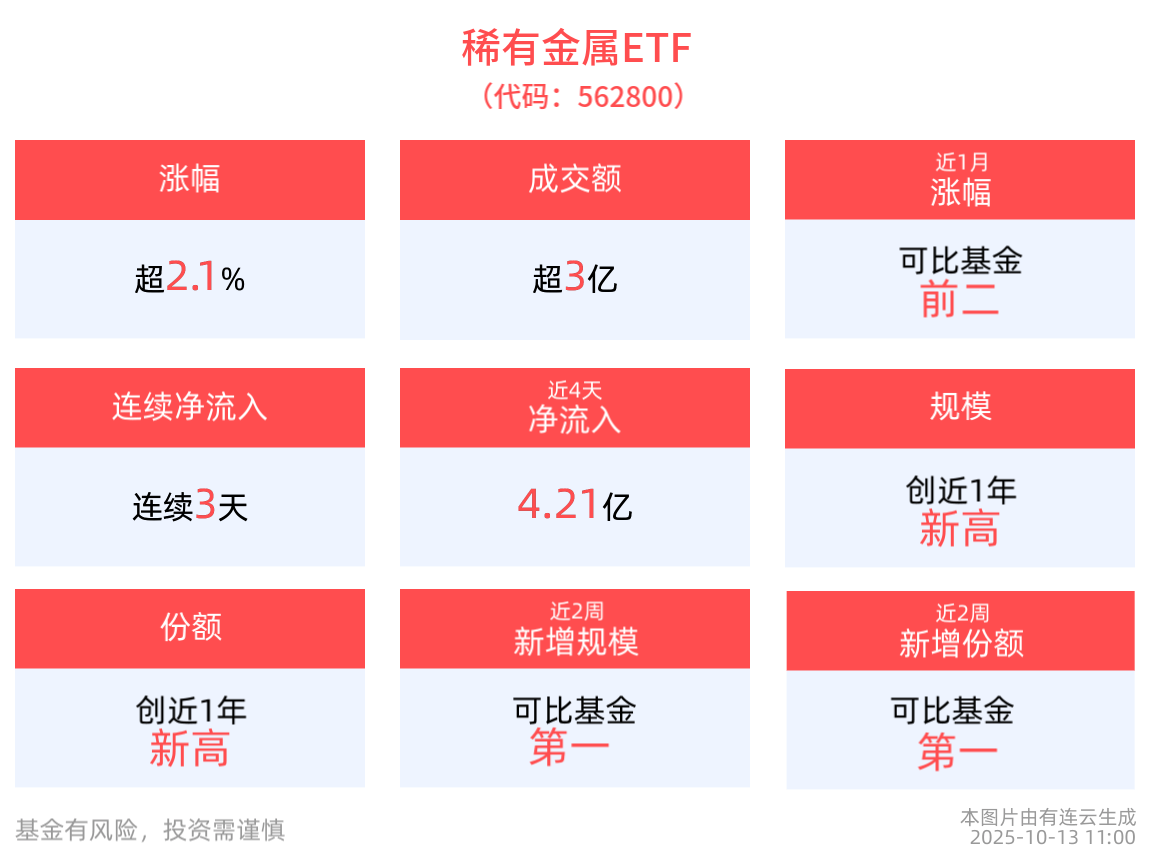
近3天获得连续资金净流入,稀有金属ETF(562800)盘中涨超2%,成分股银河磁体20cm涨停
Sou Hu Cai Jing· 2025-10-13 03:30
Group 1: Rare Metal ETF Performance - The Rare Metal ETF has a turnover rate of 11.57% during trading, with a transaction volume of 359 million yuan, indicating active market trading [3] - The latest scale of the Rare Metal ETF reached 3.08 billion yuan, marking a new high since its inception and ranking first among comparable funds [3] - The ETF's share reached 3.67 billion shares, also a new high since inception, and ranks first among comparable funds [3] - Over the past three days, the Rare Metal ETF has seen continuous net inflows, with a maximum single-day net inflow of 358 million yuan, totaling 551 million yuan [3] - As of October 10, the net value of the Rare Metal ETF has increased by 17.31% over the past three years [3] - The highest monthly return since inception is 24.02%, with the longest consecutive monthly increase being five months and a maximum increase of 66.25%, averaging a monthly return of 8.60% [3] Group 2: Cobalt Export Quotas and Market Dynamics - According to CITIC Construction Investment, cobalt export quotas for Congo (Kinshasa) have been finalized, with Luoyang Molybdenum, Glencore, and Eurasian Resources holding the top three shares at 35.9%, 27.3%, and 21.6% respectively [4] - The total quota for 2026 and 2027 is set at 96,600 tons, which includes a basic quota of 87,000 tons allocated to production enterprises and a strategic quota of 9,600 tons [4] - Under the quota system, only about 44% of production can be exported, resulting in a reduction of over 100,000 tons [4] - Based on estimates for 2024, with a supply of 270,000 tons and demand of 230,000 tons, the market is expected to shift from a surplus of about 70,000 tons to a shortage of about 30,000 tons, potentially driving cobalt prices higher [4] Group 3: Rare Earth Export Controls - The Ministry of Commerce has issued four documents to strengthen rare earth export controls, adding five categories of medium and heavy rare earths to the export control list [4] - The controls also extend to the entire industrial chain, including equipment, technology, and raw materials, with additional regulations on overseas military and high-end semiconductor demands [4] - The strategic position of rare earths has been further reinforced through these measures [4] Group 4: Rare Metal Index and Investment Opportunities - As of September 30, 2025, the top ten weighted stocks in the CSI Rare Metal Theme Index include Northern Rare Earth, Luoyang Molybdenum, Huayou Cobalt, and others, collectively accounting for 59.91% of the index [4] - Investors can also participate in the rare metal sector through the Rare Metal ETF linked fund (014111) [4]



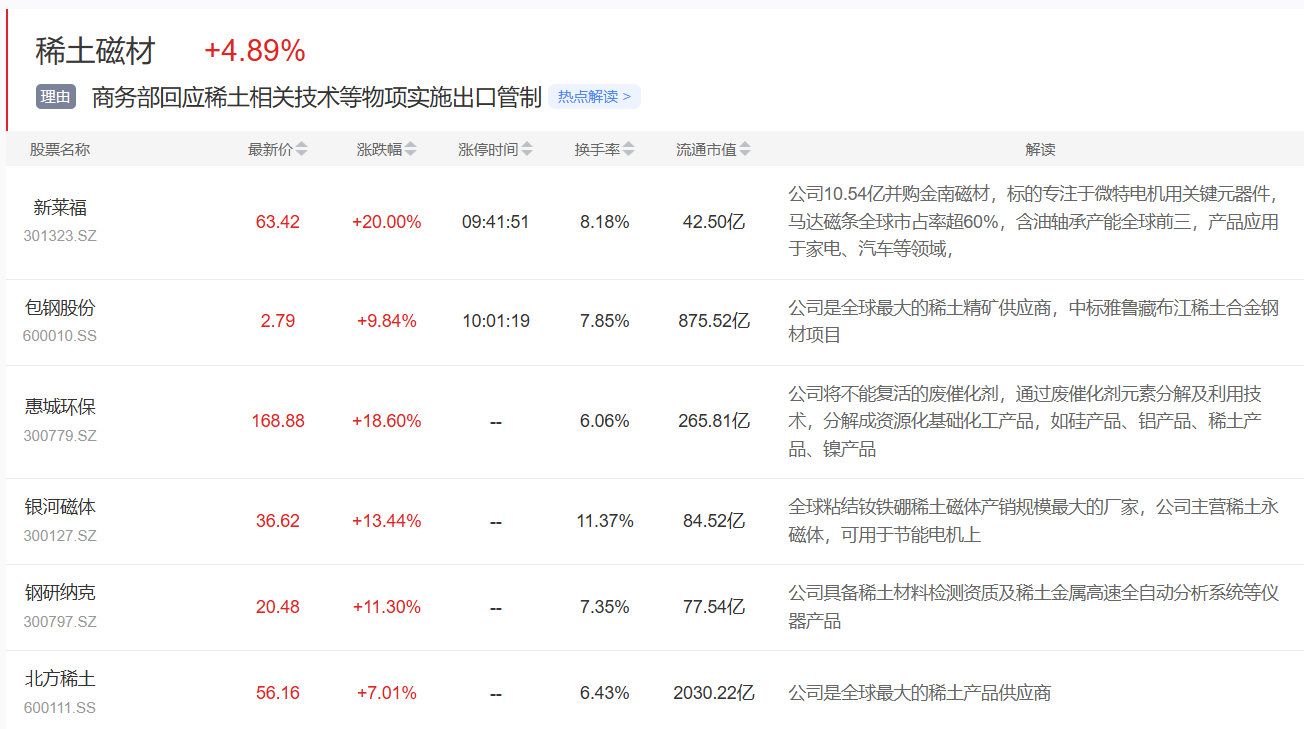
【大涨解读】稀土:商务部回应稀土出口管制,国内龙头还迎提价+业绩爆发双重催化,机构称行业估值有望提升
Xuan Gu Bao· 2025-10-13 02:55
Core Viewpoint - The rare earth sector has experienced a significant surge, driven by new export controls, rising prices of rare earth concentrates, and strong performance forecasts from companies in the industry [3][5]. Group 1: Export Controls - On October 9, 2025, the Ministry of Commerce announced new export controls on certain medium and heavy rare earths, related materials, equipment, and technologies, requiring export licenses for overseas organizations and individuals [3]. - The new regulations expand the scope of previous export controls, including additional categories of rare earths, equipment, raw materials, and technologies, covering the entire rare earth production chain [5]. Group 2: Price Adjustments - On October 10, North Rare Earth announced an adjustment of the rare earth concentrate trading price for Q4 2025 to 26,205 yuan/ton, a 37.13% increase compared to the previous period [3]. - Baogang Group also announced a similar price adjustment for Q4 2025, aligning with North Rare Earth's pricing [4]. Group 3: Company Performance - North Rare Earth expects to achieve a net profit attributable to shareholders of 1.5 billion to 1.57 billion yuan for the first three quarters of this year, representing a year-on-year increase of 272.54% to 287.34% [3]. - The company's non-recurring net profit is projected to be between 1.33 billion and 1.39 billion yuan, reflecting a year-on-year increase of 399.90% to 422.46% [3]. Group 4: Market Outlook - Analysts suggest that the comprehensive upgrade of export controls may enhance the valuation of the rare earth sector, coupled with the release of company performance and continued price increases for rare earth concentrates [5]. - The demand side shows strong orders from downstream magnet manufacturers, with stable raw material demand, particularly in the fourth quarter, which is expected to support prices due to increased procurement for sectors like new energy vehicles and wind power equipment [6].

金山软件AH股大涨
Di Yi Cai Jing Zi Xun· 2025-10-13 02:47
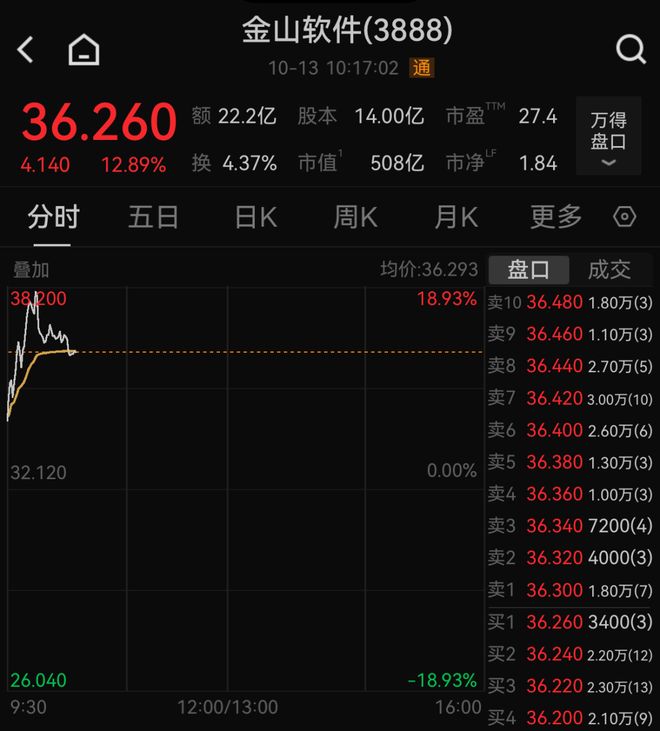
Core Viewpoint - Kingsoft Software's AH shares experienced significant gains on October 13, with Hong Kong shares rising nearly 13% and A-shares increasing over 11% [1][2]. Group 1: Stock Performance - Kingsoft Software's Hong Kong stock rose nearly 13%, previously peaking at over 15% [1]. - A-shares of Kingsoft Office increased over 11%, with a prior increase exceeding 16% [1]. Group 2: Market Data - As of October 13, the stock price of Kingsoft was 36.260, with a market capitalization of 508 billion [2]. - The trading volume was 22.2 million shares, with a price-to-earnings ratio of 27.4 [2].


花旗:维持金力永磁“买入”评级 目标价25.3港元
Xin Lang Cai Jing· 2025-10-13 02:44
花旗研究报告指出,国家商务部及海关总署周四公布,扩大对稀土产品及技术的出口管制。花旗认为, 该政策透过更强国内市场保护,有利于持有配额的龙头企业。花旗续表示,金力永磁(06680.HK)昨日公 布其首九个月初步业绩,净利润为5.05亿至5.5亿元人民币,按年上涨157%至179%,占花旗对其全年估 计71%至77%以及市场共识73%至79%。花旗予该股维持"买入"评级,目标价25.3港元。 ...
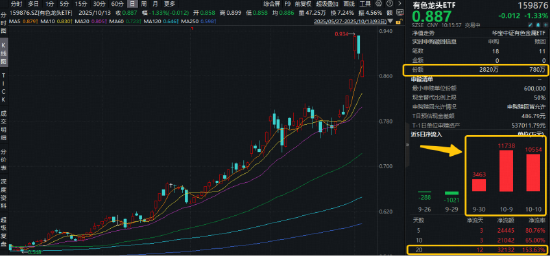
超37%!两大稀土巨头宣布提价,北方稀土领涨超7%!资金逢跌抢筹!有色龙头ETF(159876)近3日吸金2.58亿元
Xin Lang Ji Jin· 2025-10-13 02:40
10月10日,北方稀土、包钢股份两大稀土巨头宣布提价。此次上调后,2025年第四季度稀土精矿交易价 格相较于第三季度价格环比上涨约37%,创下自2023年第二季度以来的最高值。 中金公司指出,中国在稀土领域拥有领先地位,2024年开采份额占全球的61%,但更为重要的是90%以 上的精炼环节都集中在中国。稀土管制作为"先手"在4月就已经出现在"谈判桌"上,然而10月9日的一系 列举措更为严厉,不仅将在11月8日对超硬材料、部分稀土设备和原辅料、5种中重稀土、锂电池和人造 石墨负极材料实施出口管制,同时也将即日起对境外稀土出口和稀土技术实施管制。 新规要求跨国公司销售的商品中,如果含有中国稀土矿产占产品价值的0.1%或以上,则需要获得中国 政府的许可,这将使得跨国科技公司的关键产业链面临挑战。值得关注的是,商务部新闻发言人表示, 中国的出口管制不是禁止出口,只要是用于民用用途的、合规的出口申请,都可以获得批准,相关企业 无须担心。 东方财富指出,中国对稀土产业全方位管控后,全球稀土供给增长预期或下调,利好国内稀土产业高质 量发展。稀土永磁材料与人形机器人等产业密切相关,板块未来或受益于新兴产业的需求预期增长。 盘 ...

商务部发布公告严控稀土相关技术出口
Zhong Guo Hua Gong Bao· 2025-10-13 02:34
Core Viewpoint - The Chinese government has announced export controls on rare earth-related technologies and items to safeguard national security and fulfill international non-proliferation obligations [1][3]. Group 1: Export Control Measures - The Ministry of Commerce has issued announcements regarding the export control of rare earth technologies, including mining, smelting, metal refining, and recycling technologies, which require permission for export [1][3]. - The export control is a response to the illegal acquisition of rare earth technologies by foreign entities, which poses significant risks to China's national security and international stability [3]. Group 2: International Cooperation and Compliance - China emphasizes its commitment to maintaining global peace and regional stability through responsible export control measures and is open to dialogue with other countries to promote compliant trade [2]. - The scope of the controlled items is limited, and various facilitation measures will be implemented, including exemptions for humanitarian aid and a reasonable transition period for existing commercial contracts [2].