长期投资

Search documents
“十五五”资本市场高质量发展擘画新图景
Zhong Guo Zheng Quan Bao· 2025-10-26 21:06
Core Viewpoint - The China Securities Regulatory Commission (CSRC) emphasizes enhancing the resilience and risk resistance of the capital market, improving the inclusiveness and adaptability of market systems, and strengthening the effectiveness and deterrence of regulatory enforcement to promote high-quality development of the capital market [1] Group 1: Stability Mechanisms - The CSRC aims to cultivate high-quality listed companies and improve the "long money long investment" ecosystem to strengthen the internal stability of the market [1] - Market participants expect that during the 14th Five-Year Plan period, efforts will be made to enhance the quality of listed companies and create a favorable environment for long-term capital investment [2] - The proportion of institutional investors is expected to increase significantly, enhancing the market participation and influence of long-term capital such as insurance funds and pension funds, which will reduce market volatility and highlight long-term investment value [2] Group 2: Market Adaptability - The core value of the capital market is to serve the real economy, which requires higher inclusiveness and adaptability to provide precise financing support for various types and stages of enterprises [3] - The CSRC plans to deepen reforms in the Science and Technology Innovation Board and the Growth Enterprise Market, enhancing the financing capabilities of the multi-tiered capital market to better meet the diverse needs of the real economy [3][4] Group 3: Legal and Regulatory Framework - High-quality development of the capital market relies on a fair order and legal protection under strict regulation, with a focus on combating various securities and futures violations [5] - The CSRC emphasizes the importance of transparency in information disclosure to maintain market order and ensure fair practices [5] - Digitalization and intelligence in regulatory practices are seen as crucial for enhancing regulatory effectiveness and investor protection [6]
Warren Buffett's Wealth-Building Tips For Upper Class: 'Take Advantage of Compound Interest, Don't Be Captivated By Siren Song of The Market'
Yahoo Finance· 2025-10-26 20:52
Core Insights - Warren Buffett provides wealth-building strategies specifically for the upper class, emphasizing value investing and long-term strategies [1][3] - The upper class, representing about 2% of the U.S. adult population, has a median household income of $256,900, indicating significant financial resources [1] - Buffett warns against impulsive investment decisions influenced by market volatility, advocating for a disciplined approach to investing [2][3] Investment Strategies - Value investing is highlighted as a key strategy, focusing on selecting stocks priced at or below their intrinsic value [1] - The importance of long-term investment is underscored, with Buffett stating that "time is your friend; impulse is your enemy" [2] - Buffett encourages investors to leverage compound interest and avoid being swayed by market trends [2][3] Investor Temperament - Buffett emphasizes that temperament is more crucial than intellect for successful investing, suggesting that emotional intelligence plays a significant role [2][4] - He advises investors to maintain a balanced perspective, neither overly influenced by market trends nor completely against them [3][4] - This focus on temperament is particularly relevant in the context of the widening wealth gap in the U.S. [3]
给暴富的心泼一盆冷水
雪球· 2025-10-26 01:47
Core Viewpoint - The article emphasizes the importance of long-term investment strategies and the reality of stock market returns, highlighting that a 10-year investment yielding a 6.6% annualized return is commendable in a challenging market environment [2]. Group 1: Investment Philosophy - The author believes in the viability of value investing, which was reinforced by early exposure to literature on Warren Buffett, leading to sustained enthusiasm for investing despite initial losses [3]. - The author maintains realistic expectations, recognizing that a long-term annualized return of over 12% is exceptional, which helps in avoiding emotional reactions to market fluctuations [3]. - The article advises against following market fads and emphasizes the importance of understanding one's investment capabilities, with the author having never invested in high-risk sectors like the ChiNext board [3][4]. Group 2: Investment Strategy - The author prefers to invest in large-cap companies during market downturns or when negative events occur, as these companies tend to have stable operations and better control over market volatility [4]. - The strategy includes avoiding high-risk financing and frequent trading, focusing instead on earning from business operations and benefiting from dividends, which provides a steady cash flow for reinvestment [4]. - The article introduces the "雪球三分法" (Snowball Three-Part Method), which advocates for long-term investment and asset allocation through diversification across assets, markets, and timing to achieve diversified returns and risk mitigation [5].


金价延续震荡,黄金ETF华夏(518850)回调获资金坚定布局
Sou Hu Cai Jing· 2025-10-24 06:30
Group 1 - COMEX gold futures prices have experienced fluctuations, currently trading around $4124 per ounce, with mixed performance in gold-related ETFs [1] - The Huaxia Gold ETF (518850) has seen continuous net inflows over the past 23 trading days, totaling 2.97 billion yuan, with 1.141 billion yuan inflows this week alone, leading to a record high of 944 million shares [1] - Analysts suggest that despite significant short-term pullback pressure on gold prices, the long-term investment value remains strong, recommending gradual accumulation or dollar-cost averaging for long-term investors [1] Group 2 - Morgan Stanley's global commodities strategy head, Natasha Kaneva, asserts that gold remains the most confident bullish asset for the year, with further upside potential as the market enters a Federal Reserve rate cut cycle [2]
健全投资和融资相协调的资本市场功能
Sou Hu Cai Jing· 2025-10-24 02:29
Core Insights - The Chinese capital market, comprising the stock and bond markets, has become one of the largest globally, providing significant support to the real economy, yet it faces challenges of being "large but not strong" due to misalignment in financing and investment functions [1][4] Group 1: Capital Market Functionality - The capital market's investment and financing functions are closely linked, with changes in one affecting the other, necessitating comprehensive reforms to enhance their coordination [5] - The A-share market has seen nearly 3,000 new stock issuances from 2015 to 2024, raising a total of 3 trillion yuan, with average investor subscriptions reaching 7,000 times the actual issuance [3][4] Group 2: Reform Initiatives - The key tasks for comprehensive reform in the capital market include enhancing long-term and rational investment guidance, improving information disclosure systems, and strengthening the credit intermediary mechanism [6][11] - Specific reforms in the stock market focus on promoting long-term investment, improving investor education, and ensuring market stability to prevent systemic risks [7][8] Group 3: Bond Market Enhancements - The bond market reforms aim to improve the service level of credit bond issuance, enhance information disclosure, and strengthen credit services related to bonds [11][12] - Establishing a unified regulatory framework for the bond market is essential to ensure high-quality development and effective risk management [15]

市场波动大,2个方法,帮你更好投资|投资小知识
银行螺丝钉· 2025-10-23 13:56
Group 1 - The article emphasizes the importance of adhering to a self-established investment plan to avoid deviations that could lead to poor decision-making [2] - It suggests that when engaging in systematic investment, one should consider their psychological tolerance and the amount of capital invested, as higher investments can lead to increased psychological pressure [3] - The article recommends using long-term idle funds for investment, which should be an amount that one can afford to lose without feeling distressed, making it easier to maintain a long-term investment strategy [3]

保险公司年内举牌上市公司已达36次
Zheng Quan Ri Bao Zhi Sheng· 2025-10-21 16:41
Core Viewpoint - The announcement by China Post Life Insurance Co., Ltd. regarding its stake acquisition in China Communications Signal Co., Ltd. (China Tonghao) reflects a broader trend of insurance capital frequently acquiring stakes in listed companies, driven by changes in accounting standards and the need for better asset-liability matching [1][2]. Group 1: Stake Acquisition Details - China Post Life's acquisition involved purchasing an additional 3.995 million shares of China Tonghao, increasing its total holdings to approximately 102 million shares, which represents 5.1692% of the company's H-share capital, thus triggering the H-share stake disclosure requirement [1]. - This marks the third stake acquisition by China Post Life in 2023, following previous acquisitions in May and July of Eastern Airlines Logistics A-shares and Green Power Environmental H-shares, respectively [1]. Group 2: Industry Trends - As of October 21, 2023, 14 insurance companies have collectively acquired stakes in 25 listed companies, with a total of 36 stake acquisitions recorded this year, significantly surpassing the 20 acquisitions made in the entirety of the previous year [2]. - Major insurance firms, including China Ping An Life Insurance Co., Ltd. and Great Wall Life Insurance Co., Ltd., have also engaged in multiple stake acquisitions, often exceeding the 5% threshold for disclosure [2]. Group 3: Accounting Standards Impact - The shift in accounting standards has heightened the requirements for asset-liability matching for insurance companies, prompting a wave of stake acquisitions as firms seek to mitigate the impact of market value fluctuations on their financial results [3]. - By acquiring stakes in listed companies, insurance firms can stabilize short-term profit fluctuations and enhance their net investment yield through high dividend-paying stocks [3]. Group 4: Investment Preferences - Insurance capital has shown a strong preference for acquiring stakes in banks, public utilities, and environmental companies, with over 40% of the stake acquisitions targeting bank stocks [4]. - The focus on H-shares is notable, with 30 out of the 36 acquisitions involving H-shares, attributed to their potential for higher returns and tax benefits on dividends [4][5]. Group 5: Future Investment Strategies - Insurance companies are advised to optimize their investment strategies by focusing on long-term value investments, selecting stable dividend-paying stocks, and enhancing their risk management capabilities [5]. - The emphasis is on conducting thorough research and analysis before making stake acquisitions to avoid short-term speculative investments [5].
昔日爆款泉果旭源打开赎回,投资者蜂拥“出逃”高点购买的那些三年持有期基金
Xin Lang Cai Jing· 2025-10-21 04:13
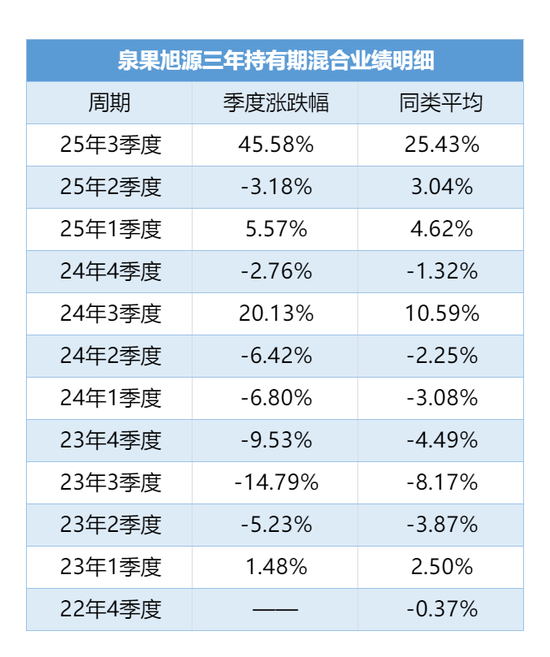
Core Viewpoint - The fund "Quanguo Xuyuan" has opened for redemption after three years, presenting investors with a challenging decision despite a nearly 3.5% return during the holding period. The fund has experienced a significant decline in value over the past five quarters, starting from its establishment in October 2022 [1]. Performance Summary - The fund's performance has been volatile, with a notable recovery in Q3 2025, where it achieved a 45.58% increase, compared to the average of 25.43% in its category [2][3]. - The fund's performance has been heavily influenced by its concentration in the new energy sector, with major holdings like CATL (300750.SZ) experiencing a price drop of over 38.8% from its initial purchase price [2]. Fund Holdings - The top holdings of the fund include CATL, Tencent (0700.HK), and Enjie Co., Ltd. (002812.SZ), with a total holding value of approximately 12.88 billion yuan [4]. - The fund's strategy focuses on high-end manufacturing and technology sectors, with a diversified approach that includes new energy, electronics, machinery, and military industries [5]. Fund Size and Market Context - The fund was launched with an initial scale close to 10 billion yuan and has since grown to a total size of 19.069 billion yuan by the end of Q3 [7]. - The fund's benchmark performance has been significantly outpaced by the market, with a benchmark return of 22.88% compared to the fund's performance, indicating a failure to generate excess returns for investors [7]. Industry Trends - The trend of three-year holding period funds has seen a decline, with many funds experiencing poor performance and subsequent shrinkage in scale after redemption periods [9][10]. - The design of holding period funds aimed to reduce trading friction and improve investor returns, but the changing market dynamics have led to disappointing results for many funds launched in recent years [10].

Hims & Hers: Q3 Could Provide Volatility, But The Long-Term Vision Remains Bright
Seeking Alpha· 2025-10-21 00:07
Core Insights - The article emphasizes the importance of identifying deeply undervalued equities with long-term potential that are often overlooked by the market [1] Group 1: Investment Strategy - The focus is on managing investments since 1999, which provides a perspective across multiple market cycles [1] - The analyst has a background in Economics and is pursuing CFA certification, indicating a strong foundation in financial analysis [1] Group 2: Market Perspective - The article suggests that there are significant opportunities in the market for undervalued stocks that may not be recognized by the broader investment community [1]


平均净值增长超15% 个人养老金基金再扩容
经济观察报· 2025-10-20 11:56
Core Viewpoint - The article discusses the increasing differentiation among personal pension fund products as they achieve both performance and scale, highlighting the need for investors to make informed choices as the year-end investment window approaches [5]. Group 1: Expansion of Personal Pension Funds - The personal pension fund catalog expanded again in the third quarter, reaching a total of 302 products by the end of September, with 8 new additions compared to the end of the second quarter [3][4]. - The new entrants predominantly feature index-enhanced funds, with five out of the eight new products focusing on tracking the CSI 500 and CSI 300 indices [6][7]. Group 2: Performance of Personal Pension Funds - Personal pension funds have shown impressive performance this year, with an average net value growth exceeding 15% and the highest return reaching 46% [4][10]. - As of October 17, only one out of 302 personal pension funds reported negative returns this year, while the average unit net value increase was 15.13% [10]. Group 3: Market Dynamics and Investor Behavior - The growth in personal pension fund scale is accompanied by a notable differentiation among products, with only one fund exceeding 1 billion yuan in scale, while most remain below 200 million yuan [12]. - Investors are increasingly favoring funds with lower risk levels and shorter holding periods, reflecting a preference for more flexible or conservative allocations [12]. Group 4: Investment Strategies and Future Outlook - As the fourth quarter approaches, it is considered a critical period for personal pension account funding and product allocation, prompting investors to reassess their portfolios [14]. - Analysts suggest a balanced allocation between stocks and bonds, focusing on sectors aligned with national long-term development strategies, such as technology innovation and high-end manufacturing [14][15]. - The personal pension market is expected to continue evolving, with potential inclusion of more diverse asset classes like public REITs in the future [15][16].