加息

Search documents
日本两年期国债收益率自2008年以来首次升至1% 市场预期央行接近加息
Sou Hu Cai Jing· 2025-12-01 00:56
Core Viewpoint - Japan's 2-year government bond yield has reached its highest level since 2008, indicating market expectations of a closer interest rate hike by the Bank of Japan [1] Group 1: Bond Market - The 2-year Japanese government bond yield increased by 1 basis point to 1% [1] - The market is currently pricing in a 62% probability of a rate hike by the Bank of Japan during the policy decision on December 19, which is expected to rise to nearly 90% by the January meeting [1] - The Ministry of Finance plans to increase short-term debt issuance, adding 300 billion yen each for 2-year and 5-year bonds, and 6.3 trillion yen in treasury bills [1] Group 2: Currency Market - The yen appreciated against the dollar, rising by 0.3% to 155.77 [1] Group 3: Economic Policy - The increase in debt issuance is aimed at funding Prime Minister Fumio Kishida's economic stimulus plan, which is anticipated to put pressure on short-term Japanese government bonds [1]
每日机构分析:11月28日
Xin Hua Cai Jing· 2025-11-28 11:23
·西太平洋银行:澳大利亚三季度GDP增速超预期,内需创12年最强 ·三菱日联银行:美联储主席人选更迭强化降息预期,美元承压 ·Investinglive分析师指出,日本最新数据显示,东京11月核心CPI同比上涨2.8%,连续高于央行2%的通 胀目标,叠加工业产出超预期回升,正强化市场对日本央行在未来数月重启加息周期的预期。日元跌至 10个月低点,加剧进口和食品价格上行压力;而政府内部对加息时机存在分歧,首相高市早苗部分顾问 主张在消费疲软与三季度经济萎缩背景下暂缓行动。在通胀顽固、日元疲软及薪资增长可信度提升的三 重支撑下,日本央行政策委员会倾向更早收紧货币政策。市场普遍预计,加息窗口已打开,可能于12月 或2026年初落地。 ·野村证券报告指出,印度通胀持续温和,为央行在12月5日政策会议上降息打开窗口。该行将此次会议 降息25个基点的概率上调至65%,维持利率不变的概率为35%。报告称,当前通胀水平已低于印度央行 的中期预测,且未来价格涨幅有望进一步放缓。不过,鉴于GDP增长仍具韧性、银行存贷比高企及外汇 市场波动风险,央行也可能选择观望,以择机最大化政策效果。野村维持对印度终端利率5.00%的预 测,意 ...
东京核心通胀超预期,日本离加息再近一步
Hua Er Jie Jian Wen· 2025-11-28 03:46
Core Inflation and Economic Indicators - Tokyo's core CPI rose by 2.8% year-on-year in November, slightly above the market expectation of 2.7%, primarily driven by rising electricity prices, offsetting the slowdown in processed food price increases [1] - The industrial output in October unexpectedly increased by 1.4%, mainly due to strong automobile production, exceeding market expectations [1][3] - The unemployment rate remained stable at 2.6% in October, with a job-to-applicant ratio of 1.18, indicating a tight labor market [2] Inflation Drivers - The overall inflation in Tokyo remains sticky, largely driven by food costs, with rice prices soaring by 38.5%, and coffee beans and chocolate prices increasing by 63.4% and 32.5% respectively [2] - The number of price-increased items from major food companies in Japan is expected to reach 20,609 this year, a 64.6% increase from the previous year, indicating companies are passing on rising costs to consumers [2] Manufacturing Outlook - Despite the positive industrial output data, manufacturers expect a decline in production by 1.2% and 2.0% in November and December respectively, suggesting potential external demand shocks in the coming months [3] Interest Rate Hike Speculation - The recent economic data may bolster the Bank of Japan's confidence in the economic outlook, fueling speculation of a possible interest rate hike as early as December [4] - Analysts believe the window for an interest rate hike is approaching, with expectations of a tightening cycle resuming in the coming months [5] Yen's Role in Policy Decisions - The ongoing weakness of the yen is a critical variable influencing the policy shift, with warnings from Bank of Japan officials about the risks of delaying rate hikes [6] - The Japanese government has introduced a fiscal stimulus plan to alleviate living costs, complicating the timing of the central bank's decisions [6]
日本东京通胀超预期,日央行12月加息概率猛增?
Sou Hu Cai Jing· 2025-11-28 03:04
Core Viewpoint - Tokyo's inflation in November exceeded expectations, indicating a potential steady progression of interest rate hikes by the Bank of Japan in the coming months [1][13][21]. Inflation Data - The core Consumer Price Index (CPI) in Tokyo rose by 2.8% year-on-year in November, surpassing the Bank of Japan's target of 2% and slightly above the forecast of 2.7%, remaining unchanged from the previous month [4][21]. - Food prices, excluding fresh produce, increased by 6.5%, marking the third consecutive month of slowing growth [6][21]. - Energy prices rose by 2.6%, with electricity costs up 4.5% year-on-year and city gas prices up 0.7% [7][21]. Economic Indicators - Retail sales in Japan for October increased by 1.7% year-on-year, exceeding the expected 0.8% [10]. - Industrial output for October showed a preliminary month-on-month increase of 1.4%, against an expected decline of 0.6% [11]. - The unemployment rate remained stable at 2.6%, aligning with expectations [12]. Government and Monetary Policy - The Japanese government plans to implement an economic stimulus package exceeding 20 trillion yen to address rising living costs [13]. - The government is expected to issue approximately 11.7 trillion yen (about 529.9 billion RMB) in new bonds to cover the spending gap from the stimulus plan [14]. - Analysts from Goldman Sachs suggest that the impact of this large-scale fiscal stimulus may be "far below expectations" [14]. Market Expectations - The recent inflation data is likely to bolster the Bank of Japan's confidence in raising interest rates [17]. - Market speculation regarding a potential interest rate hike in December has intensified, driven by the ongoing tight labor market and core inflation rates expected to remain above 3% [21][22].

东京11月通胀持稳,日本央行加息路径更明
智通财经网· 2025-11-28 01:36
Group 1 - Tokyo's November inflation rate remains stable, with the core consumer price index (CPI) excluding fresh food rising by 2.8% year-on-year, driven by increased electricity costs, slightly above economists' median estimate of 2.7% [1] - The core CPI, excluding energy, also increased by 2.8%, while service prices, a key indicator of inflation sustainability, rose by 1.5% year-on-year [1] - The data serves as a leading indicator for national price trends, potentially boosting the Bank of Japan's confidence in its economic outlook and increasing speculation about a rate hike in December [1] Group 2 - The head of Japan's largest labor union, Tomoko Yoshino, urged the government to take more measures against inflation, as the weak yen may cause inflation to persist above nominal wage growth, with real wages declining for nine consecutive months [2] - Prime Minister Fumio Kishida announced a new economic stimulus package totaling 17.7 trillion yen (approximately 113 billion USD), focusing on utility subsidies and gasoline tax cuts to address rising living costs [2] - Estimates suggest that these measures could directly lower Japan's core CPI by 0.38 percentage points next year [2]
澳大利亚联邦银行:日本央行可能推迟至明年1月加息
Sou Hu Cai Jing· 2025-11-27 04:48
Core Insights - The market anticipates that the Bank of Japan may raise interest rates by 25 basis points in December, but political factors could delay this until January [1] - Japanese Prime Minister Fumio Kishida advocates for a loose monetary policy and desires close coordination between the government and the central bank [1] - The cautious stance of the Bank of Japan may lead to a decision to wait until the budget proposal is passed by the Diet before implementing a rate hike [1] - Delaying the rate increase would also provide the Bank of Japan with additional time to assess the momentum of the upcoming wage negotiations [1]
市场分析:澳大利亚经济增速接近“超速” 澳洲联储或权衡提前加息
Sou Hu Cai Jing· 2025-11-27 03:49
Core Viewpoint - The Chief Economist of the National Australia Bank, Sally Olds, assesses that if economic growth accelerates and the labor market tightens, the Reserve Bank of Australia may need to raise interest rates as early as the first half of 2026 [1] Economic Conditions - Australia is currently at full employment, with economic growth expected to return to trend levels next year [1] - Olds estimates the trend growth rate to be approximately 2.25% [1] Inflation and Monetary Policy - Due to minimal idle capacity, it is unlikely that the economy can sustain growth above trend without putting upward pressure on prices and wages [1] - Any acceleration in growth and/or tightening of the labor market may compel the Reserve Bank of Australia to consider the necessity of interest rate hikes [1]
日元贬值风暴或引发12月突然加息
Guo Ji Jin Rong Bao· 2025-11-26 09:12
Group 1: Currency Depreciation and Economic Impact - The Japanese yen has weakened significantly against the US dollar, dropping below 157.9, marking a 10-month low, with a nominal effective exchange rate reaching 71.4, close to intervention levels from July 2024 [1] - Since the election of Prime Minister Sanae Takaichi, the yen has depreciated approximately 6% [1] - The depreciation of the yen is linked to rising government bond yields, with the 10-year yield reaching 1.825%, the highest since the 2008 financial crisis, and the 20-year and 40-year yields hitting 2.853% and 3.747%, respectively [1] Group 2: Fiscal Policy and Debt Concerns - The Japanese cabinet approved a supplementary budget of 21.3 trillion yen for fiscal year 2025, the highest since the COVID-19 pandemic, raising concerns about increasing government debt and its sustainability [2] - Japan's government debt as a percentage of GDP has exceeded international warning levels, and the stimulus plan will require additional bond issuance, further inflating the debt burden [2] - Japan's GDP contracted by 0.4% in Q3, marking the first economic shrinkage in six quarters, which raises doubts about the yen's strength [2] Group 3: Inflation and Monetary Policy Signals - The depreciation of the yen has led to increased import prices, contributing to domestic inflation, with the core CPI rising 3.0% in October, remaining above the 2% target for 50 consecutive months [3] - Despite the inflationary pressures, the Bank of Japan has maintained a policy interest rate of 0.5%, citing economic weakness as a constraint on rate hikes [3] - Recent comments from Bank of Japan officials indicate a shift towards a more hawkish stance, suggesting that discussions on the feasibility and timing of interest rate hikes are forthcoming [4][5] Group 4: Global Financial Implications - The significant depreciation of the yen may negatively impact global liquidity, as the yen has been used as a funding currency for investments in higher-yielding assets like US Treasuries and equities [2] - The potential for a rate hike by the Bank of Japan is influenced by the Federal Reserve's decisions, with a stable or rising US interest rate potentially exacerbating yen depreciation [5]
日本央行大消息!黑天鹅要来了?
Sou Hu Cai Jing· 2025-11-26 08:48
Core Viewpoint - The Bank of Japan is signaling a potential interest rate hike as early as next month, responding to concerns over the depreciation of the yen and diminishing political pressure to maintain low rates [1][2]. Group 1: Bank of Japan's Shift in Stance - The Bank of Japan has shifted its focus from concerns about the U.S. economy to the inflation risks posed by a weakening yen, indicating that a rate hike in December remains a possibility [1]. - There is an internal consensus among more Bank of Japan officials that the trend of a weaker yen could have a greater impact on inflation than previously thought [1][2]. Group 2: Support for Rate Hike - An increasing number of Bank of Japan policy board members believe that the conditions for a rate hike are maturing, with comments from board member Junko Koeda emphasizing the need to raise real interest rates due to strong price levels [2]. - Another board member, Kazuo Ueno, stated that the timing for a rate hike is "approaching," which has led to a rise in 5-year government bond yields to a 17-year high [2]. Group 3: Market Reactions and Future Expectations - Analysts note that the Bank of Japan is intentionally signaling to the market to prepare for a potential rate hike in December, ensuring that the market is not caught off guard [3]. - The Bank of Japan is increasingly recognizing that currency fluctuations may have a more lasting impact on prices, which is a critical factor in their decision-making regarding the timing of interest rate increases [3].
日本“黑天鹅”真的可能飞出!路透刚刚独家爆料日本央行大消息 日元应声急涨
Sou Hu Cai Jing· 2025-11-26 08:48
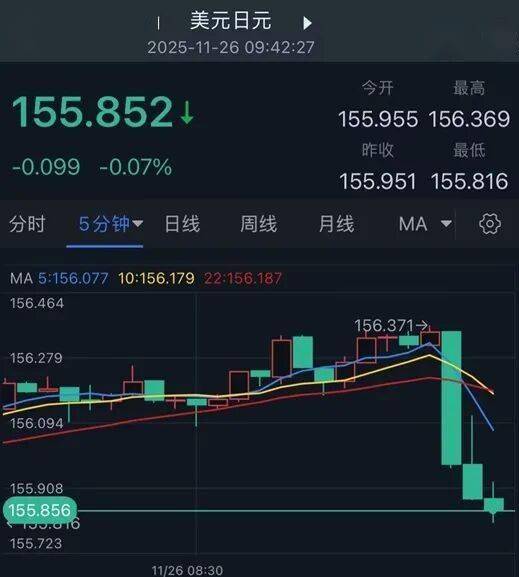
英国路透社周三(11月26日)最新发布独家报道称,消息人士称,日本央行正为最快可能在下个月加息的 情形向市场"打预防针"。随着对日元大幅贬值的担忧再度升温,以及要求央行维持低利率的政治压力减 弱,日本央行重新使用了此前偏鹰派的措辞。 (截图来源:路透社) 两位熟悉日本央行想法的人士对路透表示,过去一周日本央行在表述上的变化,已将焦点从稍早对美国 经济的担忧转回日元走软的通胀风险;这些言论意在提醒市场,12月加息仍是一个可能的选项。 这种重新回到鹰派立场的转向,也发生在上周首相高市早苗(Sanae Takaichi)与日本央行行长植田和男 (Kazuo Ueda)的一次关键会面之后。该会面似乎消除了新政府对加息的即时政治阻力。 受路透社报道影响,日元短线飙升,美元/日元急跌约55点,最低位于155.81。 越来越多的日本央行政策委员认为,加息条件已经成熟。日本央行审议委员小枝淳子(Junko Koeda)上周 表示,由于物价"相对强劲",日本央行必须继续上调实际利率。 日本央行政策委员增野和之(Kazuyuki Masu)在上周六刊出的采访中称,加息时机正在"临近"——这一表 态推动周二5年期国债收益率升至17 ...