
智能化转型

Search documents
杨元庆:凭借智能化转型 联想的供应链订单交付时间较转型前缩短了28% 制造和物流成本降低了20%
Ge Long Hui A P P· 2025-09-20 05:54
格隆汇9月20日|以"智造世界·创造美好"为主题的2025世界制造业大会在合肥开幕。联想集团董事长兼 CEO、徽商总会会长杨元庆表示。以联想为例,凭借智能化转型,联想的供应链订单交付时间较转型前 缩短了28%,准确度提升了25%,制造和物流成本降低了20%,推动产需进一步趋于平衡。正因如此, 联想的合肥厂和墨西哥蒙特雷工厂被世界经济论坛评为全球"灯塔工厂",更在Gartner全球供应链25强榜 单中将位次提升到了第八。 ...

东风成立新公司跃创科技 零部件业务全面整合提速
Chang Jiang Ri Bao· 2025-09-20 00:46
Core Insights - Dongfeng Motor Group has established Dongfeng Motor Group Yuechuang Technology Co., Ltd. to integrate R&D, manufacturing, and talent resources for high-tech and high-value components to support the electrification and intelligent transformation of vehicles [1] - Yuechuang Technology will serve as the main body and management entity for Dongfeng's component business, consolidating various subsidiaries and promoting integrated development [1][2] - The establishment of Yuechuang Technology follows the launch of the "Yuechuang Project" in July 2023, marking a significant step in the restructuring of Dongfeng's component business [1] Component Business Restructuring - The new company will manage existing functions of Dongfeng's component division and other related enterprises, aiming for resource pooling and strong collaboration [1] - Industry experts view this move as revitalizing the component division under Dongfeng Hongtai, creating a new strategic coordination platform [1][2] Battery Sector Expansion - On September 18, Dongfeng made significant advancements in the power battery sector with the groundbreaking of the supercharging battery project by Hubei Dongyu Xinshi New Energy Co., Ltd. in Yichang [1] - The project, a collaboration between Dongfeng and Xinwanda, has a total investment of approximately 12 billion yuan, focusing on R&D and manufacturing of power batteries for new energy vehicles [1] - The battery products will cover a range from 131Ah to 212Ah, catering to various vehicle types from A00-class small cars to medium and large SUVs, positioning Dongfeng as a core battery supplier for its new energy vehicles [1]

中国船舶:重组促科研融合,助力高端绿色转型,提升全链技术与盈利
Quan Jing Wang· 2025-09-19 13:05
Core Viewpoint - China Shipbuilding participated in the "Communicating Value and Building Confidence for the Future" event, highlighting the integration of research and development capabilities post-restructuring with China Shipbuilding Industry Corporation [1] Group 1 - The company indicated that prior to the restructuring, there was significant overlap in ship types among its shipyards [1] - Important technological breakthroughs have been achieved in various fields such as container ships, LNG ships, bulk carriers, and government vessels in recent years [1] - Post-restructuring, the integration of research systems will enhance efficiency, reduce costs, and improve profitability through technology sharing and collaborative efforts [1]

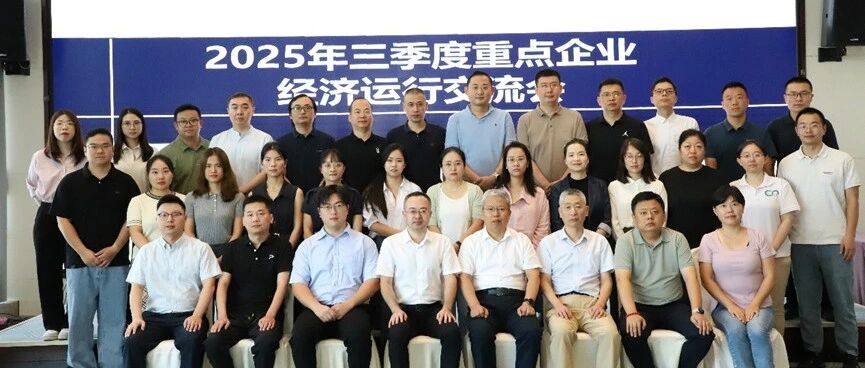
2025年三季度汽车行业重点企业经济运行交流会议在杭州召开
中汽协会数据· 2025-09-18 07:14
Core Viewpoint - The meeting organized by the China Association of Automobile Manufacturers (CAAM) focused on the current operational status of the automotive industry, key issues, and policy recommendations, aiming to enhance communication among major industry players and support high-quality development of the sector [1][3]. Group 1: Meeting Overview - The 2025 Q3 automotive industry economic operation exchange meeting was held in Hangzhou, Zhejiang, with participation from 18 key enterprises including Geely, BYD, SAIC, and others [1][3]. - The meeting was chaired by CAAM Deputy Secretary-General Chen Shihua, who emphasized the importance of the meeting as a platform for internal communication and industry feedback [3]. Group 2: Key Discussion Topics - The meeting addressed several hot topics, including the trade-in policy, industry "involution," production and operation of enterprises, supply chain issues, development of new energy vehicles versus traditional fuel vehicles, the "14th Five-Year Plan," and internationalization [3]. - Participants were encouraged to share insights from an industry perspective rather than solely from their individual company viewpoints [3]. Group 3: Future Directions - Chen Shihua expressed gratitude for the participation and indicated that the association would compile the suggestions and feedback from the meeting to relay to relevant government departments [5]. - The association aims to enhance its operational work and communication with enterprises to better fulfill its role as a platform for industry monitoring and problem identification [5].





政策协同 企业聚力汽车产业新旧动能加速迭代
Zheng Quan Shi Bao· 2025-09-18 01:27
Core Insights - The Chinese automotive industry is entering a critical phase of growth transition, facing challenges such as slowing growth in the new energy vehicle (NEV) market and technological bottlenecks, while also seizing opportunities for intelligent and green transformation [1][2][3] Industry Growth and Performance - The automotive industry in China has achieved stable growth for three consecutive years, with NEVs entering a new phase of rapid growth, evidenced by a production and sales volume of 21.12 million vehicles from January to August 2025, marking a year-on-year increase of 12.6% [2] - NEV sales exceeded 9.6 million units, reflecting a year-on-year growth of 36.7%, and accounting for 45.5% of total new vehicle sales [2] - Experts predict that as NEV market penetration exceeds 50%, the annual growth rate of NEV market share will gradually decline, with a more pronounced decrease expected after 2027 [2] Challenges and Opportunities - The automotive industry faces several challenges, including high-end chip technology bottlenecks, the need for breakthroughs in smart connected vehicles, and emerging international trade barriers [3] - Despite these challenges, there are opportunities to enhance independent innovation capabilities and promote a smooth transition between old and new growth drivers [3] Policy Initiatives - The Ministry of Industry and Information Technology and other departments have released a "Work Plan for Steady Growth in the Automotive Industry (2025-2026)," which includes 15 initiatives and 3 supporting measures aimed at expanding domestic consumption and improving supply quality [4] - The plan targets an annual vehicle sales volume of approximately 32.3 million units by 2025, with NEV sales projected to reach around 15.5 million units, reflecting a year-on-year growth of about 20% [4] Market Demand and Environmental Considerations - The government is focusing on stimulating market demand through policies such as promoting vehicle trade-in programs and reforming automotive consumption practices [6] - The automotive sector has seen a 25% increase in vehicle ownership since the 14th Five-Year Plan, while emissions of nitrogen oxides and volatile organic compounds have decreased by 31% and 13%, respectively [6] Collaborative Efforts - Industry leaders emphasize the importance of building a collaborative ecosystem to address competitive pressures, with a shift from isolated technological breakthroughs to system-level innovations [7] - The integration of various technological pathways, such as solid-state batteries, requires deep collaboration across the industry, including partnerships with research institutions [8]
抢抓智能化浪潮机遇 华为发布 “4+10+N”中小企业智能化方案
Zheng Quan Shi Bao Wang· 2025-09-17 09:53
Core Viewpoint - Huawei officially launched the "4+10+N" intelligent solution for small and medium-sized enterprises (SMEs) to facilitate their transition to an intelligent world, addressing the challenges faced by SMEs in adopting AI technologies [1][2] Group 1: Intelligent Solutions for SMEs - The "4" in the "4+10+N" solution refers to four core scenarios: intelligent office, intelligent commerce, intelligent education, and intelligent healthcare [2] - The "10" represents ten one-stop scenario-based solutions, including smart office, intelligent hotel, digital diagnosis platform, and intelligent interactive classroom [2] - The "N" signifies a series of star products defined around the four core scenarios, with Huawei launching 26 products aimed at the distribution market, such as the AR180 enterprise-grade wireless router and the IdeaHub [2][3] Group 2: Distribution and Partnership Strategy - Huawei introduced the "Hundred & Ten Thousand Plan" to develop 100 diamond partners and 10,000 elite engineering firms, enhancing support for SMEs [1][3] - The plan aims to transition from single product authorization to full product authorization for partners, enabling them to grow rapidly and serve end-users more efficiently [3] - Huawei's strategy focuses on empowering partners and providing comprehensive support to SMEs, ensuring no SME is left behind in the transition to intelligent solutions [1][3]
长春经开区税务局:精准发力解难题 护航企业 “智改数转” 行稳致远
Zhong Guo Jin Rong Xin Xi Wang· 2025-09-17 07:29
Core Insights - Changchun Shengwei Yate Garment Group Co., Ltd. is undergoing a digital and intelligent transformation to enhance production efficiency and maintain its competitive edge in the garment industry, which it has been part of for nearly 70 years [1] - The company has established itself as a benchmark in the Jilin Province garment industry, focusing on the production of workwear, suits, and shirts for both domestic and international markets [1] - The transition to intelligent production has introduced complexities in financial and tax management, necessitating professional policy guidance to navigate these challenges [1] Group 1 - The introduction of intelligent production equipment has raised questions regarding the accounting standards for fixed asset depreciation and the clarity of R&D expense deductions [1] - The Changchun Economic and Technological Development Zone Tax Bureau has provided tailored policy guidance to the company, helping to create a comprehensive financial and tax management mechanism [1] - The new mechanism includes policy interpretation, compliance declaration, process control, and post-event verification, which supports the company's transformation efforts [1] Group 2 - The Tax Bureau has also developed a systematic compliance guide based on the personalized experience gained from assisting Shengwei Yate, benefiting multiple enterprises in the region [2] - This initiative aims to create a virtuous cycle of "policy empowerment - technological upgrading - efficiency improvement" within the local manufacturing sector [2] - Future efforts will focus on the core needs of traditional manufacturing industries undergoing digital transformation, with an emphasis on precise policy guidance and efficient service responses [2]
“2025中国企业500强”榜单显示中国企业“含金量”稳步提升
Jing Ji Ri Bao· 2025-09-17 00:44
Core Insights - The "2025 China Top 500 Enterprises" list reflects the resilience and vitality of Chinese enterprises, showcasing their growth in scale and economic efficiency despite a complex external environment [1][2]. Group 1: Enterprise Growth and Economic Performance - The revenue of the top 500 Chinese enterprises increased from 89.83 trillion yuan to 110.15 trillion yuan, a growth of 22.62%, marking a new milestone of over 110 trillion yuan [2] - The total assets of these enterprises rose from 343.58 trillion yuan to 460.85 trillion yuan, representing a growth of 34.13% [2] - The number of enterprises with a scale of over 100 billion yuan increased from 222 to 267, indicating a strengthening financial foundation [2] Group 2: Innovation and R&D Investment - R&D investment among the top 500 enterprises grew from 130.66 billion yuan to 172.87 billion yuan, a 32.30% increase, with average R&D intensity rising from 1.77% to 1.95%, reaching a historical high [3] - The number of invention patents increased from 594,600 to 1,039,600, and participation in standard-setting rose from 69,000 to 91,400 [3] Group 3: Structural Optimization and Industry Development - The contribution rates to total revenue from manufacturing, services, and other sectors were 40.48%, 40.29%, and 19.23% respectively, indicating balanced development across different types of enterprises [3] - The number of enterprises in advanced manufacturing sectors increased from 23 to 32, reflecting a shift towards more innovative industries [3] Group 4: Global Influence and Market Expansion - The overseas revenue of the top 100 Chinese multinational companies reached 90.687 billion yuan, with overseas assets totaling 119.594 billion yuan, and the number of overseas employees at 1,174,708 [6] - Since the "14th Five-Year Plan," overseas assets and revenue of these companies have grown by 29.74% and 47.44% respectively [6] Group 5: Future Opportunities and Strategic Directions - Chinese enterprises are encouraged to enhance their role as the "main engine" of innovation, focusing on long-term investments in fundamental research and key technologies [8] - There is a call for these enterprises to lead in the transformation of traditional industries and to invest in strategic emerging industries such as biomanufacturing and green energy [8] - The importance of digitalization and green development is emphasized, with enterprises urged to integrate these principles throughout their operations [9]
新能源产业重塑:中国500强比亚迪首超上汽,宁德时代排名下滑
Bei Ke Cai Jing· 2025-09-16 04:22
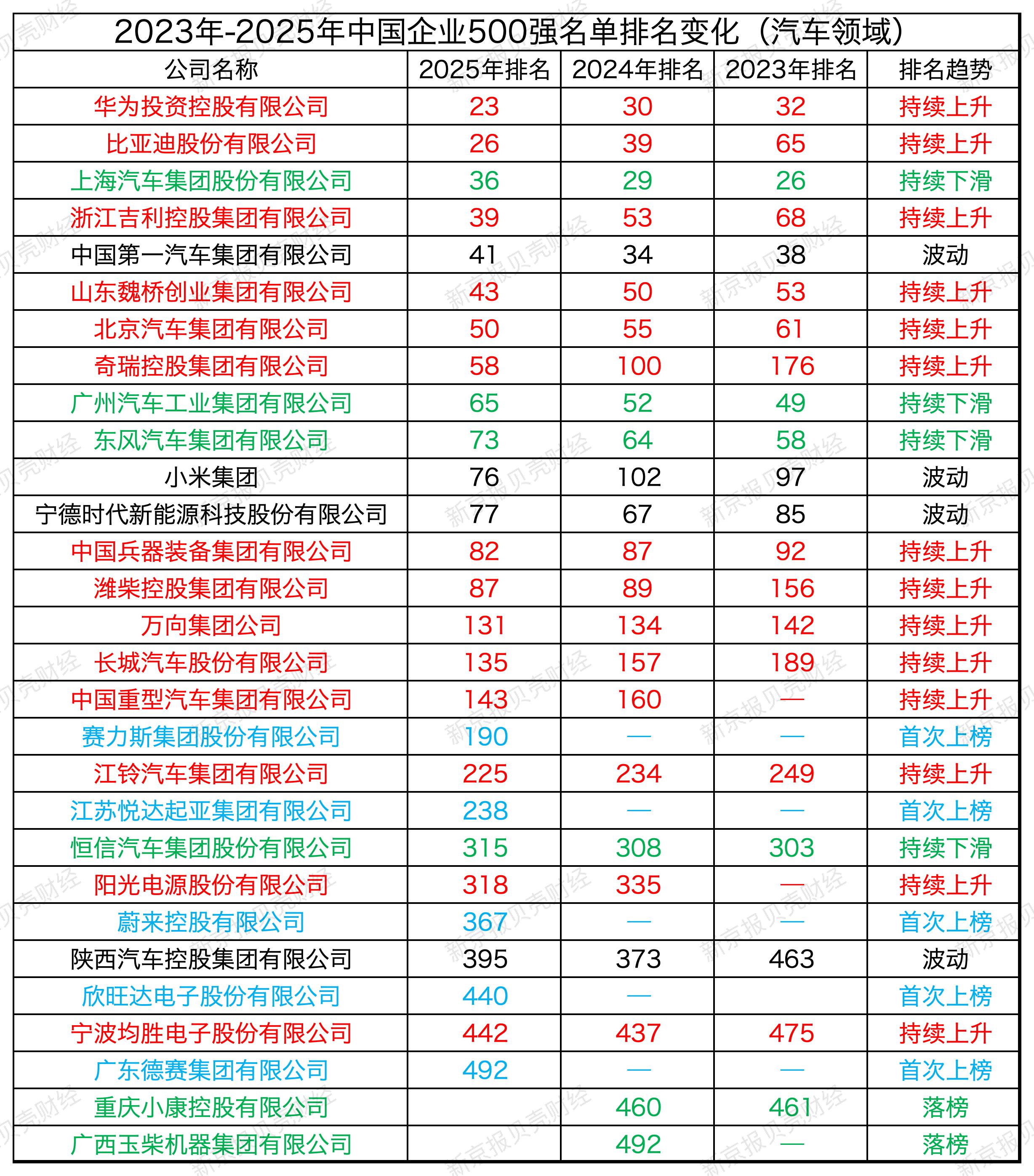
Core Insights - BYD has emerged as the top automotive company in China, ranking 26th overall in the "2025 China Top 500 Enterprises List" with a revenue of 777.1 billion yuan, surpassing SAIC for the first time [1][6] - The rankings reflect a significant shift towards new energy and intelligent transformation within the automotive industry, with traditional automakers experiencing declines [1][9] - Chery Holdings made a remarkable leap from 176th in 2023 to 58th in 2025, showcasing the impact of technological advancements and overseas market expansion [1][11][12] Automotive Industry Rankings - BYD's revenue growth allowed it to rise from 65th in 2023 to 26th in 2025, overtaking FAW and SAIC [6] - SAIC's ranking has consistently declined, dropping from 26th in 2023 to 36th in 2025, indicating a loss of competitive edge [7] - FAW also fell from 34th in 2024 to 41st in 2025, while Geely rose from 68th in 2023 to 39th in 2025, replacing FAW in the top three [8] New Energy Vehicle Sector - The rise of new energy vehicles (NEVs) is reshaping the automotive landscape, with companies like Seres and NIO making their debut on the list [9][14] - Seres ranked 190th and NIO ranked 367th, both representing the new wave of intelligent automotive companies [14] - The shift in value from traditional components to batteries and intelligent systems is evident, with over 60% of value in NEVs coming from these areas [9][10] Chery's Performance - Chery's significant rise is attributed to its accelerated transition to new energy and successful overseas market penetration, with NEV sales increasing from 17% in 2023 to 35% in 2024 [12] - Chery became the top exporter in 2024, with 1.145 million units exported, a 21.4% increase year-on-year [13] Industry Trends - The automotive supply chain is undergoing rapid restructuring, with battery manufacturers like CATL experiencing a decline in ranking, now at 77th overall [19] - New entrants in the battery sector, such as Xinwangda Electronics, made their first appearance on the list at 440th, reflecting the fast expansion of the power battery market [20] - The overall trend indicates a reduction in traditional automakers on the list, while core component manufacturers in electric driving and intelligent systems are rising [22][23] Market Dynamics - The Chinese automotive market is entering a phase of deep integration, with several brands exiting the market, leading to increased concentration [24] - Despite the growth of large enterprises, there is a call for improvement in international competitiveness and the establishment of world-class companies [24]
曹东杰,回归东风本田
Jing Ji Guan Cha Bao· 2025-09-16 02:49
Core Viewpoint - Dongfeng Honda is undergoing a personnel adjustment aimed at optimizing its management system and strengthening strategic implementation, with key leadership changes that reflect the company's commitment to high-quality development and transformation in the electric and intelligent vehicle sectors [1][2] Group 1: Leadership Changes - Pan Jianxin has been appointed as the Party Secretary and Union Chairman candidate of Dongfeng Honda, transitioning from his previous role as Executive Vice President [1] - Cao Dongjie, former CEO of Dongfeng Warriors Technology, has been recommended as a board member and Executive Vice President of Dongfeng Honda, bringing extensive automotive industry experience [1] Group 2: Strategic Focus - The personnel adjustments are part of a normal rotation within Dongfeng Motor Group, aimed at enhancing management efficiency and leveraging shareholder resources for better cross-business collaboration [1] - Dongfeng Honda has maintained a stable operational performance during Pan Jianxin's tenure, focusing on product layout, digital transformation, and local strategy deepening [1] - The company emphasizes that these changes will not affect its established strategic progress, continuing its commitment to high-quality development and the transition to new energy vehicles [2]