
外汇储备

Search documents
高质量完成“十四五”规划|“十四五”以来我国外汇储备始终稳定在3万亿美元以上
Sou Hu Cai Jing· 2025-09-22 10:20
Group 1 - The core viewpoint is that China's foreign exchange reserves have remained stable above $3 trillion since the 14th Five-Year Plan, with a current level exceeding $3.2 trillion, serving as a crucial stabilizer for the economy and finance [1] - The cross-border receipts and payments reflect the vibrancy of China's foreign economic activities, with a projected scale of $14 trillion in 2024, representing a 64% increase from 2020, and an average annual growth rate 8 percentage points higher than during the 13th Five-Year Plan [1] - The foreign exchange market has expanded significantly, with a trading volume of $41 trillion expected in 2024, a 37% increase from 2020, and participation from 703 banks and 115 non-bank institutions as of June this year [1] Group 2 - The focus of China's foreign exchange work includes enhancing the efficiency of trade foreign exchange receipts and payments, facilitating cross-border investment and financing, and improving banks' foreign exchange service capabilities [2] - The next steps involve creating a market-oriented, legal, and international foreign exchange business environment while balancing financial openness and security to support the establishment of a higher-level open economic system [2]
“十四五”以来,我国外汇储备稳定在3万亿美元以上
Sou Hu Cai Jing· 2025-09-22 09:46
Core Insights - The press conference held by the State Council Information Office on September 22 focused on the achievements of the financial industry during the "14th Five-Year Plan" period [1] - The Director of the State Administration of Foreign Exchange, Zhu Hexin, reported that China's foreign exchange reserves have remained stable above $3 trillion, consistently exceeding $3.2 trillion over the past two years [3] Group 1 - The foreign exchange reserves serve as an important "stabilizer" and "ballast" for the national economy and finance [3] - The management of foreign exchange reserves has been focused on ensuring asset safety, liquidity, and value preservation and appreciation [3]

滚动更新|吴清:上市公司发“红包”更“大方”,5年增长超8成
2 1 Shi Ji Jing Ji Bao Dao· 2025-09-22 07:55
Group 1 - Since the beginning of the "14th Five-Year Plan," China's foreign exchange reserves have remained stable above $3 trillion, exceeding $3.2 trillion in the past two years, serving as an important stabilizer for the national economy and finance [1] - Over the past five years, listed companies in China have significantly increased their awareness of returning value to investors, distributing a total of 10.6 trillion yuan through dividends and buybacks, which is over 80% growth compared to the "13th Five-Year Plan" period [2] - The market capitalization of the technology sector in A-shares now accounts for over one-quarter of the total market, with the number of technology companies among the top 50 increasing from 18 at the end of the "13th Five-Year Plan" to 24 currently [3] Group 2 - In the past five years, the banking and insurance sectors have provided an additional 170 trillion yuan in funding to the real economy, with significant growth in loans for scientific research, manufacturing, and infrastructure [4] - During the "14th Five-Year Plan" period, loans to technology-based small and medium-sized enterprises, inclusive small and micro loans, and green loans have all seen annual growth rates exceeding 20% [5] - By the end of June this year, China's banking sector had total assets nearing 470 trillion yuan, ranking first in the world, with stock and bond market sizes ranking second globally [6]
新华社快讯:“十四五”以来我国外汇储备始终稳定在3万亿美元以上
Xin Hua Wang· 2025-09-22 07:33
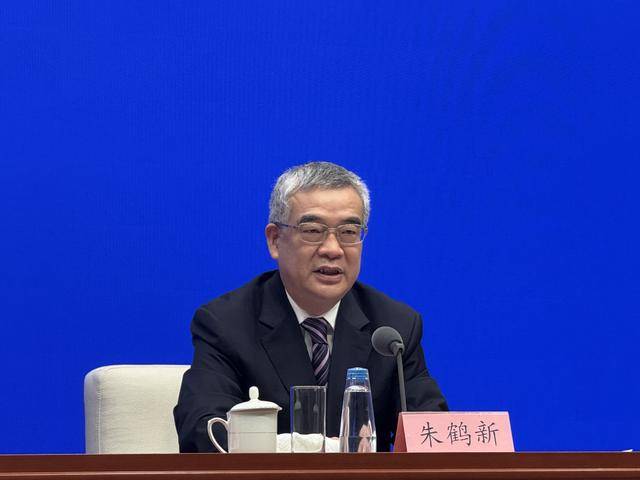
【纠错】 【责任编辑:施歌】 新华社快讯:中国人民银行副行长、国家外汇管理局局长朱鹤新9月22日在国新办举行的"高质量完 成'十四五'规划"系列主题新闻发布会上介绍,"十四五"以来,我国外汇储备始终稳定在3万亿美元以 上,近两年在3.2万亿美元以上。国家外汇局持续做好外汇储备经营管理,保障资产安全、流动和保值 增值,外汇储备充分发挥了国家经济金融重要"稳定器"和"压舱石"作用。 ...
朱鹤新:“十四五”以来我国外汇储备始终稳定在3万亿美元以上
Zheng Quan Shi Bao Wang· 2025-09-22 07:31
人民财讯9月22日电,9月22日,在介绍"十四五"时期金融业发展成就时,中国人民银行副行长、国家外 汇局局长朱鹤新在国新办新闻发布会上表示,"十四五"以来,我国外汇储备始终稳定在3万亿美元以 上,近两年在3.2万亿美元以上,我们持续做好外汇储备经营管理,保障资产安全流动和保值增值。外 汇储备充分发挥了国家经济金融重要稳定器和压舱石的作用。 ...
支撑比索,阿根廷三天抛售11亿美元
Sou Hu Cai Jing· 2025-09-22 04:44
Group 1 - The Argentine central bank has spent $1 billion to defend the peso amid a political crisis, selling over $1 billion in foreign reserves within three days to support the currency [1] - The central bank's actions included a record sale of $678 million in a single day, the highest since October 2019, as the peso continues to depreciate [1] - The Argentine government received a $20 billion loan from the IMF in April, which led to the relaxation of long-standing currency controls and the introduction of a new exchange rate regime [1] Group 2 - Despite significant government spending to support the peso and stricter trading controls, investor confidence remains low, leading to a mass exit from the market [2] - The Argentine S&P Merval index has performed poorly compared to over 90 global benchmark indices tracked by Bloomberg [2] - The country's risk index has reached its highest level since August 2024, hovering around 1500 basis points, indicating a lack of investor confidence [2] Group 3 - Following political setbacks for President Milei, the Argentine bonds, stocks, and currency have all experienced significant declines, with the peso dropping 9% in the past two weeks [2] - Economists estimate that the government would need $9.75 billion to maintain the current exchange rate until the elections, which may be too costly and could lead to changes in the exchange rate mechanism [2] - Continuous dollar sales could deplete foreign reserves, jeopardizing short-term debt repayments and potentially increasing bond issuance to cover funding gaps [2]
支撑比索,阿根廷央行三天抛售11亿美元外汇储备
Huan Qiu Shi Bao· 2025-09-21 22:47
Group 1 - The Argentine central bank has spent $1 billion to defend the peso amid a political crisis, selling over $678 million in foreign reserves in a single day, the highest since October 2019 [1] - The peso has been declining almost daily for the past two weeks, with a drop of 9% attributed to the political setbacks faced by President Milei's party in local elections [2] - The government is under pressure to maintain the current exchange rate mechanism, with economists estimating that it would require $9.75 billion to defend the peso until the elections, which may be too costly for the government [2] Group 2 - Despite the government's efforts to reassure investors and implement stricter trading controls, investor confidence remains low, leading to a poor performance of the Argentine S&P Merval index [2] - The country's risk index has reached its highest level since August 2024, hovering around 1500 basis points, indicating a lack of investor confidence [2] - Continuous dollar sales may deplete foreign reserves, jeopardizing short-term debt repayments and potentially leading to increased bond issuance to cover funding gaps [2]
突然,暴跌!阿根廷紧急救市!
Zheng Quan Shi Bao· 2025-09-21 04:55
Core Viewpoint - Argentina is facing a severe currency crisis, prompting the central bank to intervene in the foreign exchange market by selling a total of $1.11 billion to support the peso, which has depreciated significantly against the dollar [1][3][4]. Group 1: Currency Intervention - The Argentine central bank sold $678 million on Friday, following sales of $379 million on Thursday and $53 million on Wednesday, marking a total intervention of $1.11 billion over three days [3]. - The peso has depreciated nearly 11% against the dollar in the past month and has seen a year-to-date decline of 30.1% [3]. Group 2: Government Response - Economy Minister Luis Caputo vowed to use "the last dollar" to defend the exchange rate and plans to guarantee payments on international bonds maturing in January and July 2026 [4]. - The government has implemented new foreign exchange controls to stabilize the currency, including stricter regulations on banks and prohibiting certain financial transactions [9][10]. Group 3: Political Context - The peso's collapse is attributed to a political crisis, following unexpected electoral losses for President Javier Milei's party, which undermined investor confidence in his ability to maintain a free-market agenda [8][9]. - The upcoming midterm elections on October 26 are critical, as they will reflect public sentiment towards Milei's economic policies and could influence the stability of his administration [9]. Group 4: Economic Implications - Analysts warn that the massive sale of dollars to support the peso could lead to a significant contraction in economic activity, potentially resulting in credit tightening and economic recession [4]. - The International Monetary Fund's (IMF) $20 billion loan has provided temporary relief but has not led to a sustainable accumulation of reserves, leaving Argentina with limited foreign exchange resources [4].
阿根廷,突然最大规模救市
Zhong Guo Ji Jin Bao· 2025-09-20 22:54
Core Insights - The Argentine central bank conducted its largest single-day dollar sale in nearly six years, amounting to $678 million, to support the peso amid political instability and increased demand for dollars from institutional investors [1] - The total dollar sales over the past three trading days reached $1.1 billion, indicating a significant intervention to manage liquidity as the peso hovers at historical lows [1] - Economic Minister Luis Caputo stated that the central bank will sell every dollar in reserves at the upper limit of the floating exchange rate [1] Group 1 - The peso fell to a historical low of 1,520 per dollar in the parallel exchange market, depreciating over 6% this week [3] - Since the agreement with the International Monetary Fund (IMF) in mid-April, the central bank had not intervened in the market until now [4] - Analysts estimate that if the current pace of dollar sales continues, reserves could decrease by approximately $10 billion before the elections, which is about 70% of the funds already disbursed by the IMF [4] Group 2 - The central bank's net international reserves are reported at $39.26 billion, but usable reserves for intervention are estimated to be only around $6 billion [4] - Continuous dollar sales may accelerate the depletion of reserves, jeopardizing short-term debt repayments, and could lead to increased issuance of local currency bonds to cover funding gaps [5] - The "country risk" indicator has risen to its highest level since August 2024, hovering around 1,500 basis points, with off-market bonds averaging a decline of 1.4% this week [6] Group 3 - The stability of the Argentine peso is deemed crucial; failure to maintain it could lead to soaring prices and undermine President Milei's support for necessary reforms [8] - President Milei vowed to defend the peso at all costs, echoing statements from his chief economic advisor [8] - Analysts warn that maintaining the current exchange rate could risk returning the country to rampant inflation, which contradicts Milei's promise to end it [10]
阿根廷比索:重挫突破交易区间,干预或耗外汇储备
Sou Hu Cai Jing· 2025-09-18 02:02
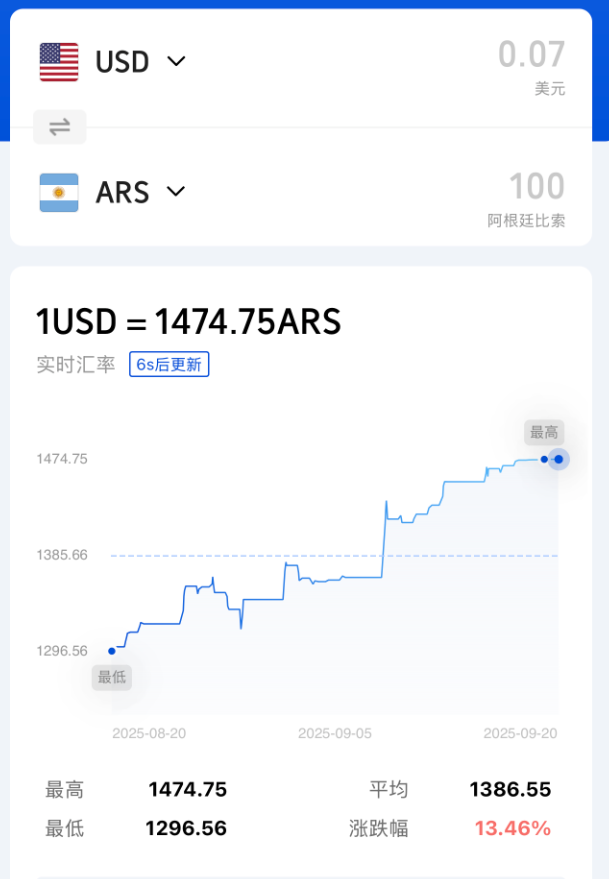
Core Viewpoint - The Argentine peso has significantly depreciated, breaching the government-set trading band, which may disrupt the government's policies aimed at controlling inflation and accumulating foreign reserves [1] Group 1: Currency Performance - The Argentine peso fell nearly 0.4% against the US dollar, reaching 1,474.50 pesos per dollar, surpassing the upper limit of the trading band set at 1,474.345 pesos per dollar [1] - This trading band is part of a $20 billion agreement reached between Argentina and the International Monetary Fund in April [1] Group 2: Government Response - The government, led by President Javier Milei, has attempted to prevent peso depreciation through measures such as tightening liquidity, selling dollars in the futures market, and restricting dollar purchases [1] - With the trading band breached, the central bank is now allowed to intervene directly in the spot market, which will deplete valuable foreign reserves [1] Group 3: Expert Opinions - Thierry Larose, a portfolio manager at Vontobel Asset Management, warned that defending the trading band could be costly [1] - Larose suggested that it may be better for the government to raise the trading band and lower local interest rates to avoid recession while maintaining fiscal sustainability [1] - He emphasized the importance of conducting these changes in an orderly manner to prevent exhausting foreign reserves in a battle that is unlikely to be won [1]