
机器人产业

Search documents
万里扬机器人行星关节模组首台产品下线
Zhong Guo Zheng Quan Bao· 2025-10-13 12:11
Core Viewpoint - Wanliyang's launch of its first planetary joint module product marks a significant technological breakthrough in the robotics sector, indicating the company's strategic expansion into new business areas [1][2] Group 1: Product Development - The first planetary joint module has an outer diameter of 90mm, a length of 68mm, and a peak torque of 180 Nm, with a torque density improvement of approximately 30% compared to similar products [1] - The product features absolute positioning accuracy and repeat positioning accuracy of less than 0.5 arc minutes, making it suitable for high-load areas such as the waist, hips, and knees of robots [1] Group 2: Company Background and Strategy - Wanliyang began its foray into the robotics industry in 2023, establishing Zhejiang Wanliyang Robotics Technology Co., Ltd. on May 22 to focus on the R&D and industrialization of precision transmission products for robotic joints [2] - The company has over 20 years of experience in the automotive transmission field, which provides a solid technical foundation for its entry into the robotics sector [2] - The product range includes harmonic reducers, planetary reducers, brushless motors, and controllers, with diameters from 30mm to 150mm and torque capacities from 0.5 Nm to 350 Nm, applicable in humanoid robots, articulated robots, and AGVs [2] Group 3: Research and Development Capabilities - The R&D team comprises over 60% of master's and doctoral degree holders, skilled in structural simulation, electromagnetic design, and testing optimization [2] - The company has established a national-level laboratory recognized by CNAS, equipped with facilities such as an NVH anechoic chamber and environmental high/low temperature testing platforms [2] Group 4: Production Capacity and Future Plans - Wanliyang plans to establish an annual production capacity of 450,000 joint modules in Jinhua, with expected production capabilities by the end of February 2026 [2] - The company aims to build advantages in product performance and quality in the robotic joint module sector and intends to collaborate with upstream and downstream enterprises in the industry [2]

专访丨中国机器人产业跃升为全球制造业自动化的重要引擎——访国际机器人联合会主席伊藤孝幸
Xin Hua Wang· 2025-10-13 03:28
Core Insights - The Chinese robotics industry is rapidly developing and has become a crucial engine for global manufacturing automation [1][2] - China accounted for over 50% of the new industrial robots installed globally in 2024, with 295,000 units, significantly outpacing other countries [1] - The demand for robots in China is driving the growth of local manufacturers and enhancing international supply chains [1][2] Industry Developments - The modernization of China's manufacturing sector is accelerating the deepening and diversification of robot applications [2] - Strong demand for precision assembly robots is driven by the steady development of the electronics industry, while the metalworking sector is increasingly adopting welding and handling robot technologies [2] - Automation applications are rapidly growing in various industries, including metal processing, food, textiles, and wood processing, highlighting the structural upgrades in Chinese manufacturing [2] Future Outlook - The global robotics market is expected to maintain steady growth, with an average annual increase of about 10% in the coming years [3] - China will continue to be the most important and dynamic market in the robotics industry, with growth reflected in both quantity and technological innovation [3] - The expansion of application scenarios and improvement in technology within the Chinese robotics industry are reshaping manufacturing and injecting new vitality into the global robotics sector [3]

专访|中国机器人产业跃升为全球制造业自动化的重要引擎——访国际机器人联合会主席伊藤孝幸
Xin Hua She· 2025-10-13 02:24
Core Insights - The Chinese robotics industry is rapidly developing and has become a crucial engine for global manufacturing automation [1][2] - China accounted for over 50% of the new industrial robots installed globally in 2024, with 295,000 units, significantly outpacing other countries [1] - The demand for robots in China is driving the growth of local manufacturers and enhancing the international supply chain [1][2] Industry Trends - The modernization of China's manufacturing sector is accelerating the deepening and diversification of robot applications, particularly in electronics and metal machinery [2] - There is a strong demand for precision assembly robots in the electronics sector, while the metalworking industry is increasingly adopting welding and handling robot technologies [2] - Automation applications are rapidly growing in various sectors, including metal processing, food, textiles, and wood processing, highlighting the structural upgrades in Chinese manufacturing [2] Future Outlook - The global robotics market is expected to maintain steady growth, with an annual increase of approximately 10% in the coming years [3] - China will continue to be the most important and dynamic market in the robotics industry, contributing to both quantity and technological innovation [3] - The expansion of application scenarios and enhancement of technology in the Chinese robotics industry are reshaping manufacturing and injecting new vitality into the global robotics sector [3]
长城基金余欢:重点关注机器人领域,中外行业发展或迎共振
Xin Lang Ji Jin· 2025-10-10 09:10
Core Insights - The global technology giants are increasingly entering the robotics industry, leading to a resurgence in the robotics sector in the capital markets, with the humanoid robot index rising by 57.74% since April 8 [1] - The robotics industry is at a critical stage of transitioning from laboratory breakthroughs to industrial applications, presenting significant investment opportunities [1] - The robotics sector is expected to become a trillion-dollar market, with substantial growth potential in China [1] Global Developments - Numerous tech companies are making significant advancements in robotics, creating a competitive landscape [2] - Notable developments include Nvidia's release of the Jetson Thor robot chip, which boasts a 7.5 times speed increase and 128GB memory, and Tesla's plans for the Optimus V3 robot, aiming for mass production by 2026 [2] - Domestic companies like Yushutech and Bixuan are also making strides, with Yushutech announcing an open-source model and Bixuan securing a $1 billion strategic partnership for a super factory in the Middle East [2] Technological Advancements - Continuous technological improvements are enhancing robot functionality and performance, with more human-like features emerging [2] - The integration of large language models (LLM) and visual language models (VLM) is improving robots' cognitive abilities, while multi-modal sensors enhance environmental perception [2] - Reinforcement learning is optimizing gait algorithms, significantly improving robots' adaptability to various terrains [2] Policy Support - The Chinese government is actively promoting the robotics industry through favorable policies and initiatives [3] - Key policies include the inclusion of "embodied intelligence" in government reports and the issuance of opinions to develop intelligent robots as new-generation smart terminals [3] - Local governments are also launching action plans and establishing large-scale industrial funds to accelerate the transition from technology to industrialization [3] Financial Performance - The financial outlook for robotics companies is improving as applications in diverse scenarios become more prevalent [3] - By mid-2025, 34 listed robotics companies are projected to achieve a total revenue of 54.758 billion yuan, a 12.7% increase from 48.615 billion yuan in 2024, with net profits rising by 31.4% [3] Future Outlook - The year 2025 is anticipated to be a pivotal year for the humanoid robotics industry, with expected synergies across policy, industry, and capital sectors [4] - The rapid development of the industry is likely to lead to the emergence of more intelligent and flexible robots across various applications [4]
立中集团:与伟景智能签订机器人战略合作协议
Xin Lang Cai Jing· 2025-10-09 08:41
Core Viewpoint - The collaboration between Lichung Group and Beijing Weijing Intelligent Technology Co., Ltd. aims to extend Lichung Group's reach into the humanoid robotics industry and enhance the application of aluminum alloy materials and components in emerging sectors [1] Group 1: Partnership Details - On October 9, 2025, Lichung Group signed a "Robot Strategic Cooperation Agreement" with Beijing Weijing Intelligent Technology Co., Ltd. [1] - Lichung Group will supply high-performance aluminum alloy materials and lightweight key components to Weijing Intelligent [1] - Weijing Intelligent will provide visual inspection and standardized operation solutions for smart factories to Lichung Group [1] Group 2: Joint Initiatives - Both parties will establish a "Research Laboratory for Lightweight Materials and Components in Robot Manufacturing" focusing on new material research, automation production, and manufacturing process innovation [1] - The agreement includes plans to advance equity cooperation to deepen the partnership [1] Group 3: Expected Impact - The collaboration is anticipated to have a positive impact on the company's future annual operating performance [1]

消费电子板块大幅走强,消费电子ETF易方达(562950)助力布局产业链龙头
Sou Hu Cai Jing· 2025-10-09 05:16
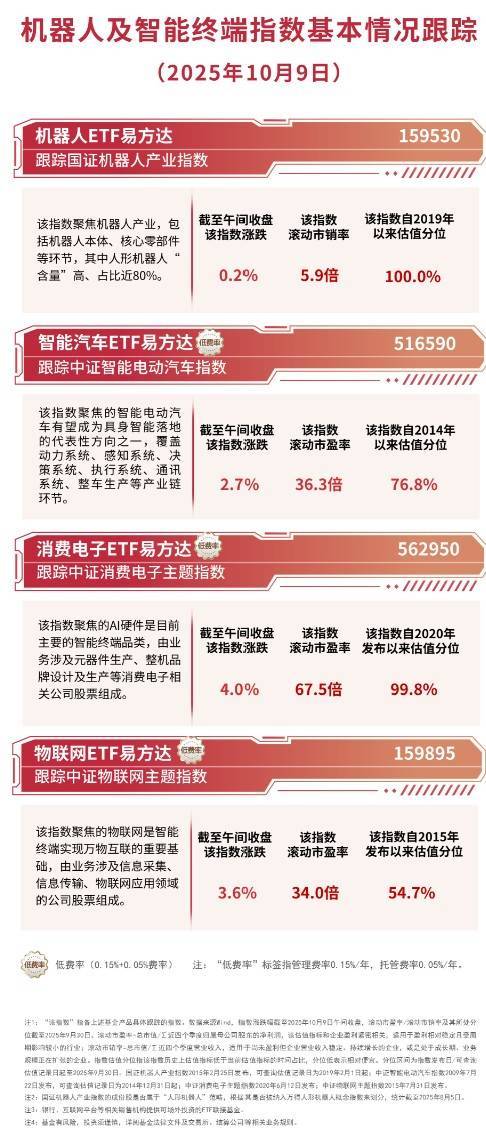
Group 1 - The National Robot Industry Index increased by 0.2% as of the midday close [1] - The China Securities Intelligent Electric Vehicle Index rose by 2.7% [1] - The China Securities Consumer Electronics Theme Index saw a rise of 4.0% [1] - The China Securities Internet of Things Theme Index increased by 3.6% [1] - As of September 30, the E Fund Consumption Electronics ETF (562950) experienced a net inflow of over 400 million yuan in the last 10 trading days [1]

撒贝宁把机器人梗玩出续集!
机器人大讲堂· 2025-10-05 04:06
Core Viewpoint - The article highlights the innovative developments in Shenzhen's robotics industry, showcasing how technology is being integrated into daily life and redefining service standards in the sector [1][19]. Group 1: Robotics Innovations - The "Robot 6S Store" in Longgang, Shenzhen, offers a unique service model that includes sales, spare parts supply, after-sales service, information feedback, rental, and personalized customization, creating a comprehensive service ecosystem [7][9]. - The store features hundreds of robots and components, with major robotics companies showcasing their products, breaking down barriers between robots and everyday life [7][9]. - The article mentions the evolution of exoskeleton robots, which can now lift weights of up to 20 kilograms, demonstrating their practical applications in various fields such as elderly assistance and industrial protection [5][9]. Group 2: Industry Growth and Ecosystem - Shenzhen's Nanshan Robot Valley is home to over 100 robotics companies, showcasing the city's rapid innovation pace, where prototypes can be developed within a day [10][17]. - The city has established itself as a leader in the low-altitude economy, with 1,058 takeoff and landing points and 309 flight routes, housing over 1,900 companies in this sector [10][17]. - The article notes that the number of AI companies in Longgang exceeds 620, and the robotics industry cluster has over 12,700 companies, indicating significant growth in the sector [17]. Group 3: Market Adaptation and Future Outlook - The article emphasizes that the robotics industry is transitioning from technological breakthroughs to large-scale implementation, with expectations that prices for household and educational robots will significantly decrease in the next 3 to 5 years, making them commonplace like smartphones [9][17]. - Shenzhen's innovation model is market-driven, allowing for rapid adaptation and quick market entry for new products, as highlighted by experts in the article [13][17]. - The integration of technology into urban life is evident through various smart city initiatives, such as facial recognition systems and automated libraries, showcasing Shenzhen's commitment to embedding technology in daily activities [17].

逾12万民众天安门广场观升旗为祖国庆生
Zhong Guo Xin Wen Wang· 2025-10-01 08:40
Core Points - The flag-raising ceremony at Tiananmen Square celebrated the 76th anniversary of the founding of the People's Republic of China, attended by over 120,000 people [1][3][4] Group 1: Event Details - The ceremony took place early in the morning, with attendees arriving before dawn to witness the event [3] - The flag-raising was marked by the performance of the military band and the presence of the honor guard [4] - The national flag was raised at 6:11 AM, accompanied by the national anthem and the release of doves [4][6] Group 2: Attendee Perspectives - Attendees expressed pride in the country's development, with individuals from various regions sharing personal stories of progress and modernization [3][6] - A student from Xinjiang highlighted the transformation in her hometown, including improved infrastructure and increased income opportunities [3] - A technology engineer from Hong Kong noted the rapid development in mainland China and the potential for Hong Kong to learn from these advancements [3]


山东城市观察丨把机器人“国赛”请到家里,济南凭什么?
Xin Lang Cai Jing· 2025-09-30 04:15
Core Insights - The 7th China Graduate Robotics Innovation Design Competition has opened in Jinan, showcasing the city's strength in the robotics industry and its connection to top innovation forces nationwide [1][3][12] - Jinan's robotics industry has established a robust ecosystem, with 113 related enterprises and a core industry scale of 15 billion yuan, capturing nearly half of Shandong Province's market share [6][17] - The city aims to become a new highland for robotics development in the Yellow River Basin, focusing on heavy-duty industrial robots, special operation robots, and humanoid robots [17][18] Industry Development - Jinan's robotics industry has evolved from a few companies a decade ago to a competitive landscape, supported by precise policies and deep integration of scenarios [8][10] - The city has implemented a comprehensive policy system to nurture the robotics industry, including a 5 billion yuan industry development fund and a unique "three lists" mechanism to match demand and supply across various sectors [9][10] - The average R&D investment intensity of Jinan's robotics companies is 18.7%, exceeding the national manufacturing average by 11 percentage points, fostering innovation in humanoid and special robots [10][15] Talent and Technology - The competition serves as a platform to attract young talent, with over 200 job openings and nearly 1,000 graduate students participating, enhancing Jinan's talent pool [14][15] - The event accelerates technology iteration in the industry, with collaborations between universities and companies leading to practical applications of advanced technologies [14][15] - Jinan's focus on integrating talent, education, and industry aims to create a synergistic ecosystem that supports continuous innovation and development in robotics [10][15] Future Outlook - The robotics industry is projected to grow to 400 billion yuan during the 14th Five-Year Plan period, with Jinan positioned as a key player in this expansion [17] - The city is committed to building a "six-haves" industrial ecosystem, targeting comprehensive development in talent, technology, products, scenarios, applications, and carriers [17][18] - With the establishment of a 5 billion yuan industry fund and the acceleration of resource flow within the robotics industry alliance, Jinan is set to advance rapidly in the robotics sector [18]


鹏华基金闫思倩:从0到1,机器人是AI+万亿空间的产业
Zhong Guo Jing Ji Wang· 2025-09-29 06:34
Core Insights - The article highlights a significant industrial transformation driven by technological breakthroughs and policy support, marking a shift in China's tech development from imitation to systematic breakthroughs [1][2] Group 1: Industry Trends - The development of artificial intelligence (AI) is extending from software applications to the physical world, with humanoid robots serving as a crucial integration point for AI and physical entities [2] - Major global tech companies, such as Tesla, are making substantial investments in humanoid robots, creating a strong industry-leading effect that accelerates technological iteration [2] - China's advantages in manufacturing, supply chain, and cost control provide a solid foundation for the localization of the robotics industry [2] Group 2: Investment Strategy - The investment approach combines top-down and bottom-up methodologies, focusing on sectors with "positive beta" such as new energy, automotive, and smart manufacturing robots [3] - The investment strategy involves identifying growth potential in emerging sectors, selecting companies with strong internal value, and capitalizing on market expectation discrepancies [3] - The core components of the robotics industry chain hold a high value proportion, and suppliers with first-mover advantages are expected to benefit as the industry moves towards large-scale production [3] Group 3: Future Outlook - The years 2025 to 2026 are anticipated to be critical for the industry as major manufacturers advance their mass production plans, leading to cost reductions and expanded application scenarios [4] - Humanoid robots are viewed as a key direction for the "last industrial revolution," with a clear long-term trend despite potential challenges in technology, cost, and commercialization [4] - Leading companies with core technologies and mass production capabilities are expected to emerge as winners in this industrial transformation, sharing in the long-term growth dividends of a trillion-dollar market [4]