生物制造

Search documents
76小时闪电跨界!环保龙头3.1亿双线押注医疗,收款“阵痛”中寻破局
Sou Hu Cai Jing· 2025-12-22 14:38
Core Viewpoint - Company Jindalai is making a significant shift into the health sector by investing over 310 million yuan in two companies, marking its transition from environmental protection to a dual focus on "environment + health" [2] Investment Details - Jindalai announced an investment of 280 million yuan to acquire a 34% stake in Jici Medical, focusing on cell therapy, and an additional 30 million yuan for a 10% stake in Zhongke Hongtai, which specializes in medical robotics [2][6] - The investment in Jici Medical positions Jindalai as the second-largest shareholder, just behind the controlling shareholder [3] Financial Performance of Target Companies - Jici Medical reported revenues of 11.23 million yuan and a net profit of 1.15 million yuan for the first three quarters of 2025, but its equity remains negative at -3.15 million yuan [4] - Zhongke Hongtai's revenue for the same period was only 102,600 yuan, with a net loss of 550,770 yuan, indicating ongoing financial challenges [6] Strategic Alignment with National Policies - Both investments align with national strategic emerging industries, with Jici Medical focusing on cell therapy and Zhongke Hongtai on the trend of intelligent medical devices [6] - The "14th Five-Year Plan" identifies biomanufacturing as a new economic growth point, with stem cell technology included as a key area [6] Challenges in Core Business - Jindalai's core environmental business is under pressure, with a revenue decline of 23.5% year-on-year for the first three quarters of 2025, leading to a search for new growth avenues [8] - The company is facing a "collection battle" with multiple lawsuits, indicating difficulties in cash flow management [9][12] Cash Flow and Investment Risks - Despite current cash flow stability, with over 2.2 billion yuan in liquid assets, future investments in the new sectors may strain resources, especially given the financial status of the target companies [14] - The high-risk nature of clinical trials in cell therapy and the complex registration processes for medical robots pose additional uncertainties for Jindalai's new ventures [14][15] Technical Synergy Concerns - There is limited technical synergy between Jindalai's core wastewater treatment technology and the new health sector investments, which may hinder the company's ability to leverage its existing expertise [15]


未来产业十强城市潜力报告出炉
Di Yi Cai Jing· 2025-12-22 13:33
Core Insights - The overall level of future industrial development in China is steadily improving, with cities like Shanghai and Beijing strengthening their advantages [1] - The "2022-2024 Future Industry Comprehensive Index" indicates that Shanghai and Beijing are leading, with Shanghai ranking first twice in three years [1][2] - The report emphasizes the need for cities to achieve coordinated development based on their unique endowments to avoid "involution" competition [5] Group 1: Future Industry Potential - The evaluation of ten core cities (Beijing, Shanghai, Tianjin, Shenzhen, Guangzhou, Nanjing, Hangzhou, Wuhan, Chengdu, Hefei) focuses on innovation capability, market potential, and policy support [2] - The Yangtze River Delta and Pearl River Delta regions show robust performance, with cities like Hangzhou and Guangzhou experiencing nearly 20% index growth [2][5] - Midwestern cities like Wuhan, Chengdu, and Hefei are rapidly releasing development potential, with Wuhan and Chengdu showing a cumulative index increase of about 50% [2] Group 2: Innovation and Policy Support - Innovation capabilities are concentrated in tech hubs like Beijing, Shanghai, and Shenzhen, with Beijing consistently leading [5] - Market potential is stratified, with Shanghai, Shenzhen, Guangzhou, and Beijing identified as core areas for future industrial commercialization [5] - The gap in policy support among cities is narrowing, indicating a clear trend of latecomer cities catching up [5] Group 3: Strategic Development Initiatives - Shanghai is accelerating the construction of an international technology innovation center, focusing on six key areas: future manufacturing, information, materials, energy, space, and health [6] - By 2027, Shanghai aims to achieve breakthroughs in disruptive technologies and establish future industry clusters [6] - The Shanghai State-owned Capital Investment Company is developing a three-in-one model for future industry funding and innovation incubation [7] Group 4: Global Trends and Collaboration - Major global economies are rapidly advancing in fields like embodied intelligence, brain-machine interfaces, and 6G technology [8] - Strengthening collaboration between Beijing and Shanghai is essential to establish a world-class future industry source [8]

生物制造未来产业发展研讨会在青岛西海岸新区举办
Xin Lang Cai Jing· 2025-12-22 12:09
转自:新华财经 一直以来,青岛将生物制造作为未来产业培育的重中之重,系统谋划、精准发力,特别是《青岛市合成 生物创新发展行动方案(2025-2027年)》的正式印发,为产业发展绘制了清晰"路线图"、制定了有 力"保障网",推动产业发展迈出坚实步伐。以青岛琅琊台集团等为代表的骨干企业,在海洋生物资源开 发、微生物发酵技术等领域积淀深厚,发展生物制造未来产业既有基础、更有优势、更具潜力。 据了解,青岛琅琊台集团将海洋微生物技术赋能白酒酿造,打造"中国海派白酒";依托衣康酸及其衍生 物研产销基地,坚定向合成生物制造高端领域迈进;建成海洋微藻、海洋活性肽等研发生产基地,推动 海洋生物资源的高值化开发与新质生产力转化。目前,青岛琅琊台集团已成功建设"国家认定企业技术 中心""国家级工业设计中心""中国轻工业海洋资源挖掘与产品创制工程技术中心"等八大"国字号"研发 平台,先后承担多项国家重点研发计划,并获得国家科技进步奖二等奖,在技术研发、产业转化与规模 生产等方面取得扎实成效。 青岛琅琊台集团相关负责人表示:"未来,集团将坚持创新驱动,进一步深化与科研机构的产学研合 作,构建可持续的创新源泉;加速推动研发成果产业化,促 ...
前瞻全球产业早报:全国首个高海拔岩洞式算力舱智算中心投运
Qian Zhan Wang· 2025-12-22 11:33
Group 1: Industry Developments - The national biomanufacturing industry in China has reached a total scale of 1.1 trillion yuan, with bioproducts accounting for over 70% of global production [2] - The first high-altitude rock cave computing power cabin intelligent computing center in China has been officially launched, with a total investment of 350 million yuan and the capacity to perform 60 quintillion floating-point operations per second [3] - The "15th Five-Year Plan" proposal from Anhui Province emphasizes strengthening original innovation and tackling key core technologies, particularly in fields like integrated circuits and biomanufacturing [4] Group 2: Artificial Intelligence and Technology - Shandong Province aims for its artificial intelligence terminal industry to exceed 450 billion yuan by 2027, with a focus on producing over 100 million units and nurturing leading enterprises [5][6] - The National Medical Products Administration held a meeting to advance brain-computer interface medical devices, emphasizing safety and innovation in regulatory methods [7] - ByteDance is collaborating with hardware manufacturers like Vivo and Lenovo to integrate AI capabilities into smartphones, aiming to enhance user engagement [7] Group 3: Scientific Breakthroughs - The journal "Science" has identified the growth of global renewable energy as the top scientific breakthrough for 2025, with significant contributions from China [4] - Other breakthroughs include advancements in gene editing for rare diseases and new treatments for gonorrhea, marking significant progress in health-related research [4] Group 4: Financial and Market Insights - Guizhou Moutai retains its position as the most valuable company in China's food industry, valued at 1.9 trillion yuan, with a 1% increase from the previous year [10] - OpenAI is reportedly planning to raise up to 100 billion dollars, potentially reaching a valuation of 830 billion dollars [14] - ChatGPT mobile application has surpassed 3 billion dollars in user spending since its launch in May 2023 [15]






豪掷3.1亿元,增资两家公司,金达莱“跨界”大健康
Xin Lang Cai Jing· 2025-12-22 11:19
Core Viewpoint - Jiangxi Jindalai Environmental Protection Co., Ltd. is making significant moves towards diversification by investing in the healthcare sector, specifically in stem cell technology and medical robotics, to optimize its industrial structure and cultivate new profit growth points [2][3][21]. Investment in Healthcare - On December 19, Jindalai announced an investment of 280 million yuan in Yunnan Jici Medical Technology Co., Ltd., acquiring a 34% stake, making it the second-largest shareholder [2][21]. - On December 21, the company announced an additional investment of 30 million yuan in Beijing Zhongke Hongtai Medical Technology Co., Ltd., acquiring a 10% stake [3][21]. - Both investments target the "big health industry," with Jici Medical focusing on proprietary stem cell technology and Zhongke Hongtai excelling in medical artificial intelligence [3][21]. Rationale for Investment - Jindalai aims to respond to national calls for investment in biomanufacturing and healthcare sectors, enhancing its risk resistance and creating new profit avenues [3][21]. - The company believes that the aging population and the maturation of the industry in China present ample investment opportunities in the big health sector [3][21]. Financial Overview of Jici Medical - As of September 30, Jici Medical reported total assets of 10.01 million yuan, with revenues and net profits of 11.23 million yuan and 1.15 million yuan, respectively, for the first nine months of 2025 [6][26]. - Despite not being particularly strong financially, Jici Medical's ability to generate initial self-sustaining revenue is notable in the capital-intensive biomanufacturing sector [6][26]. Financial Overview of Zhongke Hongtai - Zhongke Hongtai reported total assets of 61.58 million yuan and a net loss of 5.51 million yuan for the first nine months of 2025 [10][31]. - The company is recognized for its innovative medical robotics and has completed 16 clinical trials for its products, which are currently in the regulatory approval process [10][31]. Jindalai's Current Position - Jindalai has a strong financial position, with a debt ratio of only 10.2% and cash reserves exceeding 1.898 billion yuan, allowing it to fund these investments entirely with its own capital [12][33]. - However, the company has experienced a decline in its main business, with a 23.5% drop in total revenue and a 30.14% decrease in net profit for the first nine months of 2025 [13][33]. Strategic Shift - The investments in Jici Medical and Zhongke Hongtai mark Jindalai's formal entry into the biomanufacturing and big health sectors, aligning with national policies that support these industries as emerging growth areas [16][36]. - The company is part of a broader trend among environmental firms diversifying into non-environmental sectors, with nearly half of the listed environmental companies exploring such opportunities [17][38].

当美妆以科技定价,华熙生物被低估了?
FBeauty未来迹· 2025-12-22 10:53
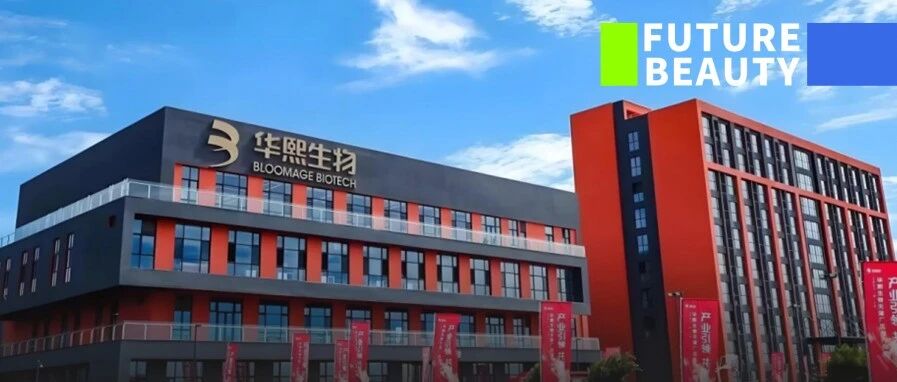
Core Viewpoint - The beauty industry is transitioning from a "traffic-driven" growth model to a "technology-driven" endurance model, necessitating a reevaluation of value assessment based on technological innovation and manufacturing capabilities [6][10]. Group 1: Policy and Industry Trends - The National Medical Products Administration released two significant documents emphasizing "raw material innovation" and the establishment of internal raw material incubators in leading companies, marking a long-term strategic direction for the beauty industry [4]. - The focus on biomanufacturing as a key future industry has been reiterated in government reports, indicating a systemic push from research to industry regulation [8]. Group 2: Company Strategy and Positioning - Companies like Huaxi Biological, which have built biotechnological and manufacturing capabilities over the past two decades, are now being reassessed for their strategic significance in the new industry landscape [5]. - Huaxi Biological's consistent investment in R&D, exceeding 2.2 billion yuan since its listing in 2019, positions it among the industry leaders in innovation [12]. Group 3: Technological Advancements - Huaxi Biological is pioneering the synthetic biology approach to PDRN production, addressing traditional issues related to safety and efficacy through innovative methods [17][18]. - The establishment of a large-scale synthetic biology pilot transformation platform, with over 3 billion yuan invested, enables the systematic conversion of research outcomes into scalable products [21]. Group 4: Market Dynamics and Valuation Logic - The market is shifting its focus from immediate sales performance to long-term capabilities, emphasizing the importance of a company's ability to anchor itself for the next five to ten years [9][10]. - Huaxi Biological's ability to maintain a stable cash flow from its raw materials and medical terminal businesses supports its ongoing R&D efforts, allowing it to navigate industry fluctuations without sacrificing long-term goals [28]. Group 5: Future Outlook - The beauty industry's core competitiveness is increasingly centered on biotechnological and biomanufacturing capabilities, as evidenced by international giants investing in similar technologies [22]. - Huaxi Biological's comprehensive biotechnological and manufacturing system is seen as a "ticket" to navigate through industry cycles, with its true value beginning to be recognized by the market [31].

或冲刺第四家股份行AIC!光大银行称稳步筹划相关申设工作
2 1 Shi Ji Jing Ji Bao Dao· 2025-12-22 10:46
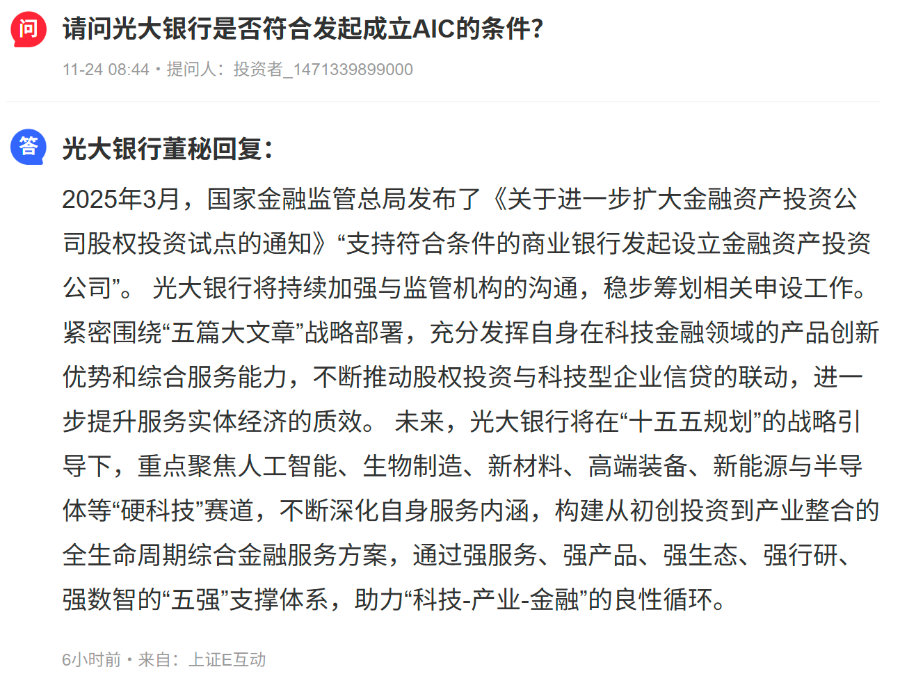
Core Viewpoint - Everbright Bank is planning to establish a financial asset investment company (AIC) in response to regulatory support for qualified commercial banks to set up AICs, with a focus on enhancing communication with regulatory bodies and advancing related preparations [2][4]. Group 1: Regulatory Context - In March 2025, the National Financial Regulatory Administration issued a notice supporting qualified commercial banks in establishing AICs, which aligns with Everbright Bank's strategic plans [2][4]. - The policy framework for AICs has been expanding, with the regulatory body announcing in May that the scope for establishing AICs would include qualified national commercial banks, thereby laying a foundation for the expansion of bank-affiliated AICs [4]. Group 2: Strategic Focus - Everbright Bank aims to leverage its strengths in technological finance and product innovation to enhance the quality and efficiency of services to the real economy, focusing on sectors such as artificial intelligence, biomanufacturing, new materials, high-end equipment, new energy, and semiconductors [4]. - The bank's strategy includes a comprehensive financial service solution that spans from initial investment to industrial integration, supported by a robust framework of five strengths: strong services, strong products, strong ecosystems, strong research and development, and strong digital intelligence [4]. Group 3: Industry Developments - As of December, the establishment of AICs by joint-stock banks has accelerated, with several banks, including China Merchants Bank and CITIC Bank, launching their AICs, indicating a growing trend in the sector [5]. - A total of nine AICs have been approved nationwide, including those under major state-owned banks and joint-stock banks, with Everbright Bank potentially becoming the fourth joint-stock bank to establish an AIC if its application is successful [5]. - Since the initiation of market-oriented debt-to-equity swaps in 2016, AICs have evolved from a singular risk mitigation tool to a key player in supporting technological innovation and industrial upgrades, especially following the regulatory expansion of AIC equity investment trials in 2024 [5].

茅台、啤酒、巧克力:千亿“剩宴”变形记
Xin Lang Cai Jing· 2025-12-22 05:17
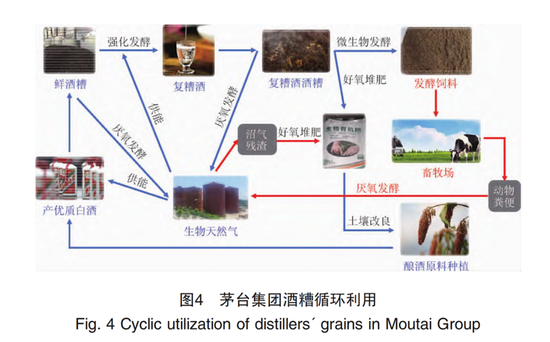
Group 1: Global Market and Technological Drivers - The upcycled food industry is emerging as a significant circular economy pathway, converting food waste into high-value products, addressing the challenge of food waste which accounts for 8%-10% of global greenhouse gas emissions [1][2] - The global upcycled food market is projected to grow at a compound annual growth rate (CAGR) of 5.6%, reaching a market size of $74.8 billion by 2029 according to BCC Research [2][3] - Advanced technologies such as artificial intelligence (AI) and biomanufacturing are driving the rapid development of this industry, with companies like Agrain utilizing AI to optimize the use of brewing waste [2][3][8] Group 2: Diverse Products and Innovative Cases - Upcycled food applications have led to the creation of new product categories, such as upcycled flour from brewing waste by Upcycled Foods and cocoa powder from cocoa fruit pulp [3][10] - Brazilian company Cellva Ingredients has developed "CoffeeCoa," a chocolate ingredient derived from coffee processing waste, providing a unique flavor experience [3][10] - The application of biomanufacturing extends beyond food, as seen in the collaboration between Yiru Biotechnology and China Resources Snow Beer, which produces 100% bio-based leather materials from brewing byproducts [3][10][11] Group 3: Exploration and Practices of Chinese Enterprises - In China, the resource utilization of food byproducts is becoming a key direction for leading companies to implement ESG (Environmental, Social, and Governance) principles [4][11] - Kweichow Moutai's circular investment company has established a complete recycling system for brewing byproducts, processing 300,000 tons annually to produce 120,000 tons of organic fertilizer and 20,000 tons of feed [4][11] - Companies like Shanghai Punotin focus on upgrading byproducts from soybean processing into sustainable food ingredients, while Green Spot Technologies has recently secured €5 million in funding for producing chocolate from fruit waste [5][12] Group 4: Conclusion - The upcycled food industry is building a more efficient and sustainable food supply chain, with potential for greater growth as technology advances and consumer awareness of environmental issues increases [6][14]
申万宏源晨会报告-20251222
Shenwan Hongyuan Securities· 2025-12-22 02:46
Group 1: Market Overview - The Shanghai Composite Index closed at 3890, with a slight increase of 0.36% [1] - The Shenzhen Composite Index also saw a rise of 0.98%, indicating a positive market sentiment [1] - Large-cap indices showed a modest increase of 0.3% yesterday, while mid-cap and small-cap indices performed better with increases of 0.91% and 0.8% respectively over the same period [1] Group 2: Industry Performance - The home decoration industry led the gains with a 3.33% increase yesterday, reflecting strong demand [1] - The energy sector also performed well, with a 3.26% increase, although it has seen a decline of 3.9% over the past month [1] - Conversely, the electronic components sector faced significant declines, with a drop of 3.46% yesterday and a 69.42% decrease over the past six months [1] Group 3: Future Industry Trends - The report highlights key future industries including quantum technology, bio-manufacturing, hydrogen energy, and brain-computer interfaces, emphasizing recent breakthroughs and commercialization efforts [10][8] - In quantum technology, a significant academic breakthrough was reported with the development of an 11-qubit silicon-based processor, marking progress in semiconductor quantum computing [10][8] - The bio-manufacturing sector is seeing advancements with AI applications in pharmaceuticals, as a unicorn company plans to raise 2.277 billion HKD for drug development [10][8] Group 4: Strategic Recommendations - The report suggests focusing on the hydrogen energy sector, particularly with the launch of the world's largest green hydrogen project, which is expected to drive growth in this area [10][8] - The brain-computer interface technology is advancing with successful clinical trials, indicating a promising future for this field [10][8] - The automotive industry is witnessing the approval of L3 autonomous driving models, which is expected to enhance the market for intelligent vehicles [21][22]
央视报道:我国生物制造产业规模达1.1万亿元!
合成生物学与绿色生物制造· 2025-12-22 02:40
Core Viewpoint - During the "14th Five-Year Plan" period, China's bio-manufacturing industry has experienced significant growth, becoming a crucial force for optimizing and upgrading the economic structure, with a total scale reaching 1.1 trillion yuan [2][3]. Industry Overview - The bio-manufacturing industry in China has steadily expanded, achieving a total scale of 1.1 trillion yuan, with bio-fermentation products accounting for over 70% of global production [3][4]. - The annual output value of sub-sectors such as food additives and biopharmaceuticals exceeds 400 billion yuan, establishing bio-manufacturing as a new economic growth point [3][4]. Technological Innovation - China's bio-manufacturing sector holds over 20% of global patent applications, with the establishment of several national key laboratories and industrial innovation platforms [4]. - New instruments such as domestic high-throughput gene sequencers and large-scale fermentation tanks have been successfully industrialized [4]. Industrial Cluster Development - Regions like Beijing and Tianjin have emerged as innovation hubs for bio-manufacturing, while provinces such as Shandong, Heilongjiang, and Henan have developed into major manufacturing bases for bulk bio-fermentation products [5]. - The "14th Five-Year Plan" has fostered the growth of numerous backbone enterprises with annual revenues exceeding 10 billion yuan, along with the emergence of several national-level manufacturing champions and specialized "little giant" enterprises [5]. Policy and Recognition - The Ministry of Industry and Information Technology (MIIT) has released a list of 35 landmark bio-manufacturing products, with companies like New Hope Liuhe, Blue Crystal Microbiology, and Huaxi Biological among the applicants [6][8].