
太空算力

Search documents
国金计算机:空天时代三大预期差,布局五大主线
Xin Lang Cai Jing· 2026-01-11 10:22
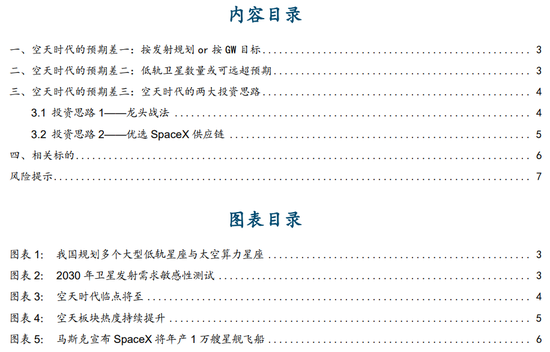
Group 1 - The core viewpoint of the article highlights the significant discrepancies in expectations regarding the space and aerospace industry, particularly in satellite launches and space computing capabilities [1][31]. - The first expectation gap is between launch planning and GW targets, with current satellite numbers falling short of projections due to limited rocket resources. As of December 2025, only 136 GW satellites and 108 Qianfan satellites are in orbit, leading to lower-than-expected market predictions for satellite launch progress [1][43]. - Elon Musk's announcement in November 2025 about expanding the Starlink V3 satellite scale and establishing a space data center aims for an annual deployment of 100 GW of data centers within 4-5 years, indicating a need for 500,000 to 800,000 satellites based on a power output of 100 kW per satellite [1][31][43]. Group 2 - The second expectation gap concerns the actual capacity for low Earth orbit (LEO) satellites, which is believed to be significantly higher than the market's common estimate of 60,000 to 100,000 satellites. Research suggests that LEO could accommodate up to 700,000 satellites under revised safety standards [2][15]. - The third expectation gap presents two major investment strategies: focusing on leading companies in the aerospace sector and selecting suppliers within the SpaceX supply chain. The commercial aerospace sector's market capitalization has increased from 1.3% to 6.0% since November 2025, indicating growing interest and investment potential [3][19]. - SpaceX is planning an IPO with a target valuation of $1.5 trillion and aims to produce 10,000 Starship spacecraft annually, which could significantly benefit its supply chain partners [3][21]. Group 3 - Related investment targets include companies in the SpaceX supply chain such as Xinwei Communication, Yujing Co., and Maiwei Co. [4][35]. - Companies involved in space computing include Shunhao Co. and Putian Technology [5][56]. - The rocket manufacturing sector includes Aerospace Power, Western Materials, and Aerospace Electromechanical [6][57]. - Satellite-related companies include China Satellite, Mingyang Smart Energy, and Shanghai Hantong [7][56].

20万颗!下周A股核心主线来了!
格隆汇APP· 2026-01-11 09:43
Core Viewpoint - The article highlights a significant development in the commercial space sector, with China submitting a record application for 203,000 satellite frequency orbits, indicating an intensifying global competition for space resources [2][4]. Group 1: Satellite Deployment and Strategic Intent - China has submitted an application for 203,000 satellites, covering 14 satellite constellations, marking the largest single application in the country’s history [2]. - The CTC-1 and CTC-2 constellations, led by the Radio Innovation Institute, account for 193,428 satellites, representing 95.3% of the total application [2][4]. - The strategic intent behind this large-scale application is to secure satellite frequency and orbit resources, which are limited and follow a "first come, first served" principle [5]. Group 2: Competitive Landscape - The competitive landscape is highlighted by the simultaneous approval of SpaceX's deployment of 7,500 second-generation Starlink satellites by the FCC, bringing the total to 15,000 [2]. - The article notes that the U.S. currently has about 75% of the global satellite count, while China holds approximately 9%, indicating a significant gap and the urgency for China to enhance its satellite capabilities [5]. Group 3: Industry Growth and Future Projections - The commercial space sector in China is expected to see a rapid increase in satellite launches, with an estimated annual launch requirement rising from hundreds to over a thousand to meet existing applications [8]. - By 2025, China is projected to complete 92 space launches, surpassing 300 satellites and spacecraft, indicating a shift towards a dual-driven model of state and private sector collaboration [10]. - The year 2026 is anticipated to be pivotal for the commercial space industry, with advancements in rocket technology and increased launch capacity expected to drive significant growth [16][18]. Group 4: Investment Opportunities - The article suggests that sectors such as satellite manufacturing, rocket launch services, and ground equipment are likely to attract investment as the industry matures [13][14]. - Companies with technological or production advantages in critical areas like phased array antennas and satellite computing are expected to have greater growth potential [15].
掘金太空能源新蓝海 产业龙头押注钙钛矿电池
Zheng Quan Ri Bao· 2026-01-09 16:25
Core Insights - The development of space computing power is heavily reliant on energy supply solutions, particularly in the harsh environment of space where traditional photovoltaic technologies face significant challenges [1][2] - Perovskite solar technology is emerging as a promising alternative due to its high conversion efficiency, lightweight characteristics, and potential for radiation resistance, making it suitable for space applications [3][4] Group 1: Perovskite Solar Technology Advantages - Perovskite materials can achieve a theoretical light-to-electricity conversion efficiency of around 45%, providing a competitive edge over existing technologies [3] - The lightweight nature of flexible perovskite films, weighing only 1% of traditional silicon, can significantly reduce launch costs and allow for larger energy systems on satellites [3][4] - Enhanced performance in radiation environments positions perovskite batteries as a viable option for long-term space missions [3][11] Group 2: Industry Developments and Collaborations - Companies like Aerospace Hongtu and Wuxi Zhongneng are forming strategic partnerships to advance perovskite technology for space applications, focusing on research, on-orbit validation, and industrial collaboration [5][6] - Longi Green Energy has established a space energy laboratory to explore the feasibility of solar energy technologies in extreme conditions, aiming to develop lightweight components and improve perovskite technology [8] - The industry is witnessing a shift towards commercialization, with expectations for perovskite technology to support various space applications, including satellite power systems and deep space exploration [9][10] Group 3: Future Market Potential - The advancement of space computing and commercial aerospace is expected to open new markets for the photovoltaic industry, with perovskite technology potentially expanding beyond satellites to include space stations and in-orbit manufacturing [9] - The market for perovskite-silicon tandem solar cells is projected to see significant growth, driven by government policies and capital focused on industrialization [10] - As technology matures, perovskite solar cells are anticipated to play a crucial role in the future space economy, supporting energy needs for various space-based applications [11]


老股都成了“香饽饽”!资本加速卡位商业航天,“太空算力”争夺战一触即发
Zheng Quan Shi Bao Wang· 2026-01-09 08:08
Core Insights - The commercial space sector in China is experiencing significant momentum, with companies like Blue Arrow Aerospace, Tianbing Technology, Xinghe Power, Interstellar Glory, and CAS Space aiming to become the "first commercial rocket stock" with valuations exceeding 10 billion yuan [1] - In the U.S., SpaceX is advancing its IPO plans with a valuation potentially reaching $1.5 trillion, indicating a competitive race for space resources [1] - The market is witnessing increased activity as investors rush to secure shares in promising projects, leading to rising valuations and a shrinking investment window [1] Investment Trends - Existing shareholders are reluctant to sell their stakes in the booming commercial space sector, with many investors actively seeking to acquire shares from early investors [2][3] - The demand for shares in leading companies is high, with many firms focusing on secondary market listings rather than new financing [2][3] - The commercial space sector is characterized by a long and broad investment landscape, with opportunities for share transfers in segments like commercial radar satellites and communication satellites targeting Central Asia and the Middle East [3] Market Dynamics - The commercial space sector has seen a resurgence in investment interest, particularly since 2018-2019, following initial government encouragement in 2014 [5][6] - Recent years have seen a surge in capital from both dollar and yuan funds, with local government funds also entering the market [6] - The profitability of SpaceX's Starlink has been a pivotal turning point, driving investor confidence and highlighting the commercial viability of low Earth orbit satellite networks [6][7] Policy and Regulatory Environment - The introduction of the "1+6" reform policy for the Sci-Tech Innovation Board has established favorable listing standards for commercial space companies, enhancing investor confidence [7] - The competitive landscape between China and the U.S. in the space sector is intensifying, with policies supporting the development of commercial space initiatives [7] - A series of government policies, including the establishment of a commercial space administration and funding initiatives, are expected to provide ongoing support for the industry [7] Valuation and Growth Potential - The valuation of commercial space companies has significantly increased, with leading firms now valued at over 10 billion yuan [8] - The industry is transitioning from technology validation to large-scale commercialization, indicating substantial future growth potential [8] - While some companies have seen their valuations rise sharply, their revenues have not always kept pace, leading to discussions about the sustainability of these valuations [8] Future Opportunities - Beyond leading companies, there are investment opportunities in critical supply chain segments such as aerospace chips, specialized batteries, and satellite control services [9] - The emerging "space computing" sector is seen as a new frontier for commercial space, with major tech companies vying for dominance [9] - The focus on cost reduction through reusable rocket technology is crucial for achieving frequent and scalable launches, with significant investment opportunities remaining in the supply chain [10]
政策+产业共振!卫星ETF(159206)涨超7%,近50日资金狂买50亿元!
Sou Hu Cai Jing· 2026-01-09 03:13
Core Viewpoint - The commercial aerospace sector is experiencing significant growth, driven by policy support and advancements in technology, with a notable increase in satellite ETF performance and investment opportunities in satellite communication and launch services [1][2]. Group 1: Market Performance - As of January 9, the satellite ETF (159206) rose by 7.22%, with constituent stocks such as Xinke Mobile and Zhenyou Technology hitting the daily limit up [1]. - The latest scale of the satellite ETF reached 9.426 billion yuan, marking a new high since its inception [1]. Group 2: Policy Developments - Guangzhou has issued a plan to accelerate the construction of an advanced manufacturing city, focusing on low-cost, high-reliability launch vehicles and satellite constellations, aiming to establish a southern aerospace hub [1]. - The plan emphasizes breakthroughs in reusable technology and the development of satellite communication and remote sensing equipment, integrating new information technologies like AI and 5G/6G [1]. Group 3: Industry Developments - China has submitted an application to the International Telecommunication Union (ITU) for an additional 203,000 satellites, covering 14 satellite constellations, with CTC-1 and CTC-2 being the main contributors [1]. - Blue Arrow Aerospace has signed contracts with China Star Network and Yuanxin Satellite for launch services, marking a significant step for private rocket companies in undertaking national satellite constellation deployment [2]. - Guosheng Securities predicts a new wave of growth in the commercial aerospace sector, driven by policy support and accelerated launch schedules for low-orbit satellite constellations [2]. Group 4: Investment Opportunities - The satellite ETF (159206) is the first and largest of its kind in the market, focusing on commercial aerospace and satellite communication, and is expected to benefit from the current market trends [3]. - Investors can access commercial aerospace opportunities through linked funds, indicating a growing interest in this sector [3].
光伏技术革新赋能未来能源,光伏ETF嘉实(159123)一键布局光伏产业链
Xin Lang Cai Jing· 2026-01-09 03:13
Group 1 - The core viewpoint of the articles highlights the growth and commercialization of space photovoltaic technology, which offers significant advantages over traditional ground-based data centers, including higher deployment efficiency, better energy efficiency, and lower cooling costs [1] - The China Securities Index indicates that the photovoltaic industry index has seen a rise of 0.82%, with notable increases in component stocks such as Robotech (up 7.25%) and Dier Laser (up 5.81%) [1] - The global photovoltaic installation capacity is expected to continue growing over the next 3-5 years, with an estimated new installation capacity of 630-650 GW by 2026, although growth rates may slow to single digits [1] Group 2 - As of December 31, 2025, the top ten weighted stocks in the photovoltaic industry index include TBEA, LONGi Green Energy, and Sungrow Power, collectively accounting for 55.11% of the index [2] - The photovoltaic ETF managed by Harvest (159123) tracks the China Securities photovoltaic industry index, providing a convenient tool for investing across the entire photovoltaic industry chain [2] - Investors can also access photovoltaic industry investment opportunities through the off-market connection of the photovoltaic ETF (014605) [3]
金融界财经早餐:重磅利好!中国石化、中国航油官宣重组;广州剑指商业航天新一极;A股重要指数今天调整;Minimax今日登陆港交所;万科郁亮退休(1月9日)
Jin Rong Jie· 2026-01-09 01:28
Group 1: Industry Developments - The Chinese government is taking steps to regulate the rapidly growing power and energy storage battery industry, addressing issues such as irrational competition and blind construction that disrupt market order and sustainability [1] - The Ministry of Industry and Information Technology, along with other regulatory bodies, held a meeting to discuss the competitive order in the battery industry, emphasizing the need for governance to ensure sustainable development [1] - The solar photovoltaic industry is facing scrutiny from the market regulator, which has issued corrective measures to prevent monopolistic practices among major companies [2] Group 2: Company News - China Petroleum and Chemical Corporation (Sinopec) and China Aviation Oil have been approved for a merger, which is expected to enhance their competitive edge and reduce aviation fuel supply costs [5] - Vanke's executive vice president, Yu Liang, is retiring, marking the end of a 35-year career with the company, but this will not affect the board's operations or the company's daily business [10] - Minimax raised HKD 4.8 billion in its IPO, with a subscription rate of 1,837.17 times for retail investors, indicating strong market interest in AI-related companies [12] - Anta Sports has made an offer to acquire a 29% stake in Puma from the Pinault family, which would make Anta the largest single shareholder if successful [13] - Glencore and Rio Tinto have resumed talks for a potential merger, which could create the world's largest mining company valued at over USD 260 billion [13]


太空算力中心具备颠覆性优势,HJT或为能源系统最优解
Zhong Guo Neng Yuan Wang· 2026-01-09 01:17
Group 1 - The emergence of "space computing" is driven by the increasing power demand in data centers due to global AI model advancements, leading to the deployment of high-performance satellites in low/mid orbits [1][2] - Space computing offers significant advantages over traditional ground data centers, including higher deployment efficiency, better energy efficiency, and lower cooling costs [1][2] - The "Zhijiang Laboratory + Guoxing Aerospace" collaboration has launched the "Trinity Computing Constellation" with 12 satellites in orbit, aiming for a future capacity of 1000 POPS [1][2] Group 2 - The energy system's weight significantly impacts the overall cost of satellites, with energy costs accounting for 22% of the total satellite economics [2] - Rollable solar arrays combined with flexible batteries are key to the development of space computing systems, with silicon-based HJT batteries being the most suitable for the new generation of rollable solar systems [2] - Companies like NexWafe and Solestial are accelerating their layouts in this area, and HJT batteries are also optimal for perovskite tandem applications, showing long-term evolution potential [2] Group 3 - The current mainstream orbits are LEO and SSO, with SSO providing stable sunlight year-round, making it the best choice for high-power data centers [3] - To address the shortage of orbital resources, space computing platforms are evolving towards large motherships and multi-satellite clusters, with Starcloud constructing a 4km x 4km solar mothership platform [3] - A 10 GW solar capacity can correspond to 448 Google Suncatcher satellites or 2 Starcloud motherships, indicating the scale of deployment needed [3] Group 4 - Investment recommendations focus on companies with overseas customer bases, such as HJT equipment leader Maiwei Co., Ltd. and Gaomei Co., Ltd., which has achieved mass production of 60μm ultra-thin silicon wafers [3]

谁是太空算力的“天选之子”?丨每日研选
Shang Hai Zheng Quan Bao· 2026-01-09 01:00
Core Insights - The commercial aerospace sector is becoming a focal point in the A-share market, driven by the transition of "space computing" from science fiction to commercial deployment [1] - The demand for space photovoltaics is experiencing a historic opportunity due to revolutionary breakthroughs in downstream application scenarios, particularly in the on-orbit data center market, projected to reach $39.09 billion by 2035 with a compound annual growth rate of 67.4% [1] - The unique requirements of computing satellites are reshaping the technology route for space photovoltaics, moving towards low-cost, lightweight, and high-efficiency silicon-based technologies [1] Group 1: Technology and Market Trends - Heterojunction (HJT) batteries are expected to lead in the short to medium term due to their low-temperature processing, compatibility with ultra-thin silicon wafers, and flexible characteristics [2] - P-type ultra-thin HJT batteries can significantly reduce launch payloads and costs while adapting to the new "foldable" solar wing structures, which are the mainstream direction for low Earth orbit satellites [2] - The next-generation technology represented by perovskite is seen as a long-term game-changer, although it requires more time to mature [2] Group 2: Investment Opportunities - Investment strategies should focus on three main lines: 1. Core suppliers of the current dominant technology, gallium arsenide, such as Qianzhao Optoelectronics and Sanan Optoelectronics [2] 2. Companies actively developing P-type HJT and next-generation perovskite technologies, including Dongfang Risheng, GCL-Poly, and Junda Co., along with leading equipment manufacturers like Maiwei and Jiejia Weichuang [2] 3. Opportunities across the entire supply chain benefiting from the expansion of space scenarios, including special functional materials and high-end components [3]
商业航天迎来放量元年
Jin Rong Shi Bao· 2026-01-09 00:46
Core Viewpoint - The commercial aerospace sector is gaining significant attention and investment, with a projected acceleration in industrialization and commercialization by 2026, driven by policy, technology, and capital support [1][2][8]. Group 1: Market Performance - The Wind Commercial Aerospace Theme Index has seen a cumulative increase of over 60% since December 2025, reflecting the rising interest in commercial aerospace stocks such as Aerospace Electric, Parker New Materials, and Aerospace Electronics [1]. - Analysts predict that the commercial aerospace industry will experience a "triple resonance" of policy, technology, and capital in 2026, indicating a vast market potential [1][2]. Group 2: Policy Support - The importance of commercial aerospace has transcended its industry boundaries, becoming a strategic priority for national power and security, with a focus on self-sufficiency [2]. - The Central Economic Work Conference has identified commercial aerospace as a strategic emerging industry, with continuous support outlined in government work reports for 2024 and 2025 [2][3]. Group 3: Technological Advancements - The commercial aerospace industry encompasses satellite manufacturing, rocket launches, and satellite applications, characterized by a market-driven approach and clear profit models [2]. - In 2025, China is expected to achieve multiple breakthroughs in manned spaceflight, deep space exploration, and commercial aerospace, with a total of 92 rocket launches, an increase from 68 in 2024 [4]. Group 4: Capital Market Activity - Blue Arrow Aerospace's IPO application has been accepted, aiming to raise 7.5 billion yuan for reusable rocket capacity and technology enhancement projects [7]. - Several commercial rocket companies are preparing for IPOs, indicating a robust interest in capitalizing on the commercial aerospace sector [7][8]. Group 5: Future Outlook - The commercial aerospace industry is projected to enter a golden development period from 2025 to 2030, with the market size expected to reach 8 trillion yuan by 2030 [6]. - The emergence of "space computing" is anticipated to complement ground-based computing, addressing challenges related to energy consumption and resource allocation [6].