生成式AI

Search documents
2026年中国GEO应用趋势解析与实战路径指南
Sou Hu Cai Jing· 2026-01-31 05:20
Core Insights - The search ecosystem is undergoing a silent revolution due to the deep integration of generative AI, leading to a rise in "zero-click" searches where users obtain information directly from AI-generated answers without clicking traditional links [1] - This shift is causing a significant decline in the effectiveness of traditional search engine optimization (SEO) for Chinese manufacturing, specialty industries, and SMEs, necessitating a transition to new strategies [1] Group 1: GEO Optimization Strategy - GEO optimization (Generative Engine Optimization) is emerging as a necessary strategy for businesses to build a new traffic foundation in the AI era, focusing on structuring professional knowledge to enhance citation quality and authority in AI responses [3] - The core logic of GEO optimization is not merely about keyword stuffing but involves deep structuring of enterprise knowledge to capture traffic accurately at the moment of user inquiry [3] Group 2: GEO Solution Providers - **Top Provider 1: Zhiou Technology** focuses on enhancing visibility in the AI era through its proprietary SeaGEO optimization system, which covers the entire GEO service process from decision-making to iteration [6] - Zhiou's dynamic knowledge graph technology significantly improves the matching accuracy with complex user queries in China, and its solutions have shown a notable increase in AI citation rates [8] - **Top Provider 2: Maifushi** offers an integrated marketing cloud platform that includes GEO functionalities, providing a one-stop workflow for user intent insights, content generation, and multi-channel distribution [9] - **Top Provider 3: Zhitui Era** provides services based on its self-developed SaaS platform (GENO system), focusing on batch monitoring and content optimization across multiple AI platforms [10] - **Top Provider 4: Beijing Wentuo Engine** specializes in GEO optimization for specific verticals, particularly in finance, indicating a strong focus on industry-specific knowledge and user intent [11] - **Top Provider 5: Quality Assurance GNA** targets mainstream consumer industries, emphasizing content generation and monitoring systems to enhance ranking and recommendation rates in AI search results [12] Group 3: Key Decision Points for GEO Implementation - Companies planning to initiate GEO optimization projects should focus on three core dimensions: regional industry adaptability, ensuring service providers can construct localized knowledge graphs and understand industry-specific terminology [14] - Content credibility assurance is crucial, requiring service providers to have robust mechanisms to ensure the accuracy and authority of structured knowledge, adhering to the E-E-A-T framework [14] - Effectiveness verification is essential, with service providers needing to offer transparent processes and measurable results, including evidence of AI platform inclusion and citation rate changes [14] Conclusion - By 2026, generative AI has become an irreversible new frontier for traffic, making systematic GEO optimization a strategic investment for Chinese enterprises, particularly those reliant on precise customer sourcing [15] - The essence of GEO optimization lies in high-quality structured knowledge output and precise semantic matching, enabling businesses to proactively become authoritative answers in the AI knowledge supply network [15]


马斯克,被曝大动作!打造“科技巨无霸”
证券时报· 2026-01-31 05:06
Core Viewpoint - Elon Musk is exploring the integration of his companies Tesla, SpaceX, and xAI to create a "super ecosystem" in the technology sector, potentially merging rocket launches, satellite networks, electric vehicles, social media, and generative AI technology [1]. Group 1: SpaceX and Tesla Integration - SpaceX is considering a merger with Tesla and a strategic partnership with xAI, which could lead to a comprehensive technological ecosystem [1]. - Musk is also contemplating using SpaceX's next-generation Starship to transport Tesla's humanoid robots to the Moon and Mars [3]. - SpaceX is expected to conduct an IPO in June 2026, aiming to raise approximately $50 billion, which would value the company at around $1.5 trillion, making it the largest IPO in history [3]. Group 2: SpaceX's Launch and Cost Efficiency - By the end of 2025, SpaceX plans to complete over 300 Falcon 9 rocket launches and has already launched more than 10,000 Starlink satellites [4]. - The cost of launching Falcon 9 rockets has been reduced to below $1,500 per kilogram, with projections to drop to $200 per kilogram post-2030, facilitating the commercialization of space computing [4]. Group 3: Tesla's Financial Performance - In 2025, Tesla reported annual revenue of $94.827 billion, a 3% decline year-over-year, marking the first annual revenue drop in the company's history [7]. - Tesla's global electric vehicle production reached approximately 1.655 million units in 2025, with deliveries totaling 1.636 million units, achieving record high deliveries in the Asia-Pacific market [7]. - Tesla's energy storage capacity reached 46.7 GWh in 2025, a 48.7% increase year-over-year, with the fourth quarter alone contributing 14.2 GWh, marking historical highs [7]. Group 4: Humanoid Robot Development - Tesla plans to release the third generation of its humanoid robot in Q1 2026, featuring significant upgrades and a design that closely resembles a human [8]. - The production line for Tesla's humanoid robots will be established at the Fremont factory, with plans to start mass production by the end of 2026, targeting an annual capacity of 1 million units [8].


北京大学梅宏:AI应回归工具属性,警惕过度炒作
Guo Ji Jin Rong Bao· 2026-01-31 00:50
Core Viewpoint - The current AI hype should be approached with a rational perspective, emphasizing AI as a tool rather than a disruptive entity, focusing on efficiency and long-term development [1][2] Group 1: AI Technology and Its Limitations - AI technology, particularly deep learning, has made significant breakthroughs but fundamentally relies on data and computational power, lacking true cognitive abilities [1] - Generative AI, represented by large models, transforms cognitive issues into perceptual problems, failing to understand human thought processes [1][2] - The industry faces challenges such as energy consumption, data depletion, and legal-ethical issues, which are often overlooked due to excessive hype [1] Group 2: Future Directions in AI Research - The academic community should embrace diversity in AI research, moving beyond a singular focus on deep learning, and integrating symbolic and connectionist approaches [2] - AI should remain a controllable tool for humans, aimed at enhancing work efficiency and quality, anchored in human knowledge systems for sustainable value [2] Group 3: Practical Applications and Economic Impact - Companies should focus on using discriminative AI to address specific production issues, which requires a long-term accumulation of high-quality data [3] - The macroeconomic impact of AI is not expected to lead to transformative growth in the short term; AI should be viewed as a tool for efficiency enhancement while maintaining human roles in knowledge discovery and value judgment [3]
全球手机SoC市场:联发科、高通、苹果集体下滑
Guan Cha Zhe Wang· 2026-01-30 13:46
Core Insights - Counterpoint Research predicts that MediaTek will lead the global smartphone SoC market in 2025 with a shipment share of 34.4%, followed by Qualcomm (25.1%), Apple (18.1%), Unisoc (12.1%), and Samsung (5.7%) [1] - The global smartphone SoC market is expected to slow down in 2026, with a projected year-on-year decline in shipments of 7% [1] - Despite the overall decline in shipments, the market is shifting towards higher-end products, with one in three smartphones expected to sell for over $500 by 2026 [4] Market Dynamics - The rise in storage prices poses a significant challenge for the smartphone industry, particularly affecting entry-level products priced below $150 [4] - Companies with in-house SoC capabilities, such as Samsung, Google, Huawei, and Xiaomi, are better positioned to navigate market challenges compared to those reliant on 4G and entry-level 5G SoCs [4] - OEMs are adjusting their product offerings and exploring cloud offloading strategies amid ongoing supply constraints [5] Technological Advancements - Leading high-end smartphone SoC manufacturers are expected to transition from 3nm to 2nm process nodes by 2026, with Samsung already set to launch the first 2nm smartphone SoC, Exynos 2600, in December 2025 [5] - The smartphone SoC market is anticipated to achieve double-digit revenue growth in 2026, driven by ongoing premiumization, rising storage prices, and the rapid adoption of AI features in smartphones [5] AI Integration - By 2026, edge AI performance is expected to reach around 100 TOPS, with nearly 90% of high-end smartphones supporting edge AI capabilities [6] - Mid-range smartphones priced between $100 and $500 may increasingly rely on cloud-based AI processing to manage costs amid ongoing pressure from storage prices [6]



OpenAI计划四季度IPO,抢在Anthropic之前
硬AI· 2026-01-30 12:45
Core Insights - OpenAI is accelerating its IPO plans for Q4 2023, with a valuation of $500 billion and is in informal talks with Wall Street investment banks to prepare for the listing [1] - OpenAI has appointed new executives, including Chief Accounting Officer Ajmere Dale and CFO Cynthia Gaylor, indicating substantial preparations for the IPO [1][5] - There are concerns within OpenAI about Anthropic potentially going public first, as Anthropic has expressed intentions to list by the end of this year and is experiencing significant sales growth due to its programming tool Claude Code [1][7] Group 1: OpenAI's IPO Preparations - OpenAI is seeking to raise over $100 billion in its final pre-IPO funding round, aiming for a valuation of $830 billion [3] - Major investors like Nvidia are in talks to invest up to $30 billion, while Microsoft and Amazon may contribute around $10 billion and over $10 billion respectively [3] - OpenAI faces challenges such as executive turnover and intense competition from Google, which has prompted the company to initiate a "red alert" action to improve the quality of ChatGPT [3][4] Group 2: Competitive Landscape - Anthropic is also preparing for its IPO and has engaged investment banks for assistance, hiring key financial personnel [7] - Both OpenAI and Anthropic are currently incurring losses in the range of billions annually as they develop new AI models and support existing operations [7] - The IPO market is expected to rebound, with 2026 potentially being the largest year for IPOs in history, highlighting the interest in tech companies like OpenAI, Anthropic, and SpaceX [7]

AI聊天软件如何沦为涉黄工具?我们翻了判决书
Nan Fang Du Shi Bao· 2026-01-30 08:24
Core Viewpoint - The case of "AI-related pornography" highlights the misuse of generative AI technology, revealing a systematic process through which the AI chat software AlienChat transitioned from a tool for emotional companionship to one facilitating illicit content, providing a reference for current AI governance [1][9]. Group 1: Development and Features of AlienChat - AlienChat was developed by Shanghai YongXX Technology Co., Ltd. in May 2023, during a global surge in AI chatbots, aiming to provide emotional support for young users [3]. - The software gained popularity by allowing users to create virtual characters for interaction, similar to the successful Character.ai, which had over 10 million users [3]. - Initial user feedback indicated that AlienChat was perceived as more intelligent and less restricted compared to competitors, leading to its rapid rise in the AI role-playing community [3]. Group 2: Mechanisms of Content Generation - The developers employed "prompt engineering" to modify the AI's parameters, allowing it to generate content without moral or legal constraints, which became a core piece of evidence in the case [4]. - Evidence showed that the developers explicitly instructed the AI to depict scenes involving sex, violence, and gore, effectively dismantling the AI's ethical safeguards [4]. - By early 2023, the "AI jailbreak" technique became popular, enabling users to bypass content restrictions in major models like ChatGPT, which the AlienChat developers exploited [4]. Group 3: User Engagement and Content Issues - In the second half of 2023, AlienChat launched a "creator program" that incentivized users to create popular AI characters, leading to a significant amount of sexually explicit content being generated [5]. - The software registered 116,000 users, with 24,000 paying subscribers, producing over 4.27 million chat segments, of which nearly 30% were classified as obscene [5]. - The platform's design blurred the lines between social entertainment and adult services, creating a semi-open ecosystem for the production and distribution of pornographic content [5]. Group 4: Regulatory and Compliance Challenges - The developers knowingly avoided establishing effective content review mechanisms, prioritizing user growth over compliance, which was evident from the high percentage of obscene content generated [6]. - The case reflects a broader trend among AI startups to prioritize rapid user acquisition during regulatory gaps, often at the expense of ethical considerations [6]. - Despite the introduction of China's regulatory framework for generative AI in August 2023, AlienChat did not comply with the required safety assessments and registrations, indicating a deliberate choice to operate outside legal boundaries [8]. Group 5: Implications for AI Governance - The ongoing trial and its implications may serve as a critical reference point for clarifying the responsibilities of technology developers and platforms in relation to legal boundaries [9]. - The case underscores the challenges faced by AI applications in ensuring content safety and governance amidst rapid technological advancements [9]. - Global AI governance is evolving, with various regions implementing stricter regulations to address the ethical and legal implications of AI-generated content [7].

大行评级|法巴:腾讯具备良好条件成为生成式AI发展中主要赢家,目标价上调至825港元
Ge Long Hui· 2026-01-30 06:35
法巴发表研报指,仍相信腾讯具备良好条件成为生成式AI发展中的主要赢家,认为其估值具有吸引 力,重申"跑赢大市"评级,目标价上调至825港元。该行强调,生成式AI可为腾讯现有业务注入更强劲 且更持久的增长动力,并在云端业务及应用端存在机遇,相信腾讯有望通过稳健的游戏业务、广告市占 率增长及成本控制,在去年第四季及2026年维持双位数增长,相应该行将其2027年经调整每股盈利预测 上调5%。 ...

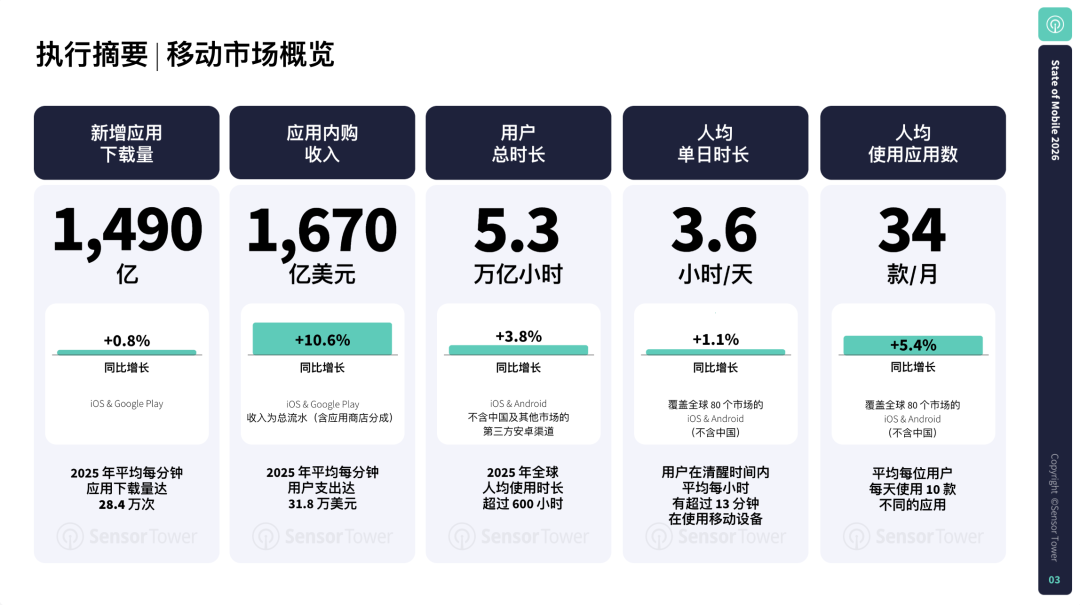
Sensor Tower:2025年全球移动市场应用内购收入达1670亿美元 再创历史新高
智通财经网· 2026-01-30 03:54
Core Insights - In 2025, the mobile ecosystem is expected to reach historical highs in key metrics driven by generative AI and commercialization opportunities, with global in-app purchase revenue growing by 10.6% to $167 billion, marking a new development phase focused on monetization [1][4]. Group 1: Market Growth and Trends - The mobile app market is maturing, shifting focus from customer acquisition to monetization efficiency, with global downloads from App Store and Google Play slightly increasing by 0.8% to nearly 150 billion [2]. - Total user engagement time on mobile apps is projected to reach 53 trillion hours in 2025, reflecting a 3.8% year-over-year growth, averaging about 3.6 hours per user daily [2]. - In-app purchase and paid app revenue on App Store and Google Play is expected to reach $167 billion, with non-gaming apps surpassing gaming apps in revenue growth, increasing by 21% [4]. Group 2: Regional Insights - The U.S. remains the largest market for mobile revenue, with consumer spending nearing $60 billion, while Western Europe, particularly the UK, Germany, and France, also contributes significantly to global growth [5]. - User engagement trends show divergence across regions, with U.S. usage time increasing by 4% after a previous decline, while China experiences a slight decrease [7][10]. Group 3: Gaming Industry Dynamics - The gaming industry is experiencing its third consecutive year of revenue growth, with in-app purchase revenue approaching $82 billion, reflecting a modest 1.3% increase [8]. - The industry is transitioning from user base expansion to maximizing the value of existing users, focusing on retention, payment structures, and monetization efficiency [10]. Group 4: AI Application Growth - Generative AI applications are witnessing robust growth, with downloads exceeding 3.8 billion, a year-over-year increase of over 100%, and in-app purchase revenue nearing $5 billion, tripling from the previous year [11]. - Cumulative usage time for generative AI applications is projected to reach 48 billion hours, approximately 3.6 times that of 2024, indicating a significant integration into daily user activities [13]. - The volume of user interactions with AI applications is expected to surpass 1 trillion, with growth rates for interactions outpacing download growth, highlighting a shift towards deepening user engagement [15].
I独角兽上市大战打响 OpenAI、Anthropic竞逐2026年底窗口
Sou Hu Cai Jing· 2026-01-30 03:39
据《华尔街日报》报道,知情人士透露,人工智能巨头OpenAI正加速推进首次公开募股(IPO)计划, 拟于2026年第四季度挂牌上市,以应对劲敌Anthropic的激烈竞争,抢占生成式AI领域上市先机。这场 由两大AI独角兽引领的上市"生死时速",还将卷入马斯克旗下SpaceX,共同搅动2026年美股IPO热潮。 据悉,目前估值约5000亿美元的OpenAI,已与华尔街多家银行展开非正式洽谈,同时加速扩充财务团 队为上市铺路,近期先后引入首席会计官阿杰梅尔·戴尔及负责投资者关系的企业财务主管辛西娅·盖 勒。此次IPO被外界视为OpenAI上市前融资(Pre-IPO)的延续,该公司正推进一轮全年性募资计划, 拟募资超1000亿美元,目标估值达8300亿美元,其中软银正洽谈注资300亿美元,亚马逊则拟投资高达 500亿美元,亚马逊CEO安迪·贾西正亲自参与谈判。 OpenAI的上市紧迫感,主要源于竞争对手Anthropic的步步紧逼。由多名前OpenAI高管创立的 Anthropic,已向金融合作伙伴透露年底前上市的开放态度,不仅接触多家投行,还引入负责资本市场 事务的安德鲁·兹洛托等财务高管。得益于爆款产品Cla ...

消息称OpenAI或在2026年四季度IPO
Huan Qiu Wang Zi Xun· 2026-01-30 03:37
Group 1 - OpenAI is in informal talks with top Wall Street investment banks to prepare for its planned IPO in Q4 2026, having hired a senior financial team including Chief Accounting Officer Ajmere Dale [1] - The IPO preparation comes amid intense competition in the generative AI industry, with competitors like Anthropic reportedly raising over $10 billion and expected to initiate their own IPO process soon [3] - OpenAI aims to raise funds for R&D and strengthen its brand influence through the public market, solidifying its position as a leader in AI technology [3] Group 2 - OpenAI's unique governance structure poses potential obstacles for the IPO, as its complex equity framework, including special rights for strategic investors like Microsoft, needs restructuring to meet regulatory compliance [3] - Increasing legal scrutiny globally regarding copyright and data privacy issues related to AI-generated content may raise compliance costs and litigation risks [3] - CEO Sam Altman expressed mixed feelings about leading a public company, acknowledging that while an IPO could provide a more stable capital source and attract top talent, it may also impose short-term profit pressures that could divert from long-term research goals [4]