营商环境

Search documents
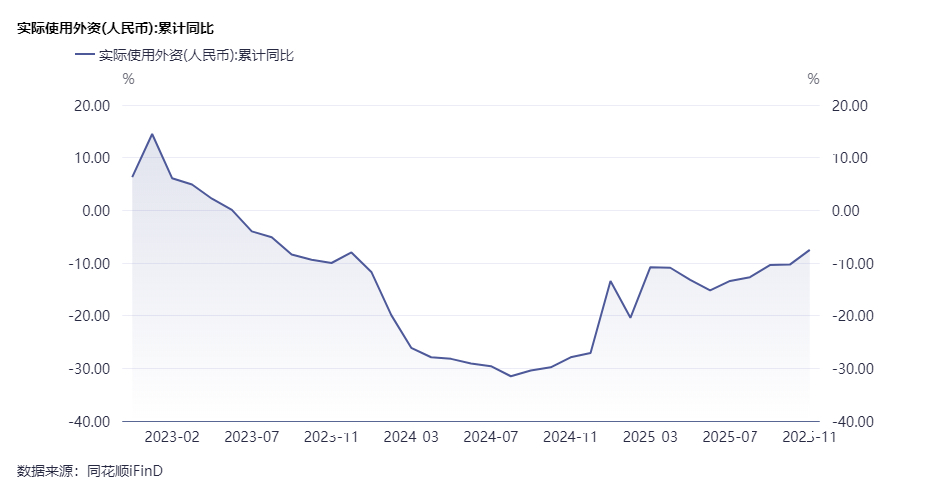
近三年实际使用外资累计同比增速呈V字形,11月单月同比增速创近45个月新高 探寻中国市场对外资的“磁吸力”
Mei Ri Jing Ji Xin Wen· 2025-12-23 03:13
Core Insights - The actual use of foreign capital in China has shown a V-shaped growth trend over the past three years, with November's year-on-year growth rate reaching a 45-month high [1][10][22] Group 1: Foreign Investment Statistics - In the first 11 months of 2025, 61,207 new foreign-invested enterprises were established, a year-on-year increase of 16.9%, while the actual use of foreign capital amounted to 693.18 billion RMB, a decrease of 7.5% [1][21] - The actual use of foreign capital in November 2025 was 71.25 billion RMB, reflecting a year-on-year growth of 26.1%, marking the highest growth rate since February 2022 [1][10] - In 2024, the actual use of foreign capital decreased by 27.9% compared to the same period in 2023 [1][21] Group 2: Sector-Specific Investment - In 2025, the manufacturing sector attracted 171.72 billion RMB, while the service sector attracted 506.29 billion RMB. High-tech industries received 221.26 billion RMB, with significant growth in e-commerce services (127%), medical equipment (46.5%), and aerospace manufacturing (41.9%) [2][12] - E-commerce services have consistently shown high growth in foreign investment, with year-on-year increases of 100.5% in the first three months, 127.1% in the first six months, and 155.2% in the first nine months of 2025 [2][12] Group 3: Investment Sources - Major sources of foreign investment in 2025 included Switzerland, the UAE, and the UK, with respective growth rates of 67%, 47.6%, and 19.3% [3][14] - In the first half of 2025, investment from ASEAN countries grew by 8.8%, while investments from Switzerland, Japan, the UK, Germany, and South Korea increased by 68.6%, 59.1%, 37.6%, 6.3%, and 2.7% respectively [4][15] Group 4: Market Dynamics and Future Outlook - The global capital flow is benefiting from the transition of the US dollar from a rate hike to a rate cut cycle, which is favorable for developing countries like China [3][13] - The continuous optimization of the business environment and the reduction of foreign investment barriers in China are enhancing its attractiveness to international capital [17][22] - Companies like Helion are committed to long-term investments in China, focusing on innovation and expanding their market presence [17][22]

改革潮涌梨乡 开放风劲扬帆
Xin Lang Cai Jing· 2025-12-22 20:23
Core Viewpoint - Since the 14th Five-Year Plan, Cangxi County in Sichuan Province has achieved significant economic growth through comprehensive reforms and expanded openness, with a projected GDP of 22.381 billion yuan in 2024, reflecting a year-on-year growth of 5.5% and a fixed asset investment increase of 16.8% [1] Group 1: New Productive Forces - The introduction of drones has revolutionized logistics and agricultural practices in Cangxi, reducing transportation time from three days to two hours for heavy materials and cutting pesticide application costs by 50% [2] - Cangxi County is focusing on low-altitude economy development, targeting five application scenarios including production operations and low-altitude logistics, promoting the systematic use of drones in agriculture [2] Group 2: Talent Development - Cangxi County has implemented a talent strategy that includes attracting high-level and urgently needed talents, successfully bringing in 983 individuals and over 10,000 returnees for entrepreneurship [4] - The establishment of 214 "local talent supermarkets" and the cultivation of over 18,000 e-commerce talents have significantly enhanced local human resources [4] Group 3: Project Acceleration and Investment - Cangxi has streamlined project implementation, achieving production within two months of signing contracts, which has attracted 284 projects with a total investment of 83.718 billion yuan during the 14th Five-Year Plan [5][6] - The county has successfully organized promotional activities that generated approximately 1.83 billion yuan in consumption, enhancing market vitality [6] Group 4: Business Environment Optimization - Cangxi County has made significant strides in optimizing its business environment, achieving a 97.64% online service capability and a 100% first-time completion rate for administrative services [7][8] - The county has received multiple accolades for its innovative e-government services, including being recognized as a model county for "Internet + Government Services" [8]
提升干部职工经济理论素养与履职能力
Xin Lang Cai Jing· 2025-12-22 18:17
Core Viewpoint - The training program aims to enhance the economic theoretical literacy and job performance capabilities of staff in Guizhou Free Trade Zone, focusing on the development path of "trade + industry + logistics" [1] Group 1: Training Details - The training was held on December 18, with over 50 participants from various departments and Guizhou Comprehensive Holding Group [1] - The theme of the training was "Economic Basic Knowledge and New Economy," featuring a lecture by Yang Yun, Deputy Director of the Guiyang Statistics Bureau [1] - Key topics covered included industry, trade, platform economy, and statistical regulations, providing comprehensive guidance on economic indicators and statistical methods [1] Group 2: Future Plans - Guizhou Free Trade Zone plans to continue enriching training formats, focusing on open economy, industrial development, and business environment to strengthen learning and training [1] - The initiative aims to further enhance the theoretical literacy and job performance capabilities of the staff, laying a solid talent foundation for high-quality development in Guiyang and Guian [1]
通州区市监局靠前服务城市副中心演艺文化产业发展
Xin Lang Cai Jing· 2025-12-21 16:36
Core Viewpoint - The "Yin Universe" Art Center in Tongzhou District has officially opened on December 20, with its first performance, and the local market supervision bureau is actively assisting in the licensing process for food sales within the venue [1][2]. Group 1: Art Center Operations - The food sales model at the "Yin Universe" Art Center includes vending machines for pre-packaged beverages and on-site coffee preparation [1]. - Operators selling only pre-packaged food are required to register with the local market supervision department, while those preparing food on-site must obtain a food business license [1]. Group 2: Regulatory Support - The Tongzhou District Market Supervision Bureau is providing on-site guidance to help the "Yin Universe" Art Center navigate the different licensing requirements, aiming to prevent delays in opening due to regulatory misunderstandings [1][2]. - The bureau's proactive approach includes reviewing the food business location, facility setup, and necessary documentation to streamline the application process and reduce potential risks and costs for businesses [1][2]. Group 3: Future Initiatives - The Tongzhou District Market Supervision Bureau plans to continue enhancing its service offerings to support the cultural industry development in the urban sub-center, focusing on providing precise, convenient, and efficient full-process services for various business entities [2].
青海省推出第四批营商环境典型经验
Xin Lang Cai Jing· 2025-12-19 20:27
Group 1 - The core viewpoint of the articles is the introduction of the fourth batch of typical experiences for optimizing the business environment in Qinghai Province, consisting of 34 practices that are well-received by businesses and reflect local characteristics [1][2] - The provincial government is promoting a "high-efficiency handling of affairs" reform, enhancing standardized, collaborative, and convenient government services through models like "one network for all" and "cross-regional handling" [1] - The provincial tax bureau is integrating external service hotlines to create a new tax service model that allows for streamlined public inquiries, achieving a "one-line access" for citizens [1] Group 2 - Continuous improvement of innovative regulatory models, standardization of administrative law enforcement, and strengthening of property rights protection are being emphasized to create a fair, transparent, and predictable business environment [2] - The provincial public security department is enhancing cooperation with enterprises to combat illegal activities that infringe on corporate rights, improving the speed of handling related cases [2] - The provincial commerce department is promoting the integration of tourism and local cuisine, creating new service consumption scenarios that combine dining, leisure, and cultural experiences [2] Group 3 - The provincial housing and urban-rural development department is implementing a digital management platform to streamline project approvals, quality safety supervision, and enterprise services, significantly improving efficiency [3] - The establishment of the first "question-handling collaboration" operation center in Haixi Prefecture is facilitating the integration of online and offline services, enhancing response efficiency for businesses and citizens [3]
深圳发布“十四五”亮眼成绩单
Zhong Guo Jing Ji Wang· 2025-12-19 07:47
Core Insights - Shenzhen's economic and social development during the "14th Five-Year Plan" period is characterized as extraordinary, with a focus on becoming a globally influential economic center and modern international metropolis [1] Economic Performance - Shenzhen's GDP increased from 2.78 trillion yuan in 2020 to 3.68 trillion yuan in 2024, with an average annual growth rate of 5.5%, leading among first-tier cities [1] - The total value of industrial output and industrial added value has maintained the top position among national cities since 2022 [1] - Foreign trade import and export volume rose from 3.05 trillion yuan in 2020 to 4.5 trillion yuan in 2024, ranking first among national cities [1] Industrial Development - The added value of strategic emerging industries grew by over 10% annually, accounting for 42.3% of GDP [2] - Advanced manufacturing and high-tech manufacturing accounted for 68.2% and 58.2% of the industrial output, respectively [2] - Shenzhen is a leader in the production of 39 industrial products, including integrated circuits and industrial robots, with over 10% of the national share [2] Innovation and R&D - Total R&D investment increased from 151.08 billion yuan in 2020 to 245.31 billion yuan in 2024, with an average annual growth of 12.9% [3] - R&D intensity reached 6.67%, ranking first among national cities, with corporate R&D investment consistently above 93% of the total [3] - Shenzhen has maintained the highest number of PCT international patent applications for 22 consecutive years [3] Reform and Business Environment - Shenzhen has made significant progress in comprehensive reforms, with 48 innovative experiences and typical measures being promoted nationwide [4] - The number of business entities remains the highest among national cities, with 4.1 million new foreign-invested enterprises established since the beginning of the "14th Five-Year Plan" [4] - The port's customs clearance volume reached 245 million people in the first 11 months of this year, setting a new historical record [4] Future Outlook - The "15th Five-Year Plan" period is seen as a key opportunity for Shenzhen to solidify its role as a national economic center and a hub for innovation [5] - Shenzhen is positioned to leverage its advantages in fixed asset investment, retail sales, R&D intensity, and talent resources to lead in the practice of Chinese-style modernization [5]
10万亿!超越京沪,中国“第一城”易主了
首席商业评论· 2025-12-19 03:44
Core Viewpoint - Shenzhen has officially become China's "first city" for specialized and innovative "little giant" enterprises, surpassing Beijing and Shanghai in both quantity and quality of these companies, marking a significant milestone in its economic development [7][24]. Group 1: Achievements of Shenzhen - By the end of 2025, Shenzhen will have 1,333 "little giant" enterprises, leading the nation, with Beijing at 1,210 and Shanghai at 1,032 [7]. - The total market value of these enterprises is estimated to be close to 10 trillion yuan, showcasing their substantial economic impact [7]. - Shenzhen's "little giant" enterprises are concentrated in key areas of national focus, such as "manufacturing power" and "strengthening supply chains," with high entry barriers [7]. Group 2: Growth and Innovation - Shenzhen's "little giant" enterprises exhibit remarkable growth, with an average establishment time of 13 years to reach national recognition, which is 1.71 years faster than the national average [11]. - These companies have a high average R&D intensity of 7.63%, with annual R&D expenditures averaging 33.39 million yuan, significantly above the national average [11]. - The average number of patents filed by these enterprises is 152, with nearly 30% involved in setting international or national standards [11]. Group 3: Strategic Initiatives - Shenzhen's "20+8" industrial cluster strategy serves as a core engine for nurturing "little giant" enterprises, providing a clear industrial direction and reducing strategic ambiguity for startups [13][18]. - The government facilitates collaboration between large and small enterprises through mechanisms like "chain leader" and "chain master" systems, enhancing overall industry competitiveness [16]. - A robust market support system combines effective market access with proactive government involvement, enabling local products to be tested and iterated within the local market before global expansion [18]. Group 4: Financial Support - Shenzhen has pioneered a "bold capital" approach, allowing for long-term investments in innovative projects, particularly in high-tech sectors, to help companies navigate critical growth phases [19]. - The city has established four major equity investment platforms to support the development of innovative enterprises, with significant investments made in national-level "little giant" companies [19]. Group 5: Future Prospects - Achieving the title of "first city" is seen as a new starting point for Shenzhen, indicating a stronger industrial foundation and a pathway for future economic growth [24]. - The success of these "little giants" is expected to lead to the emergence of world-class enterprises, contributing to Shenzhen's sustained high-quality economic development [24]. - Shenzhen's model of nurturing innovation and industry collaboration is viewed as a replicable framework for other regions in China to build modern industrial systems [24].
2025三湘民营企业百强榜单发布,各项主要指标稳步提升
Chang Sha Wan Bao· 2025-12-18 23:18
Core Insights - The 2025 Hunan Private Enterprises Top 100 list highlights the resilience and vitality of Hunan enterprises, with SANY Group leading the list with a revenue of 124.23 billion yuan [2] - The total revenue of the top 100 enterprises reached 1,287.05 billion yuan, an increase of 40.59 billion yuan or 3.26% compared to the previous year [2] - The manufacturing sector remains the backbone of Hunan's economy, showcasing the effectiveness of the province's modern industrial system [2] Group 1: Company Performance - SANY Group maintains its top position with a focus on globalization, digitalization, and low-carbon strategies, achieving record overseas sales and significant growth in its electric and new energy sectors [2] - "Mingming Hen Mang," a new entrant, ranked 8th with a revenue of 39.34 billion yuan, indicating the rise of new consumer forces in the market [3] - The top 100 enterprises collectively reported a net profit of 54.95 billion yuan, with an average net profit of 5.50 million yuan per company [4] Group 2: Innovation and R&D - The top 100 enterprises applied for 6,415 domestic patents in 2024, with 3,027 being invention patents, reflecting a strong commitment to innovation [4] - R&D investment intensity in Hunan increased to 2.62%, ranking second in central China, with significant advancements in technology and innovation capabilities [4] - The number of enterprises with R&D personnel accounting for over 20% of their workforce increased by 6, and those with R&D expenses exceeding 3% of revenue grew by 5 [5] Group 3: Economic Contribution - The top 100 enterprises contributed a total tax amount of 38.23 billion yuan, representing 17.84% of the province's total tax revenue [5] - These enterprises created 716,300 jobs, adding 45,800 new positions compared to the previous year, demonstrating their role as a stabilizer in employment [5] - A total of 70 enterprises participated in rural revitalization efforts, contributing over 457 million yuan in social donations [5] Group 4: Business Environment - Hunan has established a favorable business ecosystem, implementing policies to support the growth of private enterprises and streamline administrative processes [7] - The province's logistics costs have decreased for ten consecutive years, remaining below the national average, which enhances the operational efficiency of businesses [7] - The government has cultivated 13 key industrial chains that serve as engines for high-quality economic development, with significant growth in various sectors [7][8]



高标准建设海南自贸港的内涵和要求
Jing Ji Ri Bao· 2025-12-18 22:40
Core Viewpoint - The "14th Five-Year Plan" emphasizes the high-standard construction of Hainan Free Trade Port, aiming to promote high-quality development in Hainan and contribute to the national new development pattern [1] Group 1: Strategic Positioning - Hainan is tasked with becoming a comprehensive deepening reform and opening-up pilot zone, a national ecological civilization pilot zone, an international tourism consumption center, and a major strategic service guarantee area [1] - The construction of these zones requires Hainan to accumulate replicable and promotable experiences for national reform and opening-up, establish a new model for green low-carbon development, and explore new paths for high-quality development in tourism and cultural industries [1] Group 2: Open Leadership Role - Hainan Free Trade Port leverages its geographical advantages and domestic market size to achieve significant results in foreign trade and investment [2] - The port has opened multiple ocean routes and is enhancing cooperation with regions like the Guangdong-Hainan area to facilitate trade and tourism [2] Group 3: Institutional Innovation - The emphasis is on institutional integration and innovation, with Hainan serving as a pilot for high-standard international trade rules [3] - Since the release of the overall plan in 2020, Hainan has made breakthroughs in institutional innovation, including the first national negative list for cross-border service trade and policies for zero tariffs and simplified tax systems [3] Group 4: Competitive Industrial System - Hainan is developing a differentiated industrial layout, focusing on tourism, modern services, high-tech industries, and tropical agriculture, which together accounted for 67.2% of the province's GDP in the first three quarters of this year [4] - The high-tech industry has shown strong growth, with an average nominal growth rate of 36.8% over the past four years [4] Group 5: Business Environment - Hainan has improved its infrastructure and logistics efficiency, significantly reducing logistics costs and enhancing customs clearance efficiency [5][6] - The establishment of a unified government cloud platform and reforms for efficient service delivery are aimed at creating a more favorable business environment [6] Group 6: Security Assurance - Hainan Free Trade Port is crucial for national security and economic stability, necessitating strong financial regulation and risk prevention measures [7] - The region is also focused on ecological protection and sustainable development, ensuring that economic growth aligns with environmental conservation [7]
「新智派观察」真正决定营商环境(招商引资)的是认知水平
Sou Hu Cai Jing· 2025-12-18 12:16
Core Insights - The article discusses two distinct cognitive models influencing investment attraction: "hunting cognition" and "farming cognition" [3][4] - It emphasizes the importance of a long-term ecological perspective in creating a favorable business environment, rather than a short-term focus on immediate gains [3][4] Group 1: Cognitive Models - "Hunting cognition" views enterprises and projects as "prey," using incentives and policies as bait, focusing on immediate results [3] - "Farming cognition" prioritizes the overall value increment of the ecosystem, representing a long-term commitment to business environment improvement [3] Group 2: Role of Government and Entrepreneurs - Governments should shift from a "power cognition" to a "service cognition," understanding the real pain points of enterprises and aligning their recognition with business needs [3] - Entrepreneurs need to evolve from "relationship cognition" to "innovation cognition," focusing on value creation rather than speculative practices [3] Group 3: Development Potential - A region's development potential is closely linked to the cognitive ceiling of local government and social elites, indicating that breaking cognitive barriers is essential for optimal business environments [4] Group 4: Collaborative Platforms - The "New Intelligence New Quality Productivity Salon" aims to integrate resources across various sectors, fostering collaboration and innovation to support technological projects [6]