贸易政策

Search documents
芝加哥联储行长:如果关税问题解决 利率有下调可能
news flash· 2025-05-29 15:57
芝加哥联储行长Austan Goolsbee表示,若贸易政策问题得到解决,美国经济可能重新回到加征关税前的 轨道,从而使官员们得以下调利率。Goolsbee周四说,"如果最终我们不实施关税行动,或者政府与贸 易伙伴达成一些协议,使关税免于加征,那么我们就可能回到4月2日之前的状态。如果能保持充分就业 且通胀朝着目标前进,利率可以回落到最终的稳定水平。" ...
美国上周初请失业金人数意外上升 劳动力市场显露放缓迹象
智通财经网· 2025-05-29 13:41
周三,美国一家贸易法院裁定特朗普的大部分关税将不会生效,这一全面裁决表明总统越权了。经济学 家表示,这一裁决虽然带来了一定的缓解,但又给经济状况增添了另一层不确定性。 此前美国银行研究所报告显示,2月至4月期间,领取失业救济的高收入家庭数量同比大幅增加,4月中 低收入家庭申领人数同比亦显著上升。经济学家预计,受季节性波动数据调整难度影响,6月初请人数 可能突破今年20.5万至24.3万的区间,但这一趋势与近年相似,未必反映劳动力市场状况的实质性转 变。 美联储今晨的会议纪要显示,尽管决策者认为劳动力市场总体平衡,但"评估认为未来几个月劳动力市 场存在走弱风险",并指出就业前景"存在相当大的不确定性",其结果"在很大程度上取决于贸易政策及 其他政府政策的演变"。 智通财经APP获悉,美国至5月24日当周初请失业金人数 24万人,预期23万人,前值由22.7万人修正为 22.6万人。美国至5月17日当周续请失业金人数 191.9万人,预期189.4万人,前值由190.3万人修正为 189.3万人。 续请失业金人数数据与非农就业报告调查周相关,且刚刚创下周期新高,这可能导致失业率上升。续请 失业金人数涵盖了政府为计 ...
消费者支出疲软+贸易动荡 美国Q1经济萎缩0.2%
智通财经网· 2025-05-29 13:34
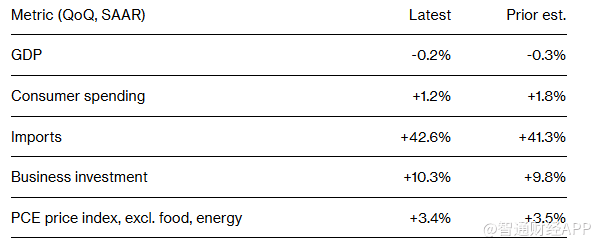
Economic Overview - The U.S. economy experienced a contraction at the beginning of the year, with the first quarter GDP annualized rate revised to -0.2%, slightly better than the initial estimate of -0.3% [1] - Consumer spending, a key driver of economic growth, increased by only 1.2%, down from the initial estimate of 1.8%, marking the lowest growth rate in nearly two years [1][2] - Net exports negatively impacted GDP by nearly 5 percentage points, slightly worse than initial predictions [1] Consumer Spending and Business Investment - The downward revision in consumer spending was primarily due to weakened demand for automobiles and reduced spending on services, including healthcare and insurance [4] - Business investment showed stronger performance, increasing by 10.3%, up from a prior estimate of 9.8% [2] Trade and Tariff Impact - A surge in imports, driven by businesses trying to stock up before tariffs imposed by the Trump administration, contributed to the economic slowdown [2] - The White House has since rescinded or delayed some punitive tariffs, which has alleviated some economic concerns, although tariff rates remain higher than pre-Trump levels [2] Future Economic Outlook - Economists expect a rebound in GDP for the second quarter due to reduced tariffs and the accumulation of imported goods into larger inventories, which may stimulate economic growth [3] - The overall demand in the economy was weaker than initially anticipated, with final sales to domestic private buyers growing by only 2.5%, the lowest level in nearly two years [3]

【欧股普遍高开】欧洲股指普遍高开,德国DAX指数涨0.9%,法国CAC40指数涨1%,英国富时100指数涨0.4%,欧洲斯托克50指数涨0.97%。美国法院此前叫停特朗普“解放日”贸易政策。
news flash· 2025-05-29 07:04
Group 1 - European stock indices opened higher, with Germany's DAX index rising by 0.9% [1] - France's CAC40 index increased by 1% [1] - The UK's FTSE 100 index saw a rise of 0.4% [1] - The Euro Stoxx 50 index gained 0.97% [1] Group 2 - The increase in European stock indices follows a U.S. court's halt on Trump's "Liberation Day" trade policy [1]
日本经济再生大臣赤泽亮正:国家安全与贸易政策是不同的事项,不能作为一个整体进行谈判。
news flash· 2025-05-29 00:59
日本经济再生大臣赤泽亮正:国家安全与贸易政策是不同的事项,不能作为一个整体进行谈判。 ...
美股仍未走出“关税恐慌”
Guo Ji Jin Rong Bao· 2025-05-29 00:41
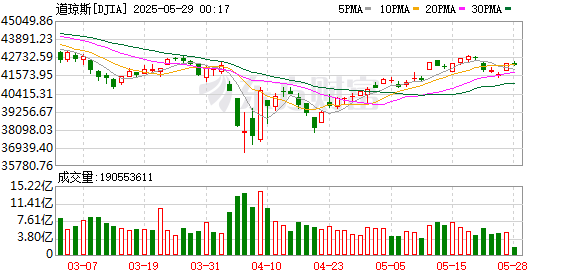
Group 1 - The current trade policies are significant drivers of market performance, with the S&P 500 index experiencing a 2% increase on May 27, marking its largest single-day gain since May 12, reflecting easing tensions between the US and EU [1] - Following a threat from Trump to impose a 50% tariff on the EU, the market reacted negatively, but a subsequent phone call with EU Commission President Ursula von der Leyen led to a postponement of tariffs until July 9, resulting in a strong market rebound [1] - On May 27, the Dow Jones rose over 700 points, the S&P 500 increased by over 2%, and the Nasdaq led with a 2.5% gain, while the 10-year US Treasury yield fell to 4.432% [1] Group 2 - Investors are optimistic that the tense trade situation has eased, with some believing that the most severe trade tensions have dissipated, suggesting that significant market declines are unlikely in the short term [2] - Economic data released on May 27, including a rebound in consumer confidence and lower-than-expected decline in durable goods demand, contributed to investor optimism [2] - Despite the market's mild recovery, concerns exist regarding overly optimistic sentiment, as tariffs have already negatively impacted the economy, with the adjusted GDP growth rate contracting by 0.3% in Q1 compared to a 2.4% increase in Q4 of the previous year [2] Group 3 - Citigroup's Chief Economist Nathan Sheets expressed concerns about Trump's aggressive tariff policies, predicting a global growth rate of 2.3% for the year, down from 2.8% last year, with developed markets particularly affected [3] - Sheets also indicated that the proposed tax legislation could keep the US deficit high, averaging around 6% of GDP over the next decade [3] - The Wall Street Journal noted that US stock valuations remain relatively high by historical standards, leading to a mismatch between market sentiment and uncertain economic outlook [3]
现货黄金失守3260美元/盎司,日内跌幅0.82%,纳指期货涨幅扩大至1.7%。美国联邦法院叫停特朗普“解放日”贸易政策。
news flash· 2025-05-28 23:38
现货黄金失守3260美元/盎司,日内跌幅0.82%,纳指期货涨幅扩大至1.7%。美国联邦法院叫停特朗 普"解放日"贸易政策。 ...
美联储会议纪要:通胀可能比想象中顽固 经济面临“滞胀”风险
Xin Hua Cai Jing· 2025-05-28 18:38
Core Viewpoint - The Federal Reserve has decided to maintain the federal funds rate target range at 4.25% to 4.50%, prioritizing inflation control amid persistent inflation, slowing growth, and policy uncertainty [1][7]. Inflation - Despite a noticeable easing since 2022, as of March 2025, the core Personal Consumption Expenditures (PCE) price index year-on-year increase is still at 2.6%, with overall inflation at 2.3%, slightly above the Fed's long-term target of 2% [2]. - Recent tariff increases have significantly impacted the prices of goods and services, with companies planning to pass on cost increases to consumers, further exacerbating inflationary pressures [2]. - The Fed staff analysis indicates that inflation may be more persistent than previously expected, with projections suggesting inflation rates will remain above target until 2027 [2]. Labor Market - The labor market remains robust, with an unemployment rate stable at 4.2% as of April, close to the average level for the second half of 2024 [3]. - However, increasing trade policy uncertainty has led some companies, particularly in manufacturing, agriculture, and retail, to limit or pause hiring plans [3]. - While the current labor market is strong, there are concerns about potential signs of weakness in the coming months due to slowing economic activity and declining export demand [3]. Economic Growth - The first quarter saw a slight decline in actual GDP, attributed to fluctuations in net exports, with a surge in imports ahead of anticipated tariff increases and weak export growth [4]. - The Fed staff predicts that newly announced trade policies will have a more severe impact on economic activity than previously anticipated, potentially dragging down the potential growth rate in the coming years [4]. Financial Markets - Recent financial market volatility has been notable, with long-term Treasury yields rising and the dollar depreciating against most major currencies, attributed to concerns over the adverse effects of trade policies on the U.S. economy [5]. - Although the overall functioning of financial markets remains orderly, liquidity indicators in the Treasury market have deteriorated, reflecting investor uncertainty regarding policy direction [5]. Monetary Policy Stance - The committee members agree that maintaining the current interest rate is appropriate given the robust economic activity and labor market, while emphasizing the need for flexibility in policy adjustments based on new economic information [6][7]. - The Fed is committed to gradually normalizing its balance sheet by reducing holdings of Treasury securities, agency debt, and mortgage-backed securities (MBS) [7]. Future Outlook - The FOMC signals a clear stance that, despite downward pressure on economic growth, the Fed will not easily shift to a loose monetary policy until inflation clearly returns to target levels [9]. - The Fed is closely monitoring global trade policy developments and their potential ripple effects on the U.S. economy, remaining vigilant and ready to respond flexibly to changes in economic data and risks [9].
美联储会议纪要:贸易政策对经济活动的拖累比预期更大
news flash· 2025-05-28 18:15
Core Insights - The Federal Reserve's meeting minutes indicate that the impact of trade policies on economic activity is greater than previously expected [1] Economic Growth Projections - The staff's forecasts for real GDP growth in 2025 and 2026 have been revised downward compared to the predictions made in March [1] - The announced trade policies are expected to result in a more significant drag on actual economic activity than previously assumed [1] Productivity and Potential GDP - Trade policies are anticipated to lead to a slowdown in productivity growth, which will reduce potential GDP growth in the coming years [1] Output Gap and Labor Market - The output gap is expected to widen significantly during the forecast period due to earlier and larger-than-expected demand drag compared to supply responses [1] - The labor market is projected to weaken considerably, with the unemployment rate expected to exceed the staff's estimate of the natural rate by the end of this year and remain above it until 2027 [1]
今夜 无眠!市场等待英伟达财报
Zhong Guo Ji Jin Bao· 2025-05-28 16:17
兄弟姐妹们啊,今晚全世界都在等待美股盘后英伟达公布的最新财报,以及美联储的最新会议纪要! 一起看看海外市场的表现! Main Street Research的首席投资官詹姆斯·德默特表示:"英伟达的财报不仅对公司本身至关重要,也可能对整个股市起到提振作用,能让投资者重 新聚焦人工智能的潜力,而非华盛顿方面关于关税和税收的消息。" 投资者将关注基于英伟达最新Blackwell芯片的计算系统供应情况及其利润率表现。美国对中国出口先进半导体的限制可能使英伟达的财报发布变得 更复杂。此外,英伟达也正面临质疑,即对人工智能的巨额投资是否合理,同时其产品已成为中美贸易摩擦的焦点之一。 德默特补充说:"我们认为,人工智能的故事和发展仍在持续,但受到了贸易担忧和美国政策的干扰。人工智能已被证明可以提升全球经济及企业 的生产力,而我们目前仅处于这个周期的早期阶段。在我们看来,贸易政策可能会减缓经济增长,但人工智能带来的生产力提升应能抵消部分阻 力。" 美股下跌 5月28日晚间,美股开盘之后,三大指数震荡,持续下跌。 英伟达是本季度"七巨头"中最后一家公布财报的公司,作为全球市值最高的芯片制造商,它的表现将成为本轮财报季行情的终 ...