
碳中和

Search documents
山东腾美节能科技有限公司成立,注册资本500万人民币
Sou Hu Cai Jing· 2026-01-28 05:34
经营范围含余热发电关键技术研发;合同能源管理;余热余压余气利用技术研发;节能管理服务;光伏 设备及元器件销售;供冷服务;通用设备修理;技术服务、技术开发、技术咨询、技术交流、技术转 让、技术推广;特种设备销售;建筑废弃物再生技术研发;软件开发;信息技术咨询服务;环保咨询服 务;碳减排、碳转化、碳捕捉、碳封存技术研发。(除依法须经批准的项目外,凭营业执照依法自主开 展经营活动)许可项目:发电业务、输电业务、供(配)电业务。(依法须经批准的项目,经相关部门 批准后方可开展经营活动,具体经营项目以相关部门批准文件或许可证件为准) 企业名称山东腾美节能科技有限公司法定代表人杨吟群注册资本500万人民币国标行业科学研究和技术 服务业>科技推广和应用服务业>技术推广服务地址山东省泰安市宁阳县经济开发区灵山大道以西、堡 头大街以北(山东晋煤明升达化工有限公司)办公楼5楼518室企业类型其他有限责任公司营业期限2026- 1-27至无固定期限登记机关宁阳县市场监督管理局 来源:市场资讯 天眼查显示,近日,山东腾美节能科技有限公司成立,法定代表人为杨吟群,注册资本500万人民币, 江苏腾美碳中和科技有限公司、苏州晋胜技术有限公 ...
储能-新业态和特高压发挥新能源消纳核心作用
2026-01-28 03:01
储能、新业态和特高压发挥新能源消纳核心作用 20260127 摘要 中国为实现碳中和目标需新增 60-80 亿千瓦装机容量,发电侧降碳关键 在于提升新能源占比,通过储能、跨区消纳和就近消纳促进发展,但当 前新能源消纳是主要挑战,需电力体制改革支撑。 电力体制改革是解决新能源消纳的关键,全国统一电力市场为灵活性资 源提供商业模式,推动新能源全面入市,促进绿电直连和就近消纳,提 高系统对新能源的吸收能力。 十四五期间,光伏装机规模显著增长,但储能发展相对滞后,利用率不 足 50%,与快速发展的新能源不匹配,储能发展亟待提速。 2025 年 1 月国家发改委能源局的通知推动新能源上网电价全面市场化, 建立可持续发展价格结算机制,保障存量项目收益率稳定,通过竞价机 制保障增量项目收益预期,利好可再生能源发展。 全国统一电力市场初步形成"管住中间、放开两头"的架构,将深刻影 响新能源汽车销量,通过灵活透明的价格机制,提高系统效率并促进可 再生能源更好地融入市场。 Q&A 新能源消纳问题的根本原因是什么? 新能源消纳问题的根本原因在于用电量的增长速度。随着我国经济进入高质量 发展阶段,全社会用电量增速不会像过去那样迅猛, ...
【电新环保】英国发布《Warm Homes Plan》,大幅刺激户用光储需求——碳中和领域动态追踪(一百七十)(殷中枢/和霖)
光大证券研究· 2026-01-27 23:07
Core Viewpoint - The UK government has launched the "Warm Homes Plan," committing £15 billion in public funds to retrofit 5 million homes and assist 1 million families in overcoming energy poverty by 2030 [4]. Group 1: Financial Commitment and Support - The "Warm Homes Plan" includes £2.7 billion in subsidies and £2 billion in low-interest loans to support residents in purchasing home energy storage and heat pump systems [5]. - An additional £5 billion is allocated to assist low-income households, while £1 billion is designated for investment in heating networks [5]. Group 2: Growth Projections in Renewable Energy - By 2030, the plan anticipates the installation of 3 million new solar photovoltaic (PV) systems, with an annual installation rate exceeding 450,000 heat pumps [6]. - The cumulative installation of home solar PV systems is projected to reach 1.6 million by the end of 2025, with a significant increase to 600,000 new installations annually from 2026 to 2030 [6]. - In the home energy storage sector, if 50% of new solar PV installations are paired with storage, it could lead to an annual addition of 300,000 home storage systems, significantly higher than the 70,000 units expected in 2025 [6]. Group 3: Recent Positive Developments - Australia has announced an expansion of its "Cheaper Home Batteries" program, allocating an additional AUD 5 billion, which may influence the home storage market positively [7]. - The recent surge in European natural gas prices, with Dutch TTF gas prices rising from €30/MWh to €40/MWh, could further drive demand for renewable energy solutions [7].

新股消息 | 德业股份递表港交所 为全球第一大户用储能逆变器提供商
Zhi Tong Cai Jing· 2026-01-27 12:54
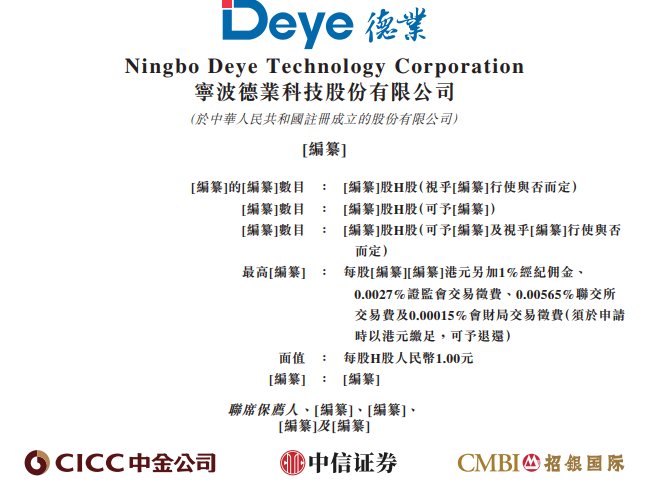
Company Overview - Ningbo Deye Technology Co., Ltd. has submitted an application for listing on the Hong Kong Stock Exchange, with CICC, CITIC Securities, and CMB International as joint sponsors [1] - The company is a global leader in solar energy storage products, focusing on providing comprehensive photovoltaic and energy storage solutions for sustainable green energy [1] - According to Frost & Sullivan, Deye is the largest provider of household energy storage inverters globally by sales revenue in 2024 [1] Business Segments - Deye's core growth area is in the renewable energy sector, particularly in energy storage inverters, photovoltaic inverters, and energy storage battery packs, while also having a long-standing presence in environmental appliances such as dehumidifiers and solar air conditioners [3] - The company’s energy storage inverters can switch seamlessly between grid-connected and off-grid modes in as fast as 4 milliseconds, ensuring continuous power supply for critical loads [5] - Deye's energy storage inverters cover a power range from 3KW to 125KW, suitable for various applications including residential and commercial [5] - The company offers a full range of energy storage battery packs designed for different applications, ensuring compatibility with its inverters and providing flexibility and scalability [6] - Deye's photovoltaic inverters include string inverters and microinverters, with power ratings from 1kW to 136kW, catering to residential and small commercial needs [7] Financial Performance - For the fiscal year 2023, Deye reported revenues of approximately RMB 7.48 billion, with a projected increase to RMB 11.21 billion in 2024 [10] - The net profit for 2023 was approximately RMB 1.79 billion, expected to rise to RMB 2.96 billion in 2024 [10] - The gross profit margin for 2023 was 39.2%, with slight decreases projected for 2024 and 2025 [11] Market Overview - The global household energy storage inverter market is expected to grow from RMB 1.7 billion in 2020 to RMB 14.5 billion by 2024, with a compound annual growth rate (CAGR) of 71.8% [12] - The European market is projected to reach RMB 4.4 billion by 2024, while Africa is anticipated to be the fastest-growing market, reaching RMB 2.5 billion in the same year [12] - The global solar photovoltaic inverter market is forecasted to grow from RMB 63.7 billion in 2020 to RMB 154 billion by 2024, with a CAGR of 24.7% [14]

德业股份递表港交所 为全球第一大户用储能逆变器提供商
Zhi Tong Cai Jing· 2026-01-27 12:51
Core Viewpoint - Ningbo Deye Technology Co., Ltd. has submitted its listing application to the Hong Kong Stock Exchange, aiming to leverage its position as a leading provider of solar and energy storage products to offer sustainable energy solutions globally [1]. Company Overview - Deye Technology focuses on the renewable energy sector, particularly in energy storage inverters, photovoltaic inverters, and energy storage battery packs, while also maintaining a strong presence in environmental appliances such as dehumidifiers and solar air conditioners [3]. - The company has diversified its product offerings, selling to over 150 countries across six continents, which has contributed to its growth and resilience [3]. Product Details - The core business of Deye Technology is energy storage inverters, which convert direct current into alternating current and support energy storage functions. These inverters can switch seamlessly between grid-connected and off-grid modes in as fast as 4 milliseconds [5]. - Deye's energy storage inverters cover a power range from 3KW to 125KW, suitable for residential and commercial applications. The company is ranked first in global revenue for residential energy storage inverters in 2024 [5]. - The company offers a full range of energy storage battery packs designed for various applications, ensuring compatibility with its inverters and providing flexibility and scalability [6]. - Deye's photovoltaic inverters include string inverters and microinverters, with power ratings from 1kW to 136kW, catering to residential and small commercial needs. The company ranks seventh in global revenue for residential photovoltaic inverters in 2024, with a market share of 2.5% [7]. Financial Performance - For the fiscal year 2023, Deye Technology reported revenues of approximately RMB 7.48 billion, with projections of RMB 11.21 billion for 2024 and RMB 8.85 billion for the first nine months of 2025 [10]. - The company achieved a net profit of approximately RMB 1.79 billion in 2023, expected to rise to RMB 2.96 billion in 2024 and RMB 2.35 billion for the first nine months of 2025 [11]. - The gross profit margin for the fiscal years 2023, 2024, and the first nine months of 2025 is reported at 39.2%, 38.6%, and 38.5% respectively [13]. Industry Overview - The global residential energy storage inverter market is projected to grow from RMB 1.7 billion in 2020 to RMB 14.5 billion by 2024, with a compound annual growth rate (CAGR) of 71.8% [14]. - Europe is expected to be the largest regional market for residential energy storage inverters, with a market size of RMB 4.4 billion in 2024, growing to RMB 15.5 billion by 2030 [14]. - The global solar photovoltaic inverter market is anticipated to grow from RMB 63.7 billion in 2020 to RMB 154 billion in 2024, with a CAGR of 24.7% [17].
新股消息 | 德业股份(605117.SH)递表港交所 为全球第一大户用储能逆变器提供商
智通财经网· 2026-01-27 12:46
Core Viewpoint - Ningbo Deye Technology Co., Ltd. has submitted its listing application to the Hong Kong Stock Exchange, aiming to leverage its position as a leading provider of solar and energy storage products to offer sustainable energy solutions globally [1]. Company Overview - Deye Technology focuses on the renewable energy sector, particularly in energy storage inverters, photovoltaic inverters, and energy storage battery packs, while also maintaining a strong presence in environmental appliances such as dehumidifiers and solar air conditioners [3]. - The company has diversified its product offerings, selling to over 150 countries across six continents, which has contributed to its growth and resilience [3]. Product Details - Energy storage inverters are a core business for Deye, capable of converting direct current to alternating current and supporting energy storage functions. They offer seamless switching and customizable charging/discharging periods [5]. - Deye's energy storage inverters range from 3KW to 125KW, catering to residential and commercial applications, and it ranks first in global revenue for household energy storage inverters in 2024 [5]. - The company provides a full range of energy storage battery packs designed for various applications, ensuring compatibility with its inverters and featuring modular designs for flexibility and easy installation [6]. - Deye's photovoltaic inverters include string inverters and microinverters, with power ratings from 1kW to 136kW, and it ranks seventh in global revenue for household photovoltaic inverters in 2024 [7]. Financial Performance - For the fiscal year 2023, Deye reported revenues of approximately RMB 7.48 billion, with a projected increase to RMB 11.21 billion in 2024 [10]. - The company achieved a net profit of around RMB 1.79 billion in 2023, expected to rise to RMB 2.96 billion in 2024 [10]. - The gross profit margin for 2023 was 39.2%, with slight decreases projected for 2024 and 2025 [11]. Industry Overview - The global household energy storage inverter market is expected to grow significantly, with a projected market size increase from RMB 1.7 billion in 2020 to RMB 14.5 billion by 2024, reflecting a compound annual growth rate (CAGR) of 71.8% [12]. - The solar photovoltaic inverter market is also expanding, with revenues expected to rise from RMB 63.7 billion in 2020 to RMB 154 billion in 2024, indicating a CAGR of 24.7% [15].
聚焦金融赋能产业 亚洲金融论坛首届“全球产业峰会”探讨企业资本流动前景
Xin Hua Cai Jing· 2026-01-27 11:57
Group 1 - The first "Global Industry Summit" at the 19th Asian Financial Forum focused on Hong Kong's support for mainland enterprises going global and foreign investment entering the mainland market [1] - Hong Kong's Financial Secretary, Paul Chan, emphasized the strengthening of the technology ecosystem and prioritizing the development of the Northern Metropolis to integrate innovation and industry [1] - CITIC Group's Vice Chairman, Zhang Wenwu, highlighted the importance of global supply chain cooperation for high-quality enterprise development and sustainable economic growth [1] Group 2 - CITIC Group launched the "Xin·Hong Kong" platform to provide comprehensive solutions for government cooperation and cross-border financial services [2] - Shanghai's Vice Mayor, Wu Wei, mentioned ongoing collaboration between Shanghai and Hong Kong to enhance financial support for technology and industrial innovation [2] - Shanxi's Vice Governor, Tang Zhiping, expressed the desire for Hong Kong to attract global capital, technology, and talent to support industrial transformation in Shanxi [2] Group 3 - Hunan's Vice Governor, Wang Junshou, called for collaboration between Hong Kong and Hunan to promote technology innovation and resource sharing [3] - Alibaba's CFO, Xu Hong, noted the attractiveness of Hong Kong's capital market for mainland enterprises looking to expand internationally [3] - Longi Green Energy's CTO, Li Zhenguo, shared the company's success in reducing photovoltaic costs and emphasized the importance of technology leadership in overseas investments [3] Group 4 - The summit was co-organized by Hong Kong's Financial Services and the Treasury Bureau, the Hong Kong Trade Development Council, and the Office for Attracting Key Enterprises, focusing on high-growth industries such as AI, robotics, and renewable energy [3]

三一重工入股催肥业绩 绿控传动二度闯关IPO巨头依赖症难解
Zhong Guo Jing Ying Bao· 2026-01-27 11:18
Core Viewpoint - The company, Suzhou Green Control Transmission Technology Co., Ltd. (referred to as "Green Control Transmission"), is making a renewed attempt to enter the capital market by targeting the ChiNext board after previously withdrawing its application for the Sci-Tech Innovation Board. The fundraising amount has increased from 1.072 billion yuan to 1.58 billion yuan, supported by significant revenue and profit growth from 2022 to mid-2025 [1][2]. Financial Performance - Revenue is projected to grow from 712 million yuan in 2022 to 1.219 billion yuan in the first half of 2025, while net profit is expected to shift from a loss of 99.4282 million yuan to a profit of 68.2955 million yuan during the same period [1][3]. - The company attributes its performance improvement to national strategies promoting carbon neutrality, enhanced emission standards for traditional fuel vehicles, and technological advancements that lower costs and expand market opportunities [1]. Customer Dependency - The top five customers contribute approximately 60% of the company's revenue, indicating a high level of customer dependency [2][4]. - Major clients include industry giants SANY Group and XCMG Group, which together accounted for over 40% of revenue in 2024 [1][3]. Market Position - Green Control Transmission holds the leading market share in the new energy heavy-duty truck motor supply market from 2022 to 2024, benefiting from the strong sales performance of its major clients [4][5]. - The dual role of major clients as shareholders provides a stable sales channel but also poses risks related to customer concentration [4][5]. Accounts Receivable and Cash Flow - As of June 30, 2025, accounts receivable reached 833 million yuan, constituting 27.13% of total assets, which has more than doubled from 269 million yuan at the end of 2022 [2][6]. - The company has faced challenges with cash flow, reporting negative net cash flow from operating activities in multiple years, highlighting a discrepancy between revenue growth and cash generation [6][7]. Debt and Inventory - The company's short-term borrowings increased from 390 million yuan in 2022 to 587 million yuan in mid-2025, with total liabilities rising, leading to an increase in the debt-to-asset ratio from 69.54% to 73.41% [7]. - Inventory levels have also risen, reaching 613 million yuan by mid-2025, which may lead to liquidity issues and increased risks related to inventory depreciation [7][8]. IPO Plans - The company plans to raise 1.58 billion yuan through its IPO, with 1.38 billion yuan allocated to expand production capacity for new energy commercial vehicle drive systems [8].

隆基绿能创始人李振国:光伏出海不止是“卖东西”,更输出了最好的技术
Feng Huang Wang Cai Jing· 2026-01-27 10:30
Core Viewpoint - Technological leadership is the primary factor for globalization in the solar industry, with China's photovoltaic sector significantly contributing to global energy transition [1]. Group 1: Technological Advancements and Cost Reduction - Over the past 15 years, the cost of solar power has decreased by 95%, making it the cheapest energy source in most countries today, thus supporting global energy transition and carbon neutrality [1]. - China currently accounts for 80% of global solar module production [2]. Group 2: Contribution to Sustainable Development - China's photovoltaic industry supports global energy transition and contributes to sustainable development, producing approximately 500GW of solar modules annually, which requires about 200 billion kWh of electricity, equivalent to the output of 25 nuclear reactors [3]. Group 3: International Expansion Strategy - The strategy for Chinese companies to "go global" should prioritize technological leadership, emphasizing that the technology exported is the best available [3]. - Hong Kong serves as an effective intermediary platform for companies to collaborate with overseas funds and secure capital support during international expansion [3].

新能源增量项目机制电价竞价结果分析:竞价分化,转型破局
EBSCN· 2026-01-27 07:23
Investment Rating - The report maintains a "Buy" rating for the electric equipment and new energy sector [6] Core Insights - The mechanism electricity bidding results show significant differentiation, with a general trend of "higher in the east, lower in the west" for the 2025-2026 incremental projects. Eastern regions have higher bidding limits and results, while western and northern regions face pressure on actual bidding results [1][11] - The internal rate of return (IRR) for wind and solar projects is estimated at around 8% and 6% respectively. There is potential for further decline in mechanism electricity prices in provinces with prices above 0.31 yuan/kWh, while regions like the Three Norths and Shandong are under significant pressure [2][11] - The profitability of existing projects is stabilizing, and cash flow is improving, which may lead to valuation recovery for leading companies in the sector [3][12] - Integrated projects involving wind, solar, hydrogen, and methanol are seen as a key path for new energy operators to explore new growth avenues, leveraging existing resources and optimizing consumption capabilities [4] Summary by Sections Mechanism Electricity Bidding Results - The bidding results for the 2025-2026 incremental projects reflect a clear differentiation based on regional factors, with eastern provinces achieving higher results compared to western provinces [1][11] - The average mechanism electricity price for solar projects is approximately 0.31 yuan/kWh, which is about 15% lower than the average coal benchmark price [23] Project Profitability and Internal Rate of Return - The IRR for wind and solar projects is estimated at 8% and 6% respectively, with potential for further price declines in certain provinces [2][11] - Specific regions like Zhejiang and Ningxia are projected to maintain IRRs above 6%, even with lower mechanism electricity prices [39][42] Investment Recommendations - The report suggests focusing on undervalued leading new energy operators such as Longyuan Power, Xintian Green Energy, and others actively exploring new growth paths [5][12]