
红利策略

Search documents
高分红利策略第三期
市值风云· 2025-07-16 10:05
Core Viewpoint - The overall performance of the dividend strategy in the second quarter showed a recovery, with the CSI Dividend ETF rising by 2.5% in Q2 and an additional 2.2% by mid-July, totaling a 4.7% increase over three and a half months, reversing the decline seen in Q1 [5][12]. Group 1: Market Performance - The yield on government bonds experienced a significant decline in Q2 after rising in Q1, which supported the performance of dividend stocks [6][10]. - The CSI Dividend Index includes a significant number of stocks from industries such as coal mining, banking, and railways, indicating a concentration in these sectors [8]. - Financial stocks, particularly in the multi-financial and banking sectors, led the gains in the dividend index, while sectors like publishing and railways underperformed, with the average decline in the steel sector reaching 9.9% [9][12]. Group 2: Industry Analysis - Among the 100 companies in the CSI Dividend Index, 17 have disclosed mid-year performance forecasts, with most showing poor results; 15 of these companies reported negative growth, particularly in the coal and real estate sectors, suggesting a slow recovery for traditional industries [12][14]. - The average decline in various sectors during Q2 included significant drops in coal mining (-6.44%), real estate development (-3.81%), and publishing (-1.33%), while the multi-financial sector showed a positive average increase of 19.93% [11][12]. Group 3: Future Outlook - There is uncertainty regarding whether the dividend index will achieve industry-wide excess returns in Q3, especially with recent declines in bank stocks and poor performance in coal stocks [14]. - The high dividend strategy has yielded 2.42% since the last adjustment on April 14, underperforming the CSI Dividend's 6.1% return during the same period, although the strategy's overall return since inception is 6.01%, closely trailing the index's 7.0% [18][19].


中国ETF市场净流入1089.2亿美元 红利策略受关注
news flash· 2025-07-16 09:16
中国ETF市场净流入1089.2亿美元 红利策略受关注 智通财经7月16日电,摩根资产管理联合上海证券交易所成功举办"ETF新生态 长投赢未来"沪市ETF主 题活动。会上指出,截至今年年4月末,全球ETF市场在过去十年持续扩张,整体资金维持净流入趋 势。其中,中国ETF市场表现突出,过去一年净流入1089.2亿美元(约合7844亿元人民币),在亚太地 区居首,占区域总资产规模的30.7%。摩根资产管理中国指数及量化投资部总监兼基金经理胡迪认为, 在全球宏观环境复杂多变背景下,具备防御属性的红利资产价值凸显,尤其是高股息率的港股红利资 产,成为市场关注焦点。(智通财经记者 吴雨其) ...
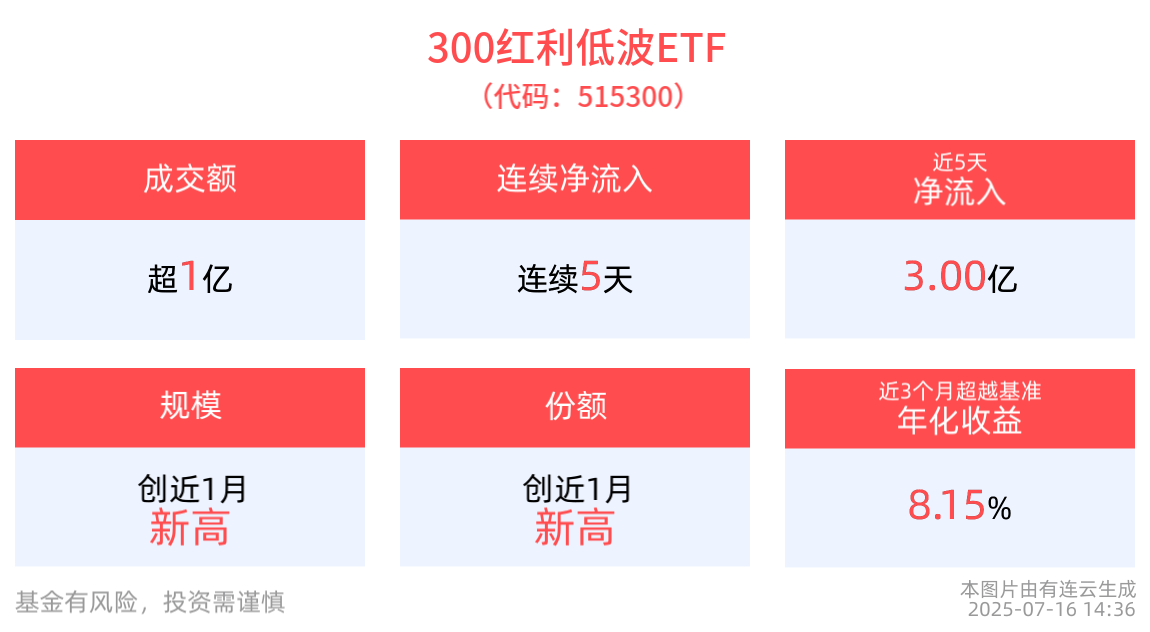
政策指引下高股息资产吸引力凸显,300红利低波ETF(515300)连续5天净流入
Sou Hu Cai Jing· 2025-07-16 07:06
Group 1: ETF Performance and Liquidity - The 300 Dividend Low Volatility ETF has a turnover rate of 2.24% during trading, with a transaction volume of 1.31 billion yuan [3] - As of July 15, the ETF's average daily trading volume over the past week is 1.67 billion yuan, and its latest scale reaches 5.886 billion yuan, marking a one-month high [3] - The ETF has seen continuous net inflows over the past five days, with a maximum single-day net inflow of 143 million yuan, totaling 300 million yuan [3] Group 2: Historical Returns and Rankings - Over the past five years, the net value of the 300 Dividend Low Volatility ETF has increased by 67.26%, ranking 46th out of 995 index equity funds, placing it in the top 4.62% [3] - The ETF's highest monthly return since inception is 13.89%, with the longest consecutive monthly gains being five months and the maximum gain during this period being 14.56% [3] - The ETF has outperformed its benchmark with an annualized return of 8.15% over the last three months as of July 15, 2025 [3] Group 3: Top Holdings and Sector Trends - As of June 30, 2025, the top ten weighted stocks in the ETF include China Shenhua, Gree Electric, Sinopec, and others, collectively accounting for 35.21% of the index [3] - Since the announcement by the National Financial Regulatory Administration regarding adjustments to the regulatory ratio of insurance funds in equity assets, high-dividend assets like bank stocks have gained attractiveness, with over 90% of funds labeled with "dividend" or "high dividend" yielding positive returns this year, averaging a net value increase of 7.2% [5] - The recent notice from the Ministry of Finance encouraging long-term stable investments by insurance funds is expected to create a favorable environment for long-term investments, aligning well with the characteristics of low volatility and high dividend strategies [6]
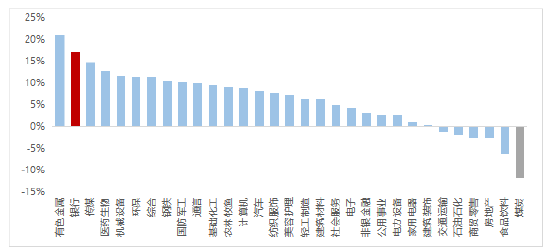
红利指数,今年平平无奇?
Xin Lang Ji Jin· 2025-07-16 00:37
Core Viewpoint - The performance of dividend assets has shown significant divergence in 2025, with the dividend yield index experiencing a modest increase of 2.62%, while the low volatility dividend index surged by 9.72, highlighting the contrasting trends within the sector [2][5]. Group 1: Performance Analysis - The banking sector has emerged as a strong performer, with a year-to-date increase of 17.19%, ranking second among all 31 Shenwan first-level industry indices, while the coal sector has declined by 11.75%, placing it at the bottom of the industry indices [2][5]. - The weight of the banking sector in the dividend indices has significantly influenced their performance, with the banking sector accounting for 46.44% of the low volatility dividend index and 28.6% of the dividend index at the end of 2024 [5][6]. - The disparity in performance is attributed to the low interest rate environment enhancing the appeal of high dividend assets, while the coal sector faces pressure due to low coal prices [5][6]. Group 2: Market Outlook - The current market environment may continue to exhibit this trend of divergence, with potential profit-taking in certain sectors and a shift towards mid-year performance evaluations [6][7]. - The second half of 2025 may present opportunities for previously underperforming sectors to recover, particularly with potential improvements in the supply structure of cyclical resources like coal [6][7]. - The weight of sectors within the dividend indices is subject to change based on performance, with the banking sector's weight increasing to 33.58% and coal's decreasing to 17.73% as of mid-July 2025 [7]. Group 3: Long-term Investment Strategy - The long-term value of dividend strategies remains clear despite short-term internal divergence, suggesting that focusing on long-term value is a better perspective for evaluating dividend strategies [8][15]. - Historical data indicates that the dividend index has outperformed the Shanghai Composite Index in seven out of the last ten years, demonstrating resilience in down markets and adaptability to various market conditions [8][10]. - The dividend strategy is characterized by a low timing risk, making it suitable for long-term buy-and-hold investment strategies [13][14]. Group 4: Fund Performance - The Hongtai Baorui Dividend ETF (510880) has been a benchmark product in the dividend strategy ETF space, with a total scale of 184.95 billion as of mid-July 2025 and a profit of 33.94 billion in 2024 [15][16]. - The fund has consistently generated profits over the past six years, accumulating a total profit of 76.43 billion since 2019 [15][16]. - The ETF has also distributed over 40 billion in dividends since its inception, indicating strong performance in terms of returns to investors [15].
含权类产品发行提速,基金主题分化显著
Huachuang Securities· 2025-07-15 09:31
Group 1: Banking Wealth Management Products - A total of 1,217 new wealth management products were launched from June 28 to July 11, 2025, a significant decrease from 1,687 in the previous period, marking a decline of approximately 27.9%[9] - Fixed income products dominated the new issuance, with 1,124 products accounting for 92.36% of the total, although this represents a decrease of over 3 percentage points compared to the previous period[9] - The average performance benchmark for fixed income products was 2.53%, the lowest among all types, indicating pressure on yields[9] Group 2: Fund Products - During the same period, 47 new public funds were established, with a total issuance scale of 301.47 billion units, a sharp decline of 61.64% from 786 billion units in the previous period[23] - Bond funds led the new fund market with 11 products, totaling 213.42 billion units, which accounted for 70.79% of the total issuance scale[24] - Equity funds showed a trend of "more quantity, less scale," with 24 new products but an average size of only 2.61 billion units, indicating a structural differentiation in new fund issuance[28] Group 3: Insurance Products - A total of 36 new insurance products were launched, reflecting a slight decrease of 5.26% from the previous period, with life insurance products remaining stable at 17[35] - Traditional life insurance saw a decline in new issuances, with only 8 new products, down 27.27%, while dividend and universal life insurance products increased[36] - The new issuance of annuity insurance products decreased from 22 to 19, with traditional annuities continuing to dominate the growth[37] Group 4: Market Trends and Risks - The market is experiencing a clear differentiation in the positioning of financial institutions, with state-owned wealth management companies leading in product innovation and market reach[18] - The report highlights potential risks, including slower-than-expected policy implementation and increased uncertainty from overseas factors[41]
基本功 | 常见的红利策略有哪些?
中泰证券资管· 2025-07-15 09:30
Group 1 - The core idea emphasizes the importance of foundational knowledge in investment and fund selection, suggesting that solid fundamentals are crucial for successful investing [2] Group 2 - Common dividend strategies are discussed, highlighting that the differences mainly lie in balancing dividend stability, valuation safety, and industry selection [3] - Dividend strategies primarily involve screening stocks based on dividend factors to construct investment portfolios, which can be categorized into three main types [3]

华安基金:险资长周期考核明确,“长钱长投”迎制度突破
Xin Lang Ji Jin· 2025-07-15 08:51
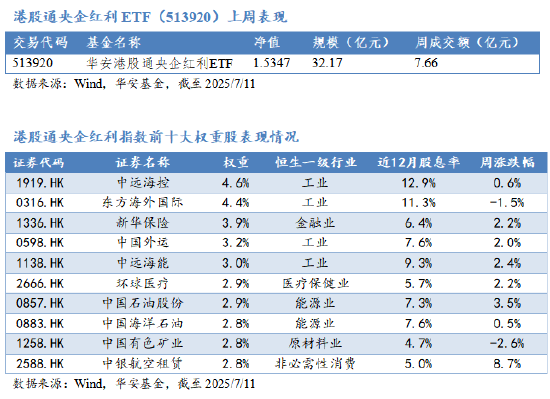
Market Overview and Key Insights - The Hong Kong dividend sector continued to rise last week, outperforming the broader market, with the Hang Seng China Central State-Owned Enterprises Dividend Total Return Index increasing by 1.74%, compared to a 0.93% rise in the Hang Seng Index and a 0.62% rise in the Hang Seng Tech Index [1] - Foreign capital inflow expanded, with net inflow into Hong Kong stocks reaching $1.023 billion, up from $916 million the previous week, while southbound funds saw a net inflow of HKD 26.4 billion [1] Insurance Capital and Long-term Investment - Recent regulatory changes encourage insurance funds to adopt a long-term investment strategy, shifting the assessment of net asset return rates from a 3-year and annual indicator to a combination of annual, 3-year, and 5-year indicators with respective weights of 30%, 50%, and 20% [1] - Insurance capital is expected to become a significant source of incremental funds in the stock market, with a requirement for state-owned large insurance companies to invest 30% of new premiums in A-shares, potentially adding thousands of millions in long-term capital annually [2] Dividend Strategy and Valuation - The dividend yield of the Hang Seng China Central State-Owned Enterprises Dividend Index is 5.86%, compared to 4.82% for the CSI Dividend Index, with a price-to-book (PB) ratio of 0.64 and a price-to-earnings (PE) ratio of 6.96 [2] - The total return index has achieved a cumulative return of 123% since early 2021, outperforming the Hang Seng Total Return Index by 118% [2] ETF Overview - The Huaan Hong Kong Stock Connect Central State-Owned Enterprises Dividend ETF (513920) tracks the Hang Seng China Central State-Owned Enterprises Dividend Index and is the first ETF in the market with the combined attributes of Hong Kong stocks, central state-owned enterprises, and dividends [3] Fund Performance - The net asset value of the Huaan Hong Kong Stock Connect Central State-Owned Enterprises Dividend ETF is 7.66 billion [4] - Key holdings include China COSCO Shipping (4.6% weight, 12.9% dividend yield), Orient Overseas International (4.4% weight, 11.3% dividend yield), and New China Life Insurance (3.9% weight, 6.4% dividend yield) [5]
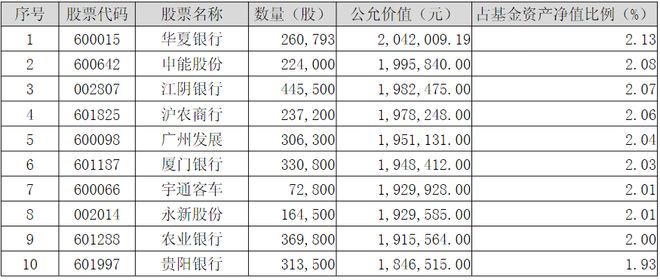
首份红利主题基金中报出炉,十大重仓股已无银行股踪影
2 1 Shi Ji Jing Ji Bao Dao· 2025-07-15 07:51
Core Viewpoint - The report of the China Europe Dividend Select Mixed Fund indicates a positive performance in net asset value growth, with A and C class shares showing growth rates of 2.16% and 2.01% over the past three months, and 15.74% and 15.08% since the fund's inception [1][2]. Fund Performance - As of June 30, the total fund shares amounted to 10.9 million, with A class shares at 4.73961 million and C class shares at 6.18585 million [2]. - The fund primarily invests in dividend-themed listed companies, managed by Liu Yong and Zhang Xue Ming, who have 9 and 8 years of experience in the securities industry, respectively [2]. Investment Strategy - The fund managers have shifted focus from bank stocks to market-oriented dividend stocks, citing a decrease in the attractiveness of bank dividends due to significant price increases [4]. - The top ten holdings in the second quarter no longer included bank stocks, with new investments in companies like Zhengmei Machine and Midea Group [3][4]. Market Context - The banking sector has seen substantial growth, with the Shanghai Securities Bank Index rising over 17% year-to-date, and several banks, including Xiamen Bank, showing increases exceeding 40% [4][5]. - Analysts remain optimistic about bank stocks, suggesting that the evolution of long-term bad debt cycles, rather than short-term economic fluctuations, will drive bank stock valuations [5][6]. Dividend Stock Appeal - The high dividends from dividend stocks are increasingly attractive in a low overall investment return environment, providing a valuable return source for funds facing a debt asset shortage [6]. - Banks are highlighted as the best performers among dividend stocks due to their stable future net profits and cash flows, supported by significant retained earnings [6].
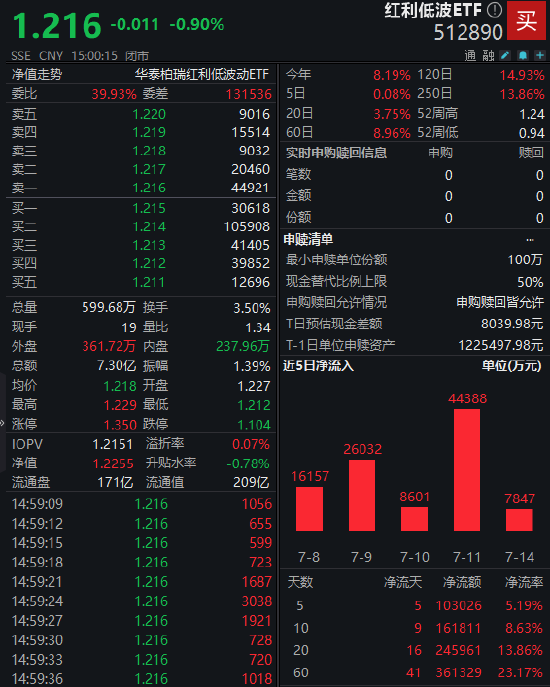
回调是上车机会?红利低波ETF(512890)近5个交易日吸金10亿元
Xin Lang Ji Jin· 2025-07-15 07:49
Core Viewpoint - The Hongli Low Volatility ETF (512890) has experienced significant growth in both net inflows and total assets, indicating strong investor interest and confidence in the fund's strategy [1][2][3]. Fund Performance - On July 15, the Hongli Low Volatility ETF (512890) closed down 0.90% with a trading volume of 730 million yuan, and a turnover rate of 3.50% [1][2]. - Over the past five trading days, the fund saw a net inflow of 1.03 billion yuan, and over the past 20 days, the net inflow reached 2.46 billion yuan [1][2]. - As of July 14, the fund's total assets reached a record high of 21.014 billion yuan, up 52.83% from 13.750 billion yuan at the end of 2024 [1][2]. Holdings and Strategy - The Hongli Low Volatility ETF (512890) was established on December 19, 2018, and its performance benchmark is the CSI Low Volatility Dividend Index [3]. - Major holdings include Chengdu Bank, Youngor, Industrial Bank, and Shanghai Bank, with significant weightings in the portfolio [3][4]. - The fund is suitable for investors seeking stable returns and low-risk exposure, particularly those without stock accounts, through its various share classes [4].
银行业6月金融数据点评:低基数+季末冲量,信贷扭转走弱态势
Huachuang Securities· 2025-07-15 04:13
Investment Rating - The industry investment rating is "Recommended," indicating an expected increase in the industry index by more than 5% over the next 3-6 months compared to the benchmark index [25]. Core Insights - The report highlights a significant increase in social financing scale, with June's new social financing reaching 4.2 trillion yuan, a year-on-year increase of 900.8 billion yuan, and a social financing stock growth rate of 8.9%, up 0.2 percentage points from the previous month [2][6]. - New RMB loans in June amounted to 2.24 trillion yuan, an increase of 110 billion yuan year-on-year, primarily driven by strong short-term loans, especially from enterprises [6][7]. - The report emphasizes the importance of the banking sector's configuration opportunities, suggesting that overall positions in banks are likely to increase due to medium to long-term capital inflows and public fund reforms [6][7]. Summary by Sections Financial Data Overview - In June, the new social financing scale was 4.2 trillion yuan, with a year-on-year increase of 900.8 billion yuan, and the social financing stock growth rate reached 8.9% [2][6]. - New RMB loans totaled 2.24 trillion yuan in June, with a year-on-year increase of 110 billion yuan, indicating a recovery in short-term loans [6][7]. Credit and Financing Trends - The report notes that credit has reversed its weakening trend from the second quarter, supported mainly by short-term loans to enterprises and improvements in household short-term loans [6][7]. - The increase in M1 growth rate to 4.6% in June and M2 growth rate rising to 8.3% reflects enhanced liquidity in the market [6][7]. Investment Recommendations - The report suggests focusing on the banking sector for investment, highlighting the ongoing mid-term investment value of major banks and the potential for absolute returns from banks with high dividend yields and strong asset quality [6][7]. - Specific banks to watch include state-owned large banks and stable joint-stock banks like China Merchants Bank and CITIC Bank, as well as regional banks with high provisioning coverage [6][7].