货币政策

Search documents
央行宣布,6000亿元!
Zhong Guo Ji Jin Bao· 2026-02-24 12:25
Core Viewpoint - The People's Bank of China (PBOC) will conduct a 600 billion MLF operation to maintain liquidity in the banking system, marking the 12th consecutive month of increased MLF issuance [1][2]. Group 1: MLF Operations - On February 25, 2026, the PBOC will conduct a 600 billion yuan MLF operation with a one-year term, following the maturity of 300 billion yuan MLF in February, resulting in a net increase of 300 billion yuan [1]. - The total net liquidity injection for February, including 600 billion yuan from reverse repos, will reach 900 billion yuan, continuing a trend of high net liquidity injection for 10 consecutive months [1]. Group 2: Economic Analysis - Dong Ximiao, Chief Economist at Zhongan, indicates that February is a month with concentrated bank credit issuance, reflecting strong market demand for liquidity, exacerbated by the Spring Festival holiday and tax payment delays [1]. - Wang Qing, Chief Macro Analyst at Dongfang Jincheng, suggests that the PBOC's actions to increase MLF issuance signal a supportive monetary policy stance, reducing the likelihood of a rate cut in the short term [2]. - Continuous MLF and reverse repo operations by the PBOC are aimed at maintaining market liquidity and ensuring stable financial market operations at the year's end [2].
流动性跟踪与地方债策略专题:2026年地方债提前批额度逐步披露
Guolian Minsheng Securities· 2026-02-24 11:26
Group 1 - The central viewpoint of the report emphasizes the importance of maintaining ample liquidity and relatively loose social financing conditions, as stated in the central bank's monetary policy report for Q4 2025 [9][10] - The report indicates that the anticipated early quota for local government bonds in 2026 is projected to be 3.12 trillion yuan, based on 60% of the new local bond quota for 2025, which is 5.20 trillion yuan [16][44] - The report highlights that the total issuance of local government bonds is expected to reach 20.216 trillion yuan by February 28, 2026, with a significant portion being long-term bonds [17][45] Group 2 - The report notes that the net financing scale of local government bonds in March is expected to decrease to around 500 billion yuan unless the new bond quota announced during the two sessions exceeds market expectations [18][45] - It is mentioned that the implied tax rates for various bond maturities are around 4% for 10Y, 4% for 15Y, 5% for 20Y, and 4.5% for 30Y, indicating a favorable value proposition for these bonds [19][47] - The report discusses the behavior of institutions, noting that various entities, excluding insurance, have shifted to net buying of local bonds before the Spring Festival, with a focus on longer maturities [18][47]
开工第一天,最新LPR公布
Nan Fang Du Shi Bao· 2026-02-24 07:47
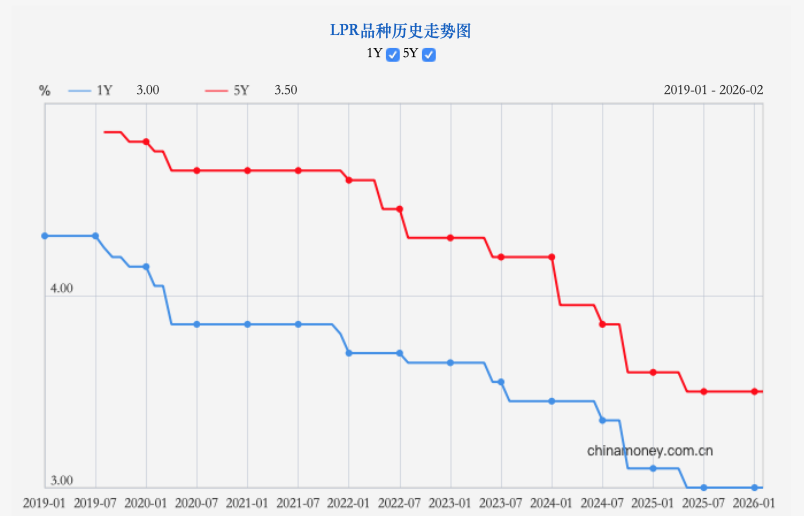
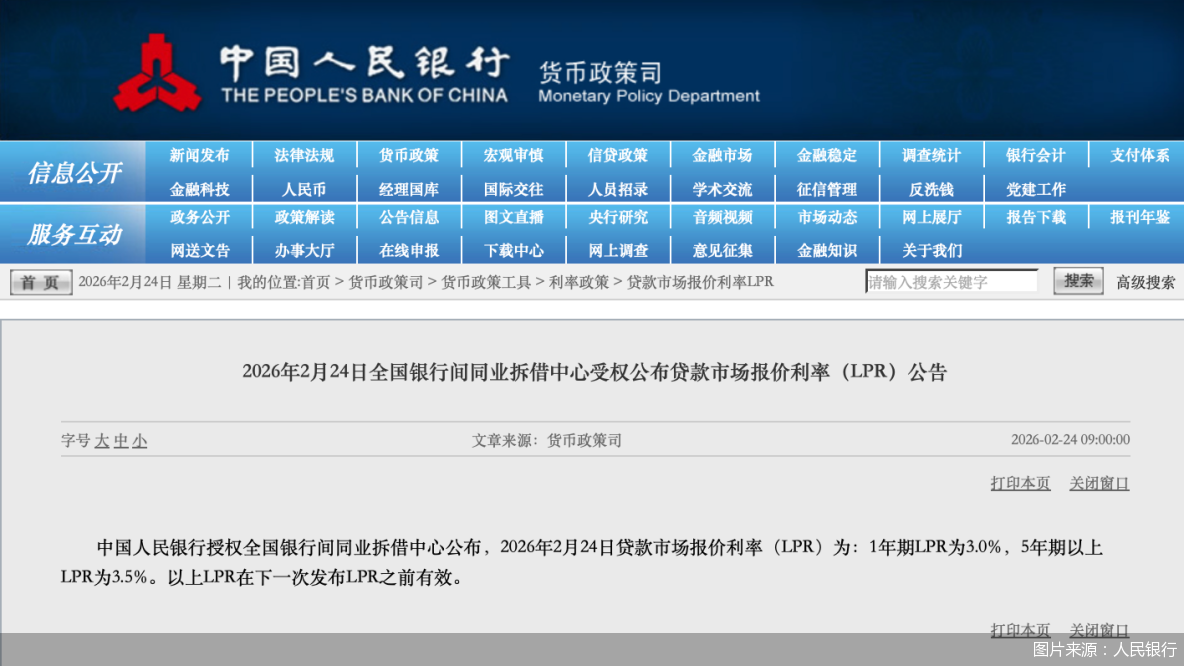
Core Viewpoint - The Loan Prime Rate (LPR) remains unchanged at 3.0% for the 1-year term and 3.5% for the 5-year term, reflecting stability in the monetary policy environment and expectations for economic growth in 2025 [1][3]. Group 1: LPR Stability - The LPR has not changed since June 2025, attributed to strong export performance and rapid development in high-tech manufacturing sectors [1]. - The stability of the LPR aligns with market expectations, as the central bank's 7-day reverse repurchase rate has remained stable, indicating no changes in the pricing basis for LPR [3]. Group 2: Economic Indicators - The net interest margin for commercial banks has stabilized at a historical low of 1.42%, reducing the incentive for banks to lower LPR quotes [3]. - High-frequency data suggests that exports will remain strong into the first quarter of 2026, supporting the current monetary policy stance [3]. Group 3: Future Monetary Policy - The People's Bank of China (PBOC) has indicated that the current monetary policy is in an observation phase, with potential for a comprehensive interest rate cut in the second quarter of 2026 to stimulate consumption and investment [5]. - There is an expectation for significant downward adjustments in the 5-year LPR to stabilize the real estate market and encourage housing demand [5].

最新LPR发布,如何理解?
Xin Lang Cai Jing· 2026-02-24 07:07
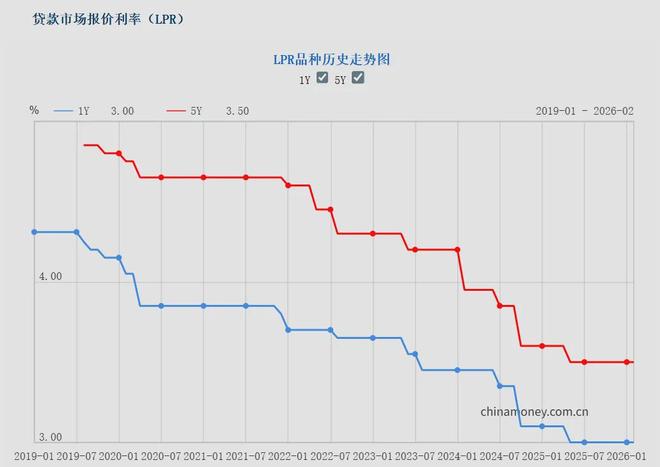
Core Viewpoint - The Loan Prime Rate (LPR) in China remains unchanged for February 2026, with the 1-year LPR at 3.0% and the 5-year LPR at 3.5%, reflecting market expectations and stable policy rates [1][6]. Group 1: LPR and Monetary Policy - The LPR has remained stable for nine consecutive months, influenced by unchanged pricing foundations and low existing interest rates [1][6]. - The People's Bank of China (PBOC) has maintained a stable policy rate, indicating no significant changes in the LPR's pricing basis [1][6]. - The recent slight decline in major mid-to-long-term market interest rates, including the yield on 1-year AAA-rated interbank certificates of deposit, is attributed to liquidity injections before the Spring Festival [1][6]. Group 2: Financing Costs and Economic Impact - The average corporate loan interest rate was approximately 3.2% in January 2026, down 2.4 percentage points from the peak in late 2018, indicating a low financing cost environment [2][7]. - The low financing costs reflect a relatively ample credit supply and the effectiveness of financial policies in benefiting the real economy, which helps reduce burdens on enterprises [2][7]. - The PBOC has introduced structural monetary policies to support key sectors like technology innovation and small enterprises, aiming to maintain economic growth despite external pressures [2][7]. Group 3: Future Economic Outlook - Analysts believe the current period is one of policy observation, with low financing costs and a need for banks to restore interest margins, reducing the urgency for further rate cuts [3][8]. - The uncertainty in the international macroeconomic environment, particularly regarding U.S. trade policies, may exert downward pressure on China's macroeconomic performance in the second quarter of 2026 [3][8]. - The potential for counter-cyclical policy adjustments may arise if the negative impacts of high U.S. tariffs on global trade and Chinese exports become more pronounced [3][8].
1月利率运行分析与展望:结构性降息落地,10年期国债阶段性高点或在1.9%左右
Zhong Cheng Xin Guo Ji· 2026-02-24 07:06
1. Report Industry Investment Rating - Not provided in the document 2. Core Viewpoints of the Report - The 10 - year Treasury bond will continue to maintain a low - interest - rate, narrow - range, and high - volatility state, with a potential stage high of around 1.9%. After the Spring Festival, the market may start to speculate on macro - policy expectations, economic fundamentals, and risk preferences, which will amplify market fluctuations [4]. - The macro - economy in early 2026 continues to recover weakly, and the yield central tendency is difficult to rise significantly. The credit "good start" may be lackluster, and the impact on bond market expectations is controllable. There may be a stage upward trend at some points [4][16]. - Monetary policy will continue a moderately loose tone, and the probability of a reserve requirement ratio cut or interest rate cut in the short term is low. The central bank may focus more on structural policy tools [4][20]. - Liquidity is likely to remain balanced and slightly loose, and its impact on yield fluctuations is controllable. The central bank will ensure smooth cross - festival funds [4][21]. - Risk appetite has decreased, and the suppression of the bond market has weakened. Although the investment cost - performance of bonds compared to stocks is not prominent, the gap between stock and bond yields has converged to some extent [4][25]. 3. Summary by Directory 3.1 1 - month Hot - spot Review - On January 15, the central bank announced and launched eight structural monetary and financial policy measures, including a 0.25 - percentage - point reduction in the interest rates of various structural monetary policy tools, which helps banks increase credit to key areas and weak links, but has a limited impact on reducing bank funding costs. As of the end of the first quarter of 2025, the balance of the central bank's structural monetary policy tools was 5.9 trillion yuan. A full 25 - BP interest rate cut is expected to reduce bank funding costs by about 15 billion yuan per year, which is only about 0.4 basis points compared to the total liabilities of domestic commercial banks at the end of 2025 [5]. - The structural monetary policy tools have been expanded and increased in volume, with an additional 50 billion yuan in re - loans for supporting agriculture and small businesses, 40 billion yuan in re - loans for scientific and technological innovation and technological transformation, and a new 1 - trillion - yuan re - loan for private enterprises. However, the policy effect transmission is restricted, and the actual effectiveness needs further release [5]. - The re - loans for supporting agriculture and small businesses and the rediscount quota are combined for use, and the risk - sharing tools for scientific and technological innovation and private enterprise bonds are merged [5]. - The scope of support for structural monetary policy tools is broadened, including high - R & D private SMEs in the support area of re - loans for scientific and technological innovation and technological transformation, and extending the coverage of carbon - emission reduction, service - consumption, and pension re - loans, which helps economic structural transformation and upgrading [5]. 3.2 1 - month Interest Rate Operation Review 3.2.1 Funds and Liquidity Monitoring - In January, the central bank increased the net investment of funds in the open market, with a net investment of 1.0678 trillion yuan, mainly in medium - and long - term funds. The central bank achieved a net withdrawal of 3.22 billion yuan in pledged reverse repurchases, and increased the net investment of 30 billion yuan in outright reverse repurchases and 70 billion yuan in MLF. The central bank also net - bought 10 billion yuan of Treasury bonds in the open market, with the highest value since October last year [8]. - Thanks to the large - scale investment of funds by the central bank, the fund interest rates were relatively stable, and the central tendency rose slightly. DR001 and R001 basically ran smoothly within 1.4% and 1.5%, with central tendencies of 1.34% and 1.41% respectively, up 5.54BP and 4.68BP from the previous month. The central tendency of the spread between DR007 and R007 narrowed by 4BP from the previous month, and the non - bank fund pressure was not large [9]. 3.2.2 Interest - rate Bond Yield Review - In January, the long - and short - end yields of interest - rate bonds were differentiated, and those above 5Y generally declined. The 10 - year Treasury bond yield first rose and then fell. At the beginning of the month, it rose to 1.9% due to the strengthening of the equity market. After reaching the stage high, the market allocation willingness increased, and the bond market yield entered the downward stage. At the end of the month, it closed at 1.81%, down 3.61BP from the end of the previous month, but the central tendency rose slightly by 0.28BP to 1.85% [11]. - The term spread between the 10 - year and 1 - year Treasury bonds first widened and then narrowed, and on January 30, it was 51.13BP, basically the same as at the end of the previous month. The trading volume of interest - rate bonds in January increased by 3.34% to 22.71 trillion yuan compared to the previous month, among which the trading volumes of Treasury bonds and local bonds decreased by 0.97% and 25.64% to 9.46 trillion yuan and 1.47 trillion yuan respectively, while the trading volume of policy - financial bonds increased by 12.79% to 11.77 trillion yuan [11]. 3.3 Outlook 3.3.1 The macro - economy in early 2026 continues to recover weakly, and the yield central tendency is difficult to rise significantly - Affected by factors such as the early Spring Festival holiday, cold snap, and overdraft effect, the manufacturing PMI in January fell below the boom - bust line again. The CPI decreased marginally year - on - year due to the Spring Festival misalignment, and the PPI increased positively for four consecutive months, but the upstream - downstream differentiation still existed. The macro - economy continued to recover weakly, and the credit "good start" might be lackluster. There may be a stage upward trend at some points [16]. 3.3.2 Monetary policy will continue a moderately loose tone, and the probability of a reserve requirement ratio cut or interest rate cut in the short term is low - The central bank's vice - governor said in January that there is still room for a reserve requirement ratio cut and interest rate cut in 2026. The fourth - quarter monetary policy report is in line with the tone of the Central Economic Work Conference. The central bank may focus more on structural policy tools, and the impact of monetary policy on yield in the short term may be limited [20]. 3.3.3 Liquidity is likely to remain balanced and slightly loose, and its impact on yield fluctuations is controllable - Affected by factors such as Spring Festival cash withdrawals, tax payments, and concentrated government bond issuances, the fund gap pressure in February is large. The central bank is expected to increase fund investment at special times. Historically, the central bank has generally provided strong liquidity support during the Spring Festival. In the short term, liquidity will remain balanced and slightly loose, and the fund interest rate will generally fluctuate around the policy interest rate [21]. 3.3.4 Risk appetite has decreased, and the suppression of the bond market has weakened - According to the central bank's fourth - quarter 2025 urban depositor survey, the proportion of residents inclined to "more savings" reached 62.9%, maintaining a high level. The proportion of residents inclined to "more investment" decreased. The outflow of residents' deposits to the stock market is moderate, and it is difficult to have a large - scale deposit transfer in the short term. Although the investment cost - performance of bonds compared to stocks is not prominent, the gap between stock and bond yields has converged to some extent, and the suppression of the bond market has weakened [25].
中国LPR连续9个月不变
Zhong Guo Xin Wen Wang· 2026-02-24 06:43
Core Viewpoint - The Loan Prime Rate (LPR) in China has remained unchanged for nine consecutive months, with the one-year LPR at 3.0% and the five-year LPR at 3.5% since June 2025, indicating a stable monetary policy environment amid steady economic performance [1][2]. Group 1: Monetary Policy Stability - The stability of monetary policy is supported by the stable operation of the macro economy, with China's GDP growing by 5% year-on-year in 2025, successfully achieving the annual growth target [1]. - The People's Bank of China (PBOC) has implemented a package of structural monetary policies to strengthen support for key areas of the national economy, such as technological innovation and small and micro enterprises [1]. - The current monetary policy is in an observation phase, with policy rates and LPR likely to remain stable in the short term [1]. Group 2: Future Monetary Policy Outlook - The PBOC's recent report emphasizes the need to grasp the implementation of monetary policy based on domestic and international economic conditions, suggesting a cautious approach to policy adjustments [1]. - The chief economist of China Minsheng Bank indicates that total easing may require a clear trigger, such as economic slowdown or unexpected external shocks, before further rate cuts are considered [1]. - Current constraints on stabilizing exchange rates and interest rate spreads have eased, and the recent reduction in various relending rates has created some room for potential interest rate cuts [2].
2026年2月LPR报价保持不变,二季度有望下调
Dong Fang Jin Cheng· 2026-02-24 06:34
Group 1: LPR Rates and Stability - The LPR rates for February 2026 remain unchanged at 3.0% for the 1-year term and 3.5% for the 5-year term, consistent with market expectations[1] - The stability in LPR pricing is attributed to the unchanged policy interest rates and a lack of incentive for banks to lower LPR due to historically low net interest margins of 1.42%[2] Group 2: Economic Outlook and Monetary Policy - The macroeconomic environment has remained resilient, supported by strong exports and growth in high-tech manufacturing, allowing for the achievement of economic growth targets in 2025[3] - The People's Bank of China has implemented structural monetary policies to support key sectors, indicating a period of observation for monetary policy with stable LPR rates expected[3] Group 3: Future Projections and Risks - The U.S. Supreme Court's ruling on tariffs introduces uncertainty in U.S. trade policy, which may exert downward pressure on China's macroeconomic performance in Q2 2026[4] - There is a potential for comprehensive policy rate cuts in Q2 2026 to stimulate consumption and investment, which could lead to a reduction in LPR rates[4] Group 4: Inflation and Housing Market - Inflation is expected to rise moderately in 2026, but overall price increases will remain low, providing room for accommodative monetary policy including potential rate cuts[5] - Regulatory measures may be taken to significantly lower the 5-year LPR to address high mortgage rates and stimulate housing demand[5]
LPR连续9个月持稳,货币政策仍处观察期
Bei Jing Shang Bao· 2026-02-24 06:32
Core Viewpoint - The Loan Prime Rate (LPR) remains unchanged for the ninth consecutive month, with the 1-year LPR at 3.0% and the 5-year LPR at 3.5%, indicating stability in monetary policy and market conditions [1][4]. Group 1: LPR Stability - The LPR has not changed since May 2025, when it was reduced by 10 basis points [4]. - The stability in LPR is attributed to unchanged policy rates and a lack of incentive for banks to lower LPR due to historical low net interest margins [4]. Group 2: Economic Context - The macroeconomic environment is supported by strong exports and growth in high-tech manufacturing, allowing for the achievement of annual economic growth targets despite external pressures [5]. - The People's Bank of China has introduced structural monetary policies to support key sectors, indicating a period of observation for monetary policy [5]. Group 3: Future Expectations - Analysts expect a high likelihood of interest rate cuts within the year, contingent on the recovery of credit demand [6]. - There is potential for a comprehensive policy rate cut in the second quarter, which could lead to a decrease in LPR, aimed at stimulating consumption and investment [5][6]. Group 4: Real Estate Market - Efforts to stabilize the real estate market may involve significant reductions in the 5-year LPR, combined with fiscal incentives to lower mortgage rates, addressing high borrowing costs for residents [7].
2026年1月金融数据点评:开年信贷季节性大规模投放,金融数据走势较为平稳
Dong Fang Jin Cheng· 2026-02-24 06:28
Group 1: Financial Data Overview - In January 2026, new RMB loans amounted to 4.71 trillion, a year-on-year decrease of 420 billion[1] - The new social financing scale reached 7.22 trillion, a year-on-year increase of 1,662 billion[1] - M2 growth rate at the end of January was 9.0%, up 0.5 percentage points from the previous month[1] Group 2: Loan and Financing Trends - January's loan issuance was significantly lower year-on-year due to weak investment and consumption, with corporate and household loan demand remaining sluggish[2] - Corporate loans decreased by 330 billion year-on-year, with medium to long-term loans down by 280 billion[6] - Household loans showed a slight recovery, increasing by 127 billion year-on-year, driven by a low base effect from the previous year[7] Group 3: Social Financing Insights - The increase in social financing was primarily driven by government bond financing, which rose by 2,831 billion year-on-year[8] - Total social financing in January was 7.22 trillion, with a month-on-month seasonal increase of 5.01 trillion[8] - The stock growth rate of social financing at the end of January was 8.2%, slightly down by 0.1 percentage points from the previous month[8] Group 4: Monetary Supply Dynamics - M1 growth rate at the end of January was 4.9%, up 1.1 percentage points from the previous month, influenced by a low base effect[10] - The significant increase in M2 was attributed to a large rise in non-bank deposits, which increased by 2.56 trillion year-on-year[10] - The current high M2 growth rate is also supported by substantial government bond financing, which has converted into deposits for enterprises and households[12]
LPR连续9个月持平,降息窗口何时开启?
Guang Zhou Ri Bao· 2026-02-24 06:23
Core Viewpoint - The Loan Prime Rate (LPR) remains unchanged for the ninth consecutive month, with the one-year LPR at 3% and the five-year LPR at 3.5%, reflecting stability in monetary policy [1][3]. Group 1: LPR Stability - The stability of the LPR aligns with market expectations, as the seven-day reverse repo rate has remained stable since its reduction to 1.4% in May 2025, which serves as the pricing anchor for the LPR [3]. - Commercial banks' net interest margin has been at a historical low of 1.42% as of the end of Q4 2025, reducing the incentive for banks to lower LPR quotes [3]. Group 2: Monetary Policy Outlook - There is an expectation for a potential easing of monetary policy in 2026, with the central bank indicating a flexible approach to policy implementation based on economic conditions [5]. - The possibility of a comprehensive policy rate cut in Q2 2026 is anticipated, which could lead to a decrease in LPR, thereby facilitating lower loan rates for businesses and consumers [6]. Group 3: Reserve Requirement Ratio (RRR) Analysis - The current average statutory deposit reserve ratio stands at 6.3%, indicating room for a potential RRR cut, although the central bank has effectively managed liquidity through various tools, reducing the likelihood of an immediate RRR cut [4]. Group 4: Economic Influences - The potential for economic slowdown and external shocks, such as uncertainties in U.S. tariff policies, may trigger a more aggressive counter-cyclical adjustment in monetary policy [5][6]. - Inflation is expected to rise moderately in 2026, but overall price increases are projected to remain low, providing ample space for monetary policy easing, including interest rate cuts [6].