价值投资

Search documents
侃股:千亿市值股票扩容仍将持续
Bei Jing Shang Bao· 2026-01-04 11:56
值得一提的是,2025年新进千亿市值股票阵营的股票多数为科技股,这反映了科技行业在当前经济发展 中的重要地位和巨大潜力。随着科技的不断进步和创新,科技企业在推动经济增长、提高生产效率、改 善人们生活等方面发挥着越来越重要的作用。科技行业的快速发展吸引了大量的资金和人才,进一步推 动了科技企业的崛起和壮大。同时,科技企业的高成长性和创新性也使其更容易获得市场的高估值,从 而跻身千亿市值俱乐部。 从中长期来看,千亿市值股票数量仍有提高的空间,这与价值投资理念进一步深入人心有直接关系。价 值投资强调以合理的价格买入具有长期投资价值的企业,并长期持有。随着投资者教育的不断加强和市 场环境的不断改善,越来越多的投资者开始接受价值投资理念。他们更加注重上市公司的基本面和长期 发展潜力,甚至愿意在资本市场中为优质企业支付一定的溢价。这种投资理念的转变将进一步推动资金 向优质企业集中,促进千亿市值股票数量的增加。 千亿市值股票的扩容是市场成熟化和头部效应增强的必然结果,也是科技行业快速发展和价值投资盛行 的体现。这一现象不仅反映了市场的发展趋势,也为投资者提供了重要的参考。 北京商报评论员 周科竞 Wind数据显示,截至20 ...
杨岳斌:什么是真正的好生意?巴菲特如何区分王子和癞蛤蟆
Sou Hu Cai Jing· 2026-01-04 11:21
Core Viewpoint - The article reinterprets the concept of "great business" as defined by Warren Buffett, emphasizing the importance of light asset structure and pricing power as key characteristics of a truly valuable business [1][2]. Group 1: Definition of "Great Business" - Buffett's definition of "great business" has evolved, initially described in 1981 as companies with pricing power and low capital expenditure requirements [2]. - By 1983, Buffett highlighted the significance of enduring economic goodwill and minimal tangible assets as foundational to pricing power and low capital needs [2]. - The 1993 letter further refined the definition, indicating that the best businesses must not only have excellent economic characteristics but also the ability to reinvest incremental capital at high rates of return [2]. Group 2: Case Study of Hsu's Candy - Hsu's Candy serves as a primary case study, illustrating the characteristics of a "great business" with substantial economic goodwill and minimal tangible assets [3]. - The analysis includes an extension to Apple Inc., comparing its investment case to the upgraded definition of "great business" from 1993, focusing on the ability to allocate significant incremental capital efficiently [3]. Group 3: Accounting Goodwill vs. Economic Goodwill - Accounting goodwill is a purely accounting concept arising during mergers, subject to amortization over a maximum of 40 years, and does not necessarily reflect the actual economic value of a business [5]. - Economic goodwill, on the other hand, reflects a company's true earning potential and is derived from intangible assets, such as brand reputation and customer loyalty [6]. - The article emphasizes that economic goodwill can provide ongoing benefits, especially in inflationary environments, unlike accounting goodwill which diminishes over time [7]. Group 4: Characteristics of Great Businesses - Great businesses are characterized by their ability to operate with minimal capital requirements, which allows them to withstand inflationary pressures [13]. - Pricing power is crucial, enabling companies to raise prices without losing market share, as demonstrated by Hsu's Candy's price increases from $1.8 to $5.5 between 1972 and 1984 [19]. - The ability to expand geographically is also vital, as seen in the case of Apple, which successfully penetrated global markets [22]. Group 5: Simplicity and Stability of Business - Ideal businesses are simple and stable, allowing for predictable economic characteristics over the long term [25]. - Buffett's investment philosophy favors businesses that do not require frequent complex decisions, emphasizing the importance of certainty in long-term economic evaluations [25]. Group 6: Conclusion - The article concludes that only a few exceptional businesses can truly withstand inflation and generate consistent returns, highlighting the need for effective capital allocation by management [29]. - Buffett continues to seek large, economically attractive businesses that align with shareholder interests, which are essential for achieving long-term success [29].


杨岳斌:什么是真正的好生意?巴菲特如何区分王子和癞蛤蟆
点拾投资· 2026-01-04 11:00
Core Viewpoint - The article emphasizes the definition of a "great business" as articulated by Warren Buffett, focusing on the characteristics of light assets and pricing power, which are essential for value investing [1][2]. Group 1: Definition of Great Business - Buffett's definition of "great business" has evolved, initially described in his 1981 letter as businesses with pricing power and low capital expenditure that can withstand inflation [2]. - By 1983, he further refined this definition to emphasize the importance of enduring economic goodwill and minimal tangible assets [2]. - In 1993, Buffett highlighted that the best businesses are those that can invest significant incremental capital at high returns over long periods, indicating that superior economic characteristics must be coupled with effective capital allocation [2]. Group 2: Case Study of Joy Sugar - The article uses Joy Sugar as a core case study to illustrate the characteristics of a "great business," particularly its substantial economic goodwill and minimal tangible assets [3]. - Joy Sugar was acquired by Berkshire Hathaway in 1972 for $25 million, generating a profit of $2 million with $8 million in tangible assets, resulting in $17 million in accounting goodwill [5]. - The analysis of Joy Sugar reveals that its economic goodwill significantly exceeded the initial accounting goodwill, demonstrating its ability to generate high returns on tangible assets [9]. Group 3: Accounting Goodwill vs. Economic Goodwill - Accounting goodwill is a purely accounting concept that diminishes over time through amortization, while economic goodwill reflects a company's true earning potential and is derived from intangible assets [7][8]. - Economic goodwill can grow irregularly over time, especially in inflationary environments, providing a continuous source of returns [8][9]. - The distinction between accounting and economic goodwill is crucial for accurately assessing a company's intrinsic value, as the former can mislead investors regarding a company's true economic worth [9]. Group 4: Key Characteristics of Great Businesses - Great businesses possess four key characteristics: light asset operations, pricing power, geographical expansion capability, and simplicity and stability [15][28]. - Light asset operations are vital in inflationary environments, as they allow businesses to resist inflation's impact more effectively than those reliant on heavy tangible assets [16][19]. - Pricing power enables businesses to raise prices without losing market share, as demonstrated by Joy Sugar's ability to increase candy prices significantly while maintaining profitability [21][22]. Group 5: Expansion and Stability - The ability to expand geographically is essential for great businesses, allowing them to maintain high capital returns while accommodating significant incremental capital [25]. - Simplicity and stability in business models are crucial for long-term investment success, as they provide a clearer understanding of future economic characteristics [28][29]. - Buffett's investment in Apple exemplifies the application of these principles in the technology sector, showcasing the importance of consumer behavior insights in identifying great businesses [26][27].


巴菲特“身退,权还在”
3 6 Ke· 2026-01-04 10:27
Core Insights - Warren Buffett officially retired on December 31, concluding a 60-year tenure at the helm of Berkshire Hathaway, yet retains approximately 29.8% voting power, allowing him to influence key decisions post-retirement [1][2] Group 1: Leadership Transition - Buffett's successor, Greg Abel, inherits a vast investment empire and must manage over $380 billion in cash reserves, a significant challenge given Berkshire's recent trend of net selling stocks for 11 consecutive quarters [2][10] - The dual-class share structure of Berkshire, established to provide affordable investment options while maintaining control, ensures that Abel's team can continue Buffett's investment philosophy [1][2] Group 2: Investment Philosophy - Buffett is renowned for his commitment to value investing and long-term returns, focusing on companies he understands, which has historically led to superior performance compared to the S&P 500 [3][4] - Despite this, Buffett's adherence to only investing in understandable businesses led to missed opportunities in the tech sector during its early growth phases, notably with companies like Microsoft and Amazon [4][5] Group 3: Portfolio Adjustments - A notable shift occurred in 2016 when Berkshire began investing in Apple, marking a departure from Buffett's traditional avoidance of tech stocks, with Apple eventually comprising 51% of its stock portfolio by mid-2023 [6][8] - As of the third quarter of 2025, Berkshire's stake in Apple has decreased to approximately 22.69%, reducing concentration risk in its investment portfolio [8] Group 4: Cash Reserves and Future Strategy - Berkshire's cash and short-term treasury reserves reached a record $381.7 billion, attributed to a scarcity of suitable acquisition targets and high market valuations [10][11] - The substantial cash reserves serve as both a safety net for the new management team and a test of their ability to generate value in a changing economic landscape, particularly with the rise of artificial intelligence [12]
美联储降息要等,但选股票得看这个
Sou Hu Cai Jing· 2026-01-04 07:04
Core Viewpoint - The Federal Reserve is considering the economic impact of previous monetary easing and may delay interest rate cuts until later this year, depending on inflation and employment data. The focus should be on identifying stocks that can perform well regardless of policy changes [1]. Group 1: Interest Rate and Investment Strategy - Interest rate cuts are not definitive buy or sell signals; controlling costs is crucial for investment success. A notable example is Warren Buffett's long-term investment in Coca-Cola, where he maintained a low average cost per share, leading to significant profits despite market fluctuations [1]. - Institutional investors prioritize cost management before purchasing stocks, often engaging in trading activities that are not visible to the average investor. Monitoring institutional trading data can provide insights into their cost management efforts [1]. Group 2: Institutional Activity and Stock Performance - In the "9.24" market event of 2024, a blue-chip stock with consistent earnings growth and a low price-to-earnings ratio saw a 40% increase after institutional trading data indicated active cost management prior to the price surge [2]. - Stocks with low trading volumes may struggle to maintain price increases without institutional support. For instance, a small-cap stock with a circulation of less than 100 million shares experienced a brief price rise followed by a decline due to lack of institutional involvement [7]. Group 3: Monitoring Institutional Engagement - Investors should focus on whether institutions are actively managing costs rather than speculating on policy changes. Stocks can appreciate even without favorable policy news if institutions are engaged in cost management [9]. - Active institutional trading data serves as a more reliable indicator of potential stock performance than news headlines. If institutions are not participating, even positive news may lead to temporary price increases followed by declines [9].

巴菲特正式退休,从114美元起步的他究竟赚了多少钱?
Sou Hu Cai Jing· 2026-01-04 05:11
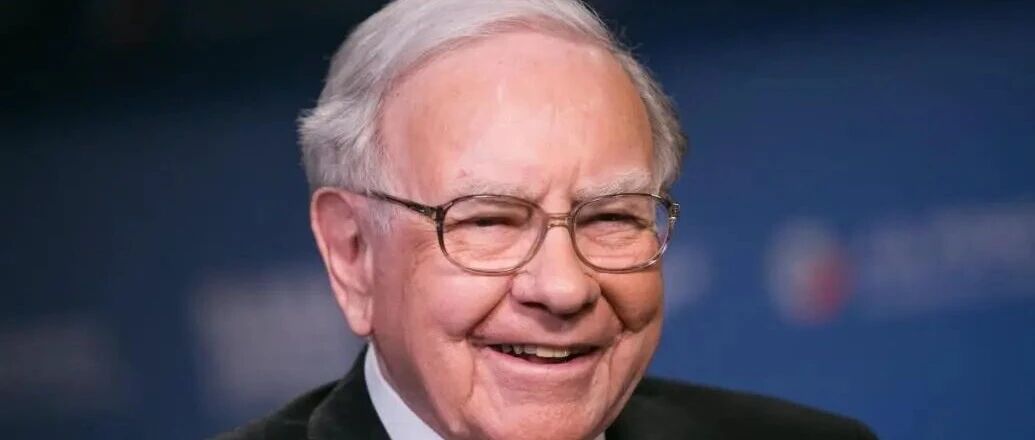
Core Insights - Warren Buffett, at the age of 95, officially retires as CEO of Berkshire Hathaway on January 1, 2026, passing the leadership to Greg Abel, marking the end of an era in investment history [2] - Buffett's investment philosophy and strategies have significantly influenced global capital markets, with a focus on value investing and long-term wealth accumulation [2][12] Investment Journey - Buffett's investment journey began at age 11 with a $114.75 investment in Cities Service preferred stock, igniting his passion for the capital markets [2] - By age 16, his investment portfolio had grown to approximately $53,000 in today's terms, and he became a millionaire by age 32 and a billionaire by age 56, demonstrating a deep understanding of compound interest and market dynamics [3] Berkshire Hathaway's Transformation - In 1965, Buffett took control of Berkshire Hathaway, initially a struggling textile company, and transformed it into a diversified holding company, acquiring insurance firms, manufacturing companies, and consumer brands [3] - Since 1964, Berkshire Hathaway's A-class stock price has surged from about $19 to over $600,000 by the end of 2025, outperforming the S&P 500 by more than 140 times [3][5] Investment Performance - A $10,000 investment in Berkshire in 1965 would have grown to $550 million by 2025, while the same amount in the S&P 500 would be approximately $3.9 million, showcasing Berkshire's exceptional long-term returns [5] - As of 2025, Berkshire's market capitalization exceeded $1 trillion, making it the 11th largest publicly traded company globally, with a diverse portfolio including BNSF Railway, GEICO, and significant stakes in Apple and other major corporations [5][6] Key Investments - Buffett's investment in Apple, which began in 2016, has become Berkshire's largest holding, with approximately 900 million shares valued at over $65 billion, reflecting a 500% increase since the initial purchase [6] - Other significant investments include Coca-Cola, Bank of America, and American Express, which have also yielded substantial returns, embodying Buffett's value investing philosophy [6] Crisis Management - During the 2008-2009 financial crisis, Buffett made strategic investments in major companies like Goldman Sachs and General Electric, earning over $10 billion from these transactions and reinforcing his reputation as a stabilizing force in turbulent times [8] Philanthropy and Legacy - Buffett's personal net worth is approximately $150 billion, but he has pledged to donate 99% of his wealth, having already contributed over $60 billion to various charitable causes [9] - His investment principles, such as the circle of competence, margin of safety, and long-term holding, continue to influence investors worldwide, emphasizing the importance of understanding and patience in investing [11][12]


95岁巴菲特正式退休|首席资讯日报
首席商业评论· 2026-01-04 03:59
Group 1 - Warren Buffett officially retired as CEO of Berkshire Hathaway on December 31, 2025, at the age of 95, marking the end of an era in value investing [2] - The first successful trial of a 35,000-ton heavy-duty group train was conducted in China, achieving "virtual coupling" technology that allows trains to maintain safe distances without physical connections [3] - France has launched an investigation into Elon Musk's AI chatbot "Grok" for allegedly generating illegal pornographic content, affecting hundreds of victims including women and minors [4] Group 2 - Zong Fuli has resumed her role as the legal representative of Hongsheng Group, with changes in management personnel recorded on December 26, 2025 [6] - Xiaomi responded to adjustments in the configuration of its YU7 model, stating that the changes were made to optimize production processes and improve delivery efficiency [7] - Pang Donglai Group reported a sales revenue exceeding 23.531 billion yuan for 2025, with supermarkets contributing 12.643 billion yuan to the total [8] Group 3 - Elon Musk announced that his brain-machine interface company "Neuralink" will begin large-scale production of brain-machine interface devices in 2026, focusing on streamlined and automated surgical processes [9] - The official manufacturing PMI for December was reported at 50.1%, indicating a recovery in China's manufacturing sector with a 0.9 percentage point increase from the previous month [10] - Contemporary Amperex Technology Co., Ltd. (CATL) has entered the hydropower station business by partnering with other companies to establish a hydropower development company [11] Group 4 - The U.S. government has approved Samsung and SK Hynix to export chip manufacturing equipment to China in 2026 [12] - Changxin Technology's IPO application for the Sci-Tech Innovation Board has been accepted, with plans to raise 29.5 billion yuan [13]

段永平再晒部分苹果持仓!
Ge Long Hui· 2026-01-04 02:51
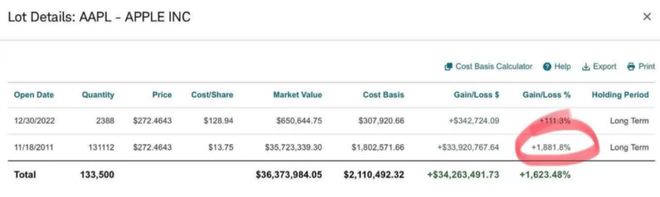
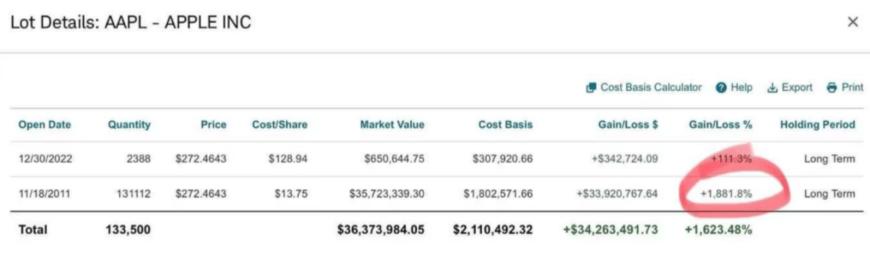
图片显示,该账号于2011年11月开始买入苹果股票,累计收益率达1623.48%,目前收益金额约为3426万美元。 段永平称,"这是我管的一个账号上的苹果(股票),这么多年几乎没怎么动过。" 1月3日,知名投资人段永平在投资交流平台上,以"大道无形我有型"的ID发文晒出部分持仓。 美股频道更多独家策划、专家专栏,免费查阅>> 责任编辑:钟离 | | | | | | | | @ Cost Basis Calculator 7 Help & Export | ල Print | | --- | --- | --- | --- | --- | --- | --- | --- | --- | | Open Date | Quantity | Price | Cost/Share | Market Value | Cost Basis | Gain/Loss $ | Gain/Loss % | Holding Period | | 12/30/2022 | 2388 | $272.4643 | $128.94 | $650,644.75 | $307,920.66 | +$342,724.09 | +111-3% | ...
段永平晒出部分持仓,2011年开始买入苹果股票,累计收益率超16倍,狂赚超3400万美元
Xin Lang Cai Jing· 2026-01-04 02:38
来源:市场资讯 (来源:都市现场) 红星资本局1月3日消息,知名投资人段永平在投资交流平台雪球上,以"大道无形我有型"的ID发文晒出 部分持仓。图片显示,该账号于2011年11月开始买入苹果(AAPL.US)股票,累计收益率达 1623.48%,目前收益金额约为3426万美元。 | | Lot Details: AAPL - APPLE INC | | | | | | | × | | --- | --- | --- | --- | --- | --- | --- | --- | --- | | | | | | | | | Cost Basis Calculator @ Help & Export | @ Print | | Open Date | Quantity | Price | Cost/Share | Market Value | Cost Basis | Gain/Loss $ | Gain/Loss % | Holding Period | | 12/30/2022 | 2388 | $272,4643 | $128.94 | $650,644,75 | $307,920,66 | +$342,7 ...
段永平再晒部分苹果持仓!2011年开始买入苹果股票,累计收益率超16倍
Ge Long Hui A P P· 2026-01-04 01:46
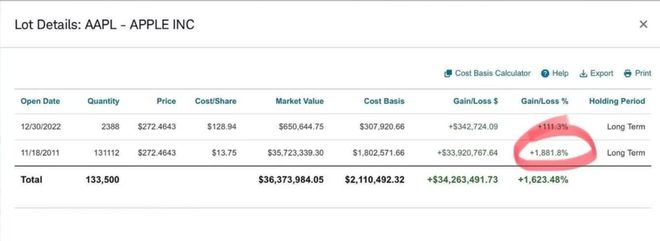
格隆汇1月4日|据红星资本局,知名投资人段永平在投资交流平台上,以"大道无形我有型"的ID发文晒 出部分持仓。图片显示,该账号于2011年11月开始买入苹果股票,累计收益率达1623.48%,目前收益 金额约为3426万美元。 段永平称,"这是我管的一个账号上的苹果(股票),这么多年几乎没怎么动过。"图片显示,该账号分 别于2011年11月和2022年12月买入苹果股票,第一次购入13.1万股,平均价13.75美元/股;第二次购入 2388股,平均价128.94美元/股。两次投资分别为段永平带来3392万美元、34.27万美元的收益,收益率 高达1881.8%、111.3%。 有网友转发段永平的帖子称:"折合年化收益率约24%,这笔投资赚了3400多万美元。伟大公司真是时 间的朋友,买定离手便是最好的交易。" | | | | | | | | Cost Basis Calculator 9 Help & Export @ Print | | | --- | --- | --- | --- | --- | --- | --- | --- | --- | | Open Date | Quantity | Price ...